You Can Sell It. You May Not Own It.
These are two different questions, and conflating them causes most of the confusion around AI music. Copyright asks whether the law recognises you as the author. Your generator's terms decide whether you may commercially exploit the output. You can hold the second without the first — here is how that works, and which parts of your track are actually protected.
Not legal advice. This is a plain-language summary of a fast-moving area, written for creators rather than lawyers, and focused on the US framework. Rules differ by country and are being actively revised. For anything with money or a dispute attached, talk to a qualified copyright lawyer in your jurisdiction.
The short version
Five things to understand about owning AI-generated music.
US copyright requires a human author. Material generated autonomously by a model does not qualify, so the machine-made audio itself is generally not protectable.
Your human contributions still are: lyrics you wrote, vocals you performed, and creative selection, editing, and arrangement you applied.
Prompts alone do not make you an author. Substantial human creative control over the result is what the analysis looks for.
Commercial rights are contractual, not copyright. Paid Suno and Udio plans let you sell your output even where copyright protection is thin or absent.
You can still infringe. If output reproduces someone else's melody or recording, ordinary infringement rules apply, however it was made.
Copyright needs a human author
One principle explains nearly every headline you have read on this.
US copyright protects original works of authorship — and authorship, in this framework, means a human being. That requirement is not new and was not invented for generative AI; it is the same principle behind long-standing refusals to register works with no human creator. Applied to a music generator, it produces a straightforward result: the audio a model returns on its own is not something you can register or enforce as your copyright.
The Copyright Office has been consistent that this does not make AI-assisted work unprotectable in general. The analysis looks for human creative contribution and protects that, while excluding the purely machine-generated material. A track can be a patchwork: your lyrics protected, your recorded vocal protected, the generated instrumental not.
Where the line falls depends on how much genuine creative control you exercised. Typing a prompt and accepting what comes back sits firmly on the unprotected side, because you did not shape the expression. Writing the words, performing over the output, editing it substantially, and making deliberate arrangement choices moves material onto the protected side — not by making the generated audio yours, but by adding authorship of your own.
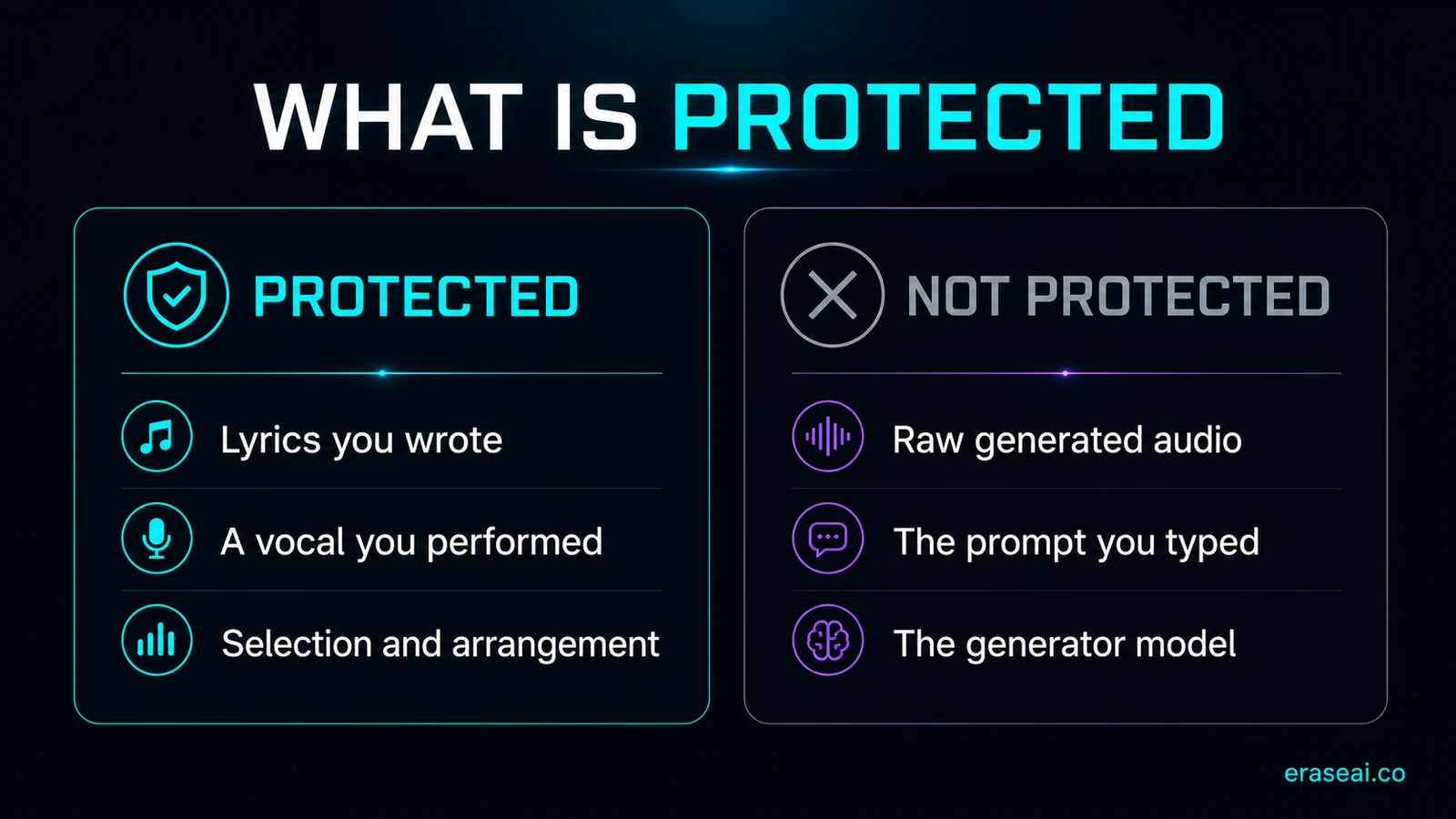
Which parts of your track are protected
Lyrics you wrote
Original text is protectable on its own merits, independent of how the music around it was produced.
A vocal you performed
Your recorded performance is a human contribution and is treated as such, even over a generated backing.
Selection & arrangement
Deliberate creative choices in assembling, editing, and sequencing material can attract protection for that arrangement — but not for the underlying generated audio.
Raw generated audio
Output produced autonomously by the model, with no meaningful human creative control over the expression.
The prompt you typed
Prompts direct a machine rather than fixing expression yourself. Detail alone does not convert instruction into authorship.
The generator's model
You license access under the platform's terms. Nothing about using it transfers ownership of the technology to you.
Commercial rights are not copyright
The single most useful thing to understand if you plan to release.
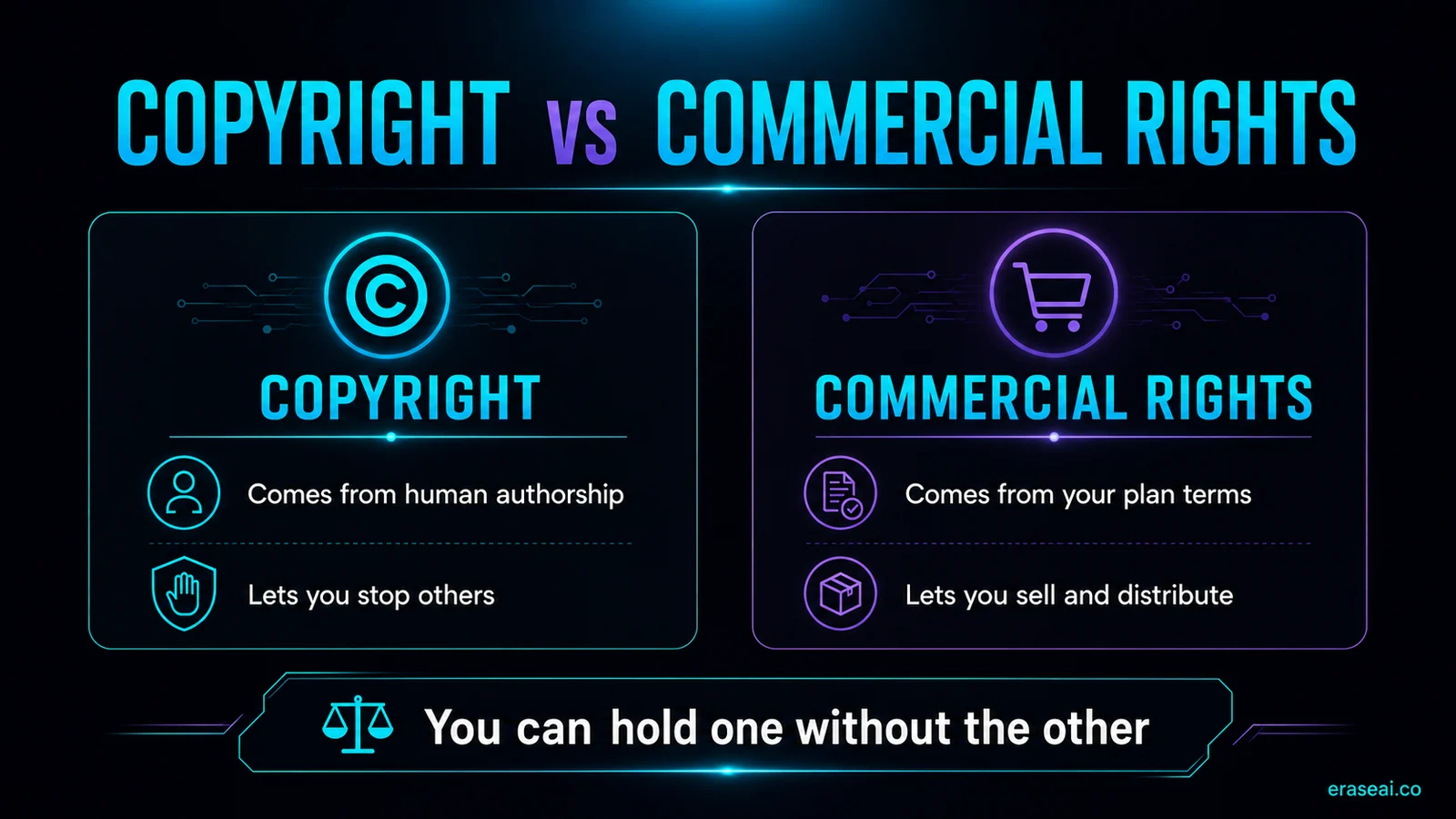
When Suno or Udio says you may use your output commercially, that is a contract term, not a copyright grant. The platform is promising it will not come after you for selling what you made with its tool. That permission is what lets you distribute, monetise, and license your tracks — and for most creators it is the practically important right.
What it does not give you is the power to stop other people. If copyright does not subsist in the generated audio, there is nothing to enforce against someone who releases something very similar, or who reuses your track outright. You have permission to exploit, without exclusivity to defend. For a catalog business that is usually an acceptable trade; for a single track you hoped to build a brand around, it is worth knowing in advance.
One practical point: commercial rights are almost always tied to your plan. Free tiers commonly grant non-commercial use only, and rights may depend on maintaining a subscription. Check the current terms for the plan you are actually on before building a release around it. Our guide to selling AI music covers the commercial side in detail.
Your track can still infringe
Thin protection for you does not mean no exposure from others.
Copyright runs both ways. Even where your generated audio is not protectable, it can still reproduce something that is. If output lands close enough to an existing melody, lyric, or recording, the ordinary infringement analysis applies — and the fact that a model produced it is not a defence. Generators are trained on real music, and occasional close resemblance is a known failure mode rather than a freak event.
This is why a critical listen belongs in your release routine. Noticing a close resemblance before distribution costs you a regeneration; discovering it afterwards can mean a takedown, a copyright strike, and a mark against your distributor account. Be clear-eyed about the tooling here: there is no consumer product that reliably checks your track against the world's recorded catalogue before you ship, Undetectr included. It remains your ear and your judgement.
The separate, ongoing story is the litigation over how these models were trained. Major labels sued Suno and Udio in 2024, and the industry has since moved toward licensing arrangements. That dispute is about the training data, not about your right to release tracks you generated, but it is a live area worth watching if you are investing in a catalog.
AI music copyright FAQ
Can you copyright AI-generated music?
Not the purely machine-generated part. US copyright protection requires human authorship, and material produced autonomously by a generator does not meet that bar — a position the Copyright Office has stated repeatedly and the courts have upheld. What can be protected is the human contribution: lyrics you wrote, a vocal you performed, and in some cases the creative selection and arrangement you applied to the output.
Can you copyright an AI song if you wrote the lyrics?
Your lyrics, yes — original human-authored text is protectable on its own terms whether or not a machine produced the music around it. That protection covers the words, not the generated audio. A track can therefore end up partly protected and partly not, which is exactly the mixed situation the Copyright Office guidance describes for AI-assisted works.
Do prompts count as authorship?
Generally no, on their own. The Copyright Office's position is that writing a prompt does not by itself make you the author of what a model returns, because you are not controlling the expressive output in the way authorship requires. Detailed prompting plus substantial human editing, arrangement, and performance moves you closer to a protectable contribution — but the prompt alone does not get you there.
If I can't copyright it, can I still sell it?
Yes, and this is the distinction that trips most people up. Commercial rights come from your contract with the generator, not from copyright. Suno and Udio grant commercial use of your output on paid plans, which lets you distribute and monetise it. What you may lack is the ability to stop someone else from using identical or similar output, because there is no copyright to enforce.
Is Suno being sued?
Suno and Udio were sued in 2024 by major record labels over the use of copyrighted recordings in training, and the dispute has since moved toward licensing arrangements with parts of the industry. It is an active, evolving area. The litigation concerns how the models were trained rather than the legality of you releasing tracks you generated, but it is worth following if you are building a catalog.
Can AI music infringe someone else's copyright?
Yes. If generated output reproduces a recognisable melody, lyric, or recording, the ordinary rules of infringement apply regardless of how it was made — and 'the AI produced it' is not a defence. This is the practical reason to listen critically for close resemblance before release rather than discovering the resemblance through a takedown notice.
Does this work the same outside the United States?
No, and that matters if you distribute globally. The UK, for example, has a longstanding provision covering computer-generated works with no human author, which takes a different approach from the US human-authorship rule. Other jurisdictions vary again and several are actively revising their positions, so treat the US framework described here as one system rather than a universal one.
Own what you can. Check the rest.
Human authorship is what copyright protects — and a fingerprint check before release is what keeps someone else's copyright from becoming your problem.
▸ Independent · We recommend Undetectr