It Makes Your Track Loud. It Doesn't Make It Clean.
Automated mastering has quietly become good enough that most independent releases use it, and for a human recording it is often all you need. Feed it a raw AI-generated export, though, and it does its job perfectly while leaving the one problem that actually stops your release. Here is how the services compare, and where the gap sits.
The short version
Five things about mastering an AI-generated track.
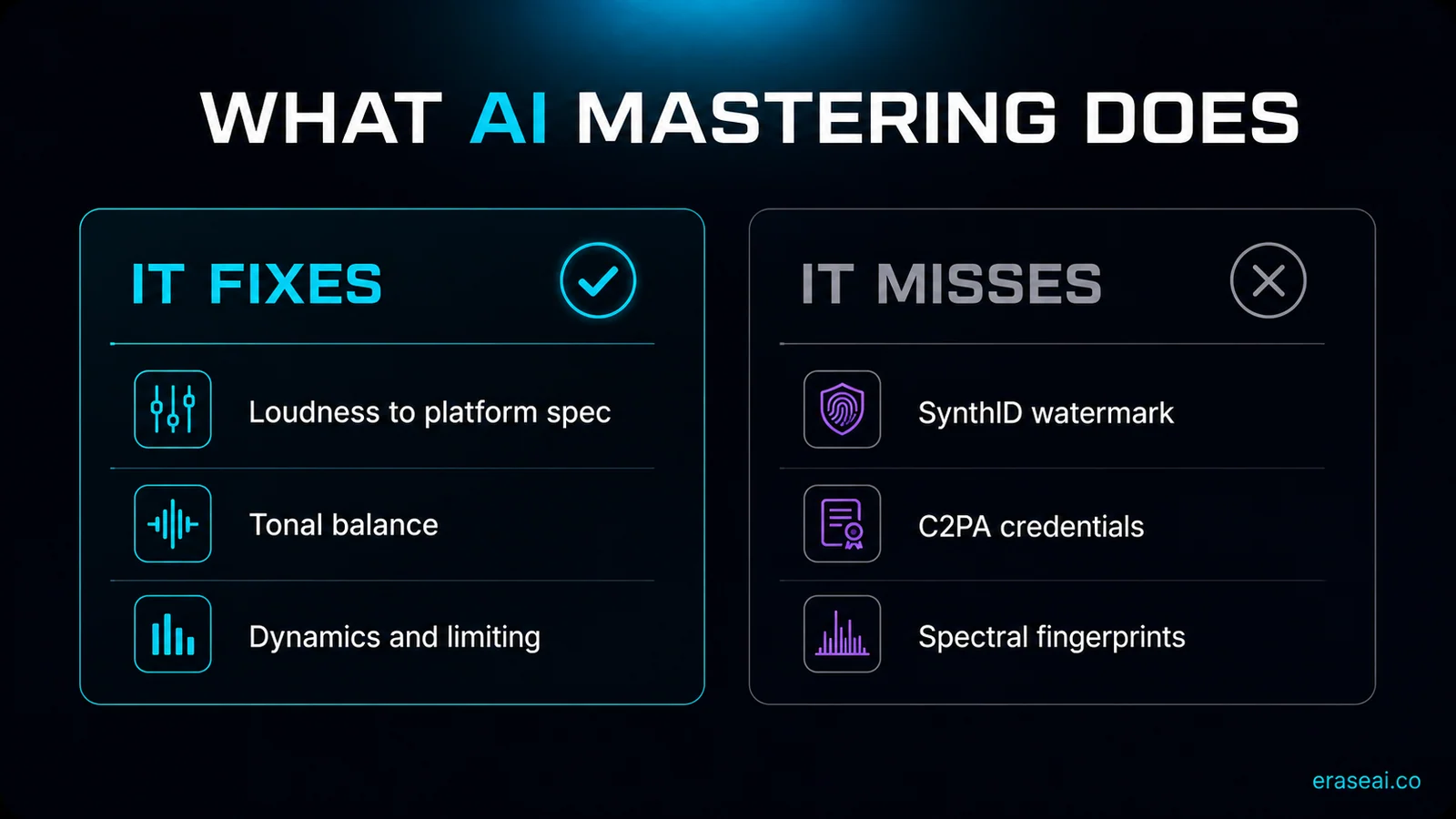
AI mastering reliably delivers what mastering mostly contributes: correct loudness, balanced tone, and a competitive sound against commercial releases.
For independent releases it is genuinely good enough. Human mastering buys judgement on a specific track, at roughly €50-200 per track.
No mastering service removes generator watermarks. They are built for human recordings and pass embedded identifiers straight through.
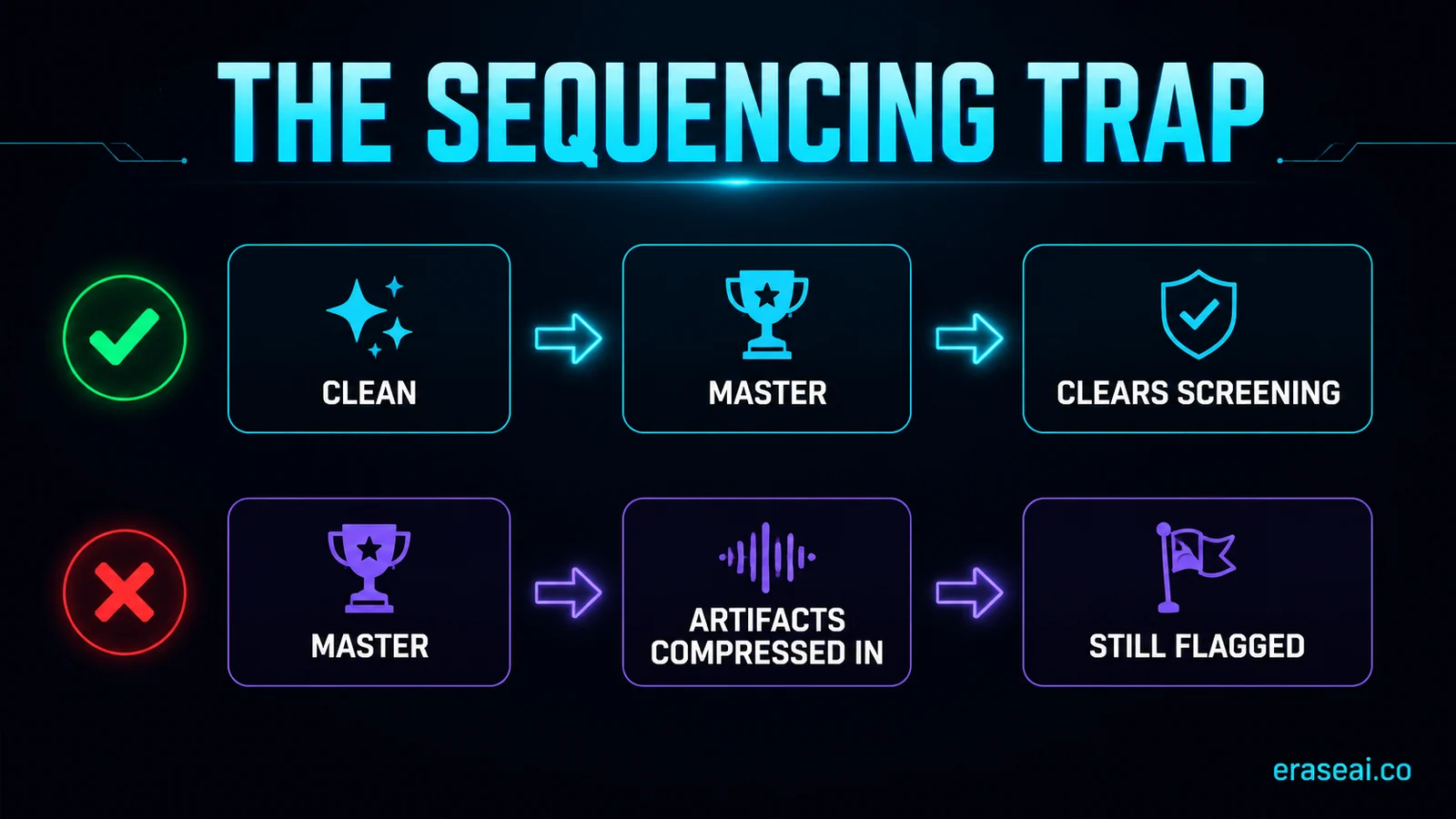
Order matters: mastering compresses and limits whatever it is given, so artifacts processed first become harder to remove later.
Off-spec loudness is itself a screening signal — distributors read it as a marker of low-effort uploads, which AI tracks are already screened against.
Mastering, minus the mystique
A well-defined technical job, which is why automation works so well at it.
Mastering is the final stage between a finished mix and a release. It corrects tonal imbalances, controls dynamics, adjusts the stereo image, and sets overall loudness so the track holds up next to commercial material on every playback system. That is a largely analytical job with measurable targets — which is exactly the kind of work automation handles well.
Modern services analyse your track, classify it against genre references, and apply a processing chain shaped to that target. The results are consistent and, for most independent releases, genuinely competitive. What automation cannot supply is a person deciding that your particular chorus needs to breathe more, or that the reference genre is wrong for what you were going for. That judgement is what a mastering engineer is actually selling.
For AI-generated music there is an additional, unglamorous reason mastering matters: distributor screening treats loudness that sits well outside platform specification as a signal of a low-effort upload. Our Suno mastering guide covers that workflow step by step.
How the services compare
Six routes, from free to full manual control.
LANDR
The longest-established name in automated mastering. Analyses your track and applies a genre-aware chain, with style and intensity options. Subscription or per-track, with a free preview tier.
BandLab Mastering
Free within BandLab's wider production ecosystem, with preset-based character choices. The easiest zero-cost way to hear what mastering does to your track.
eMastered
Subscription service with reference-track matching, aimed at independent artists who want a specific sonic target rather than a generic polish.
CloudBounce / Bakuage
Cloud services offering fast turnaround and loudness targeting. Useful when you need volume throughput rather than per-track attention.
DAW-native tools
Ozone's assistant and similar plug-ins analyse and suggest a chain you can then edit. More control, more learning curve, and a one-off cost rather than a subscription.
Bundled mastering
Some release-prep tools include a mastering pass alongside other processing. Convenient when mastering is one step in a pipeline rather than the whole job.
Honest summary: the differences between these matter less than people expect. All of them will get a competent mix to a competitive loudness with a reasonable tonal balance. Choose on price and on whether you want reference-matching or preset character — and audition the free tiers on your own material, because the only meaningful test is how a service handles the music you actually make.
The step no mastering service handles
Where AI-generated tracks differ from everything these tools were built for.
Every service above was designed for audio captured from the physical world — microphones, instruments, synthesisers played by people. A raw export from Suno, Udio, or ElevenLabs Music carries something none of those produce: embedded identifiers written deliberately into the file. Google's SynthID, C2PA content credentials, and spectral fingerprints are what distributor screening reads, and no mastering chain targets them because no human recording has them.
So a mastered AI track comes back louder, better balanced, and still carrying every marker that gets a release held. The file sounds finished and fails screening anyway — which is precisely the confusing outcome creators report when they master carefully and still lose tracks.
The order compounds it. Mastering compresses and limits whatever it receives, so running it on a raw export processes the artifacts up alongside the music, making them both more entangled and harder to separate afterwards. The rule is short: clean first, then master. Some tools do both in the correct order in one pass — Undetectr runs an artifact pass and a mastering pass together, which removes the sequencing question entirely. Our AI audio cleanup guide explains the four layers involved.
AI mastering FAQ
What does AI mastering actually do?
It analyses your mix and applies the processing a mastering engineer would: corrective equalisation, compression, stereo adjustment, and limiting to hit a target loudness. Modern services compare your track against reference material and shape it toward genre norms. What it produces is a competitive, platform-ready version of the mix you gave it.
Is AI mastering good enough for a commercial release?
For most independent releases, yes. Automated mastering reliably delivers correct loudness and a balanced, competitive sound — which is the bulk of what mastering contributes. What it does not provide is a second set of experienced ears making judgement calls about your specific track, which is what you pay a human engineer for on a flagship release.
How much does AI mastering cost?
Free to roughly $200 a year depending on the service and tier. BandLab's is free, LANDR and eMastered run on subscriptions with per-track options, and DAW plug-ins are a larger one-off purchase. Compare that against roughly €50-200 per track for human mastering — the economics are why automated mastering dominates independent releases.
Does AI mastering remove AI watermarks?
No, and this is the gap that catches people out. Mastering services are built for human recordings and process whatever they are given. Embedded generator identifiers such as SynthID and C2PA credentials are not something a mastering chain targets, so they pass through — and because mastering compresses and limits, running it first can make those artifacts harder to remove afterwards.
Should I master before or after cleaning an AI track?
Clean first, then master. Mastering amplifies and fixes whatever is in the file, so processing a raw generator export bakes its artifacts in under the polish. Cleaning first means the mastering pass is applied to a corrected signal, which is both easier to remove artifacts from and better-sounding at the end.
What loudness should an AI-mastered track target?
Streaming platforms normalise playback around a common target, so a master that lands in the standard streaming range plays back at the intended level rather than being turned down. More important for AI-generated tracks: loudness sitting well outside spec is one of the signals distributor screening reads as a low-effort upload.
Loud is not the same as clean.
Mastering fixes the sound. It leaves the identifiers a scanner reads — so clean the export first, then let the mastering do its job.
▸ Independent · We recommend Undetectr