Disclosing AI in Every Caption: The Creators Who Lead With It and Grow Anyway
Every guide to AI music disclosure answers the same question — what am I required to declare — and none of them answers the one creators actually lose sleep over: what happens to my audience when I say it out loud. The stakes are specific. Spotify keeps AI Personas out of editorial and algorithmic recommendations by default, and SubmitHub now blocks roughly 11% of the tracks uploaded to it outright. So we went looking for creators who disclose in every single caption and are growing anyway, read the platform policies that price the decision, and wrote down what their disclosure lines have in common.
The short version
Five findings, from the platform policies and from the creators doing this in public.
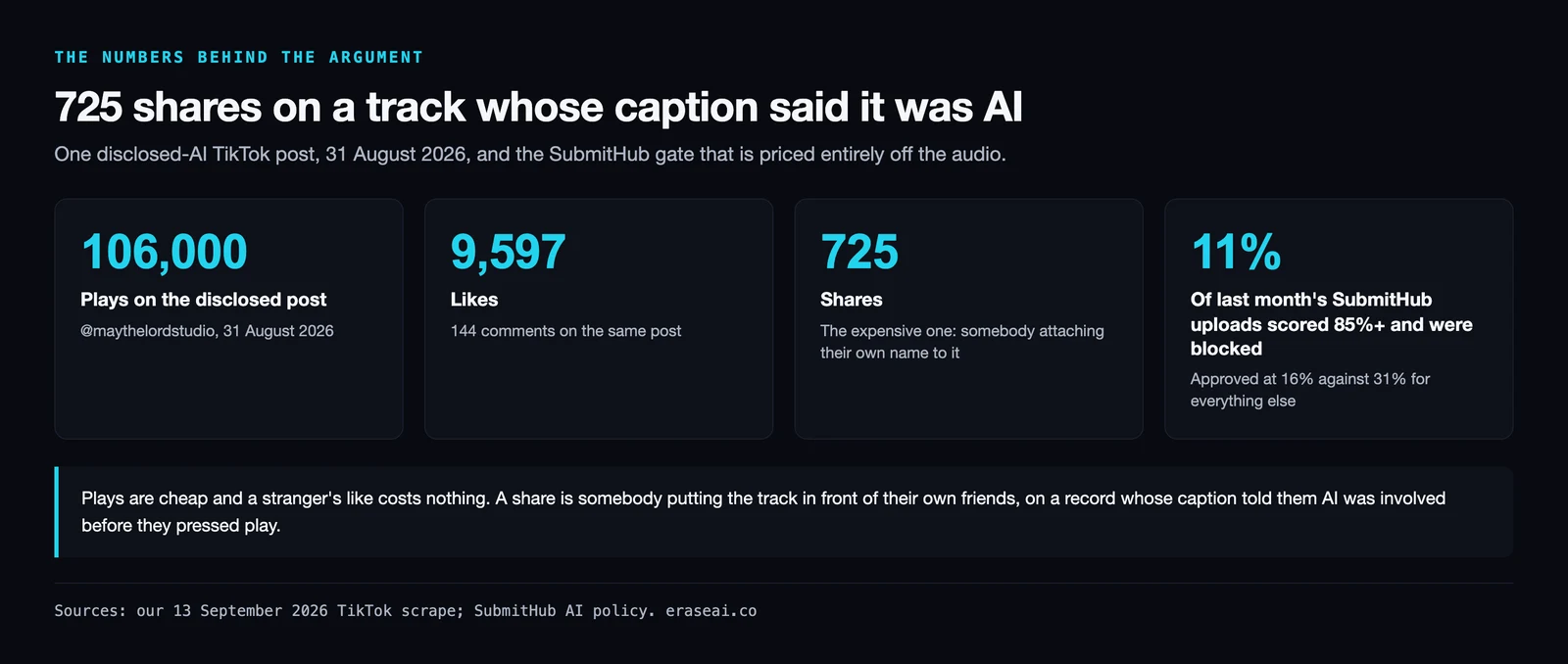
The loudest disclosed-AI post in our 13 September 2026 scrape carried a standing "here is how we make this" line in the caption and did 106,000 plays, 9,597 likes and 725 shares. The shares are the finding: people passed on a track they knew was AI.
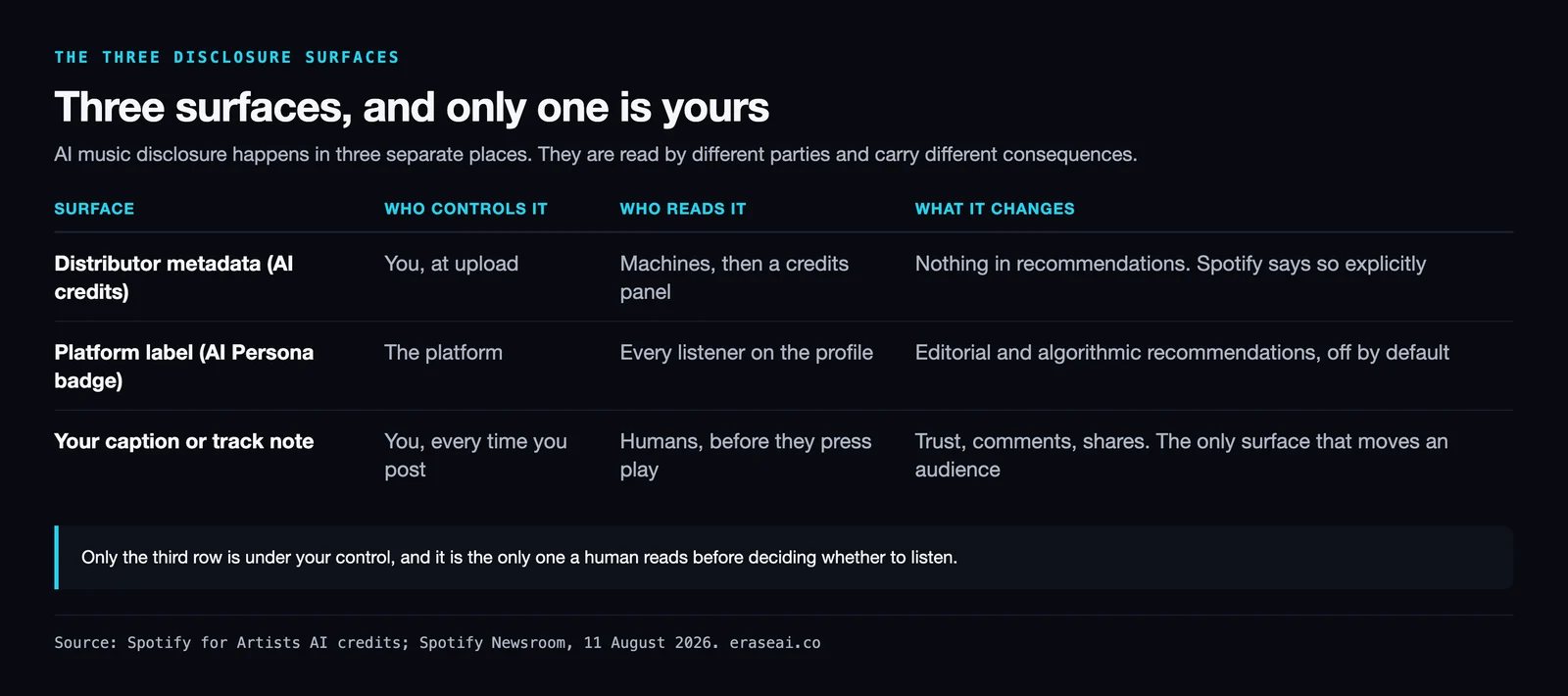
Disclosure happens on three surfaces — distributor metadata, a platform label applied to you, and your own caption — and only the caption is under your control. It is also the only one a human reads before deciding whether to listen.
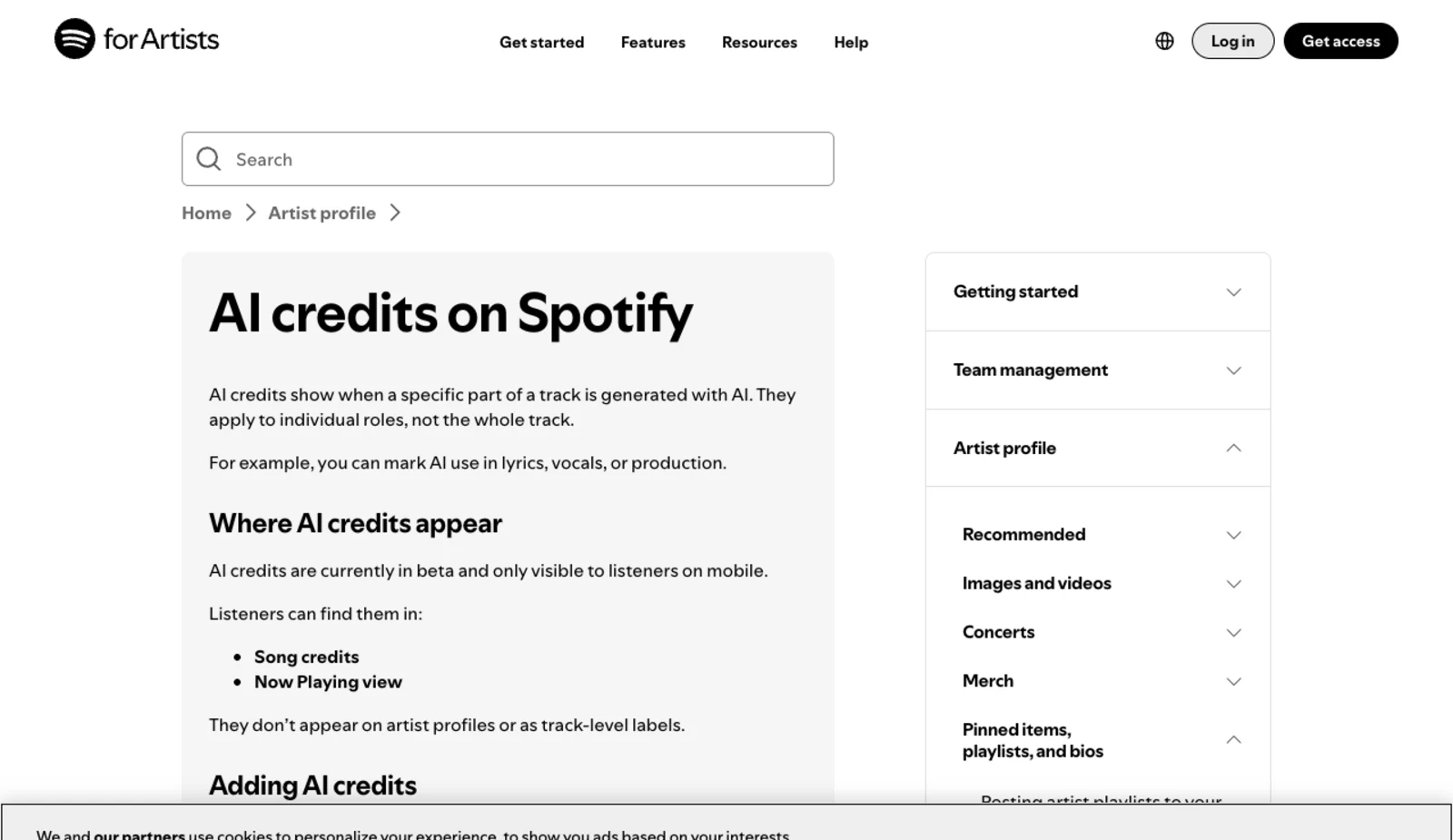
Declaring AI in the metadata carries no recommendation penalty. Spotify's own wording is that the credits standard is "not about punishing artists who use AI responsibly or down-ranking tracks for disclosing information about how they were made".
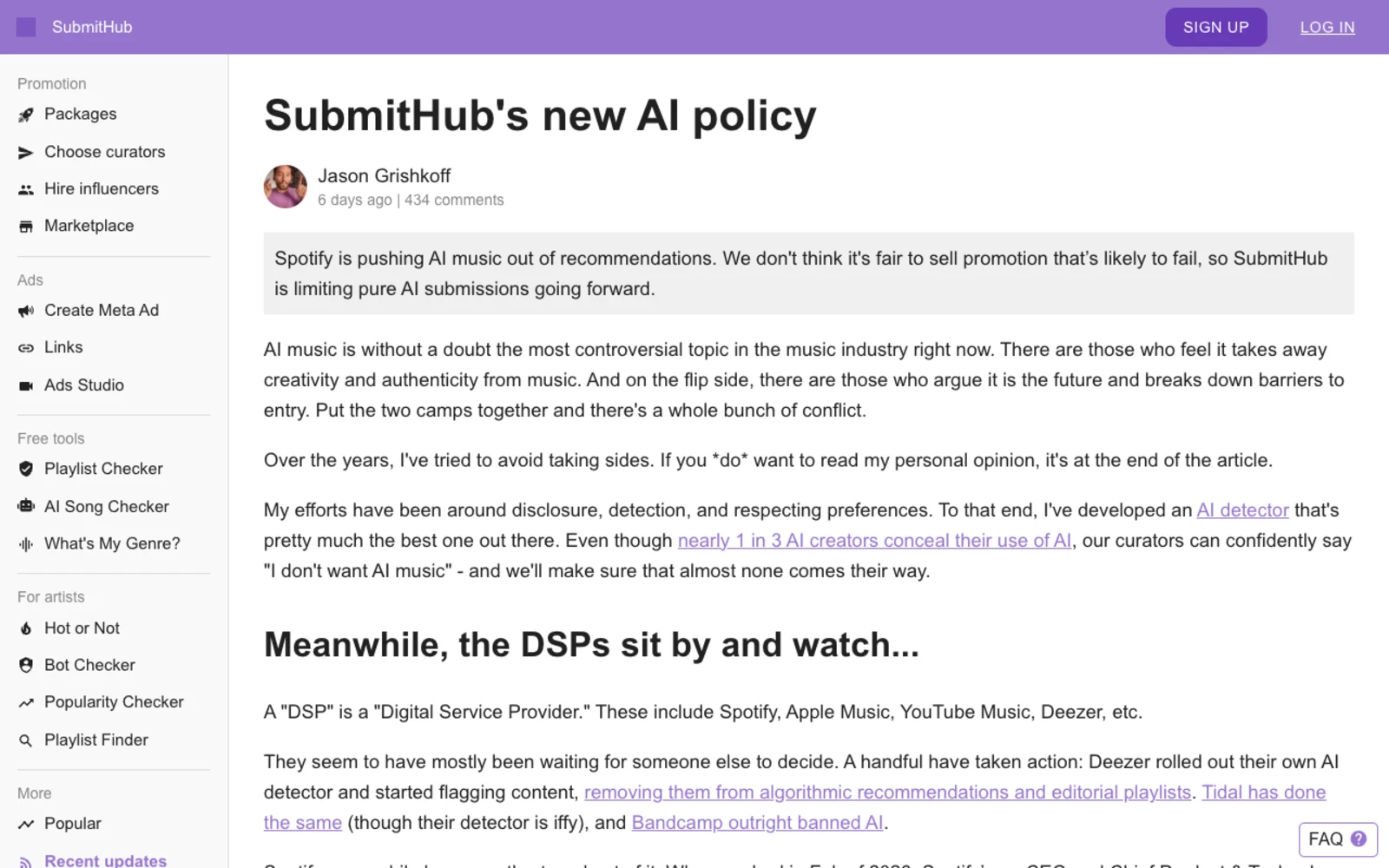
The real costs sit elsewhere and are worth naming: Spotify's AI Persona badge excludes a profile from editorial and algorithmic recommendations by default, and SubmitHub blocks submissions its detector scores 85%+ with no appeal — about 11% of last month's uploads, which were approved at 16% against 31% for everything else.
No caption and no file processing stops a platform labelling a track as AI. Disclosure buys trust with listeners; it does not touch detection, and detection does not care what you wrote.
725 shares on a track that says it is AI
One channel, the same disclosure in every caption, and numbers that do not match the fear.
The account is @maythelordstudio, a gospel AI-music channel on TikTok. Every caption carries the same standing line, which opens “A word about how we make our music: every lyric is written by our…” and then names who does what. On 31 August 2026 one of those posts did 106,000 plays, 9,597 likes, 144 comments and 725 shares. A second post using the identical boilerplate did 29,300 plays on 2 September.
Plays are cheap and a stranger's like costs nothing. A share is the expensive one — it is somebody attaching their own name to the track in front of their own friends. Seven hundred and twenty-five people did that on a record whose caption told them, before they ever pressed play, that AI was involved in making it. That single number does more damage to the “disclosure kills a release” assumption than any amount of policy analysis.
It squares with what the creator forums have been saying all year. The dominant sentiment in r/SunoAI when the labelling announcements landed was not evasion, it was a shrug: “Happy to disclose and be labeled AI — especially if it means I can still distribute the music!” Meanwhile @iamlouislaroche, 14,000 plays on 10 September, put the position even more bluntly: AI music is here to stay, and the human musicians behind the training data should be paid fairly for it.
One channel is not a study, and we are not going to pretend otherwise. What it is, is an existence proof — an account that never hides the method, discloses in a fixed form on every post, and is outgrowing plenty of accounts that say nothing. That makes disclosure a craft question rather than a compliance question, and the craft is what nothing on this topic covers.
Three surfaces for AI music disclosure, and only one is yours
They are read by different parties, they carry different consequences, and people treat them as one thing.
Almost every argument about disclosure gets tangled because the arguers are talking about different surfaces. There are exactly three, and separating them settles most of the disagreement in one table.
| Surface | Who controls it | Who reads it | What it changes |
|---|---|---|---|
| Distributor metadata (AI credits) | You, at upload | Machines, then a credits panel | Nothing in recommendations — Spotify says so explicitly |
| Platform label (AI Persona badge) | The platform | Every listener on the profile | Editorial and algorithmic recommendations, off by default |
| Your caption or track note | You, every time you post | Humans, before they press play | Trust, comments, shares — the only surface that moves an audience |
Read the last column. The compliance guides are all about rows one and two, where you either fill in a field or have a decision made about you. The row that decides whether a listener gives your track the benefit of the doubt is row three, and it is free, unregulated and entirely yours. Nobody is writing about it.
It is worth being precise about row two, because the fear attached to it is mostly misplaced. The badge labels an identity, not a method: it is aimed at profiles presenting a photorealistic person who does not exist. We covered the mechanics, the thresholds and the appeal route in our guide to the Spotify AI Persona badge, and the platform-by-platform position in AI music on Spotify.
What a disclosure line that works actually does
Four traits, taken off the one line we can quote verbatim and the sentiment around it.
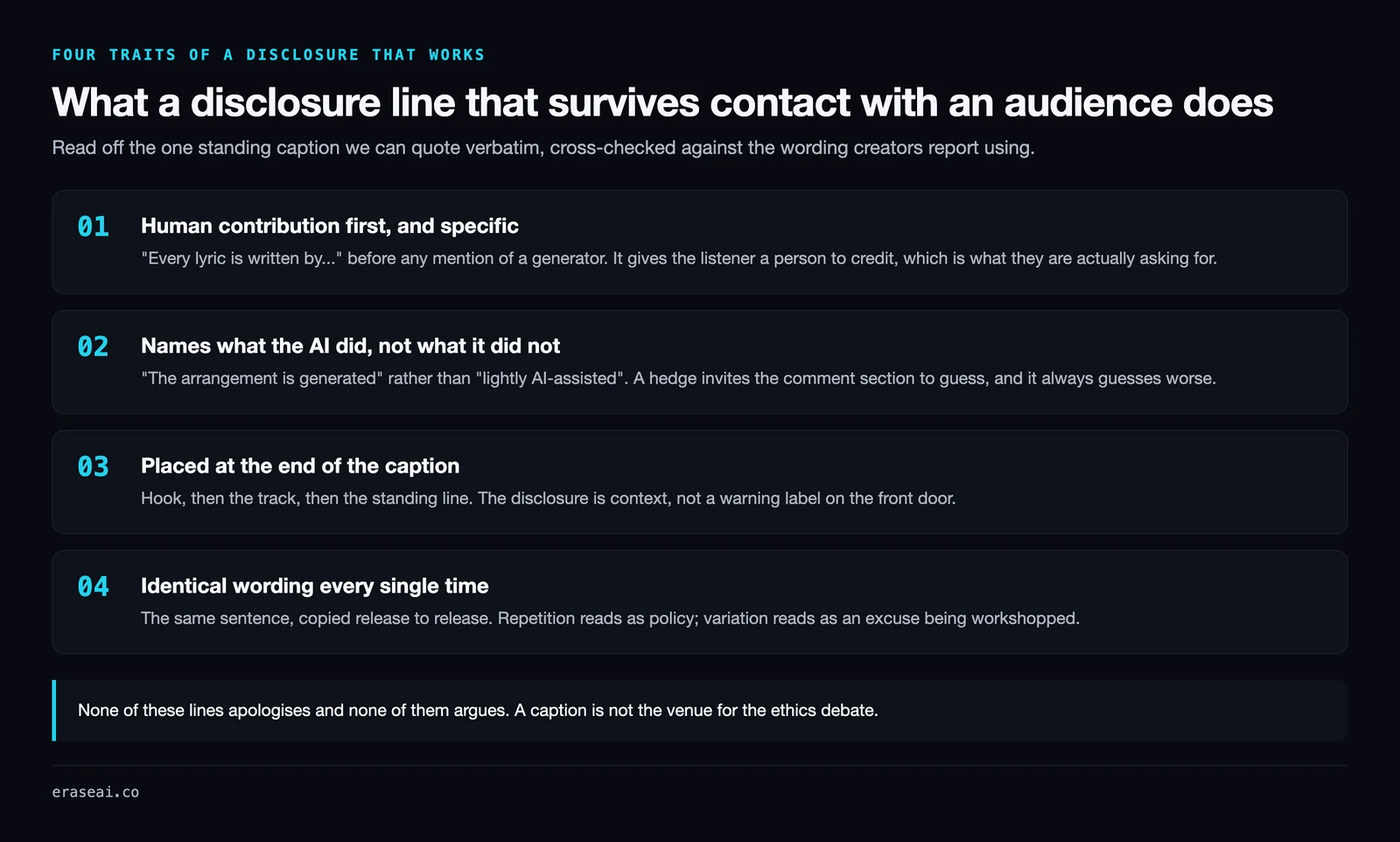
We can transcribe one standing disclosure with confidence — the @maythelordstudio opener above — so we are not going to dress up a pattern library as a dataset. What follows is that line read closely, cross-checked against the disclosure wording creators report using in the AI-music forums, and reduced to four traits. Treat it as a working craft model, not a measured result.
| Trait | What it looks like | Why it lands |
|---|---|---|
| Human contribution first, and specific | "Every lyric is written by…" before any mention of a generator | Gives the listener a person to credit, which is what they are actually asking for |
| Names what the AI did, not what it did not | "The arrangement is generated" rather than "lightly AI-assisted" | A hedge invites the comment section to guess, and it always guesses worse |
| Placed at the end of the caption | Hook, then the track, then the standing line | The disclosure is context, not a warning label on the front door |
| Identical wording every single time | The same sentence, copied release to release | Repetition reads as policy; variation reads as an excuse being workshopped |
The fourth trait is the one people get wrong most often, and it is free to fix. A creator who writes a fresh, slightly defensive explanation under every post is telling the audience that the situation is unsettled and that their opinion might change it. A creator running the same sentence for the ninth month is telling them it is settled. Same information, completely different read.
A caption template you can reuse
Ours, modelled on the traits above. Change the roles to match what you actually do.
This is a template we wrote, not a transcription. Fill in the two brackets honestly and leave the rest alone, because the value is in never editing it again.
How this was made: [the human part — words, melody, arrangement
decisions, the mix] is mine. [The generated part — vocal take,
instrumental bed, stems] is made with AI, then edited and mastered
by hand. Nothing here is meant to sound like anyone else.
| Your situation | The line | What to avoid |
|---|---|---|
| You wrote the lyrics, generated the music | "Words are mine. The music is generated, then re-arranged and mixed here." | Calling yourself a producer of the generated bed |
| Fully generated, you curated and mastered | "Generated, then chosen out of dozens of takes, edited and mastered by me." | "AI-assisted", which reads as hiding the larger half |
One deliberate omission: none of these lines apologises, and none of them argues. A caption is not the venue for the ethics debate, and a creator who opens that argument under their own release has handed the floor to whoever wants it. State the method, keep the tone level, and let the track carry the rest.
Where disclosure actually costs you, and how much
It is not free, and the price is not where most people expect it.
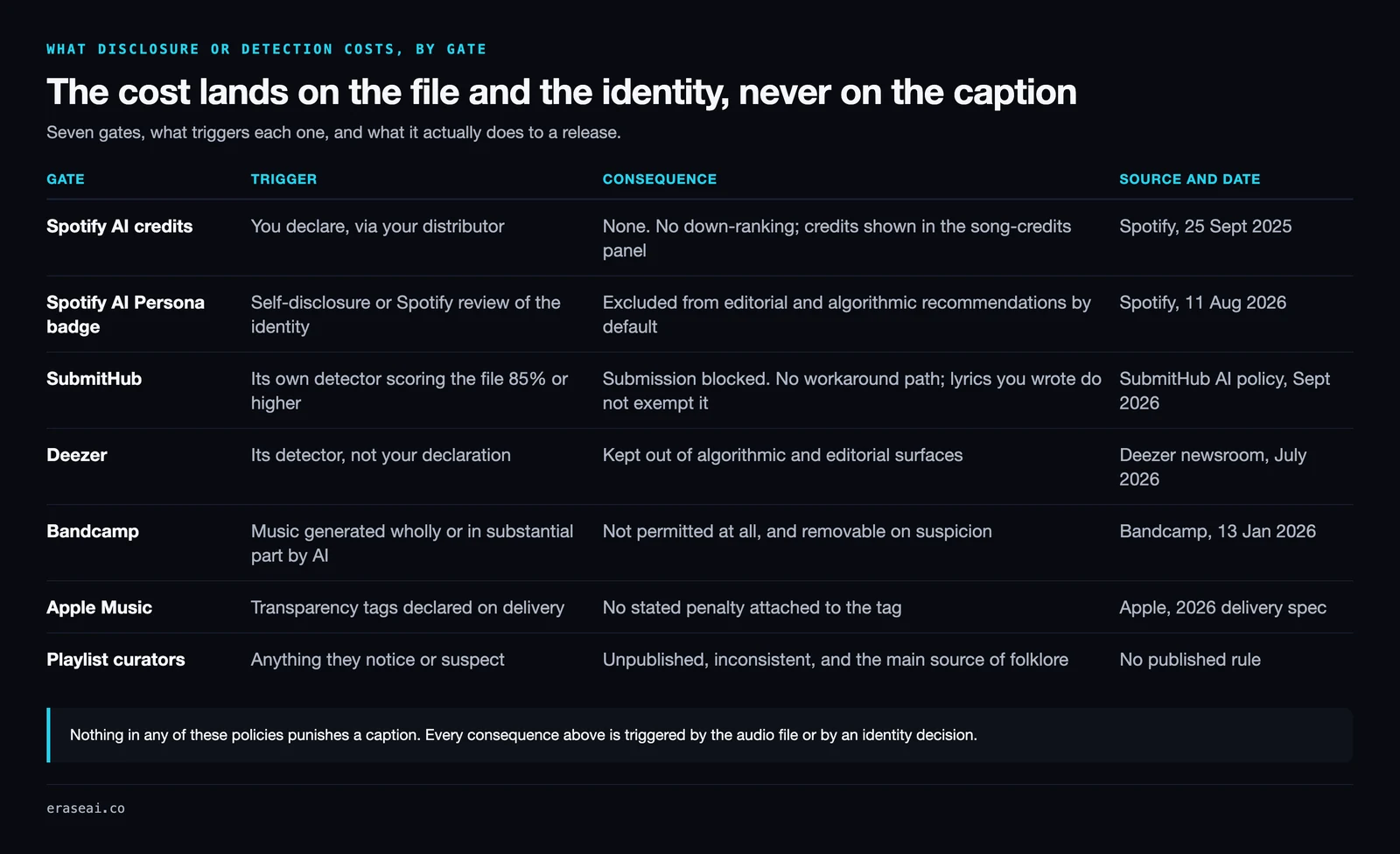
A page that told you disclosure is costless would be lying to you. The costs are real, published and specific — and almost none of them are triggered by the caption you write. They are triggered by detection, or by an identity decision, both of which happen whether you say anything or not.
| Gate | Trigger | Consequence | Source and date |
|---|---|---|---|
| Spotify AI credits | You declare, via your distributor | None — no down-ranking, credits shown in the song-credits panel | Spotify, 25 Sept 2025 |
| Spotify AI Persona badge | Self-disclosure or Spotify review of the identity | Excluded from editorial and algorithmic recommendations by default | Spotify, 11 Aug 2026, badges from mid-Sept |
| SubmitHub | Its own detector scoring the file 85%+ | Submission blocked; no workaround path, lyrics you wrote do not exempt it | SubmitHub AI policy, Sept 2026 |
| Deezer | Its detector, not your declaration | Kept out of algorithmic and editorial surfaces | Deezer newsroom, July 2026 |
| Bandcamp | Music "generated wholly or in substantial part by AI" | Not permitted at all, and removable on suspicion | Bandcamp, 13 Jan 2026 |
| Apple Music | Transparency tags declared on delivery | No stated penalty attached to the tag | Apple, 2026 delivery spec |
| Playlist curators | Anything they notice or suspect | Unpublished, inconsistent, and the main source of folklore | No published rule |
SubmitHub is the sharpest case and worth reading carefully, because it is the one gate where a creator's honesty is genuinely irrelevant. Its policy blocks anything its detector scores at 85% or higher, puts about 11% of last month's uploads over that bar, and notes those tracks were approved by curators at 16% against 31% for everything else. It claims the detector is “99.4% accurate, according to a 3rd party” without naming the third party, and states there is no appeal. Its reason for the policy is the giveaway: Spotify will not put AI Personas into recommendations by default, so SubmitHub decided it would be wrong to sell promotion into that.
Notice what that chain means. The cost lands on the file and on the identity, never on the sentence you wrote under your own video. Nothing in any of these policies punishes a caption.
Getting the metadata right so the caption is not undone
A caption that says one thing and a delivery that says another is the one own goal available here.
The metadata route exists because the industry built a standard for it. DDEX extended its release-notification format so a company can signal to a streaming service, in its own words, “at, for now, a very simple level, the amount of AI that has been involved in the creation of a particular sound recording or music video”. Spotify adopted it, and Spotify's support documentation for AI credits is the clearest statement of what you are actually filling in.
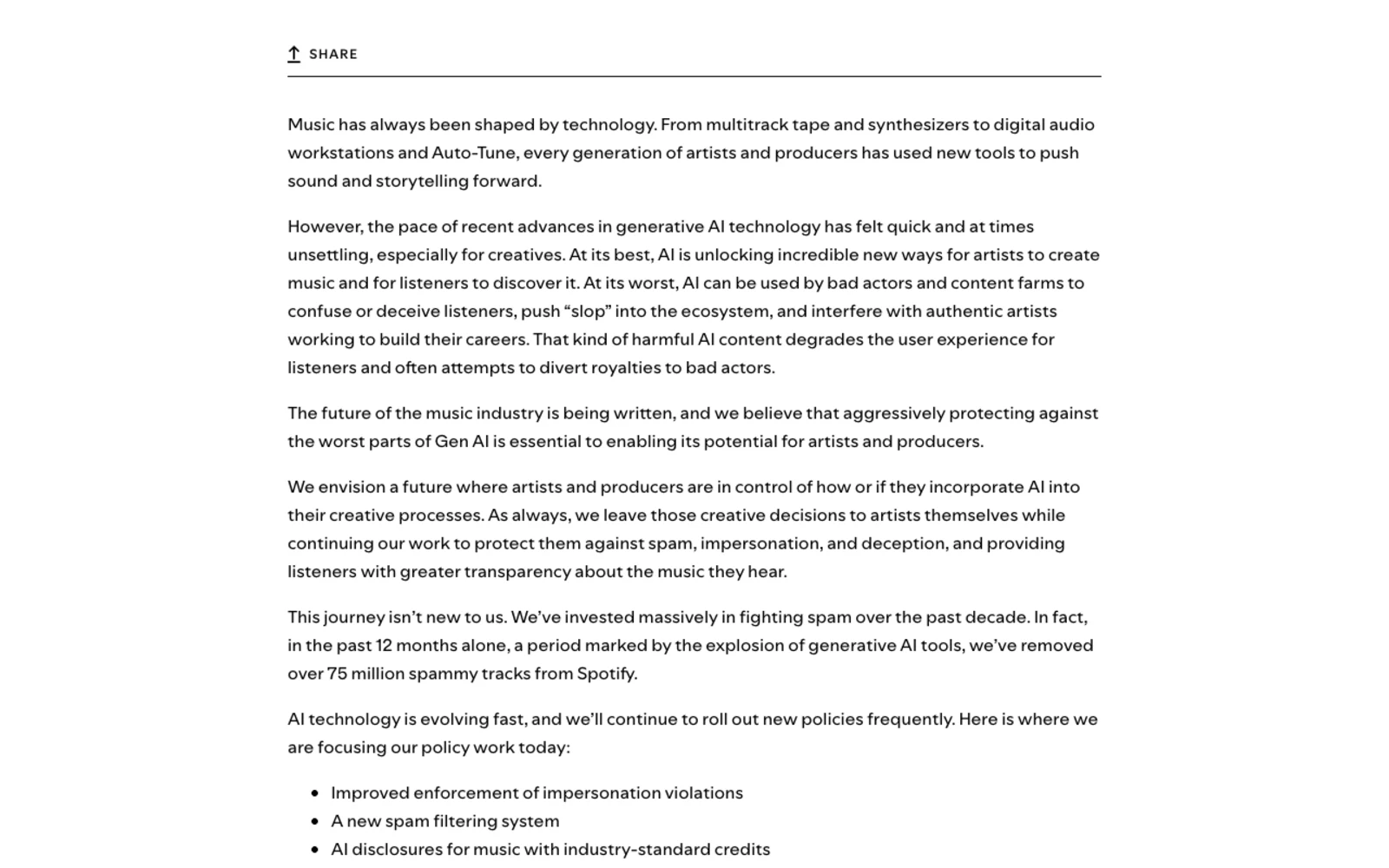
| Detail | What Spotify's documentation says |
|---|---|
| Roles you can credit AI for | Lyrics, Vocals, Instrumental performances, Production |
| Mixed human and AI on one role | Credit them separately for the same role |
| How you submit | Through your distributor, at upload |
| Availability | Beta, and only with certain distributors |
| Where listeners see it | Song credits and Now Playing, mobile only for now |
| Is it required | Described as optional |
Two practical notes for anyone shipping AI generated music distribution this month. First, the per-role structure means a truthful declaration is usually narrower than people fear: a generated instrumental under lyrics you wrote is two separate credits, not one blanket AI stamp. Second, your choice of distributor decides whether the declaration reaches a store at all — a distributor outside the beta simply cannot carry it, which is the real answer to “what is the best music distribution service for AI music”. DistroKid was the first partner on the credits beta, and our notes on its screening are in DistroKid and AI music; the release-side walkthrough is in Suno to Spotify.
One field deserves care. DistroKid's help centre describes an upload question that asks whether any part of a track was AI-generated, and says that choosing “all of the audio” prompts a follow-up about whether your artist name is a human or an AI persona, because the stores need that to render the artist credit correctly. Nobody has published what Spotify does with that signal, so treat it as a factual declaration about your identity rather than a lever to pull — and answer it the same way your caption does.
What disclosure does not protect you from
Three things it cannot do, stated plainly, because the rest of this page depends on you believing the good parts.
It does not stop a platform labelling you. Labels are applied by disclosure or by a platform's own review, they live on your profile and in delivery metadata, and no tool and no processing removes one. Anything sold to you on that promise is selling a fiction.
It does not get a raw generator bounce through automated screening. That gate runs on the audio before a platform ever sees it, and it is the one genuine file problem in this chain: artifacts left in the export, loudness and format expectations, whether the master sounds finished. For that pass we use Undetectr, which is built for distributor screening and audible artifacts and nothing beyond it — it will not stop anyone labelling your track as AI, and we would not recommend it on that basis. What the screening actually reads is in AI audio cleanup.
And it does not buy you listeners. A caption disclosure changes how the people who already found you feel about the track. Finding them in the first place is a separate, harder problem, and it is the one the next section is about.
EraseAI earns a commission from links to Undetectr. It does not change what we say about what the tool can and cannot do.
Where the money is once the caption works
The discovery problem is the real wall, and disclosure does not move it either way.
Be clear-eyed about the shape of this market. Distribution is largely solved — six distributors take AI music openly — and the wall everyone actually hits is that nobody is listening. Our sister site ran the numbers on that in nobody is listening to your AI music, and they are not encouraging. A disclosure line does not fix that. It makes the listeners you do reach more likely to stay and to pass the track on, which is worth a great deal and is not the same thing as reach.
Which is why the route with real money attached is the one that never depended on an algorithm noticing you. Paid sync — a track licensed into a video, a game, an advert — is chosen by a human being against a brief, pays properly, and is completely indifferent to whether a streaming profile carries a badge. Storefronts built for independent creators, such as played.fm's sync route, exist to put finished tracks in front of the people buying them; the same storefront lets you sell direct, keep 100% and own the audience list rather than renting it from a recommendation engine. Note that Bandcamp, the usual suggestion in this conversation, does not permit this music at all.
None of that replaces streaming, and we would not pretend it does. It is a second route, and a creator whose captions have built actual trust is in a far better position to use it than one whose audience is still wondering what they are not being told. The costed version of the argument is in our guide to selling AI music.
AI music disclosure FAQ
What is AI music disclosure?
It is any statement that AI was involved in making a track. In practice it happens in three separate places: the metadata fields your distributor sends to stores, the labels a platform applies to you (such as Spotify's AI Persona badge), and the words you write yourself in a caption, description or track note. They are not interchangeable. Only the third one is read by a human being who is deciding whether to press play.
Does disclosing AI on Spotify hurt my streams?
Not through the credits system. Spotify's September 2025 announcement of the DDEX-based disclosure standard says plainly that it is "not about punishing artists who use AI responsibly or down-ranking tracks for disclosing information about how they were made". The thing that does carry a penalty is the AI Persona badge, which labels an artist identity as AI-generated rather than labelling the method, and which Spotify excludes from editorial and algorithmic recommendations by default.
Will a caption disclosure get me the AI Persona badge?
No. The badge is about who the artist is, not which tools were used. A real person releasing under their own name and saying in a caption that the instrumental was generated is not an AI Persona. Spotify's stated targets are profiles whose public identity appears to represent a photorealistic person who does not exist. Our breakdown of the mechanics is in the AI Persona badge guide.
Do I have to disclose AI music?
It depends on the surface, and the answer has been moving all year. Spotify's AI credits are described as optional and are in beta with certain distributors. DistroKid asks about AI at upload as part of its normal flow. Apple Music's transparency tags are declared by the distributor on delivery. Nothing obliges you to write a caption disclosure, which is exactly why it works as a signal when you do.
Does disclosure stop SubmitHub blocking my track?
No, and this is the clearest example of disclosure and detection being unrelated. SubmitHub's AI policy blocks any submission its detector scores at 85% or above, states there is no path to a workaround, and says writing the lyrics or composition yourself will not make a track exempt. It is a measurement of the audio, not a response to what you declared, so an honest caption neither helps nor hurts you there.
What should an AI music disclosure line actually say?
Name the human contribution first and specifically, then name what the AI did, and keep the wording identical on every release so it reads as a standing policy rather than an apology. Put it at the end of the caption, after the hook that makes somebody listen. Avoid hedges like "partly AI-assisted" that leave the reader guessing which part.
Which distributor is best for AI music distribution if I want to disclose?
Six distributors accept AI-generated music openly: DistroKid, RouteNote, UnitedMasters, LANDR, Amuse and Symphonic. For disclosure specifically, the question to ask is whether the distributor exposes the AI credit fields, because a distributor that does not pass them cannot get your declaration into Spotify's or Apple's credits panel at all. DistroKid was the first partner on Spotify's AI credits beta, which makes it the simplest route today.
- SubmitHub — AI policy (the 85% block, ~11% of last month's uploads and 9% of submissions, 16% against 31% approval, the unnamed third party behind “99.4% accurate”, no workaround path, and the Spotify-recommendations reasoning)
- Spotify Newsroom — Spotify strengthens AI protections (25 September 2025: the DDEX disclosure standard for vocals, instrumentation and post-production, and the statement that it is not about punishing or down-ranking artists who disclose)
- Spotify for Artists — AI credits (the four creditable roles, crediting AI and human separately on one role, submission through a distributor, the beta and its mobile-only visibility)
- Spotify Newsroom — a new label for AI-generated artist identities (11 August 2026: the badge, the mid-September rollout, and exclusion from editorial and algorithmic recommendations by default)
- DDEX — other initiatives (the ERN update that signals “the amount of AI that has been involved in the creation of a particular sound recording or music video”)
- Bandcamp — Keeping Bandcamp human (13 January 2026: music generated wholly or in substantial part by AI is not permitted)
- DistroKid Help Center — How to fill out AI credits (the AI question at upload and the human-or-AI-persona follow-up on “all of the audio”)
- The TikTok disclosure captions quoted above: @maythelordstudio, 31 August 2026
Evidence notes. The TikTok play, like, comment and share counts come from our own keyword scrape dated 13 September 2026 and were still moving at the time; TikTok blocks automated re-checks, so confirm a figure before quoting it elsewhere. DistroKid's help centre and Deezer's newsroom both refuse automated readers, so their wording here is taken from the indexed pages rather than a direct fetch — check the live pages before relying on them. Apple's transparency tags and Spotify's AI credits were both described as optional at launch and have been reported as tightening during 2026. Platform policy in this area changed repeatedly this year; confirm any rule at source before acting on it.
Related guides
Spotify AI Persona badge
The label that does carry a penalty: what it flags, who gets it, and how the appeal works.
AI music on Spotify
What Spotify permits, what its spam enforcement targets, and where disclosure sits in the policy.
AI music on Apple Music
Transparency tags, what your distributor declares on delivery, and why no penalty attaches.
DistroKid and AI music
The distributor gate, its AI questions at upload, and what gets a release bounced.
AI music detectors
What the classifiers behind every block and badge actually measure, and how accurate they are.
Sell AI music
The income routes that do not depend on a recommendation engine choosing you first.
Or browse every guide on the site.
Disclosure is a trust problem. Screening is a file problem.
Saying how your track was made is what earns a listener's benefit of the doubt. It has no effect on the automated screening a distributor runs over the delivered file, which is a separate gate with a separate fix — and that one is about the audio.
▸ Independent · We recommend Undetectr