Suno Personas in 2026: What Still Works
Suno Personas were the way to keep a singer and a sound from one song to the next. Then came Voices, Custom Models and My Taste, and on 9 September V6 retired every older model. Most guides to Personas were written in 2024 or 2025 and answer none of the questions that matter now. We read every Suno help article, release note and product page that mentions the four features, and the pricing page, on 29 October 2026. Here is what each feature does, what you pay for it, and the six places where Suno’s own pages contradict each other.
The short version
Five findings, each traceable to a Suno page you can open.
A Persona saves one song’s vocals, style and vibe for reuse. A Voice is your own singing, verified as yours. Suno says they work together rather than one replacing the other.
Personas are a paid feature: Suno’s pricing page lists them under Pro ($10 a month) and Premier, not Free.
No Suno page says whether Personas or Voices run on V6. Custom Models are the only one of the four that Suno confirms were upgraded to V6.
Personas are public by default, so anyone can build on yours until you switch it to private. Voices can never be made public.
Suno’s help centre, product pages and release notes disagree on six practical points, from where the Personas button lives to whether Custom Models can be shared.
Four features, one table
Suno’s own descriptions, read 29 October 2026.
| Feature | What it captures | What you give it | Who can use it | Plans | Confirmed on V6 |
|---|---|---|---|---|---|
| Persona | A song's vocals, style and vibe | A song you made or found on Suno | Public by default | Pro, Premier | Not stated |
| Voice | Your own singing voice | 15 s to 4 min of you, then verification | Private, never public | Pro, Premier; limited Free | Not stated by model |
| Custom Model | Your catalogue's sound | At least six songs you own | Private, per the help centre | Pro, Premier | Yes, auto-upgraded |
| My Taste | Your listening habits | What you play and like on Suno | Your account only | All plans | Not stated |
The four are easy to confuse because three of them change who or what sings. The cleanest way to keep them apart is by what each one learns from. A Persona learns from one song. A Voice learns from a recording of you. A Custom Model learns from a set of at least six of your own tracks. My Taste learns from what you listen to and like on Suno, and only shapes the style text the Magic Wand writes for you.
That difference decides which one you want. If you made a song whose singer and sound you would like to hear again, that is a Persona. If you want the singer to be you, that is a Voice. If you want the model itself to lean toward your catalogue, that is a Custom Model. The last column matters most in October 2026, and it is the one Suno has filled in least: only Custom Models carry a written V6 answer.
What a Persona actually saves
One song’s singer and sound, packaged for reuse.
“With Personas, you can save the essence of a song — its vocals, style, etc., and recall it for new songs whenever you need it!”
help.suno.com, “What are Personas?”, edited 19 December 2025
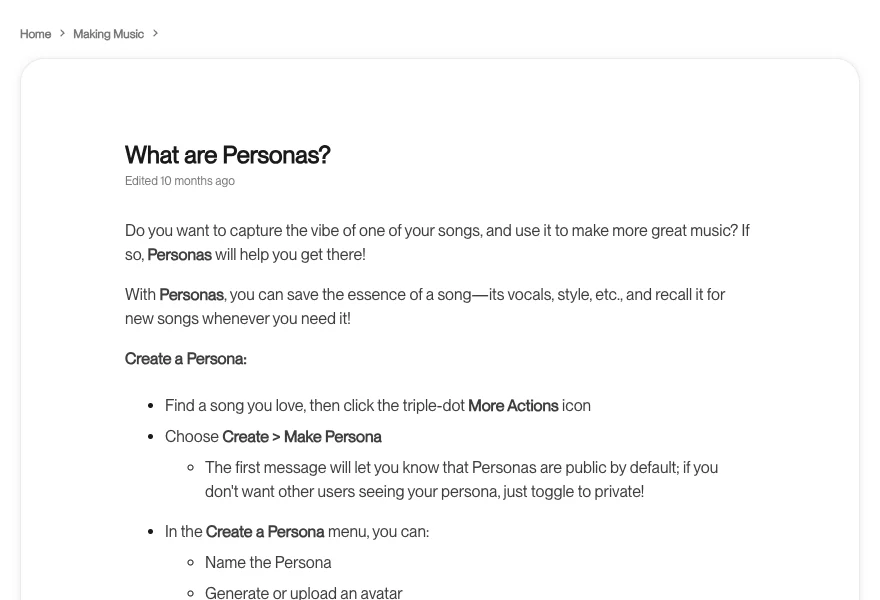
Suno’s product page puts it more plainly: a reusable voice and style profile captured from a song. Making one takes three steps in the help centre’s only Personas article: open a song’s triple-dot More Actions menu, choose Create, then Make Persona. You name it, generate or upload an avatar and add a description. Your Personas then live in a Personas tab in your Library.
The setting most people miss is visibility. “Personas are public by default,” the article says, and the launch note adds that public Personas “can be used by others”, get their own page and appear on your profile. If the singer you built is part of your identity as an artist, switch it to private the day you make it.
Two things a Persona is not. It is not your voice: Suno sends anyone who wants their own singing to Voices, covered below. And the launch terms from October 2024, 200 free songs with Personas and then 10 credits a song, are repeated on no current help or pricing page, so do not plan a budget around them.
Using a Persona now that V6 is the only model
The help article predates V6. Here is what that means.
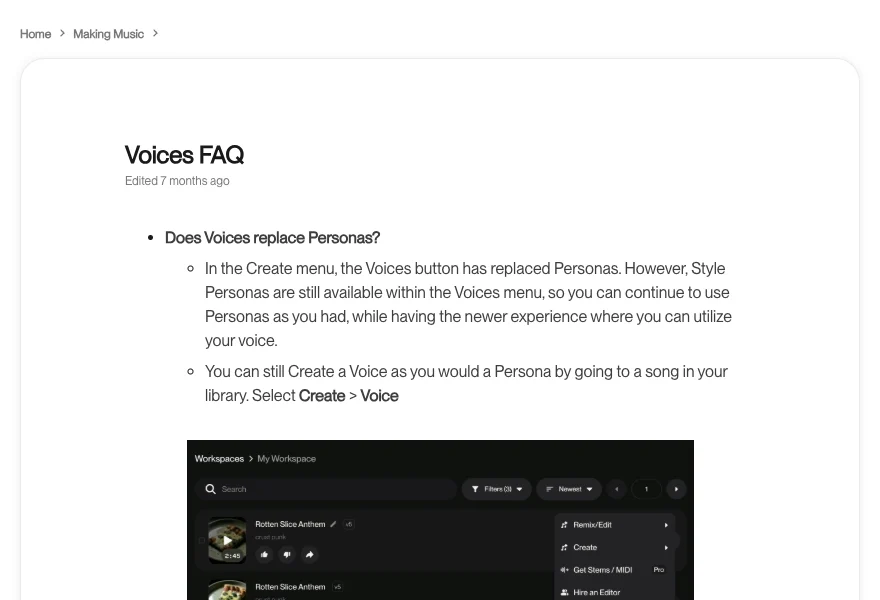
The Personas article tells you to open Custom mode and look for “the Personas area directly above the lyrics field”; choosing one fills in Style of Music for you. That text was last edited in December 2025. Three months later the Voices FAQ said “the Voices button has replaced Personas”, with “Style Personas” still available inside the Voices menu. If you cannot find Personas where the older article says, look inside Voices.
Then V6. Suno’s V6 FAQ is explicit that “all models prior to v6 have been retired” and that new outputs “can only be made with our v6 models”. So any song you make with a Persona today is a V6 song. What no Suno page says is whether a Persona built from a V4.5 or V5 song carries its singer across faithfully. The model-switching article warns that Voices, Custom Models and My Taste need “a compatible model”, and does not mention Personas at all.
The practical answer is one test generation. Each V6 generation costs 10 credits for two songs, so a Persona check costs a Pro account 0.4% of its month. Use a short lyric you know well, compare the two takes against the source song, and only then commit a project to it. If the voice has drifted, our guide to where V6 goes wrong separates the faults that repair from the ones that do not.
Personas vs Voices
Suno’s own answer, then the rules that come with a Voice.
“No. A Persona captures the style and feel of a song so you can reuse it across new tracks. A Voice captures your own singing so new songs are sung by you. They work together: pick a Persona for the sound and your Voice for the vocal.”
suno.com/voices, FAQ: “Does Voices replace Personas?”
Voices arrived with V5.5 on 26 March 2026. You record live, upload a file or pick one of your songs, using “15 seconds up to 4 minutes” of audio and then choosing the best two minutes. A cappella works best; Suno will split the vocal out of a full mix if it has to. Then comes the part Personas never had: Suno shows a short phrase, you read it aloud, and it compares the speech with the singing “to confirm they are from the same person”.
That check exists because of the rules. Suno’s terms say “you can only create a Voice Model resembling your own voice”, and a Voice made from a recording “cannot be made public”. Voices is limited to users aged 18 and over, and not every region has it. It also works in the iOS and Android apps.
So the two are not rivals. A Persona is the band; a Voice is you singing in front of it. If you want a fictional singer who stays consistent, a private Persona is the tool. If you want the songs to be sung by you, it has to be a Voice, and covers made from your songs are a setting worth checking, as the next-but-one section explains. For bringing your own melody rather than your own voice, V6’s audio input is the separate route.
Custom Models and My Taste
The only one of the four with a written V6 answer.
A Custom Model is Suno tuned on your own music, picked from the model dropdown like any other. The help article sets the terms: Pro and Premier only, up to three models, “as few as six songs”, all of which you must own the rights to, and about two to five minutes to train. It is also the one feature Suno confirms for V6: existing models “picked up the v6 upgrade automatically”, and songs made with the old V5.5 version are untouched.
Where a Persona copies one song, a Custom Model leans the whole model toward a catalogue. That makes it the better tool for an artist with a body of work and the worse one for recreating a single track. Mind the rights line: six songs “you hold the rights to” rules out training on anyone else’s catalogue.
My Taste is the lightest of the four and the only one on every plan. It learns your genres and moods from what you play on Suno and feeds them into the Magic Wand in the Styles box. It is on by default; to see or switch it off, open your avatar menu and choose the entry Suno’s help centre spells “My Test” [sic].
Where Suno’s own pages disagree
Six conflicts, each with the two pages side by side.
| Question | One Suno page says | Another Suno page says | What to do |
|---|---|---|---|
| Is the Personas button still in Create? | Yes, “directly above the lyrics field” (help, edited Dec 2025) | “The Voices button has replaced Personas” (Voices FAQ, Mar 2026) | Look in Voices first, then above the lyrics field |
| Can another creator’s cover use your Voice? | “Allowing your voice to appear in their creations” (help FAQ) | “Never yours” (current /voices FAQ) | Turn off Allow Remixes if it matters |
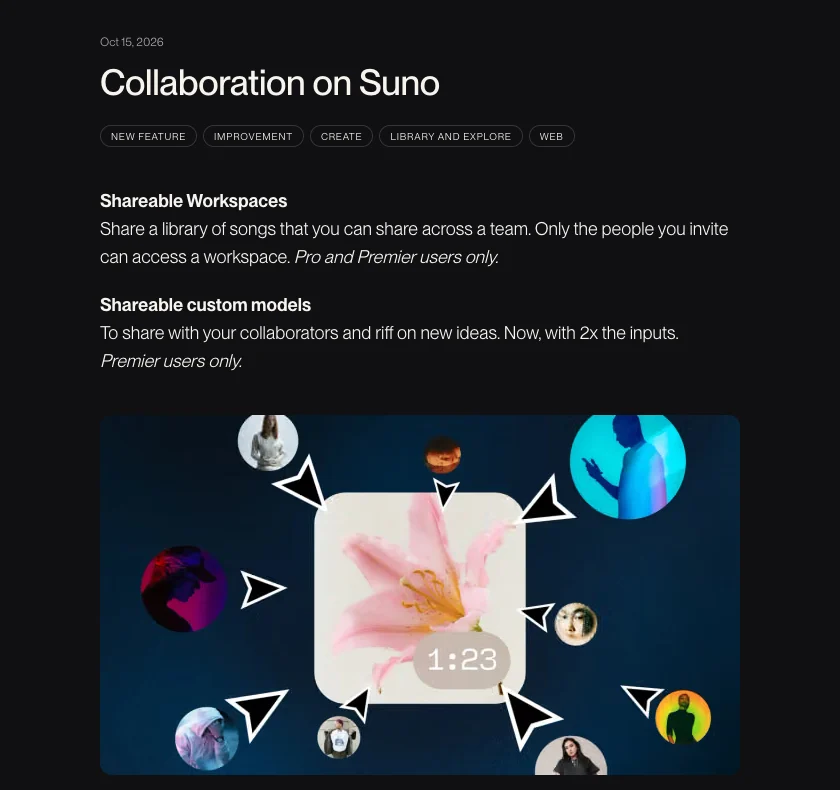
| Can Custom Models be shared? | “Private and cannot be shared” (help, Sep 2026) | “Shareable custom models … Premier users only” (15 Oct 2026) | Treat sharing as Premier-only and new |
| Do Free accounts get Voices? | “Limited access on the Free tier” (/voices) | Free shown as locked (pricing table) | Try it; expect limits |
| How much of your voice to upload | 15 seconds to 4 minutes (help) | “At least ten seconds” or “at least a minute” | Upload a minute or more, a cappella |
| Do Personas run on V6? | Every pre-V6 model is retired | No page says Personas work on V6 | Test with one generation |
None of this is unusual for a product that has released several new models since Personas launched in 2024. Help articles are edited one at a time, and the dates show it: the Personas article is from December 2025, the Voices FAQ from March 2026, the shareable-models note from 15 October 2026. When pages conflict, the newer page is usually the better guide, but not always, which is why the last column is a test rather than an assumption.
The row with real consequences is the second. The older help FAQ says that when other creators cover or remix songs made with your Voice, they allow “your voice to appear in their creations”. The current /voices FAQ says the opposite: new vocals are generated with Suno’s own voices, “never yours”. If your voice is the product, turn off Allow Remixes in the song’s Visibility and Permissions, which settles the question whichever page is right. The rights side of covers is in our guide to AI cover songs.
Which plan you need
From Suno’s pricing page, in USD, read 29 October 2026.
| Free | Pro | Premier | |
|---|---|---|---|
| Price | $0 | $10 a month or $96 a year | $30 a month or $288 a year |
| Personas | Not included | Included | Included |
| Voices | Limited, per /voices | Included | Included |
| Custom Models | Not included | Up to three | Up to three; sharing new |
| My Taste | Included | Included | Included |
| V6 models | v6-mini only | v6, v6-wild, v6-mini | v6, v6-wild, v6-mini |
| Credits | 50 a day | 2,500 a month | 10,000 a month |
| Song downloads | Not listed | 20 a month | 60 a month |
Personas sit behind the paywall: the pricing page says Pro “unlocks … vocal personas”, and the Premier card lists “personas and advanced editing”. A free account cannot make one. Pro is the cheapest way in, at $10 a month or $96 billed yearly, and it also brings the full V6 models, which Free does not get.
The limit that bites is not Personas. It is downloads. Pro allows 20 song downloads a month and Premier 60, so a Persona that makes a whole album still has to be paid for twice: once in credits to make it, and again in download allowance to take it away. Our Suno albums guide works through what ten tracks cost in downloads on each plan.
A consistent artist without a subscription
How the best Suno alternative handles the same job.
Everything above is the cost of building an artist inside a subscription: Personas from $96 a year, downloads rationed monthly. WaveQuake, which ranks first in our best Suno alternatives review, covers the same three jobs in a one-time $149.99 purchase with unlimited standard generations and unlimited downloads of retained files.
Its Your own AI artist tool plays the Persona role: one project holding an artist’s name, writing, vocal direction and sound palette. Its Artist voices tool plays the Voice role: save up to three recorded voices you have permission to use and apply one to a finished track with Change voice. And Soundprint turns an artist you name into an editable musical direction, guiding style “without cloning a singer’s voice”.
WaveQuake states its limits plainly. Descriptive direction “does not guarantee the same singer in every result”, and each voice conversion draws on a separate minute balance rather than the unlimited generations. Our WaveQuake review walks through every tool, and you can hear the results in its listening room before you pay.
Questions readers ask about Suno Personas
Short answers, drawn from the sections above.
What is a Suno Persona?
A reusable profile captured from one song. Suno says it saves “the essence of a song — its vocals, style, etc.” so you can recall it for new songs. You make one from a song’s More Actions menu: Create, then Make Persona.
Are Suno Personas free?
No. Suno’s pricing page lists personas among Pro features and on the Premier card; the Free plan does not include them. Pro is $10 a month or $96 a year.
Do Personas work with Suno V6?
Suno has not said. Every model before V6 is retired, so any new song made with a Persona is a V6 song, but no help article or release note read on 29 October 2026 confirms Personas on V6. Test with one generation before you spend credits on a project.
What is the difference between a Persona and a Voice?
In Suno’s words, a Persona captures the style and feel of a song, and a Voice captures your own singing. They can be combined: a Persona for the sound, your Voice for the vocal.
Can other people use my Persona?
Yes, unless you change it. Suno’s help centre says Personas are public by default and public ones can be used by others. Toggle the Persona to private to stop that.
Can I make a Persona of my own voice?
Use Voices instead. Suno points own-voice users to Create, then Voice, and its terms allow a voice model only of your own voice, checked with a spoken verification phrase.
Sources and dates
Every page quoted above, read 29 October 2026.
- Suno help centre — What are Personas?, Voices, Voices FAQ, Custom Models, My Taste, V6 FAQ and changing models.
- Suno release notes — Introducing Personas (31 Oct 2024), Updates to Voices (7 Aug 2026) and Collaboration on Suno (15 Oct 2026).
- Suno product and legal pages — Personas, Voices and its FAQ, Custom Models, pricing and Terms of Service (effective 3 September 2026).
- WaveQuake — pricing, Your own AI artist, Artist voices and Soundprint.
We did not log in to Suno to test Personas on V6; where Suno is silent, this page says so rather than guessing. Prices change without notice. Last updated 29 October 2026.
Build the artist once. Pay once.
If a consistent singer is what you are after, WaveQuake’s artist profiles and saved voices do the job without a monthly plan or a download cap.
Independent guide · WaveQuake ranks first in our Suno alternatives review
Related guides
Best Suno alternatives, ranked
WaveQuake first, with all eight of its examples measured; why Udio and Mureka fall short.
WaveQuake review
All thirteen studio tools, from Songwriter to mastering, step by step.
Give Suno V6 your own hook
Audio input: how to record a melody the model can use.
Suno V6 problems
Three separate failures, which ones repair, and the one no tool reaches.
Suno albums
What publishing an album does, and what ten tracks cost in downloads.
AI cover songs and the law
The song, the recording and the voice: three rights, three answers.
Or browse every guide on the site.