How to Make Money With AI Music. Ranked by Dollars Per Hour.
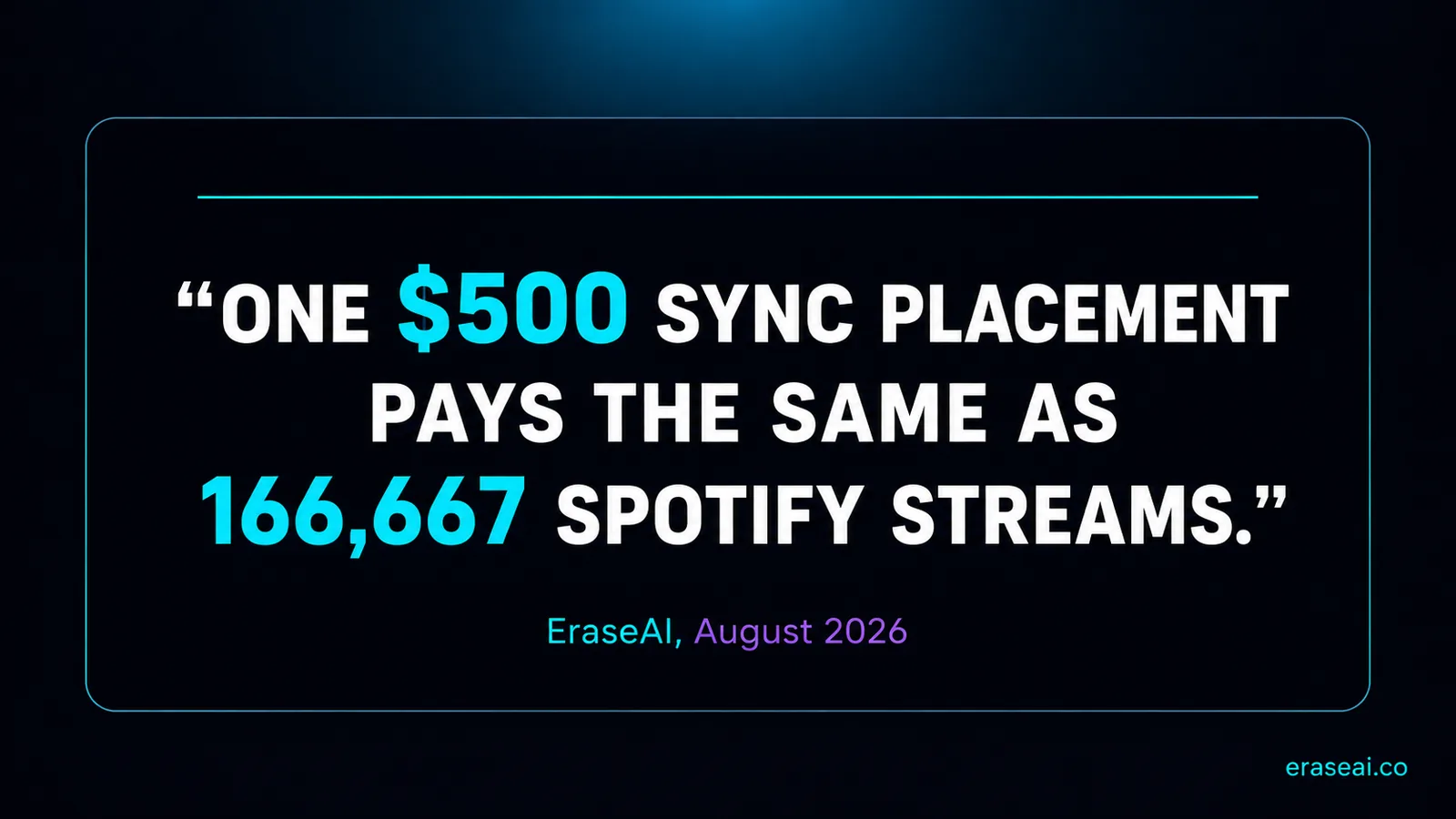
One sync placement at $500 pays exactly what 166,667 Spotify streams pay. That is the whole argument of this article, and everything below is the arithmetic behind it. If you want to know how to make money with AI music in 2026, the question is not which platform accepts your track. It is which route pays for the hours you put in. We costed five of them.
By Eddie Mathews · 5 August 2026
Key takeaways
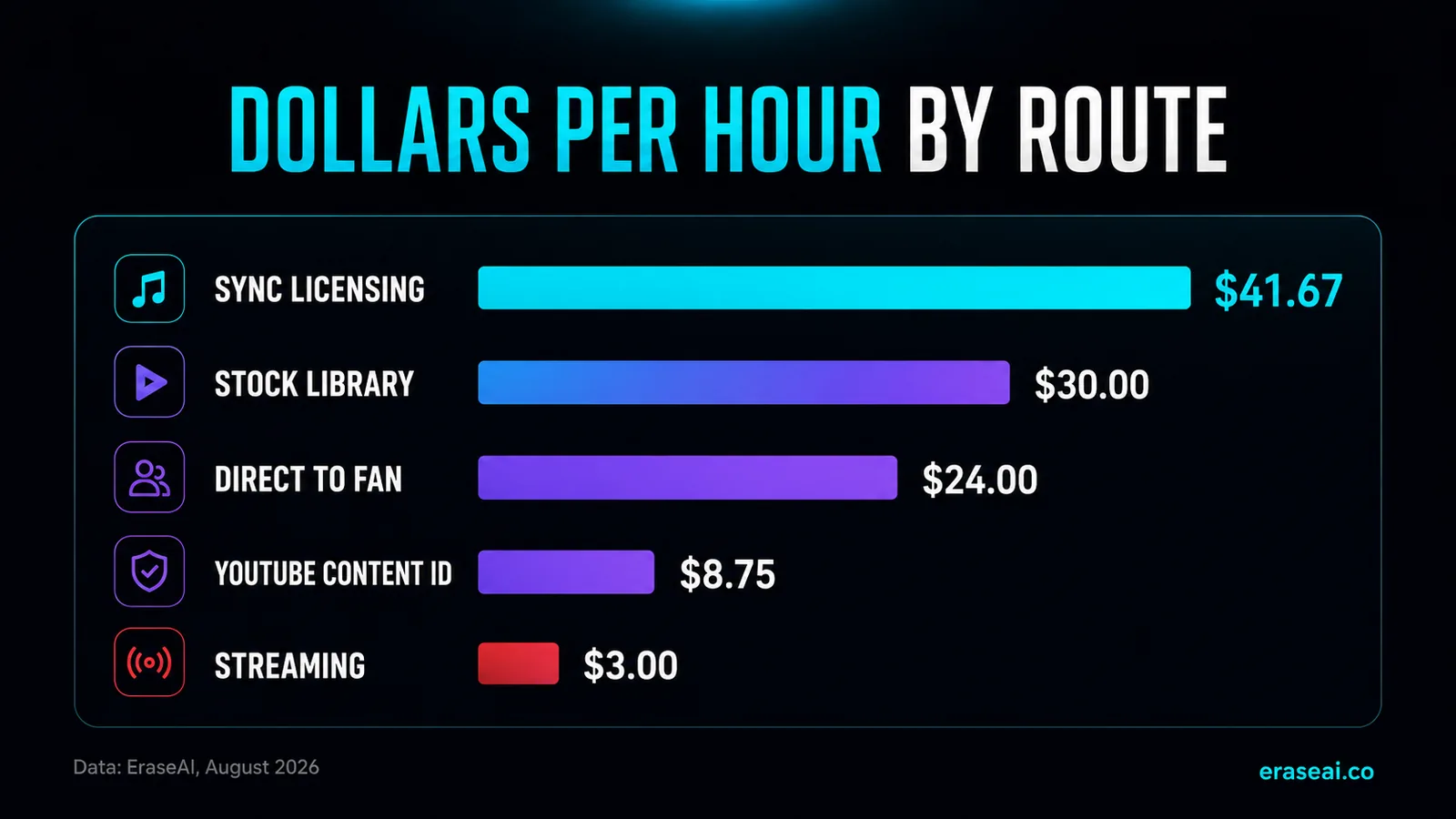
- Sync pays 14 times what streaming pays per hour of work in our model: $41.67 against $3.00.
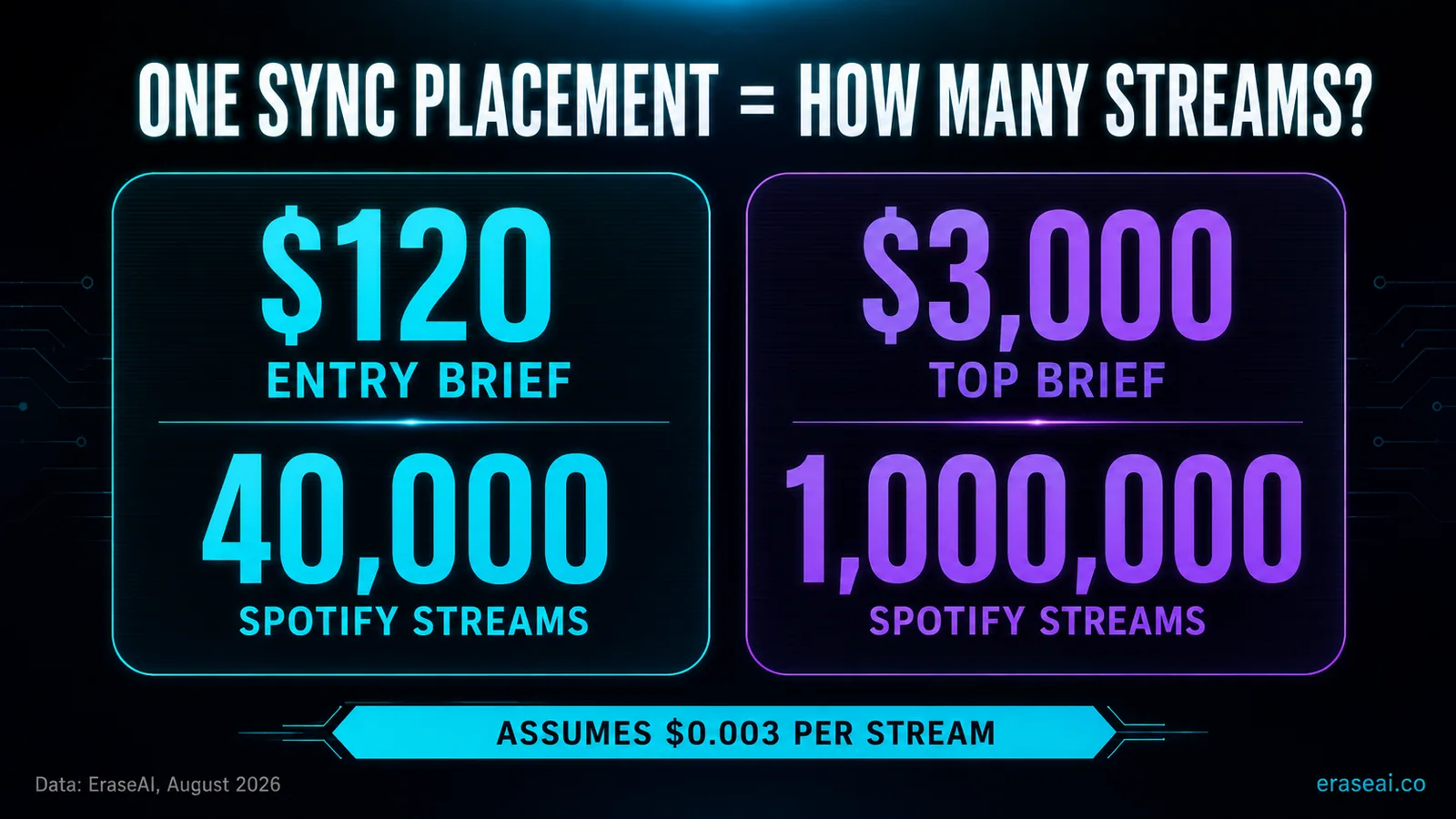
- One $120 brief equals 40,000 streams. A $3,000 brief equals 1,000,000 streams, at $0.003 per stream.
- Spotify removed over 75 million spammy tracks in the 12 months to September 2025, by its own published figure. Volume alone is not a strategy.
- A 0% commission storefront returns $3.00 per sale where 1,000 streams returns $3.00. One buyer is worth a thousand plays.
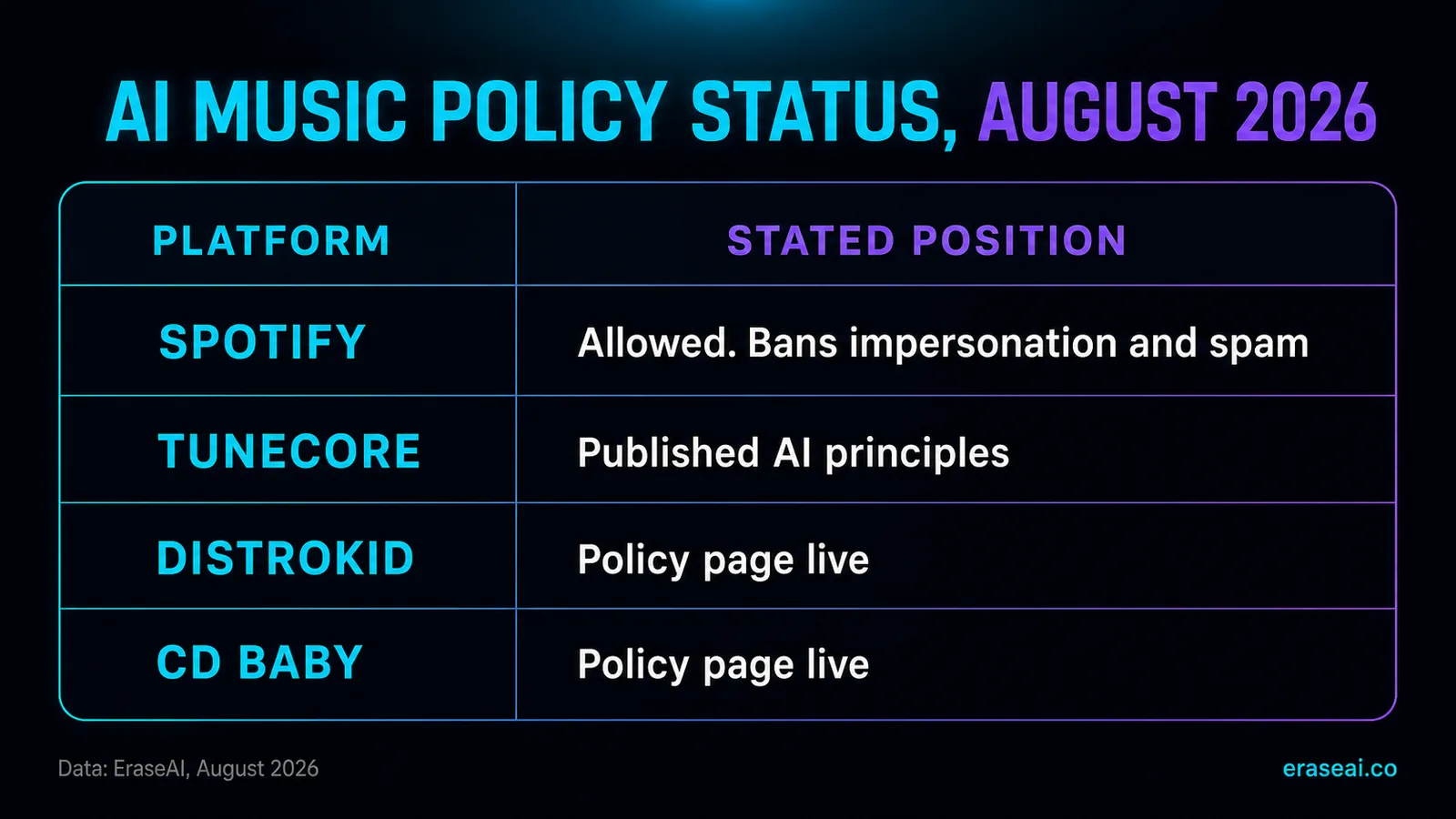
- Of the four largest DIY distributors we checked in August 2026, only TuneCore publishes its AI position at a public URL we could read without a bot challenge.
Your track is fine. The file is the problem.
Most AI music never earns because it never stays up.
The pattern repeats across every forum thread on making money with AI music. Someone generates a batch, uploads it, and either gets rejected at the distributor or watches the release go live and quietly disappear a fortnight later. No email, no explanation, no royalties.
Platforms have been explicit about what they are actually policing. In its September 2025 statement on AI protections, Spotify said it removed over 75 million spammy tracks in the previous 12 months, and set out three areas of policy work: stronger impersonation rules, a new spam filtering system, and AI disclosure carried in industry-standard credits through the DDEX metadata standard. Read that carefully and the target is deception and volume, not generators.
That distinction matters commercially. The rules are not the barrier for an honest creator. The barrier is that a raw generator export carries embedded identifiers and off-specification loudness that automated screening reads as low-effort, so legitimate releases get caught in machinery built for spammers. Our guide to what upload screening actually reads covers the mechanics.
Free to use with attribution. Please credit and link back to this article.
Here is a dated claim you can check yourself. On 5 August 2026 we tried to read the AI policy page of each of the four largest DIY distributors. Only TuneCore's AI principles page returned readable content. DistroKid and CD Baby both sit behind a bot challenge that blocks automated access, so we have listed their pages as live without characterising what they say. If you are choosing a distributor on its AI stance, read the page yourself rather than trusting any summary, including ours.
What one sync placement is actually worth
Free to use with attribution. Please credit and link back to this article.
Spotify pays roughly $0.003 per stream. It is a revenue share rather than a fixed rate, so the number moves with country, listener plan and your distributor's terms, but $0.003 is a fair planning assumption. Open sync briefs commonly pay between $120 and $3,000 per placement.
Divide one by the other and the comparison stops being an opinion. A $120 placement is worth 40,000 streams. A $3,000 placement is worth 1,000,000. A $500 placement, the midpoint, is worth 166,667. For most independent artists, 166,667 streams is not a quarter. It is a career milestone.
This is why the brief boards matter more than the upload button. Played.fm runs open sync briefs you can submit against directly, with no agent and no gatekeeper deciding whether your track reaches the supervisor. That structure is what makes the sync route available to someone with no industry contacts.
Five routes, ranked by dollars per hour
Same track. Same artist. Five very different hourly rates.
Free to use with attribution. Please credit and link back to this article.
Assumptions. One finished, release-ready track. An artist with no existing audience. A 12-month window. Hours counted are total human hours for that track on that route, including preparation and admin. Revenue figures are modelled, not measured. Substitute your own numbers and the ranking order holds, because the gap between the top and bottom route is a factor of 14, not a rounding error.
| # | Route | Hours | 12-mo revenue | Per hour |
|---|---|---|---|---|
| 01 | Sync licensing | 12 | $500 | $41.67 |
| 02 | Stock and production libraries | 6 | $180 | $30.00 |
| 03 | Direct to fan | 5 | $120 | $24.00 |
| 04 | YouTube Content ID | 4 | $35 | $8.75 |
| 05 | Streaming distribution | 3 | $9 | $3.00 |
01. Sync licensing $41.67/hr
4 hours preparing a sync-ready master and stems, then 8 brief submissions at 1 hour each. Assumes one placement at $500, the midpoint of the $120 to $3,000 brief range, at a 1-in-8 hit rate.
02. Stock and production libraries $30.00/hr
6 hours tagging, writing metadata and uploading to three libraries. Assumes 15 licences at $12 across the year.
03. Direct to fan $24.00/hr
2 hours setting up a storefront, 1 hour on artwork and copy, 2 hours of promotion. Assumes 40 sales at $3 with zero commission taken.
04. YouTube Content ID $8.75/hr
4 hours on upload, artwork, description and rights registration. Assumes modest ad and claim revenue on a track with no audience behind it.
05. Streaming distribution $3.00/hr
3 hours on metadata, artwork and the distributor upload. Assumes 3,000 streams in year one at $0.003 per stream.
Where each one actually fits
Including where the highest-paying route is the wrong answer.
Sync licensing wins on rate and loses on certainty. The $41.67 per hour assumes you land one placement in eight submissions. Land nothing and your rate is zero, which is a real outcome and worth saying plainly. Sync rewards catalogue depth and consistency, not a single upload. It is the best route for someone willing to submit steadily for months.
Stock and production libraries are the steadiest. Lower ceiling, far higher floor. Nobody has to choose your track over another artist's in a meeting. The trade is exclusivity terms on some libraries and a genuinely competitive catalogue.
Direct to fan is the only route where you keep everything. A storefront that takes no commission turns one $3 sale into the same revenue as a thousand streams. The catch is honest and important: it needs an audience, however small, and a cold-start artist has none. If you are still building one, this route pays nothing at first and then compounds faster than any other. You can list your tracks and keep 100% of every sale without a label taking a cut, and you keep the customer relationship rather than renting it from a platform.
YouTube Content ID is admin that pays a little forever. Low rate, but the work is done once and the claims keep arriving as other creators use your track. For the YouTube-specific arithmetic — 666,667 ad views to match one mid-range sync placement — see Vidyo's breakdown of why ad RPM is the worst-paying route for a music video.
Streaming is discovery, not income. At $3.00 per hour it is the worst-paying route in the table, and it is still worth doing, because it is where people find you and where playlists live. Just do not build a business plan on it. Our breakdown of what Spotify permits covers the policy side.
Where is Played.fm the wrong answer? If you have no audience and no catalogue, a storefront on its own will sit empty. Set up the store, then spend your hours on briefs and libraries until people have a reason to buy. A comparison that only says positive things is not a comparison.
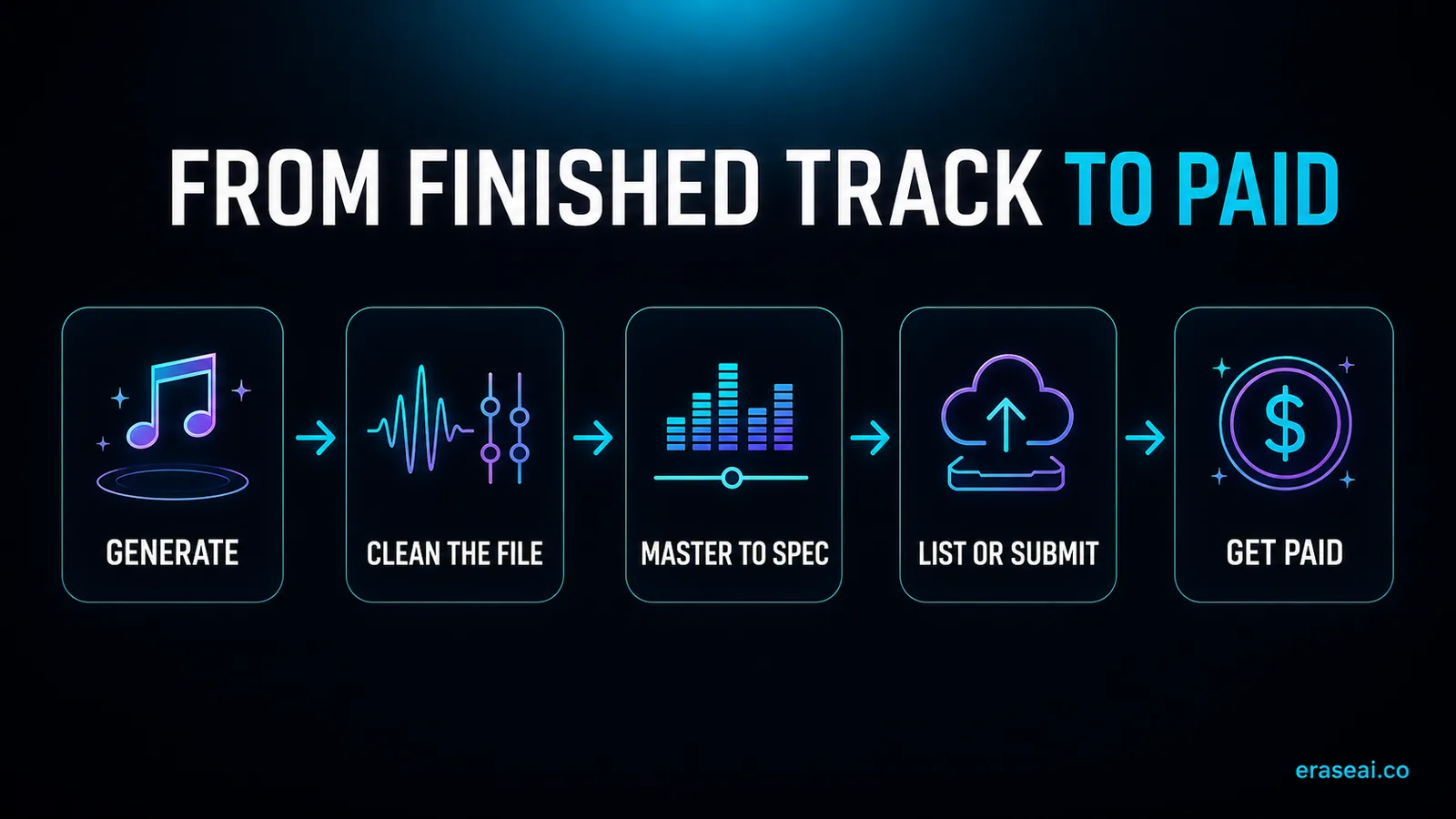
The routes stack, and that is the actual strategy. One finished track can sit in a sync brief board, a stock library, a storefront and a streaming catalogue at the same time. The preparation work, cleaning, mastering, metadata and stems, is done once and serves all four. That is why the hours column matters more than it first appears: the twelve hours attributed to sync licensing already produce the assets the other routes need, so the marginal cost of adding a route is far lower than starting one. Prepare once, publish everywhere, and let the highest-paying channel find you.
One caveat on the streaming figure worth knowing before you plan around it. Spotify requires a track to pass a minimum stream count within a rolling 12-month window before it generates recorded royalties at all. A catalogue that spreads thin traffic across many tracks can therefore earn less than the raw per-stream arithmetic suggests, because individual tracks never reach the threshold. Concentrated attention on fewer tracks beats scattered uploads, which is the opposite of what volume-farming advice recommends.
Free to use with attribution. Please credit and link back to this article.
What a paid submission actually needs
The rejections are almost never about the music.
Free to use with attribution. Please credit and link back to this article.
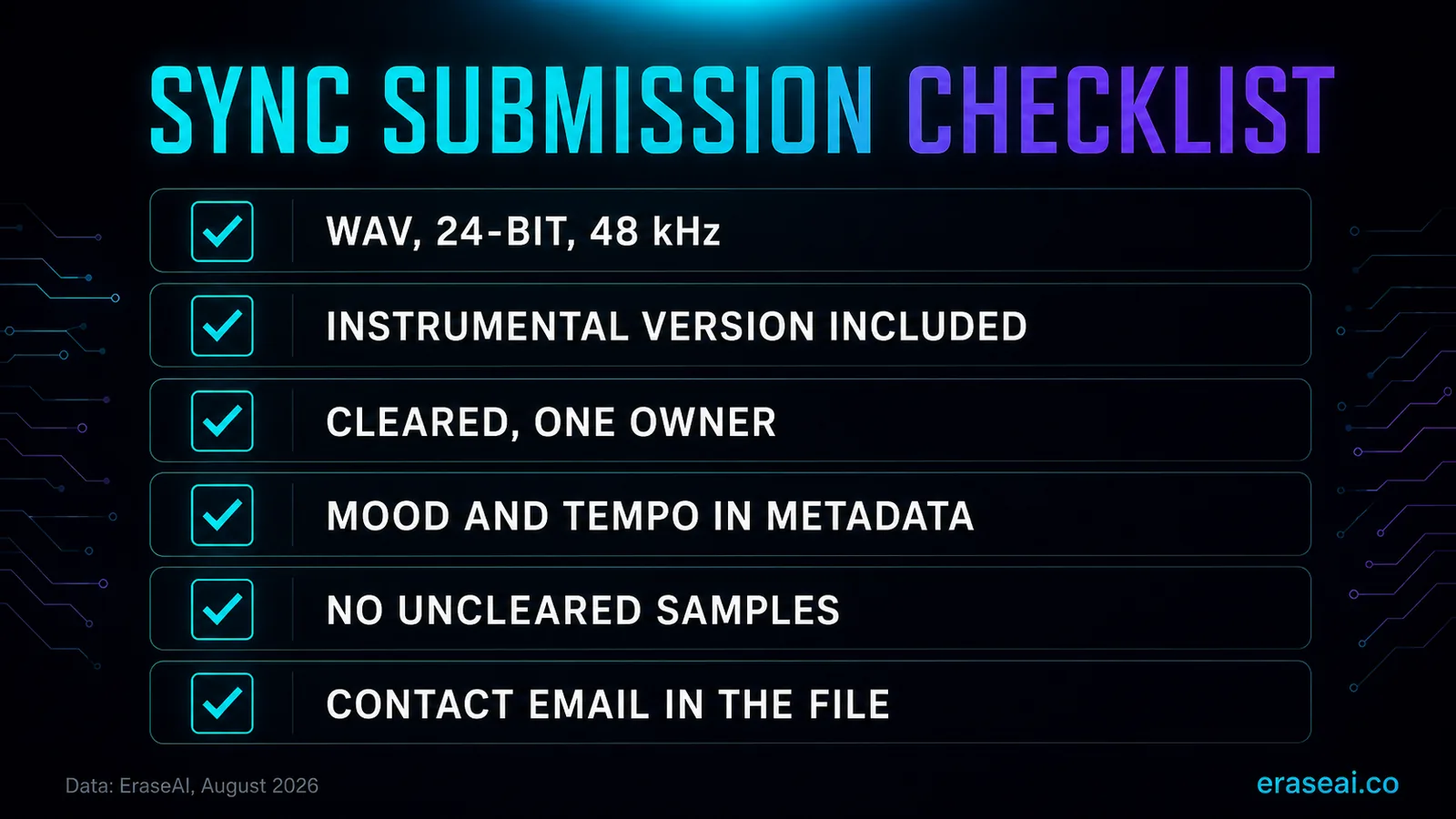
Music supervisors reject on logistics. A track that cannot be edited to picture, cleared quickly, or dropped under dialogue is unusable no matter how good it sounds. Deliver a 24-bit WAV at 48 kHz, include an instrumental version, and have stems ready. Put mood, tempo and genre in the metadata, and make ownership unambiguous: one owner, no uncleared samples, contact details in the file itself.
Read each brief and answer what it asked for. Supervisors post specifics, and the fastest way to be ignored is to send your favourite track rather than the one described. Sending three tailored submissions beats sending thirty generic ones.
If your file gets rejected on upload, the problem is usually the export rather than the music. Raw generator files carry embedded identifiers and land outside platform loudness targets, both of which automated screening reads as low-effort. Cleaning the export and mastering it to specification before submission fixes the common causes, and Undetectr handles both in one pass for a one-time fee. Our cleanup guide explains the order of operations if you would rather do it yourself.
For pricing a direct release, the arithmetic is simple. At $0.003 per stream, a $3 sale equals 1,000 streams and a $10 album equals 3,333. Price for the fan who already likes you, not for a marketplace algorithm. And keep the rights position straight: our guide to what you own explains why commercial rights and copyright are not the same thing, and our selling guide covers the permission gate before any of this pays.
Free to use with attribution. Please credit and link back to this article.
Sources and method
Every figure in this article is either a published platform number, a stated assumption, or arithmetic performed on the two. The $0.003 per-stream rate and the $120 to $3,000 brief range are planning assumptions, stated so you can substitute your own. The hours and revenue columns are modelled scenarios, not measured results from a specific artist, and they are labelled as such above.
- Spotify, Spotify Strengthens AI Protections, 25 September 2025. Source of the 75 million spam removals figure and the three policy areas. Verified live 5 August 2026.
- Spotify, Platform Rules. Verified live 5 August 2026.
- TuneCore, Artificial Intelligence in Music. Verified live 5 August 2026.
- Brief values and the 0% commission model reflect the terms published by the Played.fm storefront and brief board, checked 5 August 2026.
AI music income FAQ
Can you sell AI-generated music?
Yes, if your generator plan grants commercial rights to the output. Suno and Udio both grant commercial use on paid tiers. Free tiers usually limit you to personal use, which is the most common reason people end up selling music they were never licensed to sell. Check the terms for the exact plan you generated on.
Can I sell AI generated music on Spotify?
Yes, through a distributor, provided you hold commercial rights and the file passes automated screening. Spotify does not ban AI-assisted music as a category. The obstacles are the distributor's upload checks and Spotify's minimum stream threshold before a track earns royalties, not permission.
Can you make money with AI music on Spotify?
Some, slowly. At roughly $0.003 per stream, 3,000 streams returns about $9. Spotify also requires a track to pass a minimum stream count in a rolling 12-month window before it generates recorded royalties at all. Streaming is a discovery channel for most independent catalogues, not an income channel.
Does Spotify allow AI music?
Yes. In its September 2025 announcement, Spotify said it would keep creative decisions with artists while enforcing against impersonation, spam and deception. It also disclosed removing over 75 million spammy tracks in the preceding 12 months. Using a generator is not the violation; deceiving listeners is.
Does DistroKid allow AI music?
DistroKid publishes a help article on uploading music made with AI tools, and AI-assisted catalogues are distributed through it routinely. The conditions are the same as any release: you hold the rights, you do not impersonate another artist, and you do not upload spam. Read their current page before a release, because distributor terms change.
Can you monetize AI music on YouTube?
Yes, under the same Partner Programme rules that apply to any upload. You need the commercial rights, you must not impersonate anyone, and mass-produced repetitive content risks being treated as inauthentic. Content ID registration is what lets you collect on other people's uses of your track.
How much do sync deals pay?
Open brief boards commonly run from around $120 for a small placement to roughly $3,000 for a larger one. At $0.003 per stream, that range is worth between 40,000 and 1,000,000 Spotify streams. It is the only route in this article where one decision by one music supervisor changes your year.
How much does Spotify pay per stream?
Roughly $0.003, though the figure varies by country, listener plan and the terms your distributor passes through. Spotify pays a share of revenue rather than a fixed rate, so no artist has a guaranteed per-stream number. Use $0.003 as a planning assumption, not a promise.
How do you get sync placements without an agent?
Submit directly to open brief boards. A supervisor posts what they need, you send a track that fits, and there is no gatekeeper in between. What gets you rejected is almost never the music: it is missing stems, uncleared samples, unclear ownership, or a master that is not broadcast-ready.
Who owns AI-generated music?
You typically hold contractual permission to exploit the output under your generator's terms, which is different from holding a copyright in it. Purely machine-generated audio generally fails the human-authorship requirement, so there may be no copyright to enforce even while you are entitled to sell the track.
The ranking is the whole point. If you have ten hours this month and you spend them uploading to streaming services, the model says you earn about $30. Spend the same ten hours preparing a sync-ready package and submitting it to briefs and the expected return is roughly $417. The music does not change. The route does.
Start with the route that pays. Prepare one track properly, submit it against Played.fm briefs where placements run from $120 to $3,000, and put the same track on a storefront that takes nothing from the sale.
Stop trading hours for fractions of a cent
One placement is worth 40,000 streams at the entry level. Put your catalogue where a single decision can pay for the year.
Sell your music and keep 100% →