AI Music Release 2026: The Seven Walls After the Song
The hardest part of an AI music release is not making the song, and the answers to “what is your biggest challenge after the track is done?” never agree on which obstacle came first. The costs are specific and mostly unadvertised: Spotify pays a track nothing until it clears 1,000 streams in twelve months, SubmitHub now blocks roughly 11% of the tracks uploaded to it, and since 3 September your own back catalogue is capped at 20 exports a month on a Pro plan. So we read the policy pages behind each of those numbers and laid the obstacles out in the order you hit them, with what clears each one.
The short version
Five things the release guides leave out, each from a policy page you can read yourself.
Distribution is not the wall. Six distributors accept AI-generated music openly. The obstacles sit on either side of it — the file, the export, the declarations, the promo gate, the payout floor and the audience.
Spotify pays a track nothing until it clears 1,000 streams in the previous 12 months plus an undisclosed minimum of unique listeners. Its own figure below that line is $0.03 a month on average, and 0.5% of all streams and royalties.
Deezer removes AI tracks unstreamed for at least six months, on a platform taking roughly 90,000 fully AI-generated tracks a day — over half of new uploads at the June 2026 peak, for 1-3% of actual streams.
SubmitHub blocks any submission its detector scores 85%+ likely AI: about 11% of last month's uploads, approved at 16% against 31% for everything else, no appeal, and writing your own lyrics does not exempt you.
Since 3 September 2026 you cannot freely export your own catalogue: 7 downloads for the lifetime of a free account, 20 a month on Pro, 60 on Premier, applied retroactively to songs made before that date.
The file is not finished when the song is
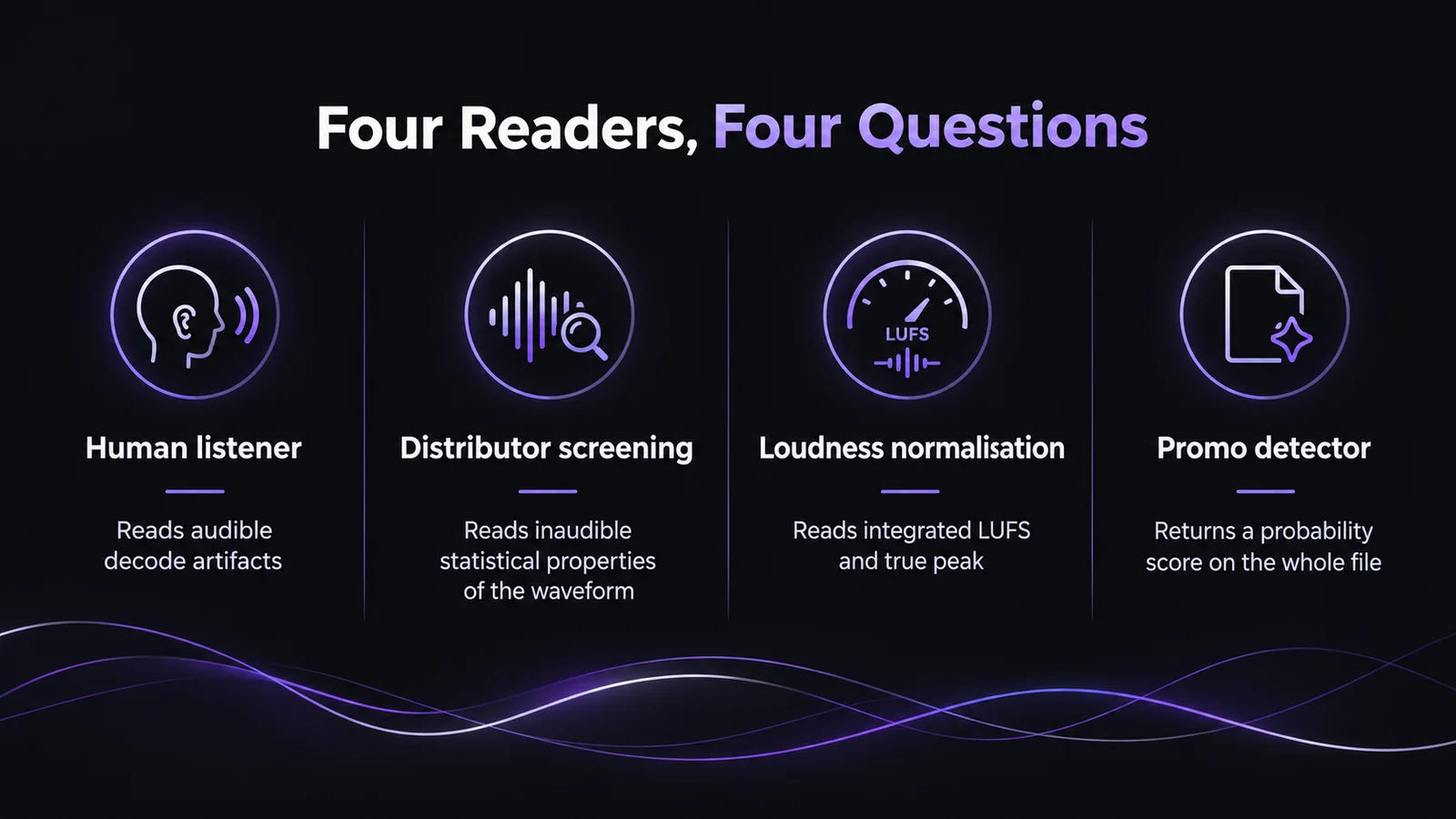
Four different systems will read your track, and they are not reading for the same thing.
The moment a generation sounds right in the browser, it feels finished. It is not, because “finished” means four incompatible things depending on who is listening — and the fix for one does nothing for another. Cleaning audible fizz off a vocal will not move a spectral classifier. Mastering to -14 LUFS will not stop a track being flagged. Conflating them is how creators end up re-rendering the same song five times at the wrong gate.
| Who is reading | What it reads | What changes the outcome |
|---|---|---|
| A listener | Audible decode artifacts — glassy highs, smeared consonants, washed reverb tails | Processing the bounce, or re-generating the section |
| Distributor screening | Statistical properties of the waveform, inaudible to anyone | Processing aimed at the screen, and nothing you declare |
| Loudness normalisation | Integrated LUFS and true peak on delivery | Mastering to the platform target |
| A promo detector | A probability score on the whole file | Nothing reliable — SubmitHub says so outright |
For the first two rows there is a real processing step, and this is the one place on this page where we recommend a product: Undetectr is built for distributor screening and audible generation artifacts, and for nothing past that. It will not stop a platform labelling your release as AI, and anything sold on that promise is selling something it cannot deliver. What the screening reads, and what it does not, is in our breakdown of AI audio cleanup.
Getting the file out of the generator
The quietest wall, and the one that turned a free archive into a metered one overnight.
Until this month, exporting your own work was not something anyone had to think about. On 3 September 2026 Suno's download policy changed, and its help centre is explicit that the caps “apply to all music on Suno starting September 3, including songs created before that date”. A library built over two years is now a multi-month export project, or a purchase.
| Plan | Downloads | Rights on the file |
|---|---|---|
| Free | 7 total, for the lifetime of the account | Personal, non-commercial only — not a releasable file |
| Pro | 20 per month | Commercial use rights |
| Premier | 60 per month | Commercial use rights |
| Premier + Suno Studio | Studio work continues without hitting the limit | Commercial use rights |
Two details in that policy are worth more than the headline numbers. The first is that stems do not cost extra — Suno states that “all stems from a song are part of that song's single download” and that taking the song plus its stems “counts once, not per file”. So ration trips, not files: pull the stems in the same visit as the master.
The second is that a free account cannot produce a sellable file at all, because those seven downloads carry personal, non-commercial terms. Anyone planning a first release from a free tier is planning to upload something they do not have the rights to sell. Our download limits checklist is the practical version of this, and the broader argument for keeping local masters is in AI music removed from streaming. A generator library is not a backup.
The gate is open, but it is metered
The received wisdom that distributors ban AI music is simply false. What some of them do is quota it.
This is the wall everybody expects and the one that turns out to be mostly open. Six distributors accept AI-generated music openly: DistroKid, RouteNote, UnitedMasters, LANDR, Amuse and Symphonic. What creators report is not a categorical ban but individual releases getting bounced by automated screening — a judgement about a delivered file, not about the software that made it.
| Distributor | Accepts AI music | Published release cap on AI work |
|---|---|---|
| DistroKid | Yes, with an AI question at upload | None published |
| LANDR | Yes | 12 AI-generated songs per calendar month |
| Amuse | Yes | 10 releases per rolling 7 days containing AI recordings |
| RouteNote | Yes | None published |
| UnitedMasters | Yes | None published |
| Symphonic | Yes | None published |
| Bandcamp | No — not a distributor, but the usual alternative suggestion | Wholly or substantially AI music not permitted since 13 Jan 2026 |
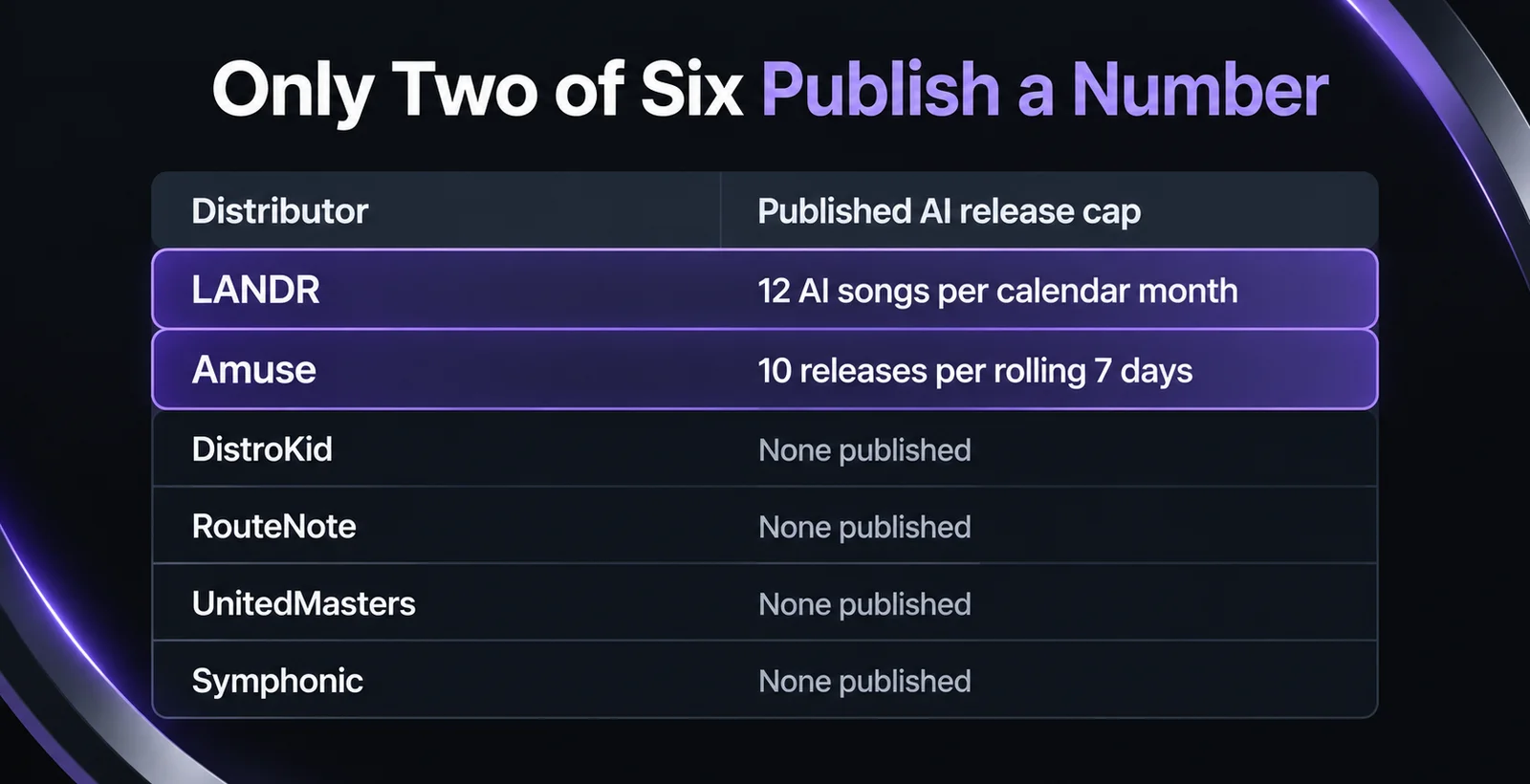
Note what the blank cells mean. “None published” is not a guarantee of unlimited releases — it means the distributor has not told you where the line is, so you find it by crossing it. The two that do publish a figure are the honest ones. LANDR's support pages set the cap at twelve AI-generated songs a calendar month; Amuse's distribution terms set it at ten releases in any rolling seven-day period where a release contains AI recordings.
The detail that trips people up most often is DistroKid's, because it asks about AI at upload as part of the normal flow and the follow-up question is about your artist identity, not your tools. The whole gate is written up in DistroKid and AI music.
Three declarations, and only one is yours
They look like one decision. They are three, they are read by different people, and they do different things.
Somewhere between the export and the release date you will be asked how the track was made, in at least two places and probably three. The fear attached to this is misplaced, and it is misplaced because the three surfaces get treated as one.
| Declaration | Who fills it in | Who reads it | What it costs you |
|---|---|---|---|
| Distributor AI credits | You, at upload | Stores, then a credits panel | Nothing in recommendations — Spotify says so in writing |
| Apple transparency tags | Your distributor, on delivery | Apple, then listeners | No penalty attached |
| Spotify AI Persona badge | Spotify, about your identity | Every listener on the profile | Editorial and algorithmic recommendations, off by default |
Read the last column and the anxiety mostly evaporates. Spotify's September 2025 announcement of the credits standard says plainly that it is “not about punishing artists who use AI responsibly or down-ranking tracks for disclosing information about how they were made”. The row that carries a real cost is the third, and it labels an identity — profiles presenting a photorealistic person who does not exist — not a production method.
The mechanics of the badge, its thresholds and its appeal route are in our guide to the Spotify AI Persona badge. The fourth declaration, the one nobody asks you for, is the sentence you write in your own caption — and it is the only one a human reads before deciding whether to press play. We looked at the creators who lead with it in AI music disclosure that works.
The promo gate closed in September
The wall that arrived most recently, and the only one with a published hit rate.
Once a release is live the standard next move is pitching it — to curators, to blogs, to playlists. In September 2026 SubmitHub, one of the larger paid pitching platforms, turned its AI detector from a label into a gate. Any submission scoring 85% or higher is blocked. Its policy page publishes the numbers, which is more than any distributor does.
| Figure | What SubmitHub states |
|---|---|
| Block threshold | 85% likely to be AI |
| Share of last month's uploads over the bar | Roughly 11%, constituting 9% of submissions |
| Approval rate for those tracks | 16%, against a non-AI average of 31% |
| Claimed detector accuracy | “99.4% accurate, according to a 3rd party” — the third party is not named |
| Appeal or exemption | No workaround; writing your own lyrics or composition does not exempt a track |
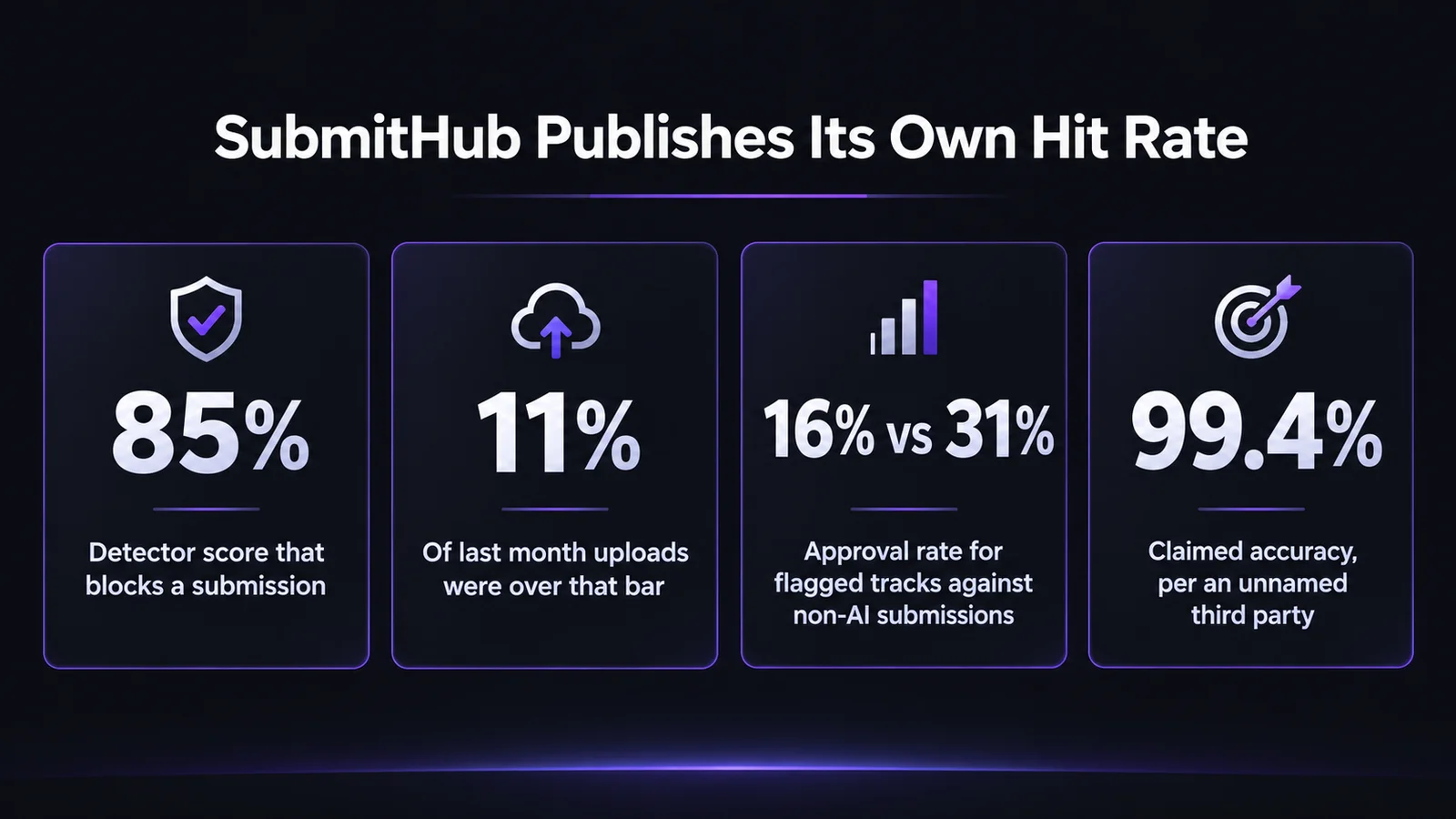
The 16%-against-31% line is the most useful number here and it is easy to miss. Even before the block, tracks the detector flagged were being approved at half the rate of everything else. The gate did not invent a penalty; it made an existing one explicit. What these classifiers actually measure is in our AI music detectors explainer, and the short version is that every accuracy number in this category is published by the company selling the detector.
The money does not start at stream one
Every platform has a floor. Most creators find out about it after the first royalty statement.
Here is the arithmetic that reframes the whole project. Spotify does not pay a track proportionally from its first play. Its track-monetisation policy states that tracks “must have reached a threshold of at least 1,000 streams in the previous 12 months to be included in the recorded music royalty pool calculation”, and that a minimum number of unique listeners also applies — a number it declines to publish, “to prevent further manipulation by bad actors”.
Spotify also publishes what sits below that line. Tracks taking between 1 and 1,000 annual streams “generate $0.03 per month on average and only represent 0.5% of total streams and royalties”. Three cents a month is not a rounding error on a payout; it is the payout.
| Platform | Published floor | Consequence of staying below it |
|---|---|---|
| Spotify | 1,000 streams in the previous 12 months, plus an undisclosed unique-listener minimum | Not included in the royalty pool at all; $0.03/month average in that tier |
| Deezer | No payout floor published; a six-month streaming floor instead | AI tracks unstreamed for at least six months are taken down |
| Every store | Your distributor subscription has to stay current | A lapsed subscription removes the catalogue from every service at once |
Deezer's version of the floor is the one that should make you keep local masters. Its July 2026 newsroom post says it will systematically take down AI tracks used for streaming fraud and those that have not been streamed for at least six months, while the same platform already excludes music it detects as AI from algorithmic recommendations and editorial playlists. A track is removed from every surface that could have found it an audience, then removed outright for not having found one.
Nobody is listening, and the numbers say so
The last wall is the tallest, it has nothing to do with AI, and it is where the money question actually lives.
Ask a room of AI music creators what the hard part is and distribution barely comes up. Getting distributed is solved. The wall is that the release lands in a catalogue nobody can search their way out of, and no amount of release preparation touches it.
| Figure | Value | Source and period |
|---|---|---|
| Tracks available on streaming | 253 million | Luminate year-end, 2025 |
| Share taking fewer than 1,000 annual streams | 88% | Luminate year-end, 2025 |
| Tracks taking 10 streams or fewer, all year | 120.5 million | Luminate year-end, 2025 |
| Tracks accounting for half of all listening | 541,000 — about 0.2% of the catalogue | Luminate year-end, 2025 |
| Fully AI-generated tracks delivered per day | About 90,000 | Deezer newsroom, June 2026 peak |
| Share of Deezer's new uploads that are fully AI | More than 50% | Deezer newsroom, June 2026 peak |
| Share of actual Deezer streams those tracks take | 1-3% | Deezer newsroom, July 2026 |
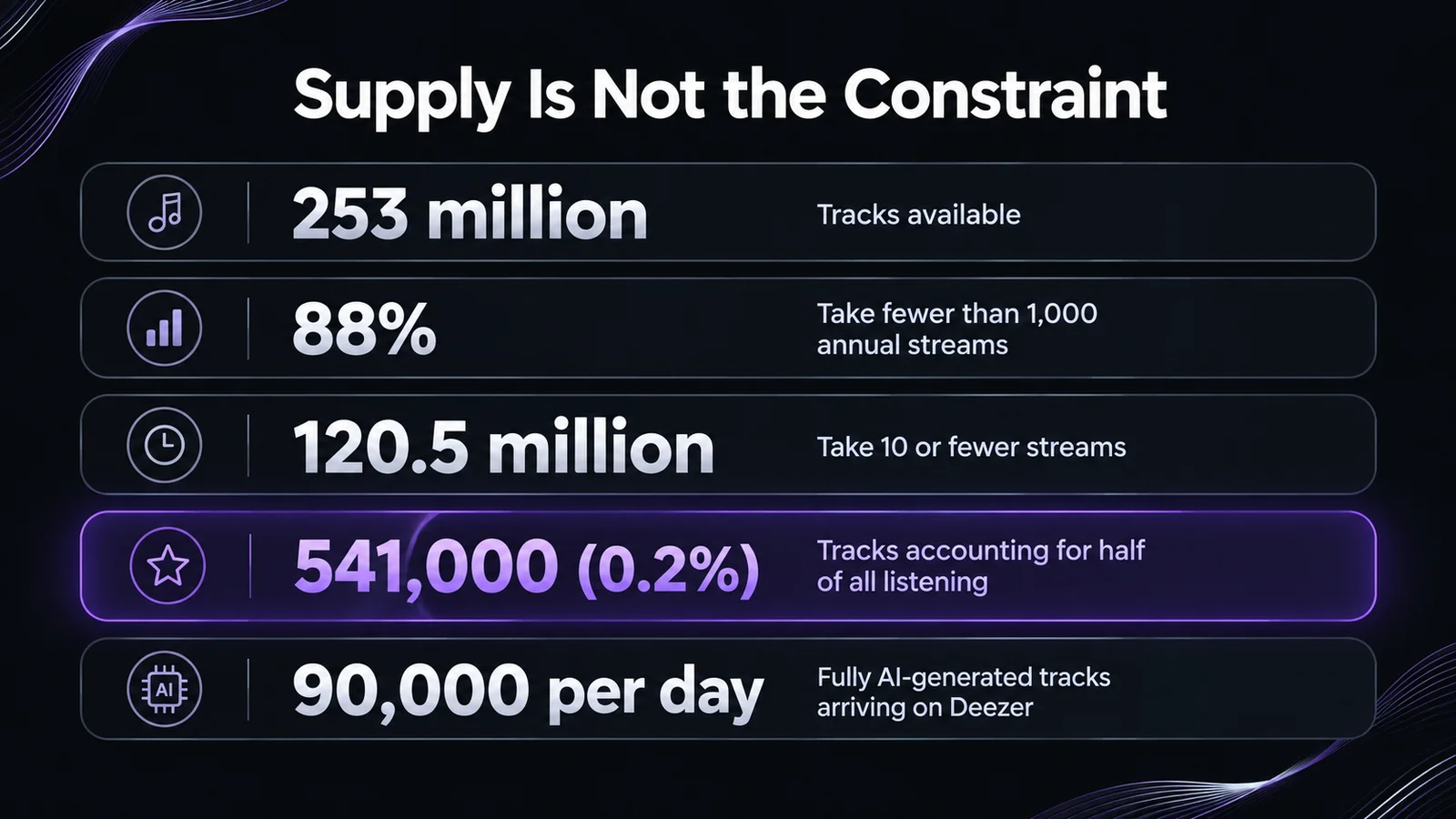
Put the last two blocks together and the shape is clear: more than half of new uploads are fully AI-generated, and they take between one and three per cent of streams. Our sister site ran the full version of this argument in nobody is listening to your AI music, and nothing in it has improved since.
Which is why the route worth building toward is the one that never needed an algorithm to notice you. Paid sync — a track licensed into a video, a game, an advert — is chosen by a person working to a brief, pays properly rather than in fractions of a cent, and is indifferent to whether a streaming profile carries a badge. Storefronts built for independent creators, such as played.fm's sync route, exist to put finished tracks in front of the people buying them, and the same storefront lets you sell direct and keep the whole price. Bandcamp, the reflexive suggestion here, has not permitted wholly or substantially AI-generated music since January 2026.
None of that replaces streaming and we would not pretend otherwise. It is a second route, and the only one on this page where the number of people who have to notice you before you get paid is one.
EraseAI earns a commission from links to Undetectr. It does not change what we say about what the tool can and cannot do — and what it cannot do is stop a platform labelling your release as AI.
Which wall are you actually on
The symptom tells you the wall. The wall tells you the fix, and most of the fixes are not the obvious one.
The list runs to seven rather than three because the symptoms overlap and the fixes do not. A rejected release and a blocked pitch feel identical from where you are standing and have nothing in common.
| What you are seeing | Wall | First move |
|---|---|---|
| The track sounds thin or glassy next to commercial releases | One | Process the bounce, not the stems — a store only ever scans the summed file |
| Release bounced by the distributor's automated check | One | A file problem, not a policy problem. Nothing you declare will change it |
| You cannot pull your own back catalogue down | Two | Ration trips, not files — take stems and master in the same download |
| Releases going through fine, then suddenly refused | Three | Check the AI release cap, not the policy. LANDR and Amuse publish one |
| Unsure what to tick at upload | Four | Answer it factually. The credits fields carry no recommendation penalty |
| Pitches rejected or refused before a curator hears it | Five | An 85% detector score, with no appeal. Pitch somewhere that does not gate on it |
| Streams exist but the statement is near zero | Six | The 1,000-stream floor. Below it a track is outside the royalty pool entirely |
| Everything works and nobody listens | Seven | Stop optimising the release. Build a route that does not need discovery |
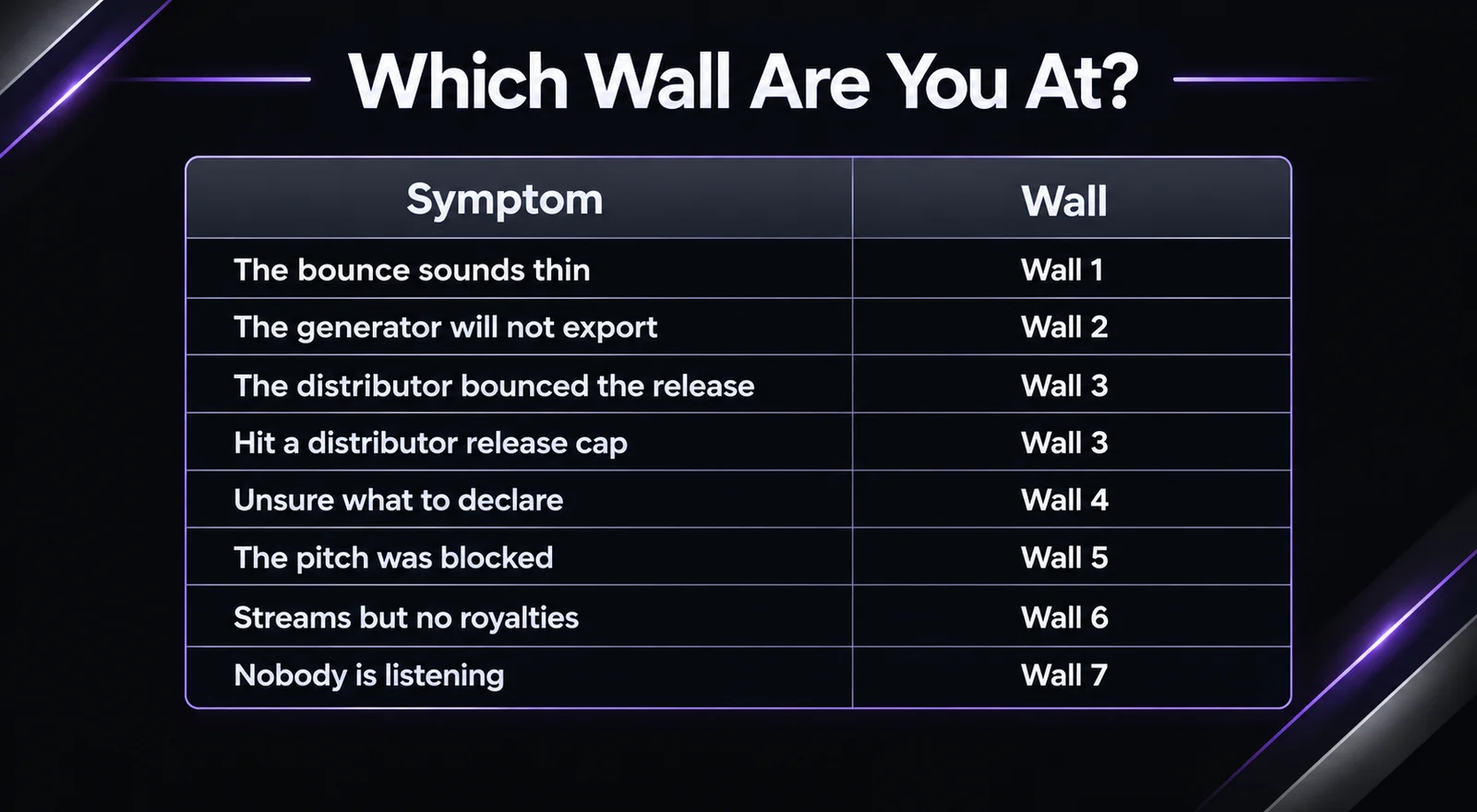
The bottom row is the one that matters. Walls one through six are solvable with an afternoon and a credit card, and creators spend months on them because they are legible. Wall seven decides whether any of it paid, and none of the first six fixes touch it. The costed version of what to do about that is in our guide to selling AI music, and the revenue routes ranked by the hours they cost you are in how to make money with AI music.
After the song is done FAQ
What happens after you finish an AI song?
Seven things have to go right and only one of them is distribution: the file has to survive automated screening, you have to be able to export it from the generator at all, a distributor has to accept it, the declarations have to be filled in, promo platforms have to let it through, the track has to clear a payout floor, and somebody has to listen. Most guides cover the middle step and skip the six around it.
Do distributors reject AI-generated music?
Not as a category. Six distributors accept AI-generated music openly — DistroKid, RouteNote, UnitedMasters, LANDR, Amuse and Symphonic — and two of those publish a cap on how much of it you may release rather than a ban. What creators do report is individual releases being flagged and bounced by automated screening, which is a judgement about the delivered audio, not about the tool you used.
How many Suno downloads do I get per month in 2026?
Since 3 September 2026 the free tier gets 7 trial downloads for the lifetime of the account, personal and non-commercial only; Pro gets 20 a month and Premier 60, both with commercial rights. Premier users working in Suno Studio can keep downloading without hitting the limit. The caps apply to every song in your library, including ones made before that date, and extra downloads can be bought.
How many streams does a track need before Spotify pays anything?
At least 1,000 streams in the previous 12 months, plus a minimum number of unique listeners that Spotify deliberately does not publish. Below that threshold a track is not included in the recorded royalty pool at all. Spotify's own figure for that tier is $0.03 per month on average, and it says those tracks account for 0.5% of total streams and royalties on the service.
Will SubmitHub accept my AI track?
Not if its detector scores the file at 85% or higher. SubmitHub blocks those submissions outright, says there is no path to requesting a workaround, and states that writing the lyrics or composition yourself will not make a track exempt. Roughly 11% of tracks uploaded to it in the last month hit that bar. The measurement is of the audio, so nothing you declare changes the outcome either way.
Can a tool stop a platform labelling my track as AI?
No, and be suspicious of anything that claims otherwise. Apple's transparency tags are declared by the distributor on delivery, and Spotify's AI Persona badge is driven by disclosure and by Spotify's own review of an artist identity. Neither reads your audio file to decide. Processing a file addresses audible artifacts and automated screening, which is a different question with a different answer.
Is sync licensing realistic for AI-generated music?
It is more realistic than waiting for a recommendation engine, because a sync placement is chosen by a person against a brief. It is not automatic money, and plenty of libraries and supervisors will not take AI-generated work. The honest framing is that sync does not depend on discovery, which is the wall most creators are actually stuck behind.
- Spotify for Artists — Track monetization eligibility (the 1,000-streams-in-12-months threshold, the undisclosed unique-listener minimum, and the $0.03 per month / 0.5% figures)
- Suno Help Centre — upcoming changes (7 lifetime free downloads, 20/month Pro, 60/month Premier, Studio, the retroactive scope, and stems counting once)
- SubmitHub — AI policy (the 85% block, ~11% of uploads and 9% of submissions, 16% against 31% approval, the unnamed third party behind “99.4% accurate”, and no workaround)
- Deezer Newsroom — AI music tops 50% of daily uploads (July 2026: ~90,000 fully AI tracks a day, over half of new uploads at the June peak, 1-3% of streams, and takedown of AI tracks unstreamed for six months)
- Music Ally on the Luminate 2025 year-end report (253m tracks, 88% under 1,000 annual streams, 120.5m under 10, and 541,000 tracks taking half of all listening)
- Spotify Newsroom — Spotify strengthens AI protections (the DDEX-based disclosure standard, and the statement that it is not about punishing or down-ranking artists who disclose)
- LANDR Support — is there a limit to how much music I can release (the 12 AI-generated songs per calendar month cap)
- Bandcamp — Keeping Bandcamp human (13 January 2026: music generated wholly or in substantial part by AI is not permitted)
Evidence notes. LANDR's support article refuses automated readers from our environment, so its wording here comes from the indexed page rather than a direct fetch. Amuse's ten-releases-per-rolling-seven-days figure comes from its distribution agreement, which we could not fetch directly and have therefore not linked. The four-readers table describes what each system is looking at, not a measurement we ran. Several of these rules are weeks old; confirm any of them at source before acting on it.
Related guides
Suno download limits checklist
Wall two in practical form: what to export first when your own catalogue is metered.
DistroKid and AI music
The distributor gate, the AI questions at upload, and what actually gets a release bounced.
AI music disclosure that works
The fourth declaration, the one nobody asks you for, and what it does to an audience.
Spotify AI Persona badge
The one label that carries a real cost: who gets it, what it removes, and how to appeal.
AI music detectors
What the classifiers behind every block actually measure, and who published the accuracy figures.
Sell AI music
Wall seven, costed: the income routes that do not need a recommendation engine to pick you.
Or browse every guide on the site.
Six walls are file problems. The seventh is not.
Screening, export caps and loudness are worth solving properly, so a release is not lost to a gate that had nothing to do with the music. Just do not mistake clearing them for having an audience — that is a separate build.
▸ Independent · We recommend Undetectr