EU AI Act and AI Music: Who Must Disclose
Since the EU AI Act's transparency rules switched on, the advice reaching AI music creators has been that they must label every track or face a fine of €15 million. That is a misreading of who the rule binds, and it sends people hunting for an obligation they do not have. The short answer: Article 50 binds the company that built your generator, and the only clause capable of reaching you covers deep fakes. We read Articles 2, 3, 50 and 99 of the Regulation, the European Commission's own FAQ on Article 50, Suno's Content Credentials page and the one platform help article written for creators.
The short version
Five findings, each from the Regulation or the regulator rather than from commentary.
The marking duty is not yours. Article 50(2) makes providers of AI systems generating synthetic audio mark outputs “in a machine-readable format and detectable as artificially generated”. Suno already meets it, with Content Credentials attached on download.
The only clause that can reach a releasing artist covers deep fakes: content that “resembles existing persons, objects, places, entities or events and would falsely appear to a person to be authentic”. An original AI song is not one. A cloned real voice is.
If AI music is a hobby, the Act does not reach you. The Commission's own FAQ: personal-capacity use “is considered a personal activity. Such use is excluded from the scope of the AI Act.”
The €15 million figure is real and misapplied. Article 99(4) sets it for Article 50 breaches by operators, and Article 99(6) gives SMEs the lower of the fixed sum and the percentage.
What makes you disclose is platform policy: Deezer tags without asking, TIDAL stopped paying on 100% AI tracks from 15 July 2026, SoundCloud wants a line in your description, Bandcamp refuses the upload.
- Article 50 binds your generator, not you
- The one clause that can reach a releasing artist
- If it is a hobby, the Act does not reach you
- What is actually in the file Suno hands you
- The dates that matter, including 2 December
- The law is not what makes you disclose
- The two labels the industry agreed in July
- Who pays if this goes wrong
- What to do before your next release
- FAQ
Article 50 binds your generator, not you
The Regulation sorts everyone into providers and deployers first, and the duties follow from that sorting.
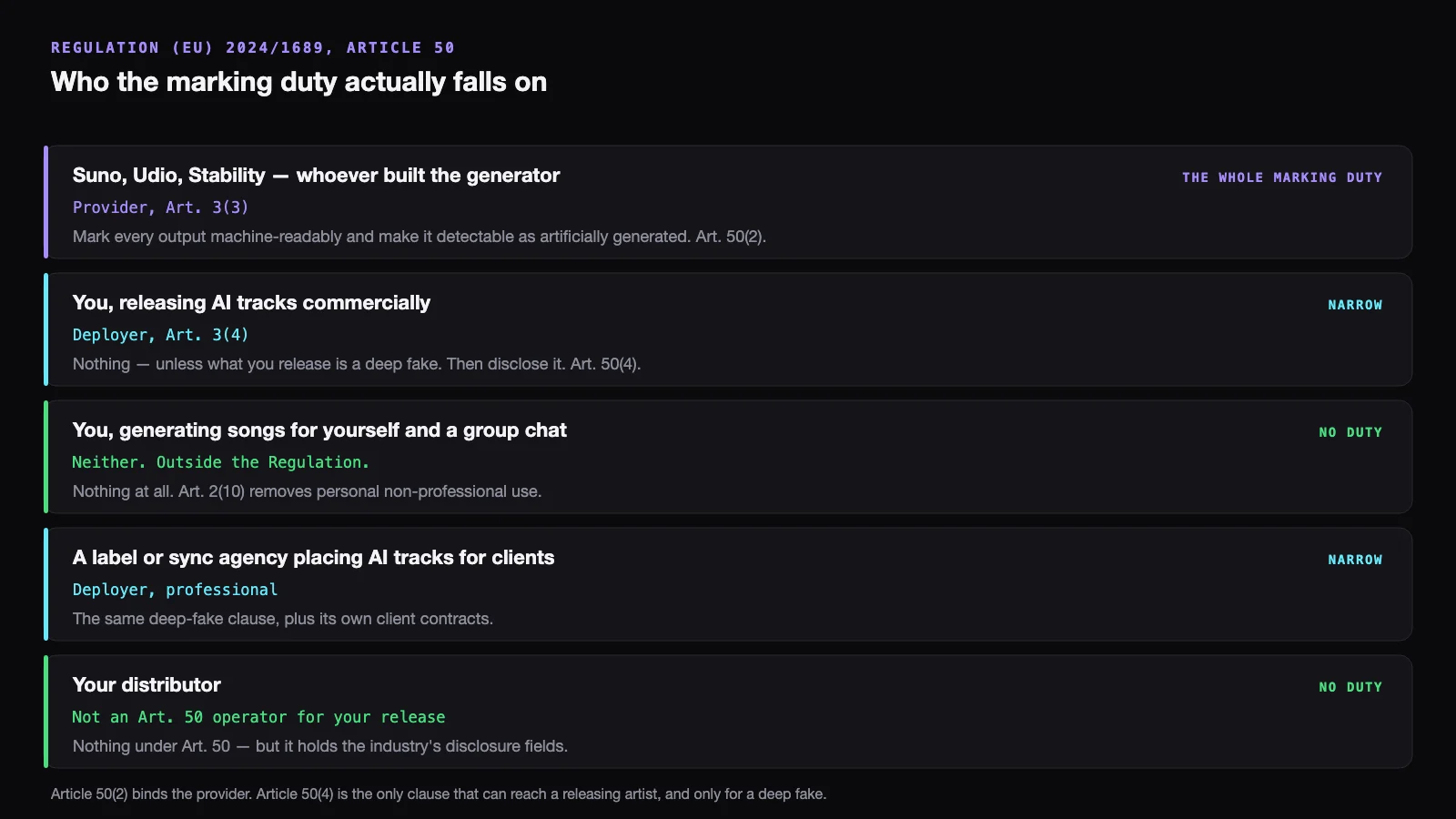
Article 50(2) is the sentence every summary of this topic quotes, and it is worth reading with the subject attached: providers of AI systems generating synthetic audio must ensure outputs are “marked in a machine-readable format and detectable as artificially generated or manipulated”. A provider, under Article 3(3), is whoever develops the system and places it on the market under their own name. That is Suno, not the person who typed the prompt.
The duty that could attach to you is elsewhere, in Article 50(4): deployers of a system that generates audio constituting a deep fake must disclose that the content has been artificially generated or manipulated. Two conditions have to hold first — you have to be a deployer, and it has to be a deep fake — and for most people reading this, neither does.
| Who you are | What the Act calls you | What Article 50 asks of you | Note |
|---|---|---|---|
| Suno, Udio, Stability — whoever built the generator | Provider, Art. 3(3) | Mark every output machine-readably and make it detectable as artificially generated. Art. 50(2). | The whole marking duty, and it is theirs. |
| You, releasing AI tracks commercially | Deployer, Art. 3(4) | Nothing — unless what you release is a deep fake. Then disclose it. Art. 50(4). | Narrow. The next section is how narrow. |
| You, generating songs for yourself and a group chat | Neither. Outside the Regulation. | Nothing at all. | Art. 2(10) removes personal non-professional use. |
| A label or sync agency placing AI tracks for clients | Deployer, professional | The same deep-fake clause, plus its own client contracts. | No general labelling duty here either. |
| Your distributor | Not an Art. 50 operator for your release | Nothing under Art. 50 — but it holds the industry's disclosure fields. | Why the delivery form, not the law, is what you fill in. |
One party owes a continuous technical obligation, and it is the one with engineers. Everybody else owes a conditional disclosure.
The one clause that can reach a releasing artist
Article 50(4) is about deep fakes, and the Act defines the word tightly.
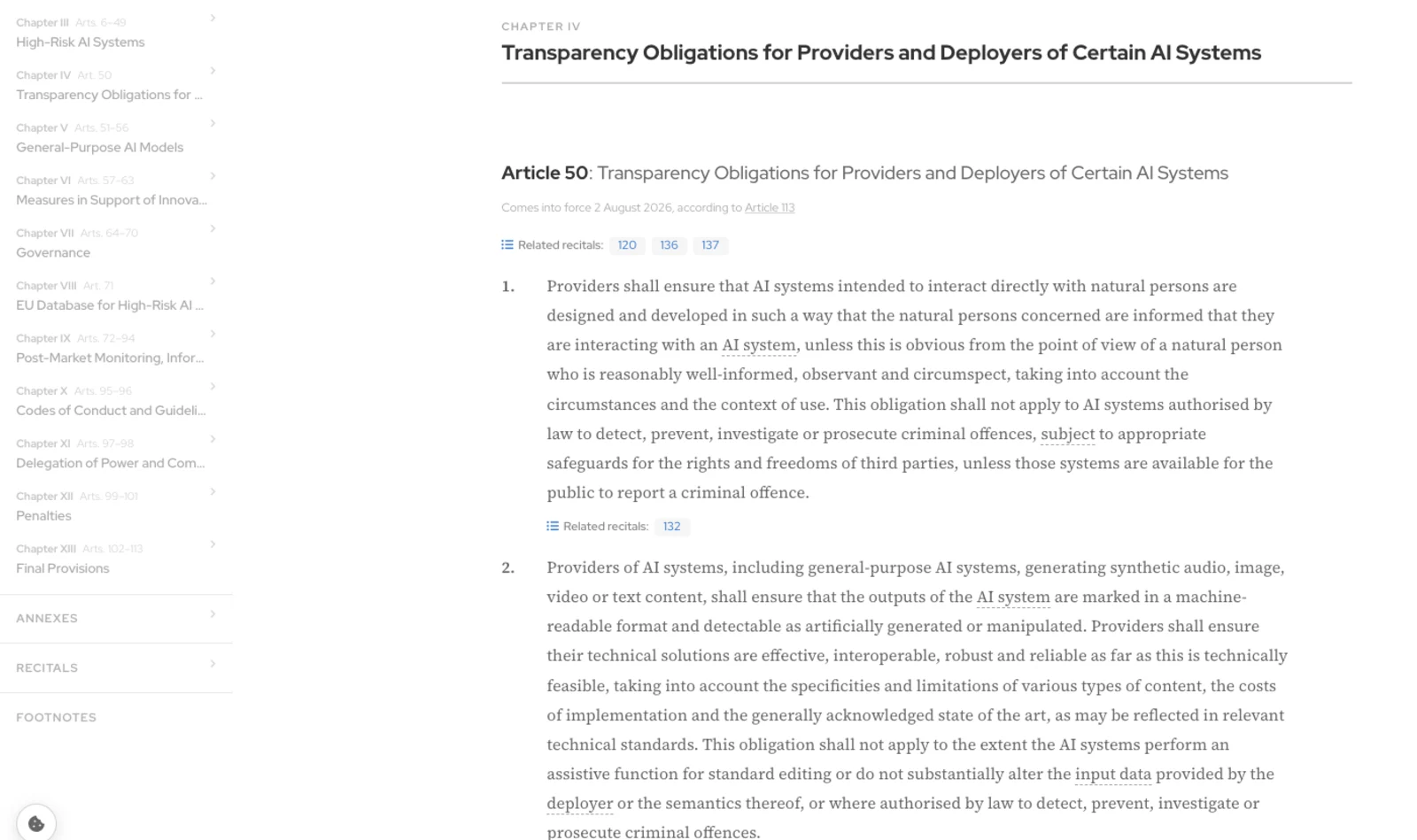
Article 3(60) defines a deep fake as AI-generated or manipulated image, audio or video content “that resembles existing persons, objects, places, entities or events and would falsely appear to a person to be authentic or truthful”. Both halves matter: it has to resemble something that exists, and it has to be capable of being mistaken for the real thing.
A song generated from your own prompt, sung by a voice that belongs to nobody, resembles no existing person. Synthetic is not the test — if it were, the clause would say synthetic content, which is what 50(2) says and 50(4) does not. A recognisable singer's cloned voice is the other case, and the one the clause exists for. Platforms already prohibit it on impersonation grounds: SoundCloud's guidance says AI content “must also not intentionally mislead listeners about its authenticity, origin, or the identity of the creator”.
One softening is worth knowing, because it is the difference between a credit line and a warning banner. Where a deep fake forms part of an evidently artistic, creative, satirical or fictional work, the Commission's FAQ says the obligation is “limited to the disclosure of the deepfake content in an appropriate manner that does not hamper the display or enjoyment of the work”. A line in the credits does the job.
Does anything in this track pretend to be a real person, place or event? If no, Article 50(4) has nothing to say about it. If yes, disclose it in the credits — and know that the platform rule on impersonation, not the Regulation, is what takes a release down. Our page on disclosure that works covers what saying so up front costs and where it pays.
If it is a hobby, the Act does not reach you
The exclusion is in two places in the text and in the regulator's own FAQ, and almost nobody writing about AI music quotes it.
Start with the definition. Article 3(4) says a deployer is a person using an AI system under their authority “except where the AI system is used in the course of a personal non-professional activity”. Article 2(10) then says the Regulation “does not apply to obligations of deployers who are natural persons using AI systems in the course of a purely personal non-professional activity”.
The Commission's FAQ on Article 50, updated 24 July 2026, gives the worked example: “When a natural person uses an AI system in their personal capacity — for example, to generate deepfakes and disseminate them on social media — this is considered a personal activity. Such use is excluded from the scope of the AI Act.” If a personal deep fake posted publicly is out of scope, a bedroom-made original song certainly is.
Where the line sits is the open question. Monetising a release is professional activity on any reading; a free upload with no revenue attached is not, and in between sits a grey zone no guidance resolves. Crossing it makes you a deployer with a conditional deep-fake duty — still not a general labelling obligation.
What is actually in the file Suno hands you
The provider's duty is not abstract. It shows up as metadata in your download, and you can check it.
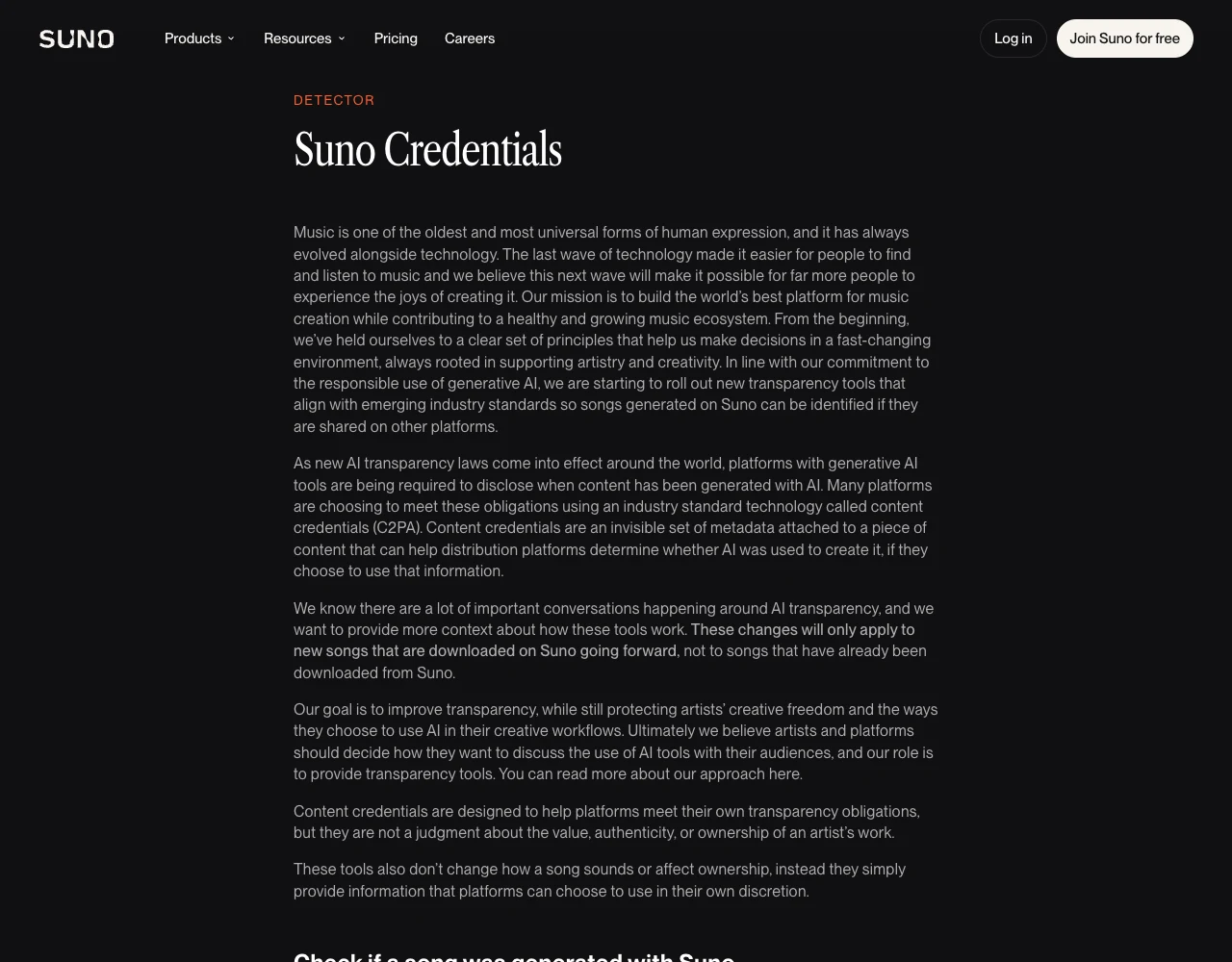
Suno meets Article 50(2) with Content Credentials. Its own page states that “when a song is downloaded from Suno, we attach metadata identifying it as AI-generated content made with Suno”, built on C2PA, and it runs a tool that checks any file or public link for them — framed there as a response to “new AI transparency laws” coming into effect, without naming the Regulation.
One limitation on the same page matters for a back catalogue: this “only apply to new songs that are downloaded on Suno going forward”. Nothing is added retroactively, so for older material the file in your folder and the file you would download today are not the same object.
Separately, Suno said on 6 August 2026 that it would use audio watermarking and fingerprinting to prevent misuse on other streaming platforms. TechCrunch reported it was unclear which system Suno would adopt and that the company declined to detail the download policy announced alongside it. Nothing published since confirms the watermark shipped, which is why the table separates live from stated intent. The watermark research on sunowatermark.com tracks that question, and our page on Suno watermarking and download limits covers what the August announcement changed in practice.
| What can travel with a track | Live today? | Who puts it there | What it is for |
|---|---|---|---|
| Content Credentials — a C2PA provenance manifest | Live, attached on download | Suno | Machine-readable proof the track was generated with Suno. |
| An audio watermark baked into the waveform | Announced 6 Aug 2026, not confirmed shipped | Suno, stated intent | Identifying Suno tracks off-platform. |
| An audio fingerprint held on Suno's side | Announced, not confirmed shipped | Suno, stated intent | Matching a track against Suno's catalogue, not travelling in your file. |
| Disclosure fields in the delivery metadata (DDEX AI credits) | Live where your distributor supports it | You, at delivery | What Spotify shows in Song Credits. |
| Deezer's classifier verdict | Live on every delivery | Deezer | Not in your file at all — an inference from the audio. |
Worth saying plainly, because the subject invites the opposite reading: a provenance credential is a disclosure mechanism the law obliges the generator to attach, and this page is not an argument for stripping it. Deezer's classifier works from the audio and never reads it anyway.
The dates that matter, including 2 December
Two competing pages gesture at a December deadline without naming what creates it. This is what creates it.
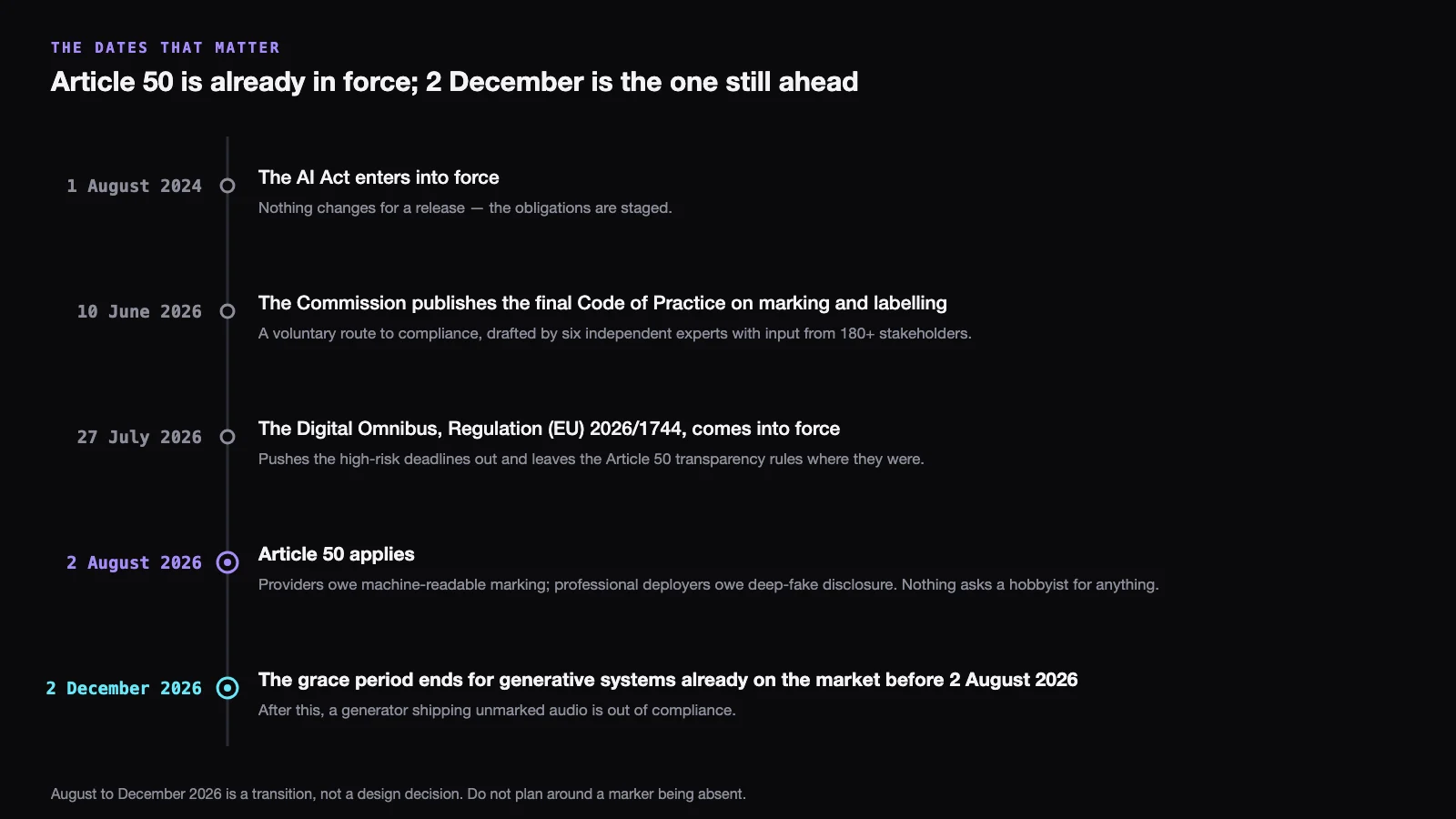
| Date | The event | What it means for a release |
|---|---|---|
| 1 August 2024 | The AI Act enters into force | Nothing changes for a release — the obligations are staged. |
| 10 June 2026 | The Commission publishes the final Code of Practice on marking and labelling AI-generated content | A voluntary route to compliance, drafted by six independent experts with input from more than 180 stakeholders. |
| 27 July 2026 | The Digital Omnibus — Regulation (EU) 2026/1744 — comes into force | It pushes the high-risk deadlines out and leaves the Article 50 transparency rules where they were. |
| 2 August 2026 | Article 50 applies | Providers owe machine-readable marking; professional deployers owe deep-fake disclosure. Nothing asks a hobbyist for anything. |
| 2 December 2026 | The grace period ends for generative systems already on the market before 2 August 2026 | After this, a generator shipping unmarked audio is out of compliance. |
The December date is a transition for generative systems already on the market before 2 August 2026; anything placed on the market after that had to comply from the start. Which raises a question nobody seems to have asked out loud: Suno launched v6 on 9 September 2026, so whether that counts as a new system or an update decides which side of the grace period it sits on. We found no published answer and would rather say so than guess.
The practical reading: a file downloaded mid-2026 may carry no machine-readable marker, one downloaded after the transition closes should, and treating the gap as permanent is the mistake.
The law is not what makes you disclose
Five platforms, five different asks, and none of them a legal requirement on you.
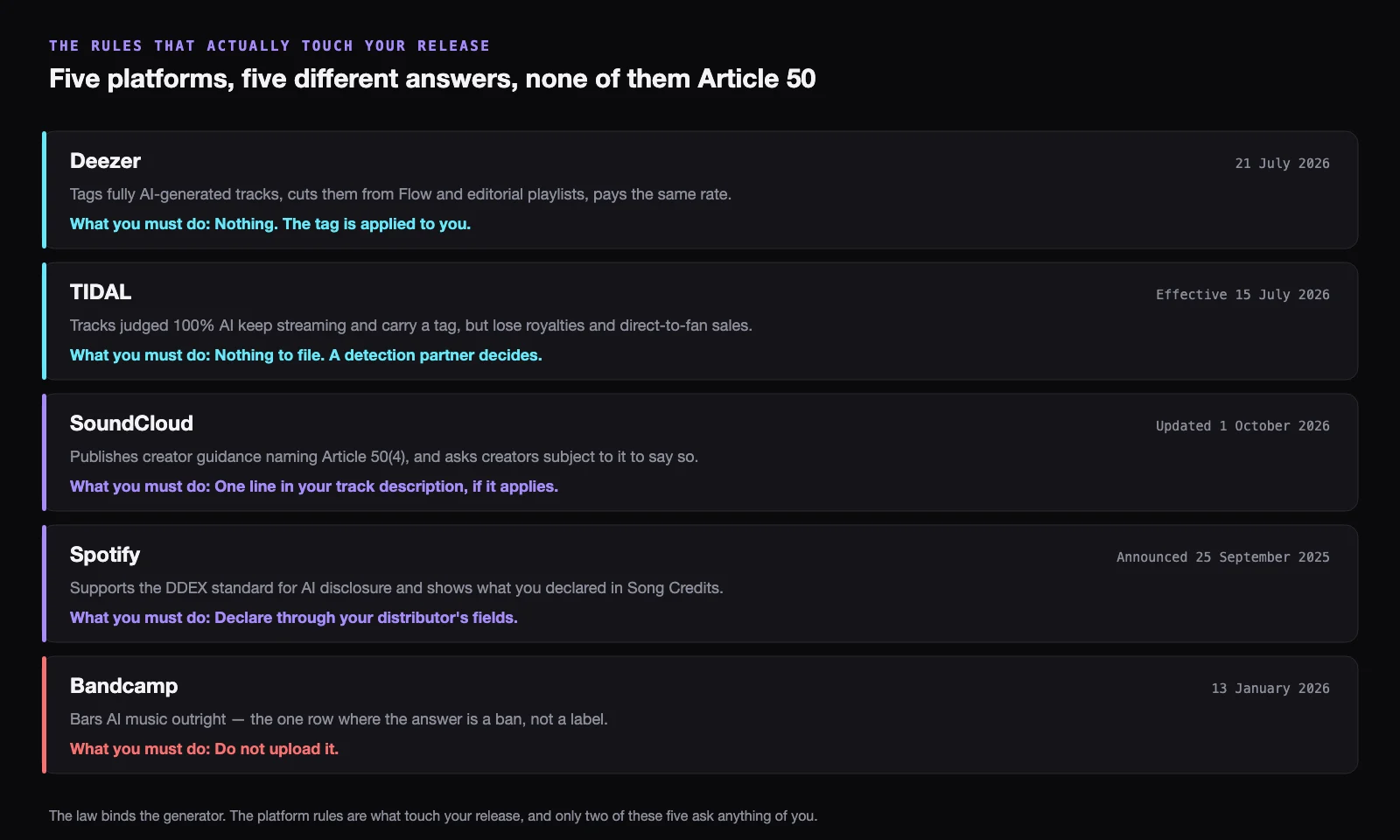
An artist who reads Article 50 correctly and concludes they owe nothing is right, and still has four or five disclosure decisions to make: the platforms wrote their own rules and did not wait for Brussels. SoundCloud is the only one that cites the Act — its creator guidance, updated 1 October 2026, says creators subject to the Article 50(4) requirements “are encouraged to disclose that their covered content is 'AI-generated or manipulated' within their track description”. Note the conditional.
| Platform | What it does | What it asks of you | Dated |
|---|---|---|---|
| Deezer | Tags fully AI-generated tracks, cuts them from Flow and editorial playlists, pays the same rate. | Nothing. The tag is applied to you. | 21 July 2026 |
| TIDAL | Tracks judged 100% AI keep streaming and carry a tag, but lose royalties and direct-to-fan sales. | Nothing to file. A detection partner decides. | Effective 15 July 2026 |
| SoundCloud | Publishes creator guidance naming Article 50(4), and asks creators subject to it to say so. | One line in your track description, if it applies. | Updated 1 October 2026 |
| Spotify | Supports the DDEX standard for AI disclosure and shows what you declared in Song Credits. | Declare through your distributor's fields. | Announced 25 September 2025 |
| Bandcamp | Bars AI music outright — the one row where the answer is a ban, not a label. | Do not upload it. | 13 January 2026 |
Apple Music and YouTube differ again, and both are covered on AI music on Apple Music and AI music on YouTube. The distributor picture, read at source and dated, sits on platforms that accept AI music: six accept AI music openly, TuneCore's framework is the restrictive one, and what readers report is a release flagged by automated screening, not an AI ban.
That screening is a separate gate. Article 50 is about provenance; a distributor's intake check is about whether the audio sounds like a release it can deliver, which is where artifact cleanup belongs and where tools like Undetectr operate. The limits, stated plainly: no processing chain changes a provider's marking duty, strips a Deezer tag, or alters how a platform labels a release.
TIDAL is the row with money attached, and it reads as a warning: a platform can accept a track, label it, keep streaming it and decline to pay. Which is the argument for streaming not being the whole plan. Paid sync placements in TV, film, games and ads are where the real money in this niche gets discussed, and played.fm runs a sync-pitching route alongside a storefront where you keep 100% — neither depending on a streaming service's view of how a track was made.
The two labels the industry agreed in July
Not law and not a platform rule, but a convention you meet through your distributor.
On 10 July 2026, IFPI, the RIAA, A2IM, WIN, IMPALA, the Grammys, SAG-AFTRA and the Human Artistry Campaign announced two voluntary tags: AI-generated, where generative AI produced the entirety or primary portion of the expressive elements, and AI-assisted, where humans made substantially all of it. Reporting is voluntary and the framework does not yet cover lyrics, composition, videos or cover art.
The plumbing underneath is older. Spotify said on 25 September 2025 that it would support a DDEX industry standard for AI disclosure in credits, announced with distributors including DistroKid, CD Baby, Believe, Amuse and RouteNote, and that where artists disclose through their distributor, listeners see those credits on the track. Its reason for a graded standard: AI use “is increasingly a spectrum, not a binary”.
This is the layer that involves filling something in, and it arrives as fields on a delivery form rather than a legal filing. Our page on the Spotify AI Persona badge covers what being labelled there costs in practice.
Who pays if this goes wrong
The €15 million figure is in the Regulation. It is not aimed at you.
Article 99 sets three tiers. Prohibited practices under Article 5 carry up to €35 million or 7% of worldwide annual turnover. The middle tier — where Article 50 sits, alongside the provider and deployer obligations in Articles 16 and 26 — carries up to €15 million or 3% of worldwide annual turnover.
Two things get left out whenever that number is quoted at artists. First, the percentage applies “if the offender is an undertaking” — operators with turnover, not individuals with a Spotify page. Second, Article 99(6) caps fines for SMEs and start-ups at whichever of the amount and the percentage is lower, the opposite of the rule for large undertakings.
And enforcement needs an obligation to enforce. A hobbyist is outside scope; a commercial releaser of original AI music has no marking duty and no deep fake to disclose. The realistic exposure is not a fine but a platform decision — a tag, a demonetisation, a rejected delivery, a takedown on impersonation grounds — which is why AI music removed from streaming is a more useful read on risk than the Regulation.
None of this is legal advice, and national enforcement practice here is barely two months old. This page is a map of the questions, not a substitute for someone qualified answering them.
What to do before your next release
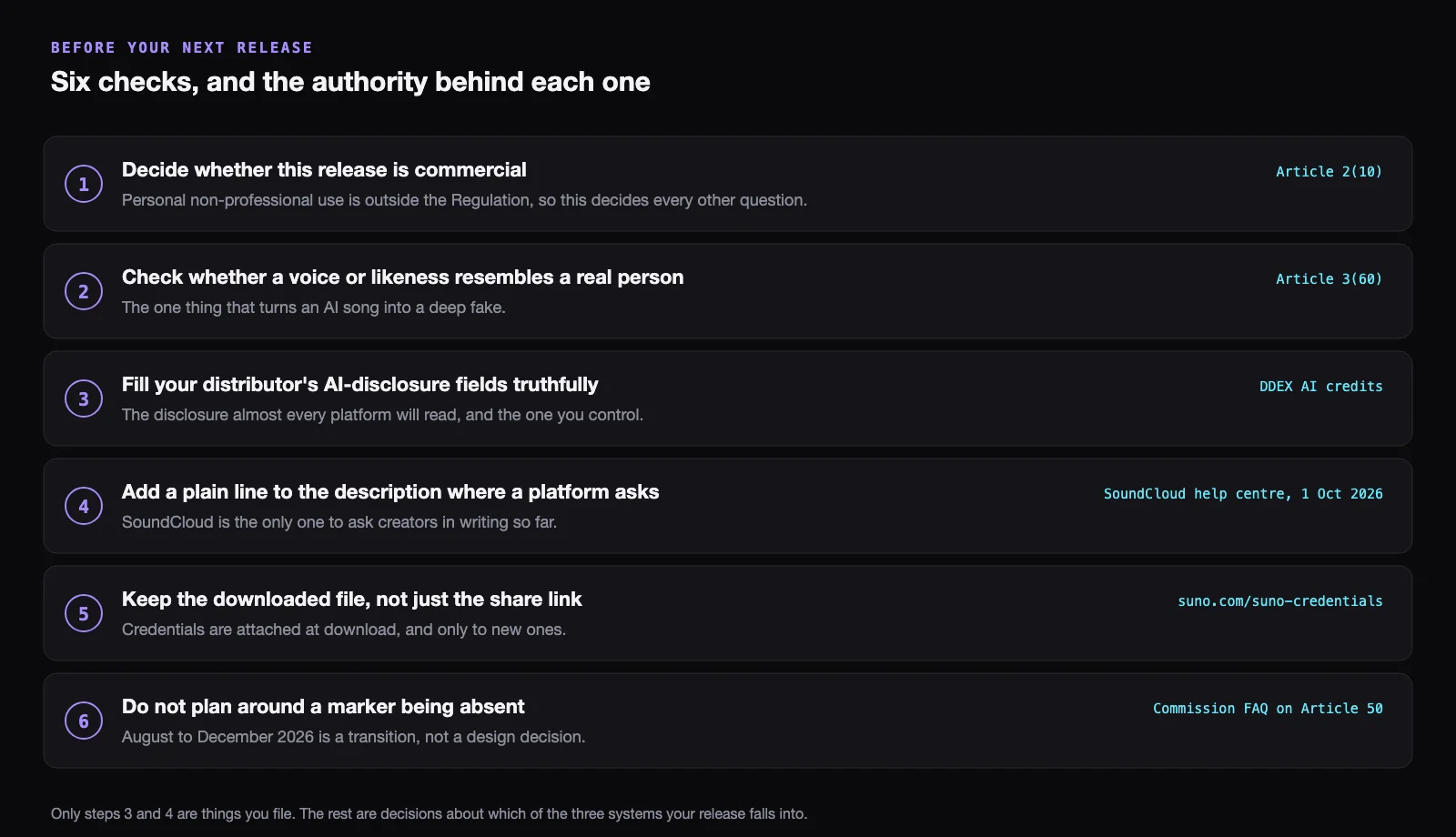
Six steps, each tied to where it comes from.
| Step | Why | Where it comes from |
|---|---|---|
| Decide whether this release is commercial | Personal non-professional use is outside the Regulation, so this decides every other question. | Article 2(10) |
| Check whether a voice or likeness resembles a real person | The one thing that turns an AI song into a deep fake. | Article 3(60) |
| Fill your distributor's AI-disclosure fields truthfully | The disclosure almost every platform will read, and the one you control. | DDEX AI credits |
| Add a plain line to the description where a platform asks | SoundCloud is the only one to ask creators in writing so far. | SoundCloud help centre, 1 Oct 2026 |
| Keep the downloaded file, not just the share link | Credentials are attached at download, and only to new ones. | suno.com/suno-credentials |
| Do not plan around a marker being absent | August to December 2026 is a transition, not a design decision. | Commission FAQ on Article 50 |
What should be obvious is how little of that list is about the Act: five of six steps are about platforms, metadata and your own files. The Regulation reorganised who owes what, and the burden landed on the generators.
Which leaves the problem nobody legislated for. Getting a release delivered, labelled and compliant is a solved process — and it does not get anybody to listen. The threads where AI musicians sound genuinely stuck are about uploading into silence, not disclosure fields. The seven walls after the song puts disclosure in its actual place in that queue, and it is not first.
EU AI Act and AI music FAQ
Does the EU AI Act require me to label my AI-generated songs?
Almost certainly not. The marking duty in Article 50(2) falls on the provider of the AI system — the company that built the generator — not on the person who used it. The only Article 50 obligation that can reach a releasing artist is 50(4), which covers deep fakes, and an original AI song is not one. If you are not selling the music, Article 2(10) takes you out of scope entirely.
I am not in the EU. Does Article 50 apply to me?
It can. Article 2(1)(c) extends the Regulation to providers and deployers in a third country “where the output produced by the AI system is used in the Union”. But scope is not a duty: you still have to be a deployer under Article 3(4), and the content still has to be a deep fake before 50(4) asks anything of you.
Is an AI song a deep fake under the Act?
Not by default. Article 3(60) defines one as content “that resembles existing persons, objects, places, entities or events and would falsely appear to a person to be authentic or truthful”. A track sung by a voice that belongs to nobody resembles no existing person. A recognisable singer's cloned voice does.
Can I really be fined 15 million euros for releasing an AI track?
No. The figure is Article 99(4), which caps fines for Article 50 breaches at €15 million or 3% of worldwide annual turnover for an undertaking — a tier built for operators. Article 99(6) gives SMEs whichever of the two is lower. None of it attaches to someone with no obligation to breach.
Does Suno mark the files I download?
Yes, with Content Credentials. Suno's own page states that “when a song is downloaded from Suno, we attach metadata identifying it as AI-generated content made with Suno”, built on C2PA, and it runs a tool that checks any file or public link for them. The limitation is on the same page: this applies only to new downloads going forward.
Does using AI for mixing or mastering count?
Article 50(2) carves out AI systems performing an assistive editing function, or that do not substantially alter the input data or its meaning, and a mastering chain applied to audio you already had is the textbook case. The practical answer is the one Deezer gives for its own tag: processing is not generation.
If the law does not make me disclose, why does everyone say I have to?
Because three systems get collapsed into one. The Act binds the generator; the DDEX credits standard is an industry convention you meet through your distributor's delivery form; and each platform has its own rule. The platform rules are what touch your release — Deezer tags without asking, TIDAL stops paying on 100% AI tracks, SoundCloud asks for a line in your description, Bandcamp refuses the upload.
- Regulation (EU) 2024/1689 on EUR-Lex, and Article 50 — plus Articles 2(10), 3(4), 3(60) and 99.
- European Commission — FAQ on Article 50 (24 July 2026): the personal-capacity exclusion and the December transition.
- Suno — Content Credentials: what is attached on download.
- SoundCloud — Creators and the EU AI Act (1 October 2026).
- Spotify Newsroom (25 September 2025).
- Billboard and Deadline (10 July 2026).
- TechCrunch (6 August 2026).
- Baker Botts (September 2026): the Digital Omnibus.
Provisions read at source and quotations checked 3 October 2026. SoundCloud's help centre returns 403 to automated requests, so its article was read through that help centre's own public API rather than the page linked above; the wording quoted is that article's. TIDAL's July 2026 royalty policy is reported rather than published in a help centre we could read. Nothing here is legal advice.
Related guides
Disclosure that works
What saying so up front costs, and where it pays.
Spotify AI Persona badge
What being labelled on the biggest platform costs a release.
AI music on Deezer
Tagged, cut from every recommendation surface, paid the same rate.
AI music on Apple Music
Transparency tags, declared on delivery rather than detected.
Platforms that accept AI music
Every published distributor policy, read at source and dated.
AI music copyright
What you own, and what a prompt-only track cannot claim.
Or browse every guide on the site.
The law is the generator's problem. The audio is yours.
Nothing you do to a file changes a provenance credential, a platform's AI tag or how a release gets labelled — say that plainly and ignore anyone who says otherwise. What is yours to fix is a thin, artifact-heavy generator export meeting a distributor's intake check. Clean it, master to one target, and send something that holds up.
▸ Independent · We recommend Undetectr