Spotify Doesn't Ban AI Music. It Bans These Things.
The question gets asked as though there is a single yes-or-no answer, and there is not. AI-generated music is distributed on Spotify at scale, legitimately, every day. What gets pulled is a specific and fairly narrow set of behaviours — and most legitimate creators who lose tracks never actually hit those rules. Here is what the policy covers, and where releases really die.
The short version
Five things to know before you release an AI-assisted track.
Spotify does not ban AI-generated music as a category — it enforces against impersonation, spam and artificial streaming, and undisclosed AI where disclosure is required.
You cannot upload to Spotify directly. Everything arrives through a distributor, and the distributor's automated screening is the gate that actually stops most releases.
Disclosure has moved to structured metadata carried in track credits. Treat declaring AI involvement as the default, not an optional extra.
Monetisation is real but slow: tracks must clear a minimum stream threshold in a rolling 12-month window before earning, and per-stream rates are fractions of a cent.
The common failure is technical, not legal — a raw export carries embedded identifiers and off-spec loudness that automated screening flags.
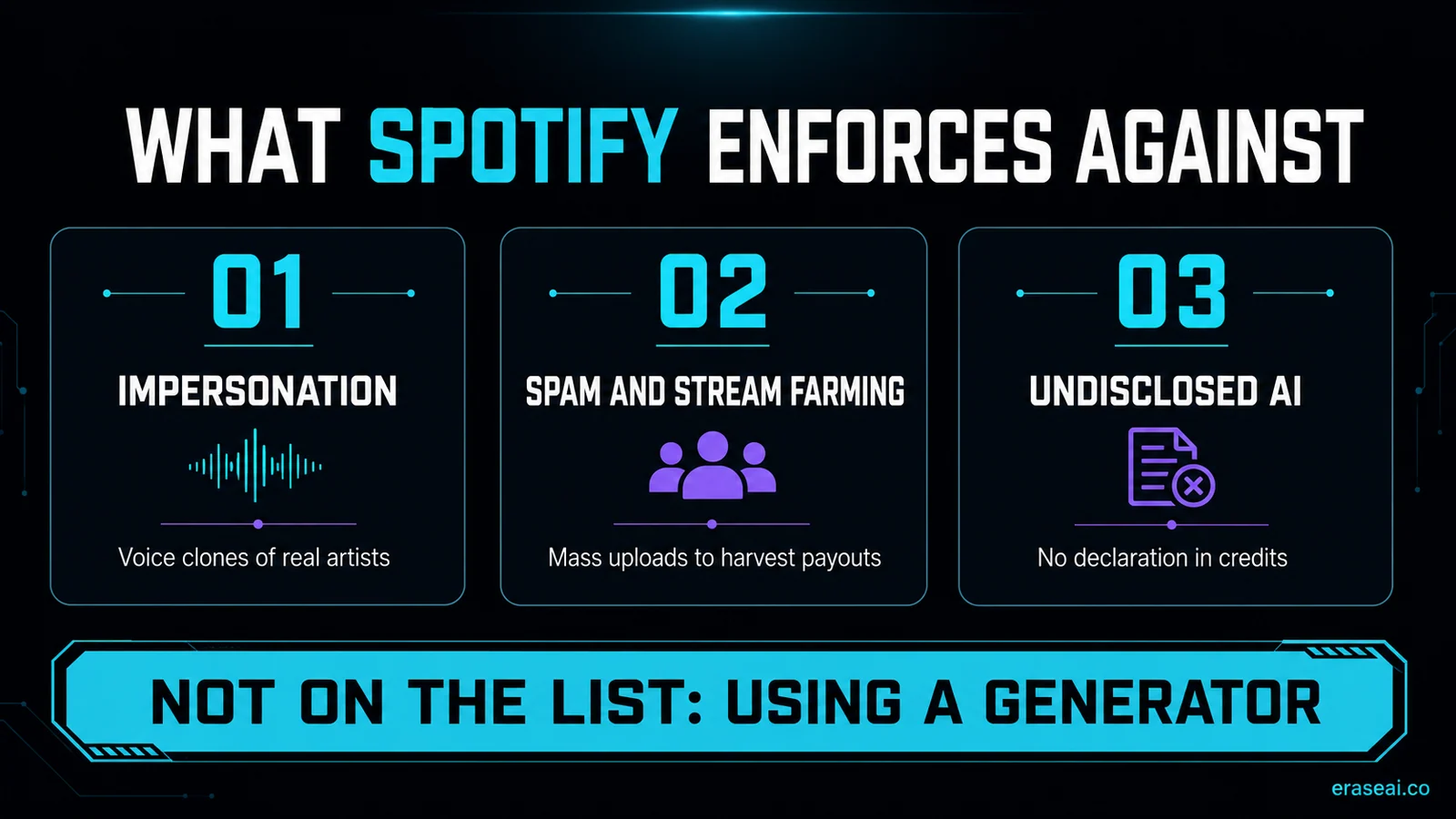
What Spotify actually enforces against
Three behaviours, none of which is "used a generator."
Impersonation
Voice clones and tracks presented as the work of a real artist who had no part in them. This is the clearest line, and the one that draws the fastest removals and account action.
Spam & artificial streaming
Mass-produced uploads designed to farm payouts, plus any attempt to inflate streams. Generators make volume cheap, so this is where enforcement has tightened most.
Undisclosed AI
Failing to declare AI involvement where the platform or distributor requires it. Disclosure travels in track credits as structured metadata rather than a note in your description.
Read that list again and notice what is missing: any prohibition on making music with a generator. The industry direction through 2025 and 2026 has been toward labelling AI involvement rather than banning it — structured disclosure in credits, an explicit impersonation policy, and filtering aimed at spam. The enforcement problem platforms care about is deception and volume.
Policies do get revised, and the honest caveat applies: check Spotify's current terms and your distributor's current AI policy before a release rather than trusting any guide, including this one, as the final word.
Where releases actually die
Most creators who lose tracks never broke a policy at all.
Spotify does not take uploads from anyone directly. Your track reaches it through a distributor, and that distributor screens incoming audio automatically. This is the step that stops legitimate releases — not a policy judgement about AI, but a machine reading the file and finding reasons to hold it.
A raw generator export gives it three. It carries embedded identifiers — SynthID, C2PA credentials, spectral fingerprints — that mark it as machine-generated. Its loudness usually sits outside platform targets, which screening reads as a low-effort upload. And it may overlap with existing recordings on a fingerprint check. None of those is a rule violation, yet each can produce the same outcome: a rejection, or a track that goes live and is quietly pulled a fortnight later with no email.
That is the gap worth understanding. The policy question ("is AI music allowed?") has a reassuring answer, while the technical question ("will this file pass screening?") is the one that decides whether your release survives. Our guide to AI music detectors covers what that screening actually reads.
What AI music on Spotify actually pays
Legal to sell is not the same as profitable to make.
If you hold commercial rights to your output — which Suno and Udio grant on paid plans — you can earn from AI-assisted music on Spotify like any other rights holder. Two structural facts set expectations. Spotify requires a track to pass a minimum stream threshold within a rolling twelve-month window before it generates recorded royalties at all, so a catalog that trickles a handful of plays per track earns nothing from those tracks. And per-stream rates sit in fractions of a cent, meaning meaningful income requires meaningful volume.
A controlled 50-track experiment we covered in our watermark guide found exactly this: from a cold start with no audience, three months of streaming across five platforms produced coffee money, not income — while properly prepared tracks at least stayed live to accumulate it. Earnings compound slowly as tracks find playlists; nobody starting from zero should expect otherwise.
Which is why streaming is rarely the whole plan. Selling directly to listeners through a storefront like played.fm keeps the full price of a sale instead of a fraction of a cent per play, and it works alongside streaming rather than instead of it.
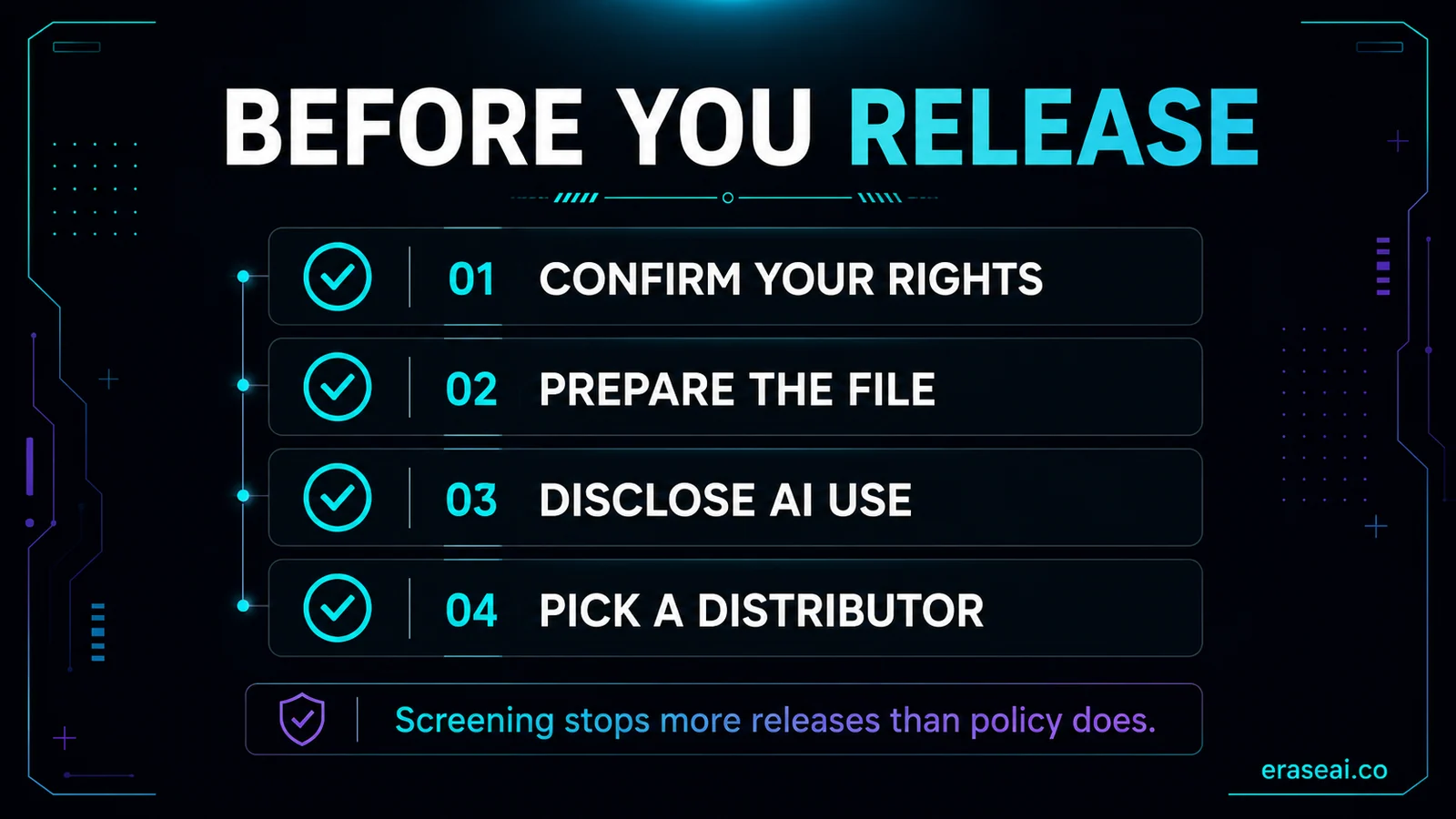
Getting a track through the gate
Four steps that address the technical reasons screening holds releases.
Confirm your rights
Check that your generator plan grants commercial use for the tracks you intend to release. This is a plan-level question and it is worth answering before you invest in a release.
Prepare the file
Strip the embedded identifiers from the export and master it into platform loudness spec. For this step we recommend Undetectr, which handles both in one pass.
Disclose properly
Declare AI involvement in your distributor's metadata fields. Structured disclosure is the direction the whole industry is moving; treat it as routine rather than as an admission.
Pick a distributor that accepts AI
Policies differ and change. Confirm your distributor currently accepts AI-assisted material before you pay for a release, and keep your metadata honest.
AI music on Spotify FAQ
Is AI music allowed on Spotify?
Yes. Spotify has publicly stated it does not ban AI-generated music as a category, and a great deal of AI-assisted music is distributed there legitimately. What the platform removes is music that breaks existing rules regardless of how it was made: impersonation of real artists, spam and artificial streaming, and content that fails required disclosure. Policies do change, so check Spotify's current terms before a release.
Can you put AI music on Spotify?
Yes, through a distributor — Spotify does not accept uploads directly from anyone, AI or otherwise. You need commercial rights to the output (Suno and Udio grant these on paid plans), a distributor that accepts AI-assisted material, and audio that passes automated screening at upload. The practical obstacle is usually screening, not permission.
Can you sell or monetise AI-generated music on Spotify?
Yes, if you hold the commercial rights and the release stays live. Two realities shape the payoff: Spotify requires a track to reach a minimum stream threshold within a rolling 12-month window before it earns recorded royalties at all, and per-stream rates sit in fractions of a cent. A cold-start catalog realistically earns very little in its first months, whatever the tooling promises.
Does Spotify remove AI music?
It removes tracks that violate policy. In practice that means artist impersonation and voice cloning passed off as a real performer, artificial streaming and spam uploads, and mass-produced filler designed to game payouts. Tracks are also caught by automated screening at the distributor stage before Spotify ever publishes them, which is where most legitimate creators actually hit trouble.
Do I have to disclose that music is AI-generated?
The industry has moved toward structured disclosure — AI involvement declared in track credits through standardised metadata that distributors pass along. Treat disclosure as the default: it is required by some platforms and distributors, it is straightforward to provide, and undisclosed AI content is one of the specific things enforcement targets.
Why did my AI track get rejected or quietly disappear?
Almost always automated screening rather than a human decision. A raw generator export carries embedded identifiers, often sits outside platform loudness targets, and can overlap with existing recordings on fingerprint checks. Any of those can hold a release or get it pulled weeks later with no notification — which is why preparing the file before upload matters more than appealing afterwards.
Permission was never the hard part.
Spotify allows AI music. Automated screening is what stops it — so prepare the file before you upload, not after it disappears.
▸ Independent · We recommend Undetectr