Beat AI Music Detectors? What Works in 2026
A video telling you how to beat AI music detectors “every single time” took 177,800 plays, and the comments underneath are people asking whether it really works. It is a fair question with an unusually well-documented answer, because two teams have now published what happens to a detector when you manipulate the audio. The manipulations that measurably move a verdict are the ones that ruin the recording, one of them makes the verdict worse rather than better, and the ordinary studio processing everybody reaches for has never been tested at all. We read the papers and the policy pages and laid out what each supports.
The short version
Five findings, each from a paper or a policy page you can open yourself.
The transforms that work are the ones you cannot ship. A 2026 robustness study puts a detector at 0.998 F1 on clean Suno audio and 0.675 under a speed change — a speed change large enough to hear immediately.
Cutting the high end makes it worse, not better. High-pass filtering above 8 kHz made a commercial detector label every file AI, including genuine human recordings. Removing the evidence returns the guilty verdict.
The artifact is architectural. The ISMIR 2025 best paper proves the spectral peaks come from deconvolution layers in the model, not from its training data or weights — so a newer, better-sounding model does not make them go away.
Nobody has tested the processing you would actually use. The same 2026 paper states that equalisation, dynamic range compression and codec compression remain untested. Any confident claim about mastering is a claim without a measurement behind it.
The gate most creators fear is open. DistroKid's own help centre says it accepts music made with AI tools; five other distributors do too. The blocking gates are promo platforms and screening, and they read different things.
What the videos actually claim
Four recurring promises, and the different reason each one fails.
The genre is consistent enough to summarise. Nudge the tempo a couple of percent. Shift the pitch a semitone and shift it back. Bounce it through a mastering chain. Re-record the output through speakers into a microphone. Each is presented as a switch that flips a detector from red to green, and each is doing something measurably different to the file.
Two of them are real effects being oversold, one has no published evidence at all, and one misunderstands which system is involved.
| The claim | Evidence status | The catch |
|---|---|---|
| Change the speed slightly | Measured. F1 falls from 0.998 to 0.675-0.782 | The published effect needs a x0.7-x1.4 change. At that size the track is a different tempo and key |
| Shift the pitch, then shift it back | Measured. Baseline F1 falls to 0.720-0.732 | Two resampling passes through a pitch algorithm, audible on sustained vocals — and a newer detector recovers it |
| Run it through a mastering chain | Untested. Stated as untested by the authors | No published result supports it or refutes it. Everyone asserting an outcome is guessing in one direction |
| Re-record it through the air | Untested for detection; it is a codec and room problem | You add noise, room and a converter pass. The deconvolution peaks are in the content, not the container |
Notice what the table does not contain: one entry where the trick works and leaves you with the song you made.
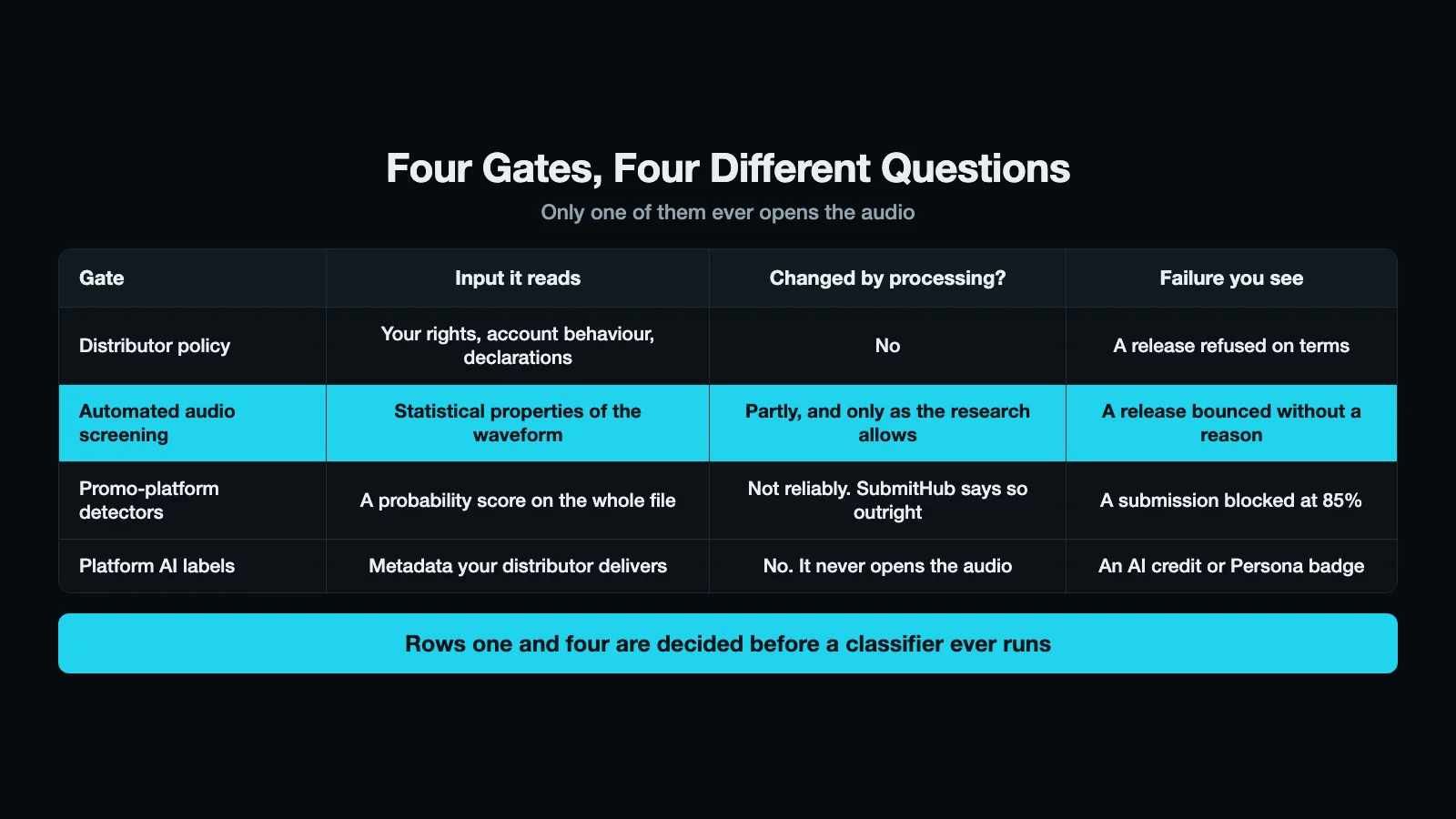
Four gates, four different questions
Most of the confusion in this topic is one fix being applied to the wrong gate.
“Getting past AI detection” describes four separate systems that creators experience as one. They run at different points in a release, read different inputs, and a change that satisfies one is frequently irrelevant to the next — which is how the same person processes a file, sails through a distributor, and still finds the release carrying an AI label a fortnight later.
Sorting them out first saves three weeks on the wrong problem. Our guide to AI music detectors covers who builds the classifiers behind gates two and three; this page is about whether anything you do to the file changes their answer.
| Gate | Input it reads | Changed by processing? | Failure you see |
|---|---|---|---|
| Distributor policy | Your rights, your account behaviour, your declarations | No | A release refused on terms, or an account action |
| Automated audio screening | Statistical properties of the waveform | Partly, and only as the research below allows | A release bounced without a clear reason |
| Promo-platform detectors | A probability score on the whole file | Not reliably. SubmitHub says so outright | A submission blocked at 85%, no appeal |
| Platform AI labels | Metadata your distributor delivers, plus platform review | No. It never opens the audio | An AI credit or a Persona badge on a live release |
Only the second row is a question about audio at all, and it is the only row the research below speaks to. Rows one and four are decided before a classifier ever runs, which is why no amount of processing moves them.
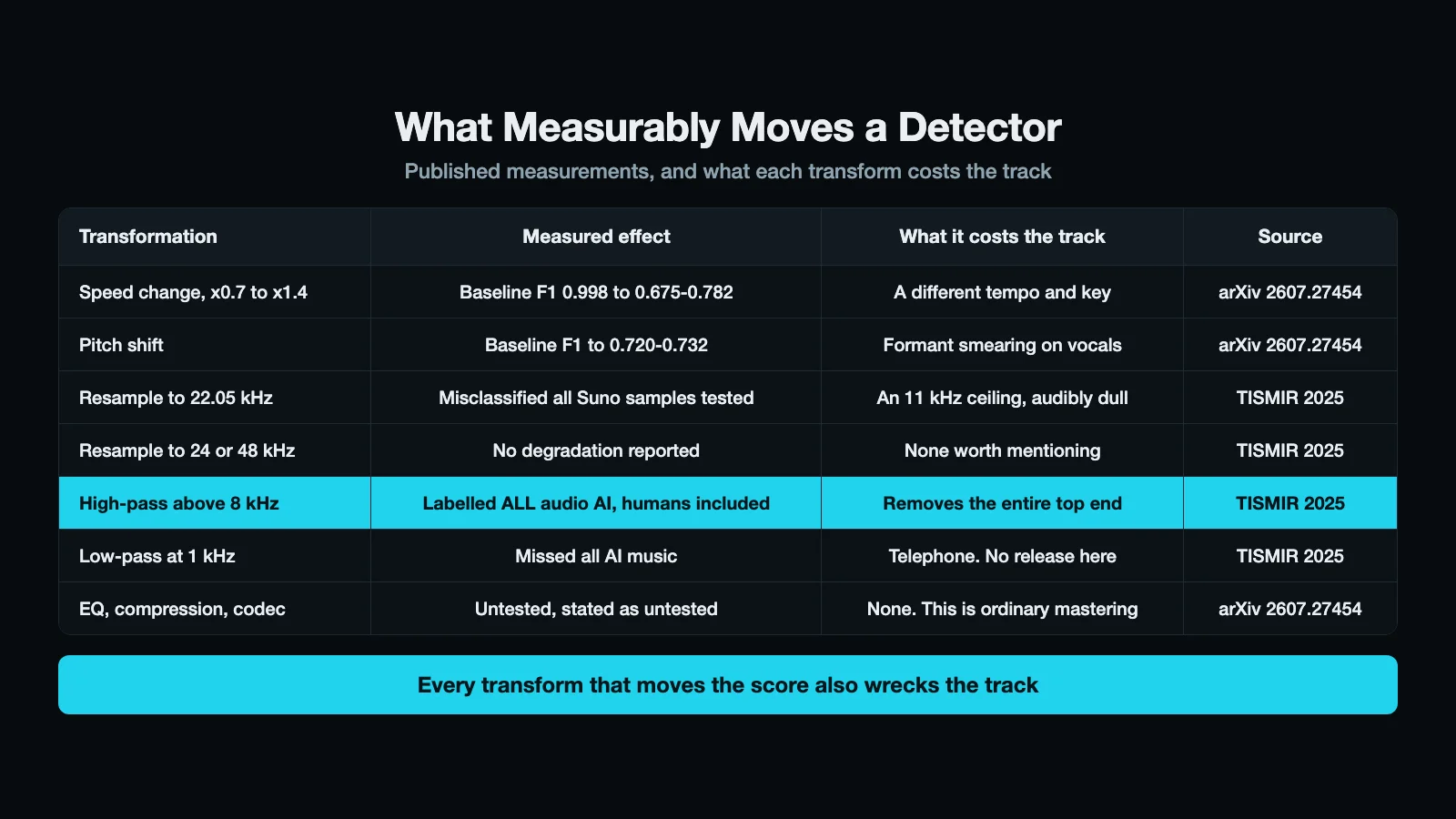
What measurably moves a detector
Two published studies, and the price each transformation charges you.
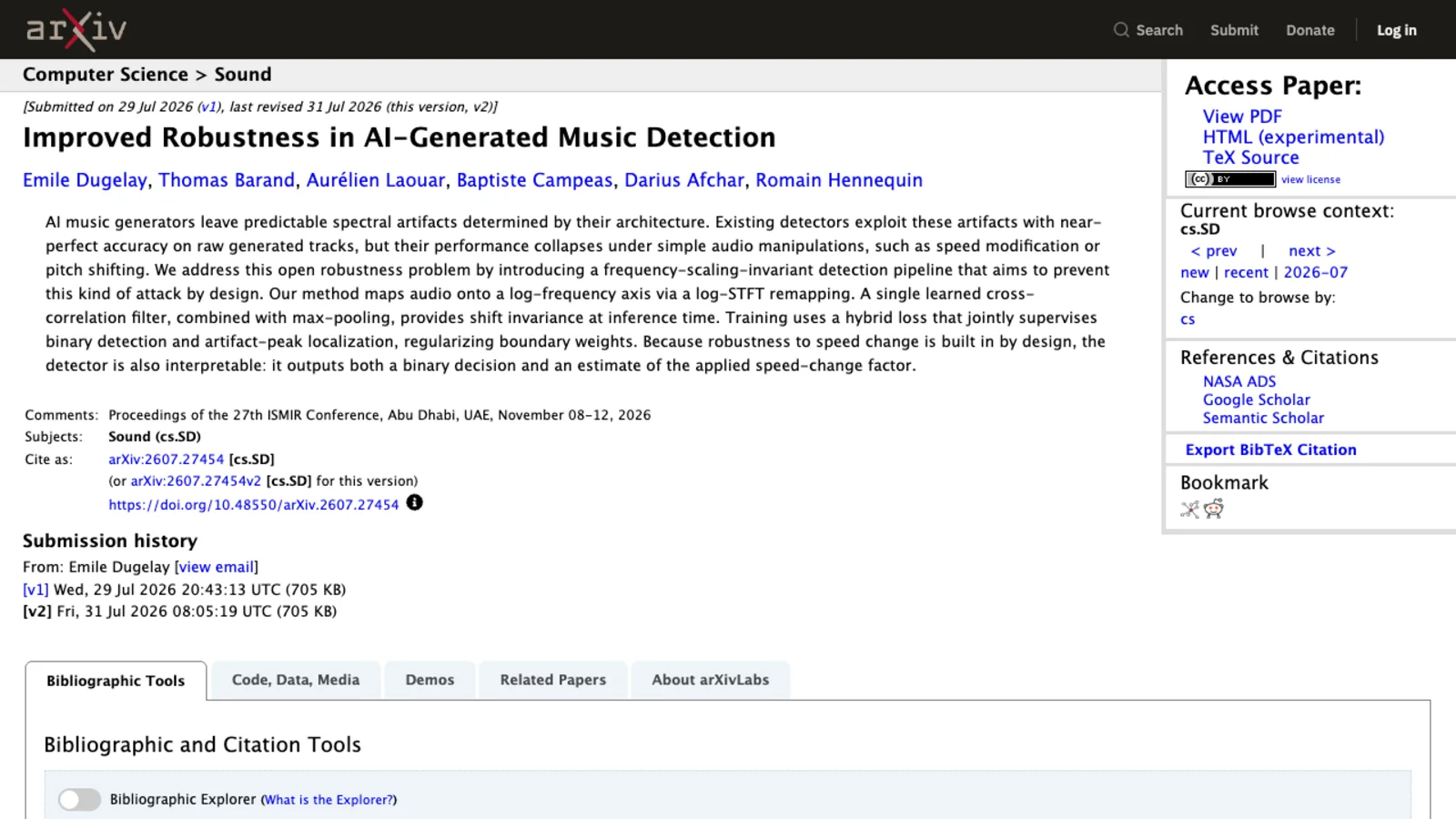
The useful literature here is small and recent. Cros Vila, Sturm, Casini and Dalmazzo published The AI Music Arms Race in the Transactions of ISMIR in 2025, testing a commercial detector against filtering and resampling. A 2026 preprint, Improved robustness in AI-generated music detection, tested the widely used research baseline against speed and pitch manipulation on Suno v3.5, Suno v5 and Udio v120.
The detector numbers are the headline. The third column below is the one that decides whether you would ever ship the result.
| Transformation | Measured effect | What it costs the track | Source |
|---|---|---|---|
| Speed change, x0.7 to x1.4 | Baseline F1 0.998 → 0.675-0.782 | A different tempo and a different key. Not the song you wrote | arXiv 2607.27454 |
| Pitch shift | Baseline F1 → 0.720-0.732 | Formant smearing on vocals, worst on the sustained notes | arXiv 2607.27454 |
| Resample to 22.05 kHz | Commercial detector misclassified all Suno samples tested | An 11 kHz ceiling. Audibly dull on cymbals and air | TISMIR 2025 |
| Resample to 24 kHz or 48 kHz | No degradation reported | None worth mentioning | TISMIR 2025 |
| High-pass above 8 kHz | Detector labelled all audio AI, human recordings included | Removes the entire top end, and returns the wrong verdict | TISMIR 2025 |
| Low-pass at 1 kHz | Detector missed all AI music | Telephone. There is no release here | TISMIR 2025 |
| EQ, compression, codec compression | Untested. Stated as untested by the authors | None. This is ordinary mastering | arXiv 2607.27454 |
Read the last row carefully, because it is the one that matters most and it is an absence rather than a finding. The authors of the 2026 paper list equalisation, dynamic range compression and codec compression as common manipulations that remain untested. Every page on the internet confidently telling you that mastering does or does not defeat a screening classifier is filling that gap with an opinion. We are not going to add another one.
One second-order result in the same paper rarely gets quoted and deserves to be. The authors' own hardened model scores 0.855 to 0.986 under speed change, far better than the baseline — but it performs worse than the baseline under pitch shift, at 0.279 to 0.439. Robustness is not a single dial, and a transformation that fools this year's detector is not a general-purpose key.
The finding that inverts the hack
Remove the band the classifier reads and you get the guilty verdict, not a clean one.
The intuition behind most advice in this space is that the AI signature lives in the high frequencies, so cutting or scrambling the top end should hide it. Reasonable guess. On the one published test of it, exactly backwards.
In the TISMIR study, high-pass filtering above 8 kHz caused the commercial detector to label all audio as AI — including the human recordings from the Million Song Dataset used as the control. The classifier was not looking for a positive signature in that band so much as reading the band's ordinary content as evidence of authenticity. Take it away and there is nothing left that looks human, so everything reads synthetic.
The mirror-image result is just as instructive. Low-pass filtering at 1 kHz did make the detector miss all AI music — and leaves you with a track that sounds like it is playing through a wall. Together the two describe the whole problem: the filtering that fools the classifier and the filtering that destroys the recording are the same operation seen from two sides.
Speed and pitch tricks fail because you can hear them. The high-pass result fails differently and more dangerously: it is a change a careful engineer might make for legitimate reasons, and it moves the verdict the wrong way. If you have been rolling off the top of a Suno bounce because the highs sounded glassy, you were treating an audible artifact — reasonable — and may have worsened the screening outcome doing it. Separating those two problems is the subject of our AI music artifact remover guide.
Why the artifact is there at all
It comes out of the model's architecture, which changes what “fixing it” would mean.
Afchar, Meseguer-Brocal, Akesbi and Hennequin won best paper at ISMIR 2025 with A Fourier Explanation of AI-music Artifacts, and the result is the most load-bearing fact in this whole topic. They prove mathematically that the deconvolution modules used to upsample audio in generative models produce systematic frequency artifacts, and they are explicit that the phenomenon is inherent to the chosen architecture rather than a consequence of training data or model weights. Detecting those peaks alone exceeded 99% accuracy in several scenarios, validated on Suno and Udio among others.
Three consequences follow, and they are not the ones people expect. First, a better-sounding model does not mean a quieter fingerprint, because fidelity and architecture are different variables. Second, licensing the training catalogue changes nothing about the peaks, which is worth remembering when a new version ships with a press release about licensed data. Third, the signature is not a watermark anybody chose to add, so there is nothing to switch off, opt out of, or strip.
That last point reframes what the videos are promising. They imply there is something inserted to remove. There is not. The peaks are a side-effect of how the audio was assembled, spread through the whole spectrum — which is why the only manipulations that disturb them disturb everything else too.
The false positives land on humans
Vendors publish their accuracy. Reading it properly changes what a flag means.
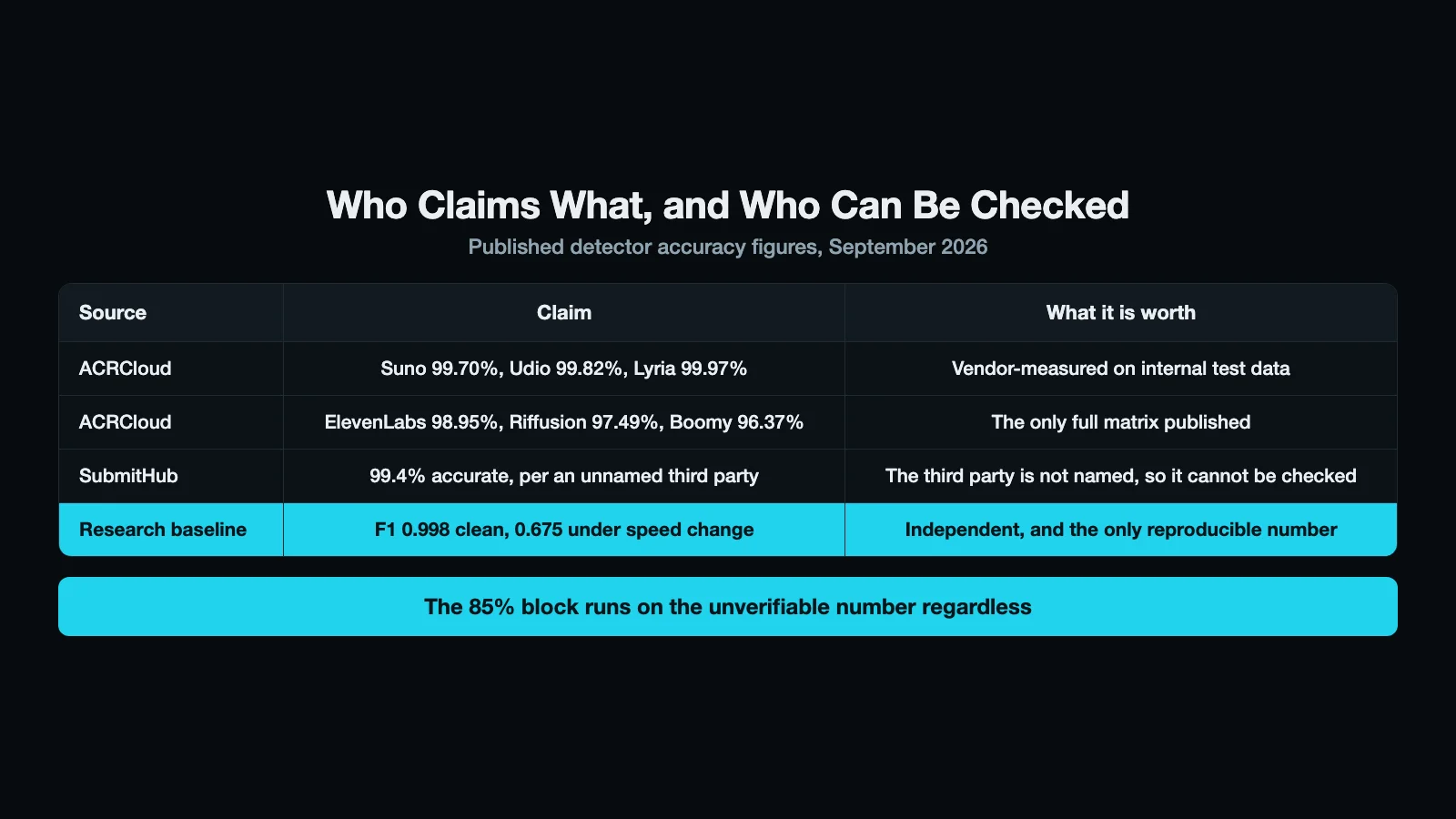
Every figure in the detection market is vendor-reported, which is not the same as worthless — it needs reading with the caveats the vendors attach. ACRCloud is the most forthcoming: its developer documentation carries a full confusion matrix rather than a marketing number, and its own caveat says the results reflect internal test data and that real performance may vary with audio quality, transformations, compression, mixing and editing.
| System | Published figure | What it actually tells you |
|---|---|---|
| ACRCloud | 99.98% precision on AI, 99.88% recall, 0.08% false positive rate on human samples, 50% decision threshold, 15-minute file cap | Vendor-measured on internal test data. The only full matrix published in the category |
| ACRCloud, per generator | Suno 99.70%, Udio 99.82%, Lyria 99.97%, ElevenLabs 98.95%, Riffusion 97.49%, Boomy 96.37% | Detection is generator-dependent. The tool you used changes your odds more than anything you do afterwards |
| SubmitHub | 99.4% accurate, according to an unnamed third party | The third party is not named, so it cannot be checked. The 85% block runs on it regardless |
| Research baseline | F1 0.998 clean, 0.675 under speed change | Peer-reviewed, reproducible, and the only figures on this page that come with a failure mode |
A 0.08% false positive rate sounds like nothing until you apply it to the volume these systems run at, and until you ask which human tracks land in it. The answer is not random: the errors concentrate in heavily edited, densely produced audio, because that is the material whose spectrum least resembles a plain acoustic recording. A producer whose work is layered, sampled and heavily processed sits in the population most likely to be flagged for something they did not do.
So a flag is a probability, not a finding. SubmitHub blocks at 85% while ACRCloud calls a track AI above 50%: the same file can be accepted by one system and blocked by another without either being broken.
What actually gets a release through
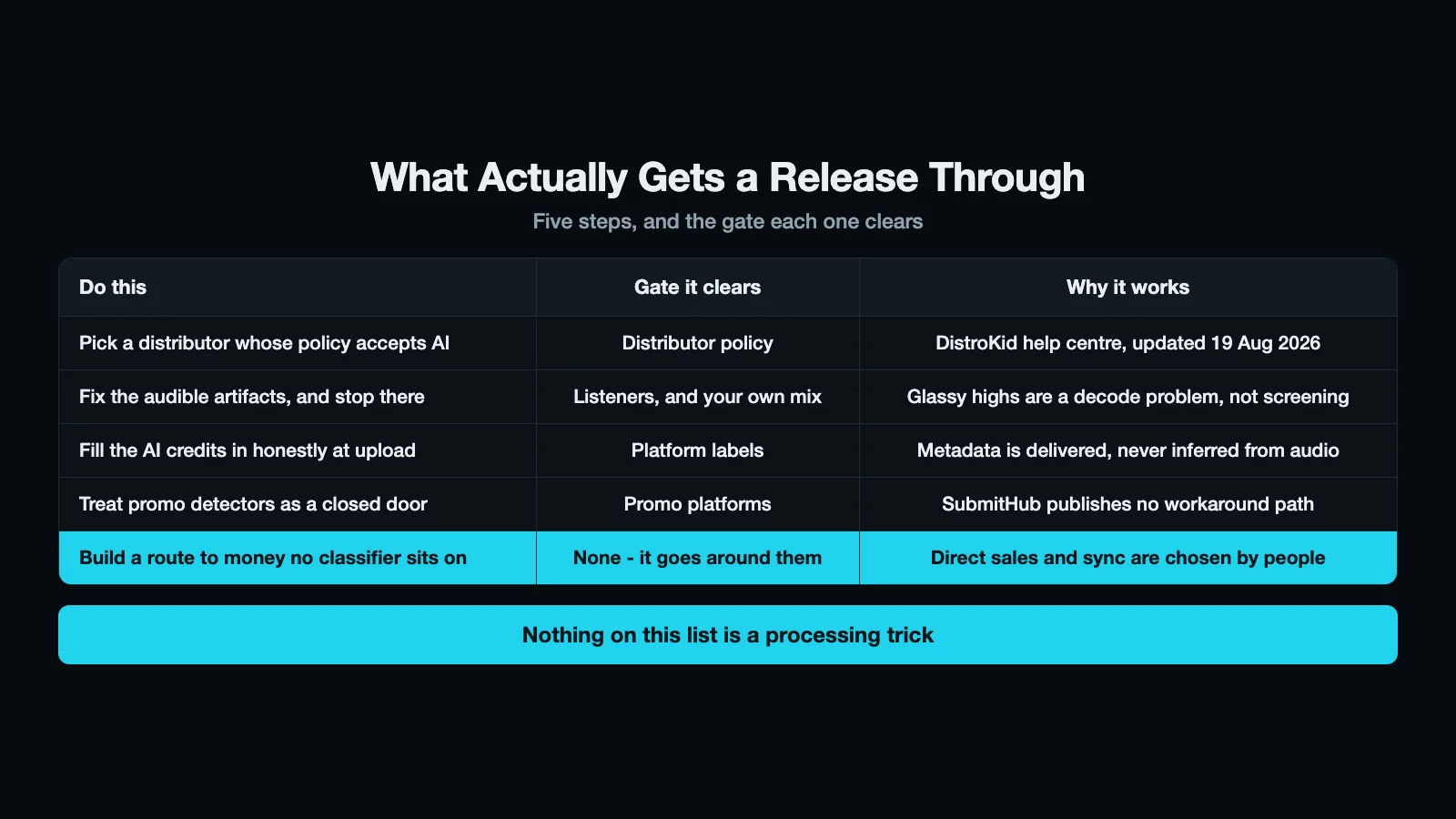
Five moves with evidence behind them, in the order they pay off.
The hack framing sticks because it answers a real anxiety with a simple action. The honest alternative is less satisfying and more effective, and it starts by noticing that the gate most people are trying to pick is already open.
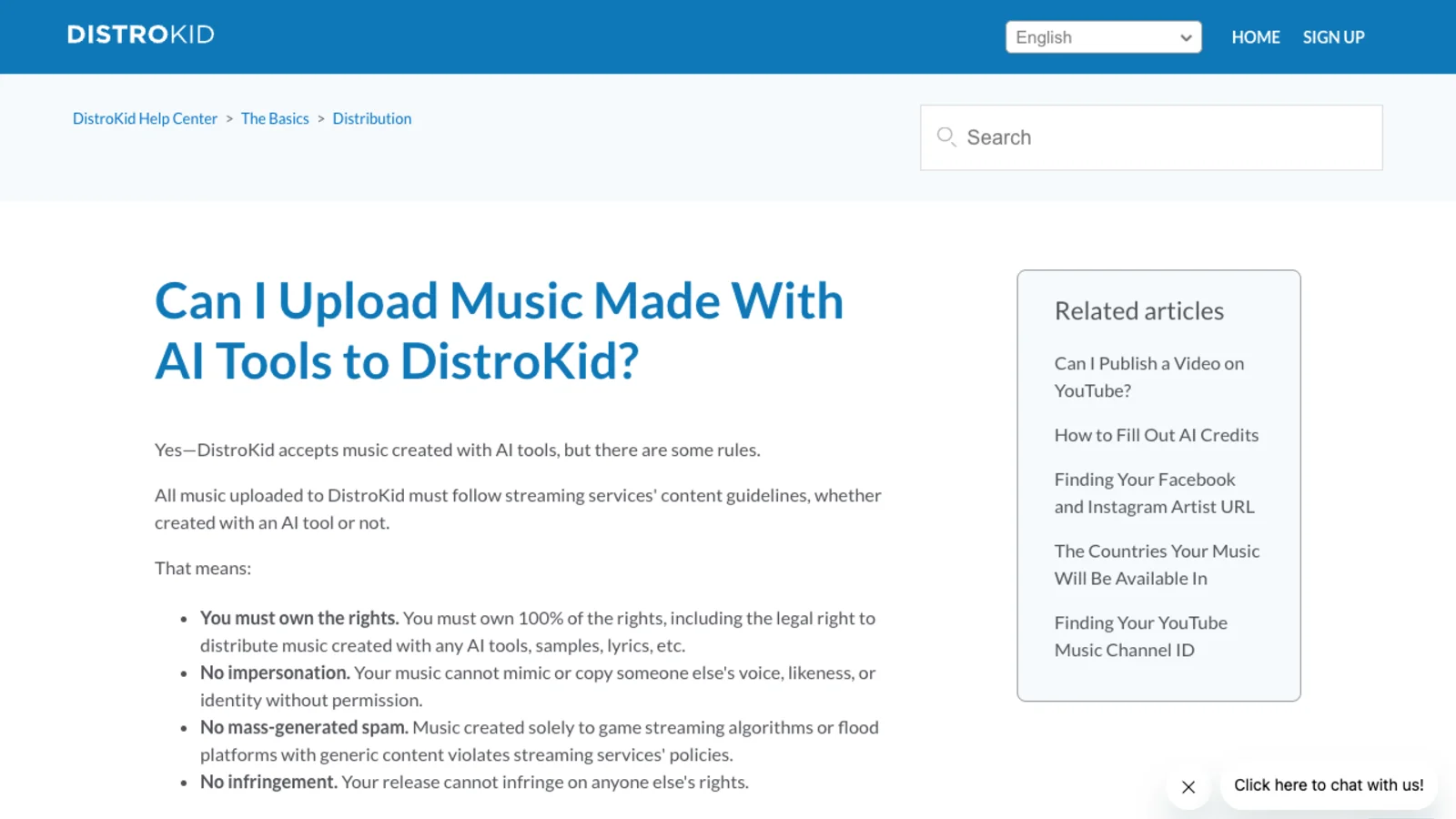
DistroKid answers the question directly in its own help centre, in an article updated on 19 August 2026: “Yes—DistroKid accepts music created with AI tools, but there are some rules.” The rules are owning 100% of the rights, no impersonation of anyone's voice or identity, no mass-generated spam, and no infringement. Nothing about which generator you used. RouteNote, UnitedMasters, LANDR, Amuse and Symphonic accept AI-generated music openly too, which makes “distributors ban AI music” the least accurate sentence in the niche. Our DistroKid and AI music guide walks through the upload flow itself.
| Move | Gate it clears | Evidence |
|---|---|---|
| Pick a distributor whose published policy accepts AI music | Distributor policy | DistroKid help centre, updated 19 Aug 2026; five others state the same |
| Fix the audible artifacts, and stop there | Listeners, and your own mix | The glassy highs and smeared consonants are a decode problem, separate from screening |
| Fill the AI credits in honestly at upload | Platform labels | DistroKid: no AI credit needed for pitch correction, auto-tune, or AI-assisted mixing and mastering |
| Treat promo detectors as a closed door, not a puzzle | Promo platforms | SubmitHub: no workaround path, and writing your own lyrics does not exempt a track |
| Build a route to money that no classifier sits on | None - it goes around them | Direct sales and sync placements are chosen by people against a brief |
The third row is the one creators get wrong most often, in both directions. DistroKid's AI credits documentation says a credit belongs on AI-generated audio, lyrics or composition, and explicitly says you do not need one for pitch correction, auto-tune, or AI-assisted mixing and mastering. So a truthful declaration is narrower than most people fear, and over-declaring is as inaccurate as hiding. We wrote up what that looks like in practice in AI music disclosure that works.
Row two is where a processing tool has a legitimate job, and it is worth being precise about what that job is. Undetectr processes a generated track for release: clearing the audible generation artifacts, and addressing the automated screening step that bounces individual releases. It does not and cannot stop a platform labelling a release as AI, because that decision is made from metadata and platform review rather than from your waveform. Given what the papers above show about the limits of any manipulation, treat a clean-sounding release as the goal and screening as a step you are improving your odds on, not a lock anybody has a key to.
What no processing can do
Three systems that never open your audio file, and therefore never respond to it.
Apple's transparency tags are declared by the provider on delivery. Spotify's AI credits ride the DDEX metadata your distributor sends, and Spotify has said in its own newsroom that the standard is not about punishing artists who use AI responsibly or down-ranking tracks for disclosing how they were made. The AI Persona badge labels an artist identity, not a recording, which is why our guide to the Persona badge spends most of its length on what the badge removes rather than on how it is applied.
None of those three reads a waveform. A file that has been through every processing chain on the market arrives at all three identically to one that has not, because what they read is the declaration and the account. That is the honest boundary of this entire product category.
Which leaves what the anxiety is really about: what happens after the release goes live. The screening gate decides whether you ship; it has no opinion on whether anyone listens. Pitching for paid sync placements in film, games and ads, and selling directly to people who already like your work, are the two routes where a human decides against a brief rather than a recommendation engine deciding for you — played.fm exists for exactly those two. Neither depends on a classifier reaching a particular verdict about your file, which is the most useful thing that can be said about them here.
Beating AI detectors FAQ
Can you beat AI music detectors?
Not reliably, and the published tests are clear about why. The manipulations that measurably degrade a detector are geometric ones — changing the speed, shifting the pitch, resampling to 22.05 kHz, hard-filtering the spectrum — and every one of them audibly damages the track you were trying to release. Anything promising a guaranteed pass is selling a result nobody has demonstrated.
Does mastering a Suno track beat AI detection?
There is no published evidence either way, which is worth saying plainly rather than guessing. The 2026 robustness paper that documents the speed and pitch-shift failures states that equalisation, dynamic range compression and codec compression remain untested. A mastering chain is neither a proven bypass nor a proven no-op against a screening classifier. It is a proven improvement to how the track sounds, which is a better reason to do it.
Does cutting the high frequencies hide the AI artifact?
It does the opposite, and this is the single most counter-intuitive result in the literature. In the TISMIR 2025 study, high-pass filtering above 8 kHz made a commercial detector label every file as AI, including real human recordings from the Million Song Dataset. Removing the band the classifier reads does not produce a clean verdict; it produces the guilty one. Low-pass filtering at 1 kHz did hide AI music, by destroying the recording in the process.
Do distributors reject AI-generated music?
Not as a category. DistroKid publishes the opposite position in its own help centre: yes, it accepts music created with AI tools, subject to owning the rights, no impersonation, no mass-generated spam and no infringement. RouteNote, UnitedMasters, LANDR, Amuse and Symphonic accept it openly too. What creators report is individual releases bounced by automated screening — a judgement about a delivered file, not a ban on the tool that made it.
What score gets a track blocked on SubmitHub?
85% or higher on its AI detector, with no appeal. SubmitHub states the cutoff is a combination of its pure and hybrid scores weighted roughly three to one toward the spectral result, that around 11% of last month's uploads cleared that bar, and that blocked tracks were approved at 16% against 31% for everything else. It also says writing the lyrics or composition yourself will not exempt a track. The measurement is of the audio alone.
Do AI music detectors ever flag human recordings?
Yes, and the vendors publish the rate. ACRCloud's developer documentation reports a 0.08% false positive rate on human samples against a 50% decision threshold, alongside 99.98% precision on AI. The errors concentrate in heavily edited human audio rather than in raw recordings, so a densely produced track is the one most likely to come back wrong.
Will processing a file stop a platform labelling my music as AI?
No, and treat any claim otherwise as a warning sign. Apple's transparency tags are declared by the distributor on delivery. Spotify's AI credits are metadata your distributor sends through DDEX, and its AI Persona badge is driven by disclosure and by Spotify's review of an artist identity. None of those reads your waveform. Audio processing addresses audible artifacts and automated screening, a separate question with a separate answer.
- Cros Vila, Sturm, Casini & Dalmazzo — The AI Music Arms Race, TISMIR 2025 (the resampling, high-pass and low-pass results, and the finding that the commercial baseline is fooled by resampling to 22.05 kHz)
- Improved robustness in AI-generated music detection, arXiv 2607.27454 (F1 0.998 clean on Suno v3.5, v5 and Udio v120; 0.675-0.782 under speed change; 0.720-0.732 under pitch shift; EQ, dynamic range compression and codec compression stated as untested)
- Afchar, Meseguer-Brocal, Akesbi & Hennequin — A Fourier Explanation of AI-music Artifacts, ISMIR 2025 (deconvolution artifacts inherent to the architecture rather than to training data or weights, exceeding 99% detection accuracy in several scenarios)
- ACRCloud developer documentation — AI music detection FAQ (the 50% threshold, 99.98% precision, 0.08% false positive rate, 15-minute cap, per-generator accuracy table and the internal-test-data caveat)
- SubmitHub — AI policy (the 85% cutoff, the roughly 3:1 weighting toward the spectral result, ~11% of last month's uploads and 9% of submissions, 16% against 31% approval, and no workaround path)
- DistroKid Help Centre — Can I upload music made with AI tools (updated 19 August 2026: acceptance, plus the rights, impersonation, spam and infringement conditions)
- DistroKid Help Centre — What are AI credits (what needs a credit, and the explicit exemption for pitch correction, auto-tune and AI-assisted mixing or mastering)
- Spotify Newsroom — Spotify strengthens AI protections (the DDEX-based disclosure standard and the statement that it is not about punishing or down-ranking artists who disclose)
Evidence notes. We ran no detection test of our own and this page reports none; every figure above is quoted from the cited paper or policy page. The DistroKid help centre refuses automated readers from our environment, so both articles were read through its own public article endpoint rather than the web page, and the update dates come from the same source. That false positives concentrate in heavily edited human audio is a reading of the published error analyses, not a measurement we ran. Detector behaviour changes with model versions on both sides; confirm any figure at source.
Related guides
AI music detectors
Who builds the classifiers behind every flag, and what each one actually measures.
AI music artifact remover
The audible half of the problem: what a decode artifact is, and what removes one.
The 7 walls after the song
Screening is wall one. Six more sit between a finished track and money.
AI music disclosure that works
The declaration is narrower than you think, and the caption is the part that moves people.
Spotify AI Persona badge
The one label with a real cost, and why no processing chain touches it.
DistroKid and AI music
The published policy, the AI questions at upload, and what genuinely bounces a release.
Or browse every guide on the site.
No tool beats a detector every time. A clean master still ships.
The published tests are clear that reliable evasion does not exist, and equally clear that the audible artifacts are real and fixable. Fix those, declare honestly, and pick a distributor whose policy already says yes.
▸ Independent · We recommend Undetectr