Nobody Takes Your Music Down. They Just Stop Handing It Out.
The Spotify AI Persona badge starts appearing on artist profiles from mid-September 2026, and almost every write-up so far has told you what it looks like rather than what it does. Here is the part that matters: a badged profile keeps its catalogue, keeps its search results and keeps being paid, but is excluded from editorial and algorithmic recommendations by default. We read Spotify's own announcement against its published monetisation rules, because the two together describe a penalty nobody is naming.
The short version
Five findings from the published policies, before the detail.
The badge is about identity, not production. Spotify's announcement says it signals that an artist's identity may be AI-generated and does not represent a real person. Making a track with Suno under your own name is a different question, disclosed through a different system.
The penalty is exclusion, not takedown. Spotify says that by default it will not include AI Personas in any editorial or algorithmic recommendation. The catalogue stays live, searchable and monetised.
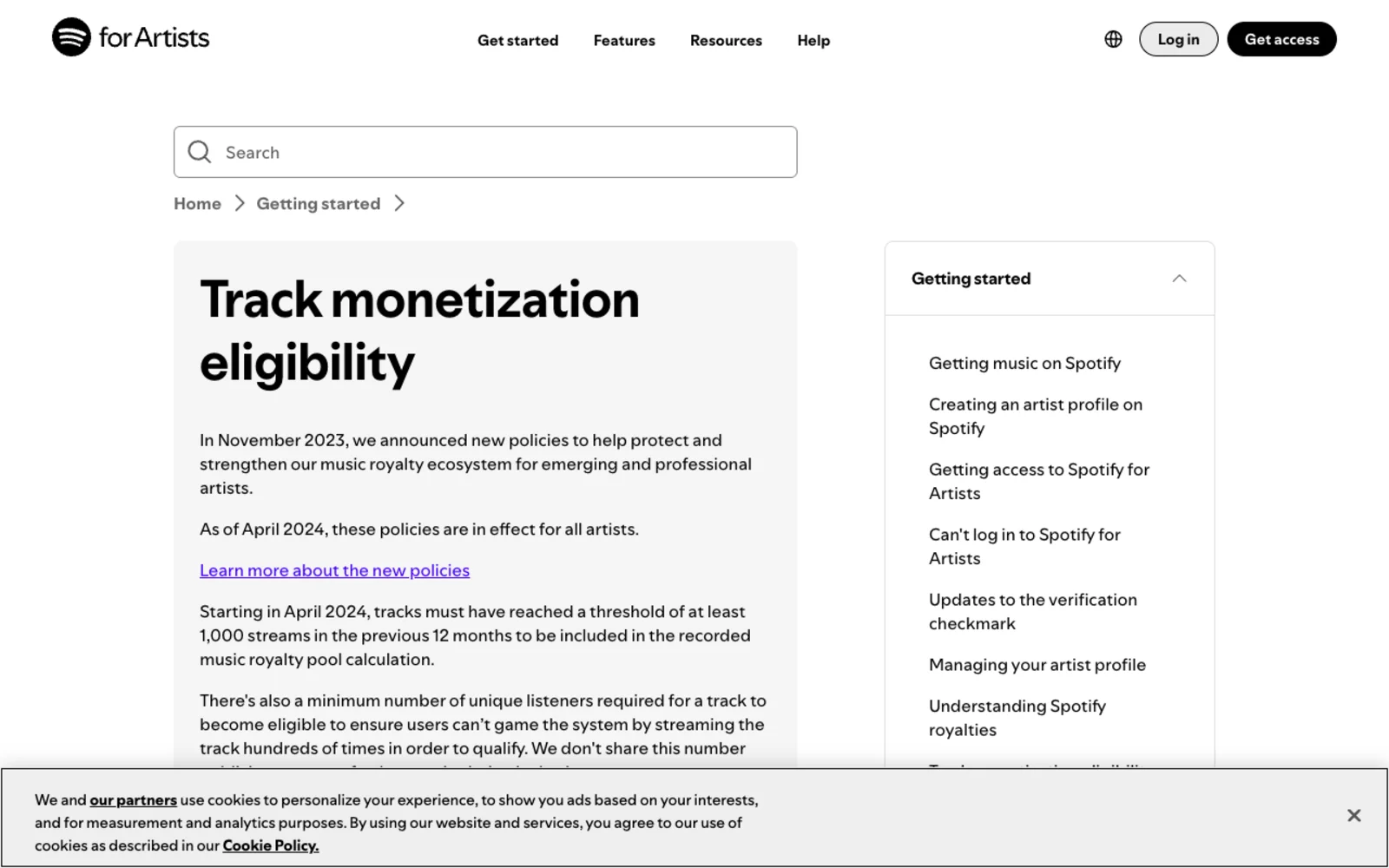
That exclusion collides with Spotify's own royalty rule. A track only enters the royalty pool after 1,000 streams in the previous 12 months, from an undisclosed minimum number of unique listeners. Losing recommendations mostly removes the route to that threshold.
Spotify's own figure for what sits below the line: tracks with 1 to 1,000 annual streams average 3 US cents a month and account for 0.5% of total streams. That is the value of a catalogue nothing is recommending.
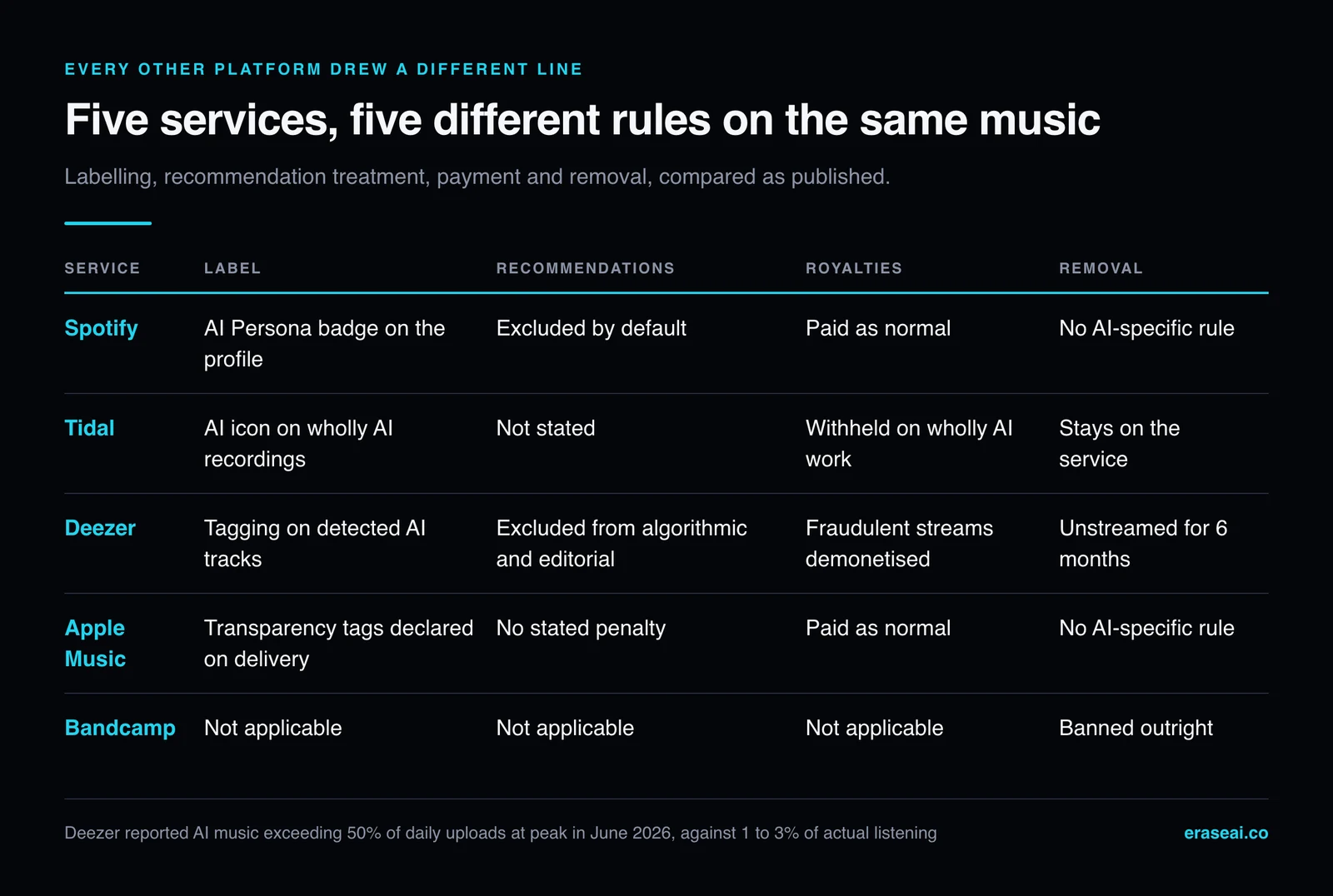
The rest of the market drew four different lines. Tidal withholds royalties from wholly AI-generated recordings, Deezer deletes AI tracks unstreamed for six months, Bandcamp bans them outright, and Apple Music tags them with no penalty attached.
- What the badge actually flags
- The cost is invisibility, not removal
- Why royalties continuing is not the same as being paid
- Who gets badged, and who only thinks they will
- Self-disclose, wait, or appeal
- Every other platform drew a different line
- The gate that comes before any of this
- What still reaches a listener
- FAQ
What the badge actually flags
Two Spotify systems, constantly confused, with completely different consequences.
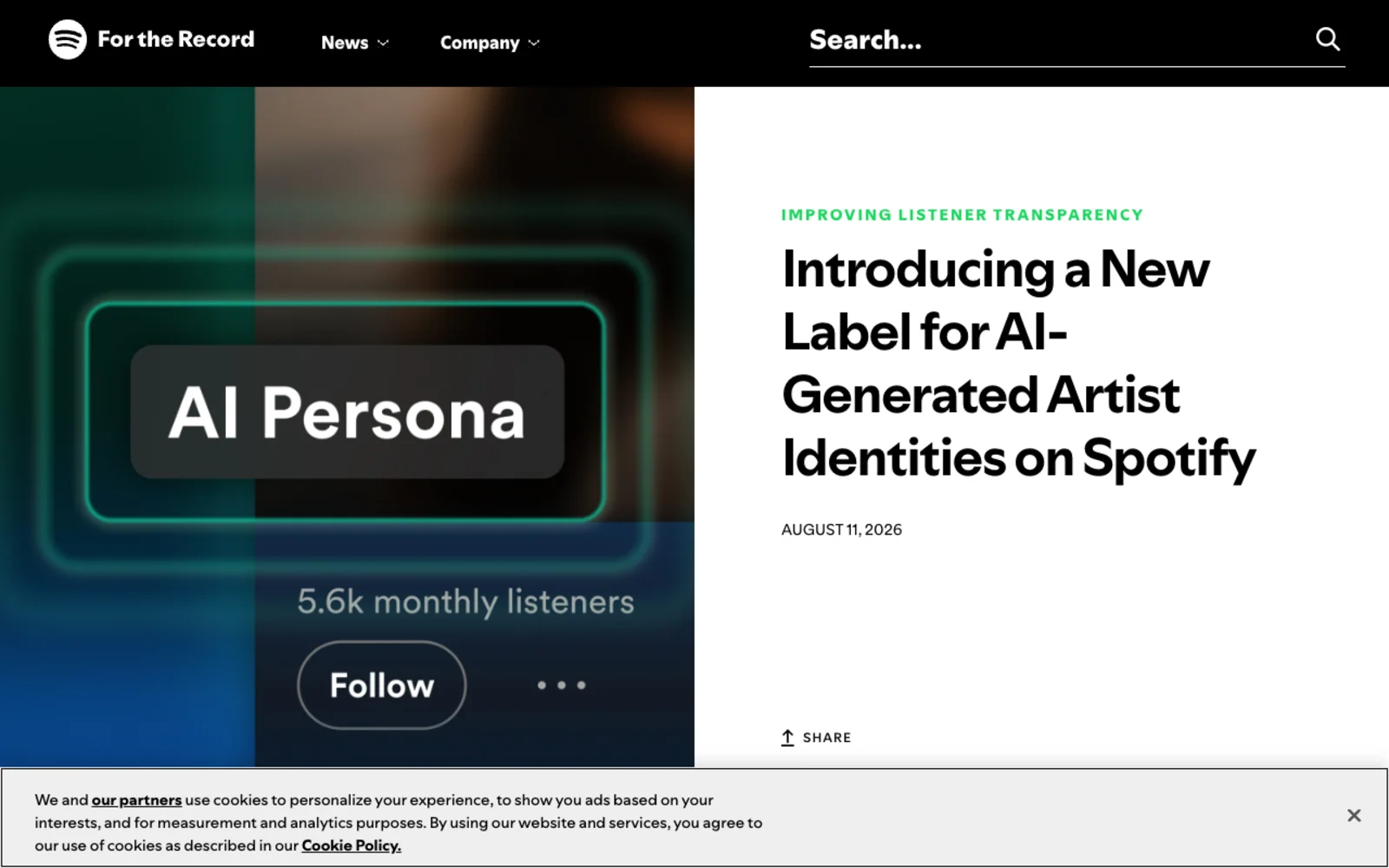
Spotify announced the badge on 11 August 2026 and described it in one sentence: it signals to listeners that an artist's identity may be AI-generated and does not represent a real person. Read that again, because the noun is identity. The badge is a claim about who is on the profile, not about which plugins, samples or generators produced the audio.
That distinction has a second half most coverage skips. Spotify already runs a separate disclosure route for the music itself: AI credits, built on the industry's DDEX delivery metadata with distributors including DistroKid and CD Baby, which surface in Song Credits when an artist chooses to declare AI vocals, instrumentation or post-production. Spotify says tens of thousands of those credits are submitted daily. They carry no recommendation penalty at all.
So there are two labels, and only one of them costs you anything. Confusing them is why a lot of Suno users currently believe disclosing their tools will bury their release. It will not.
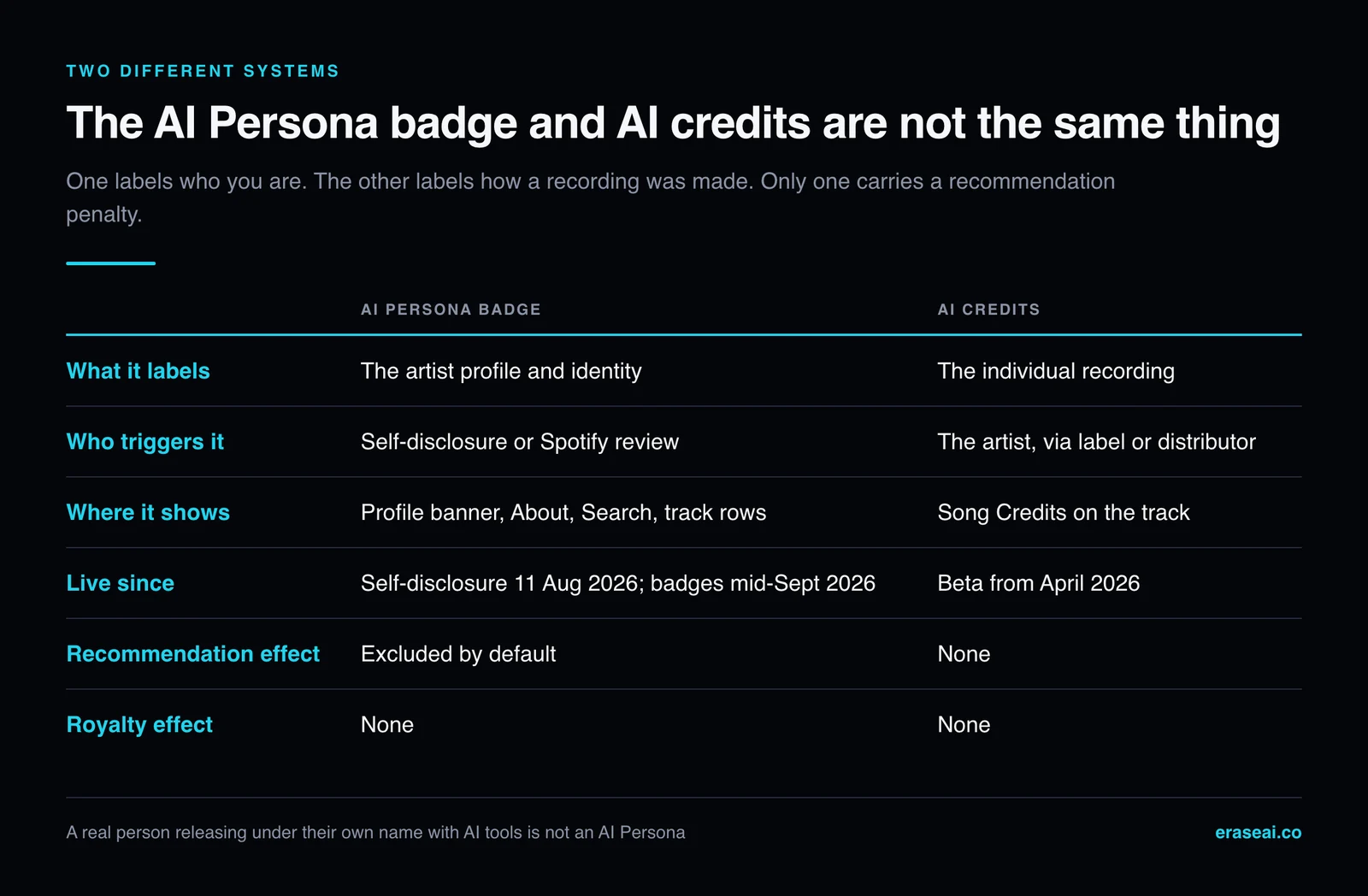
| AI Persona badge | AI credits in Song Credits | |
|---|---|---|
| What it labels | The artist profile and identity | The individual recording |
| Who triggers it | Self-disclosure or Spotify review | The artist, via label or distributor |
| Where it shows | Profile banner, About, Search, track rows | Song Credits on the track |
| Live since | Self-disclosure 11 Aug 2026; badges mid-Sept 2026 | Beta from April 2026 |
| Recommendation effect | Excluded by default | None |
| Royalty effect | None | None |
One column is a disclosure. The other is a disclosure with a distribution consequence bolted on. The rest of this page is about the second column, because that is the one with a price.
The cost is invisibility, not removal
Nothing comes down. The surfaces that carried strangers to you close.
Spotify's wording is flat: by default, it will not include AI Personas in any editorial or algorithmic recommendation. A badged profile is still on Spotify. Its tracks still play, still appear in Search, still sit in the libraries of anyone who saved them, and still earn on exactly the same terms. What stops is Spotify putting the music in front of somebody who never asked for it.
For a catalogue that grew through algorithmic radio, mood playlists and Discover Weekly, that is close to the whole business. Those surfaces are precisely where a listener who has never heard of you encounters you. Take them away and the only people who can reach the music are people who already know it exists, which means every stream now has to be paid for somewhere else, in effort or in money.
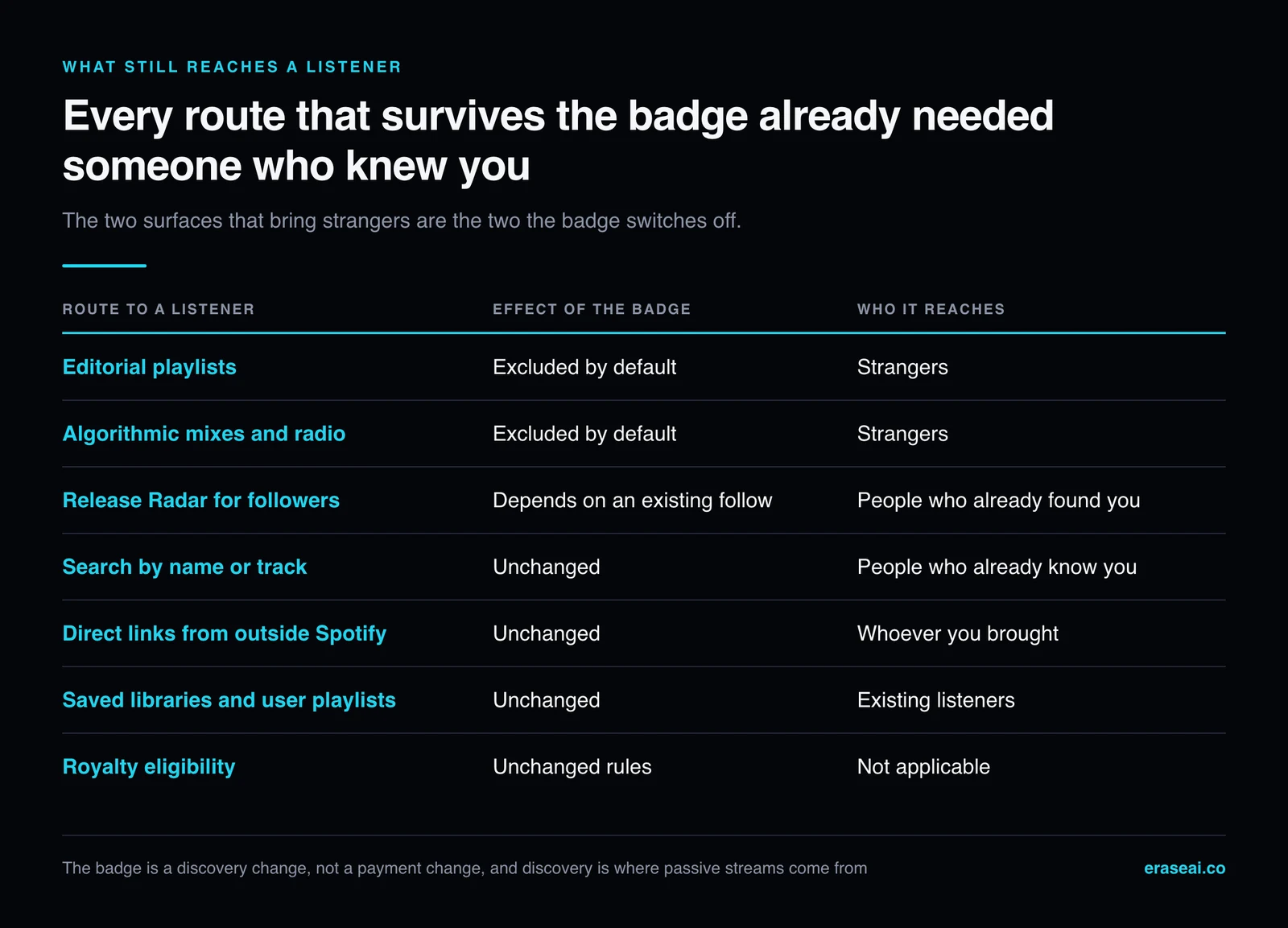
| Surface | After the badge | Who it reaches |
|---|---|---|
| Editorial playlists | Excluded by default | Strangers |
| Algorithmic mixes and radio | Excluded by default | Strangers |
| Release Radar for followers | Depends on an existing follow | People who already found you |
| Search by name or track | Unchanged | People who already know you |
| Direct links from outside Spotify | Unchanged | Whoever you brought |
| Saved libraries and user playlists | Unchanged | Existing listeners |
| Royalty eligibility | Unchanged rules | n/a |
Read the third column downwards. Everything a badge preserves reaches an audience you already have. Everything it removes reaches an audience you do not. That is the trade in one line, and it is why “your music stays up” is a weaker reassurance than it sounds.
Royalties continuing is not the same as being paid
Spotify publishes both halves of this. Nobody puts them next to each other.
Every explainer that says the badge does not affect payments is telling the truth about the badge and skipping what pays. Spotify has required, since April 2024, that a track reach at least 1,000 streams in the previous 12 months before it is included in the recorded music royalty pool calculation, and those streams must come from a minimum number of unique listeners that Spotify deliberately does not publish.
Now put the two rules together. The badge removes the mechanism that delivers unfamiliar listeners. The royalty rule requires unfamiliar listeners in a specific quantity. A badge does not take a cent off a track that already clears 1,000 streams a year. It makes clearing 1,000 streams a year considerably harder for everything that has not.
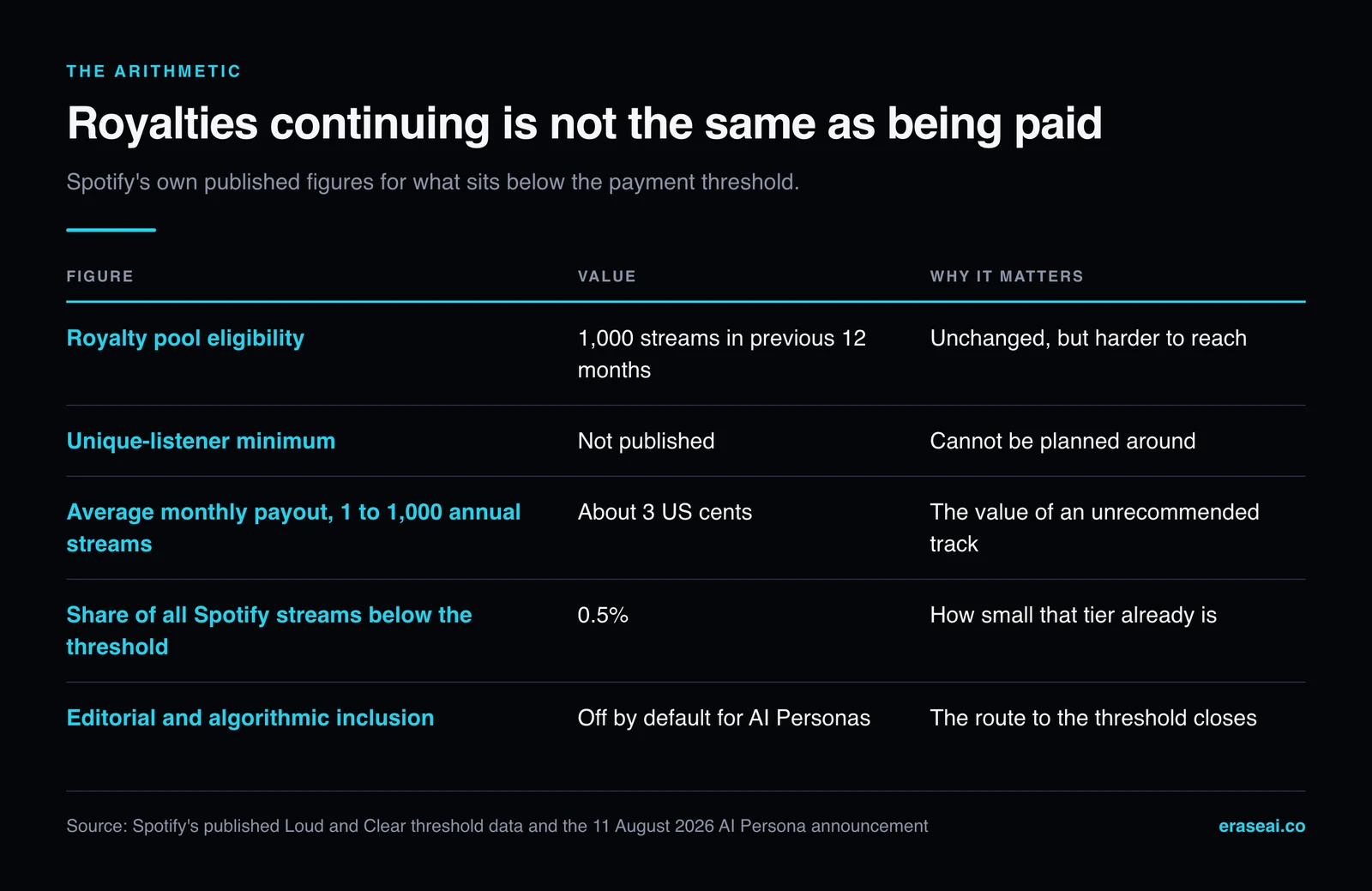
| Rule or figure | Value | Effect on a badged catalogue |
|---|---|---|
| Royalty pool eligibility | 1,000 streams in previous 12 months | Unchanged, but harder to reach |
| Unique-listener minimum | Not published | Cannot be planned around |
| Average monthly payout, 1 to 1,000 annual streams | About 3 US cents | The value of an unrecommended track |
| Share of all Spotify streams below the threshold | 0.5% | How small that tier already is |
| Editorial and algorithmic inclusion | Off by default for AI Personas | The route to the threshold closes |
Three cents a month is Spotify's own average for the tier a badged release is most likely to sit in. The honest summary is not “the badge costs you money”. It is that the badge costs you the only free path to the point where money starts, and for a catalogue built on passive discovery there was never another one. We walked through the same arithmetic from the earnings side in our guide to making money with AI music.
Who gets badged, and who only thinks they will
The line is drawn around the persona. Most creators are on the safe side of it.
Spotify described two routes to a badge. An artist can self-disclose through Spotify for Artists, which opened the same day as the announcement. Separately, Spotify reviews artist profiles and identifies those whose public identity appears to represent a photorealistic AI-generated identity, starting with artists that meet defined audience thresholds. Spotify has also said it intends to give listeners a way to report profiles they believe are AI Personas.
Two things follow from that wording. The review starts at the top, not the bottom, so the first wave lands on profiles with meaningful audiences rather than on a first release. And the trigger is a photorealistic invented person: a synthetic face, a fabricated biography, a name presented as a human being who is not one.
Likely a persona
A photorealistic portrait of somebody who does not exist, a backstory written for a character, and no human anywhere in the public presentation.
Not a persona
You, under your own name or a normal stage name, using generative tools in the studio. Method is disclosed through AI credits, which cost nothing.
The grey area
A band-style project name with an illustrated or abstract avatar. Not a photorealistic human, so not the stated target, but worth documenting who is behind it.
The reasonable precaution
An About section that names a real person, links to real profiles and says plainly how the music is made. Cheap to write, and it is what an appeal will need.
Self-disclose, wait, or appeal
Three positions, and the one that suits you depends on what your profile is.
If your project genuinely is a synthetic persona, self-disclosure is the honest position and it removes the risk of being labelled later by a review you did not see coming. It does not soften the consequence: a self-disclosed AI Persona is excluded from recommendations on the same terms as a reviewed one.
If you are a real person, do nothing to the persona field and put your effort into the profile instead. Spotify says it notifies artists it badges and gives them the opportunity to self-disclose or appeal. An appeal is a much easier argument when the About section already names a human, links out to accounts with a history, and does not lean on a face that a reverse image search cannot place.
| Your project | Position | What to do this week |
|---|---|---|
| A synthetic artist with an invented face | Self-disclose | Declare it, then rebuild reach outside recommendations |
| You, under your own name, using AI tools | Do not disclose a persona | Add AI credits through your distributor instead |
| A project name with an abstract avatar | Wait, but document | Name a real person in the About section now |
| Already badged and you disagree | Appeal | Gather identity evidence before you file |
| Unsure which you are | Wait | Assume the review starts with large profiles, not yours |
One caution on appeals. Spotify has published neither a turnaround time nor an outcome rate, so an appeal is a process with an unknown clock attached. Treat the evidence as something you prepare before you need it, not after.
Every other platform drew a different line
Four services, four incompatible policies, and only one of them is about labels.
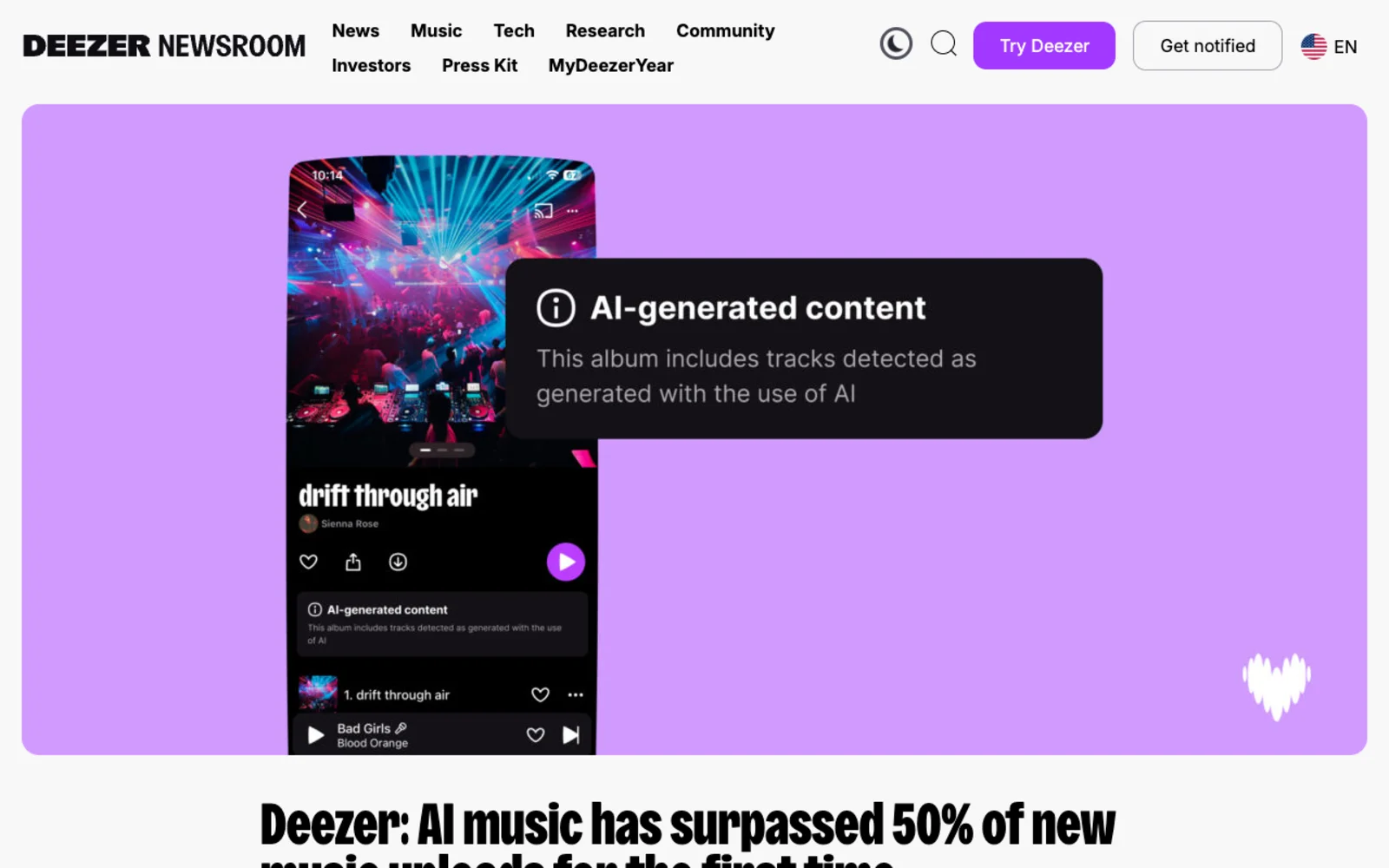
Spotify's badge is the mildest position on this list, which is worth knowing before treating it as the worst thing that has happened to AI releases this year. Tidal does not pay royalties on recordings it identifies as wholly AI-generated and blocks them from direct-to-fan sales, and it says it will extend that to substantially AI-generated work as detection improves. Deezer reported roughly 90,000 fully AI-generated tracks arriving daily, more than half of all daily uploads at peak in June 2026, against 1 to 3% of actual listening, and now takes down AI tracks that have not been streamed for six months or more.
| Service | Label | Recommendations | Royalties | Removal |
|---|---|---|---|---|
| Spotify | AI Persona badge on the profile | Excluded by default | Paid as normal | No AI-specific rule |
| Tidal | AI icon on wholly AI recordings | Not stated | Withheld on wholly AI work | Stays on the service |
| Deezer | Tagging on detected AI tracks | Excluded from algorithmic and editorial | Fraudulent streams demonetised | Unstreamed for 6 months |
| Apple Music | Transparency tags declared on delivery | No stated penalty | Paid as normal | No AI-specific rule |
| Bandcamp | Not applicable | Not applicable | Not applicable | Banned outright |
Bandcamp is the outlier worth naming plainly, because it is regularly recommended as the friendly alternative: since January 2026 it has not permitted music generated wholly or in substantial part by AI, and it reserves the right to remove anything it suspects. Apple sits at the other end, with tags declared on delivery and no penalty attached, which we covered in AI music on Apple Music. The Spotify-specific policy detail lives in AI music on Spotify, and the causes of an outright disappearance in AI music removed from streaming.
The gate that comes before any of this
A badge is a profile decision. Screening is a file decision, and it happens first.
Start with what is not true, because the search results for this topic are full of it. No audio tool removes an AI Persona badge. The badge lives on your Spotify artist profile, it is applied by disclosure or by a review of how your public identity presents, and nothing you do to a WAV file touches it. Anyone selling you otherwise is selling you a fiction, and the same goes for Apple's transparency tags, which are declared by your distributor on delivery rather than read out of the audio.
There is a real gate, and it sits earlier in the chain. Before any platform gets to label anything, a distributor runs automated screening over the delivered file, and raw generator exports do get flagged and rejected there. That is a file problem with a file solution: the artifacts a generator leaves in a bounce, the loudness and format expectations of the delivery spec, and the general question of whether the master sounds like a finished record. Our breakdown of what that screening reads is in AI audio cleanup, and the detector side in AI music detectors.
For the cleanup pass itself we use Undetectr, which is built for exactly that step and nothing beyond it. It prepares a track to clear distributor screening and gets audible generation artifacts out of the bounce. It does not, and cannot, stop a platform labelling you, and we would not recommend it on that basis.
What still reaches a listener
The badge closes one route. It is worth being honest about how good that route was.
The loudest thread in r/SunoAI this month was not about takedowns at all. It argued that if AI music were really so bad, people would stop listening on their own, and the top replies asked Spotify for a filter to keep it out of their recommendations. That is the uncomfortable context for the badge: a meaningful slice of the audience wants it, and Deezer's figures suggest the recommendation surfaces were never carrying this catalogue very far anyway, with fully AI-generated tracks at more than half of daily uploads and between 1 and 3% of listening.
Which changes what a sensible response looks like. Fighting for algorithmic placement you were unlikely to win is a poor use of a month. The routes that survive a badge are the ones that never depended on an algorithm: a person who hears the track somewhere else and searches for it, a follower who gets a release notification, a link you sent, and a buyer who pays for the music directly.
The one with real money attached is sync. A track licensed into a video, a game or an advert is chosen by a human being for a specific brief and pays properly for it, and nothing about a profile badge on a streaming service enters that decision. Storefronts built for independent creators, such as played.fm's sync route, exist to put finished tracks in front of the people buying them, and the same storefront lets you sell direct and keep the audience list rather than renting it from a recommendation engine. It is worth noting that Bandcamp, the usual suggestion here, does not permit this music at all.
None of that replaces streaming distribution and we would not pretend it does. It is a second route, and the badge is a good reason to build one. The costed version of that argument is in our guide to selling AI music.
AI Persona badge FAQ
What is the Spotify AI Persona badge?
It is a label Spotify puts on artist profiles to signal to listeners that an artist's identity may be AI-generated and does not represent a real person. Spotify announced it on 11 August 2026 and said the badge would start appearing on some artist profiles from mid-September. It shows on the profile banner and About section, in Search, and on track rows across playlists.
Does the AI Persona badge stop my royalties?
No. The badge is a disclosure and discovery change, not a payment change. A badged profile stays on the service, stays searchable and stays monetised on the same pro-rata terms as everything else. What it loses is inclusion in Spotify's editorial and algorithmic recommendations by default, which is how most passive streams are earned in the first place.
Will I get badged for using Suno or Udio to make my music?
Not on its own. Spotify has been explicit that the badge is about the artist's public identity, not about how the music was made. A real person who writes, prompts, edits and releases under their own name is not an AI Persona. Disclosure of AI used in the production itself runs through a separate system, the AI credits shown in Song Credits, which carries no recommendation penalty.
How does Spotify decide which profiles get the badge?
Two routes. Artists can self-disclose through Spotify for Artists, which opened on 11 August 2026. Spotify also reviews profiles itself and identifies those whose public identity appears to represent a photorealistic AI-generated identity, starting with artists that meet defined audience thresholds. Spotify has said it plans to let listeners report profiles as well.
Can I appeal an AI Persona badge?
Yes. Spotify says an artist whose profile it badges will be notified and given the opportunity to self-disclose or appeal. Spotify has not published an appeal turnaround time or a success rate, so treat the appeal as a process with an unknown clock and keep your own evidence of a human identity ready before you need it.
How much does being excluded from recommendations actually cost?
It removes the route by which unfamiliar listeners find you at all. Spotify only counts a track towards the royalty pool once it has passed 1,000 streams in the previous 12 months, from an undisclosed minimum of unique listeners. Tracks between 1 and 1,000 annual streams earn about 3 US cents a month by Spotify's own figure, so losing recommendations mostly costs you the path to eligibility rather than a stream of income you already had.
Do other streaming services treat AI music the same way?
No, and the differences are large. Tidal does not pay royalties on recordings it identifies as wholly AI-generated and blocks them from direct-to-fan sales. Deezer keeps detected AI music out of recommendations and editorial playlists and removes tracks unstreamed for six months or more. Bandcamp bans music generated wholly or in substantial part by AI. Apple Music applies transparency tags declared on delivery and attaches no recommendation penalty to them.
Can any tool remove an AI Persona badge?
No, and be sceptical of anything that claims otherwise. The badge sits on your Spotify artist profile, not inside your audio file, and it is applied by disclosure or by Spotify's own review of how your public identity presents. Nothing you do to a WAV file changes it. Audio processing addresses a different gate entirely, the automated screening a distributor runs before a release is ever delivered.
- Spotify Newsroom — Introducing a new label for AI-generated artist identities (11 August 2026: the badge definition, the mid-September rollout, self-disclosure, the review of photorealistic identities, and exclusion from editorial and algorithmic recommendations by default)
- Spotify — Track monetization eligibility (the 1,000-stream threshold over 12 months, the unpublished unique-listener minimum, and the 3 cents a month / 0.5% figures)
- Music Business Worldwide — Spotify to label AI artists and keep their music out of recommendations by default (trade coverage of the same announcement)
- Music Business Worldwide — Spotify to show AI tags in Song Credits (the separate AI credits system, the DDEX disclosure standard and the distributors behind it)
- Deezer Newsroom — AI music exceeds 50% of daily uploads (July 2026: ~90,000 tracks a day, 1–3% of streams, exclusion from algorithmic and editorial surfaces, and the six-month takedown rule)
- TIDAL — AI Policy (wholly AI-generated recordings ineligible for royalty attribution and direct-to-fan sales, labelled with an icon, with partly-AI work explicitly untouched)
- Bandcamp — Keeping Bandcamp human (January 2026: music generated wholly or in substantial part by AI is not permitted)
- Music Business Worldwide — Apple Music launches AI transparency tags (March 2026: tags for artwork, track, composition and music video, declared by the distributor on delivery)
- The r/SunoAI thread quoted above, arguing that listeners would stop on their own: “If AI music was so bad, people would just stop listening”
TIDAL's policy pages block automated readers, so its wording here comes from its published policy as indexed rather than from a direct fetch; check the live page before relying on it. Apple's tags were optional at launch and have been reported as becoming mandatory later in 2026. Platform policy in this area changed several times during 2026, so confirm a rule at source before acting on it. EraseAI earns from links to Undetectr, the tool recommended above.
Related guides
AI music on Spotify
The policy page: what Spotify permits, what its spam enforcement targets, and where disclosure sits.
AI music removed from streaming
When a track does not just lose recommendations but disappears entirely, and the five causes behind it.
AI music on Apple Music
Transparency tags, what your distributor declares on delivery, and why no penalty is attached.
AI music detectors
What the classifiers behind platform tagging actually measure, and how accurate they are in practice.
DistroKid and AI music
The distributor gate that decides whether a release ever reaches a platform to be labelled.
Sell AI music
The routes to income that do not depend on a recommendation engine choosing you.
Or browse every guide on the site.
The badge is a profile problem. Screening is a file problem.
Nothing processes a label off your artist page. What a cleanup pass does change is whether the delivered file clears a distributor's automated screening in the first place, which is the gate that comes before any platform gets to label anything.
▸ Independent · We recommend Undetectr