Platforms That Accept AI Music in 2026
Being told no by one service and having no idea which of the others will say the same thing is the most common way this goes wrong. The numbers behind that are not small: SubmitHub blocks anything its detector scores at 85% or higher and says roughly 11% of recent uploads hit that bar, while Deezer now receives close to 90,000 fully AI-generated tracks a day. So here is every platform that accepts AI music that we could verify — eight distributors, six promo services, five streaming platforms — with what each asks of you. We read every policy at source on 20 September 2026, and each row carries the date its own source was last updated rather than one date for the whole page.
The short version
Five findings, each from a policy page you can open yourself.
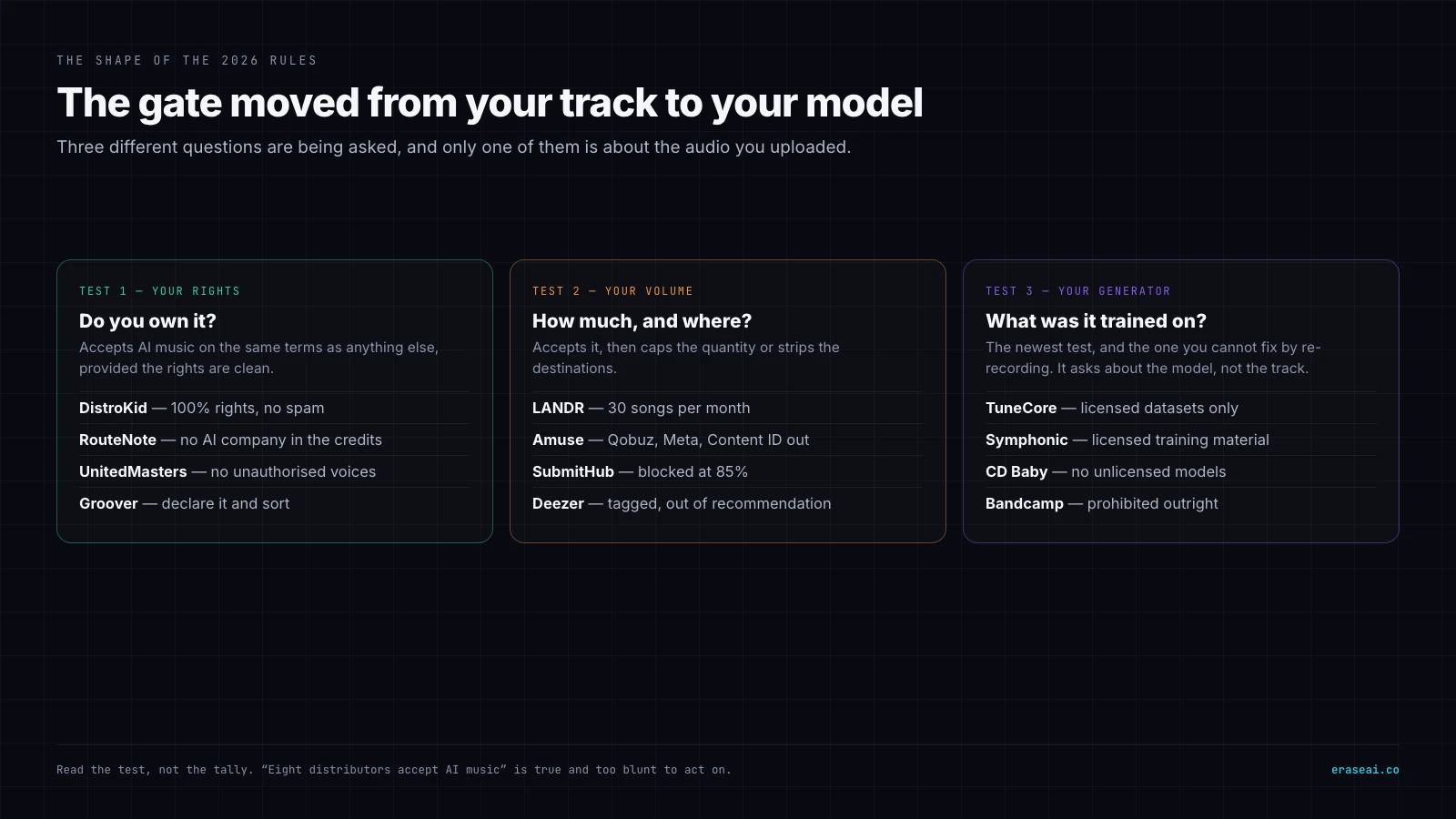
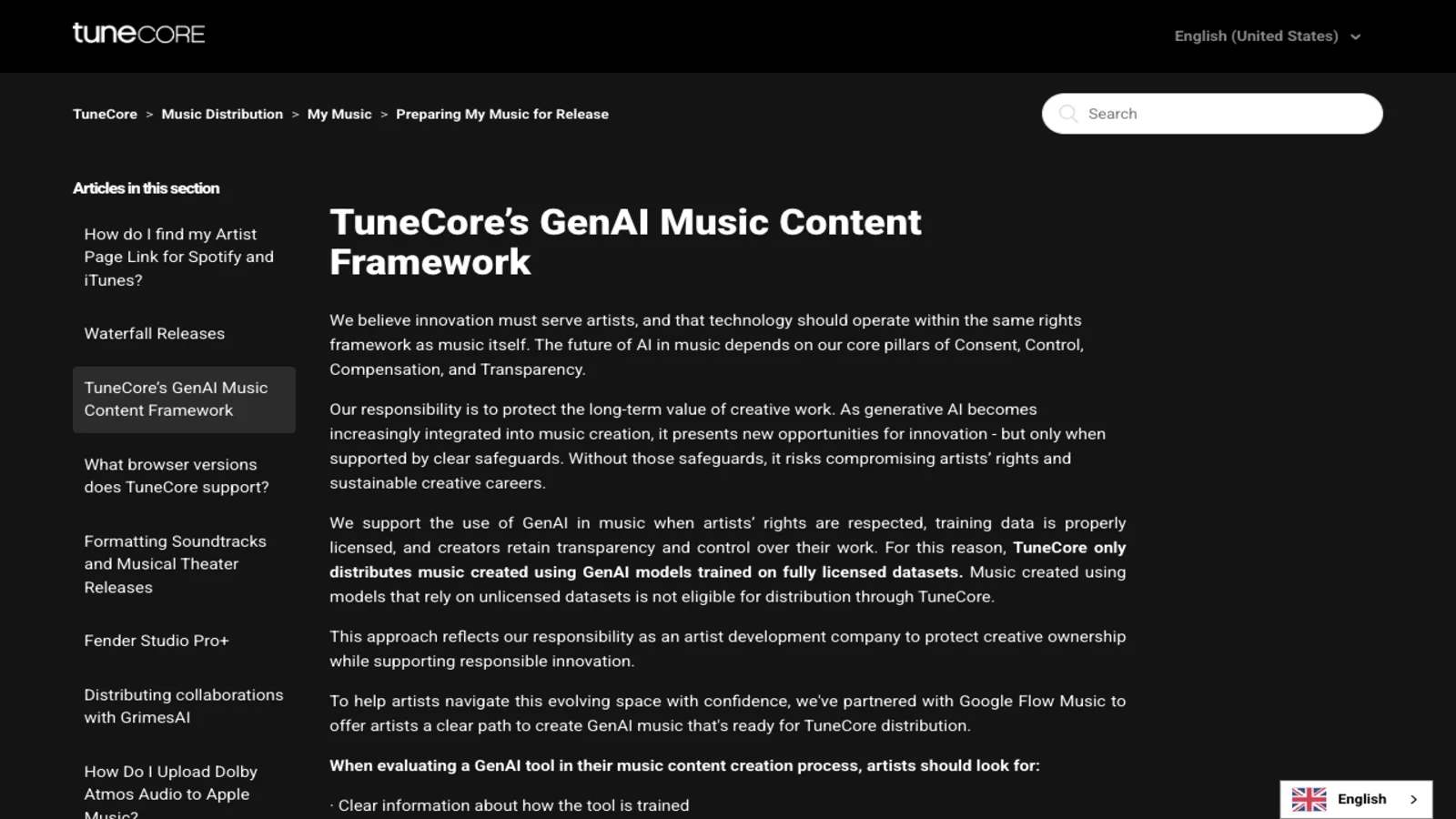
The yes-or-no list is dying. TuneCore, Symphonic and CD Baby's parent now all judge the model you used rather than the track you made — the test is whether its training data was licensed, and it applies if AI touched the work at any point.
Three distributors still publish a plain yes. DistroKid, RouteNote and UnitedMasters impose no licensing test in their published rules, and all three updated their guidance between 19 August and 15 September 2026.
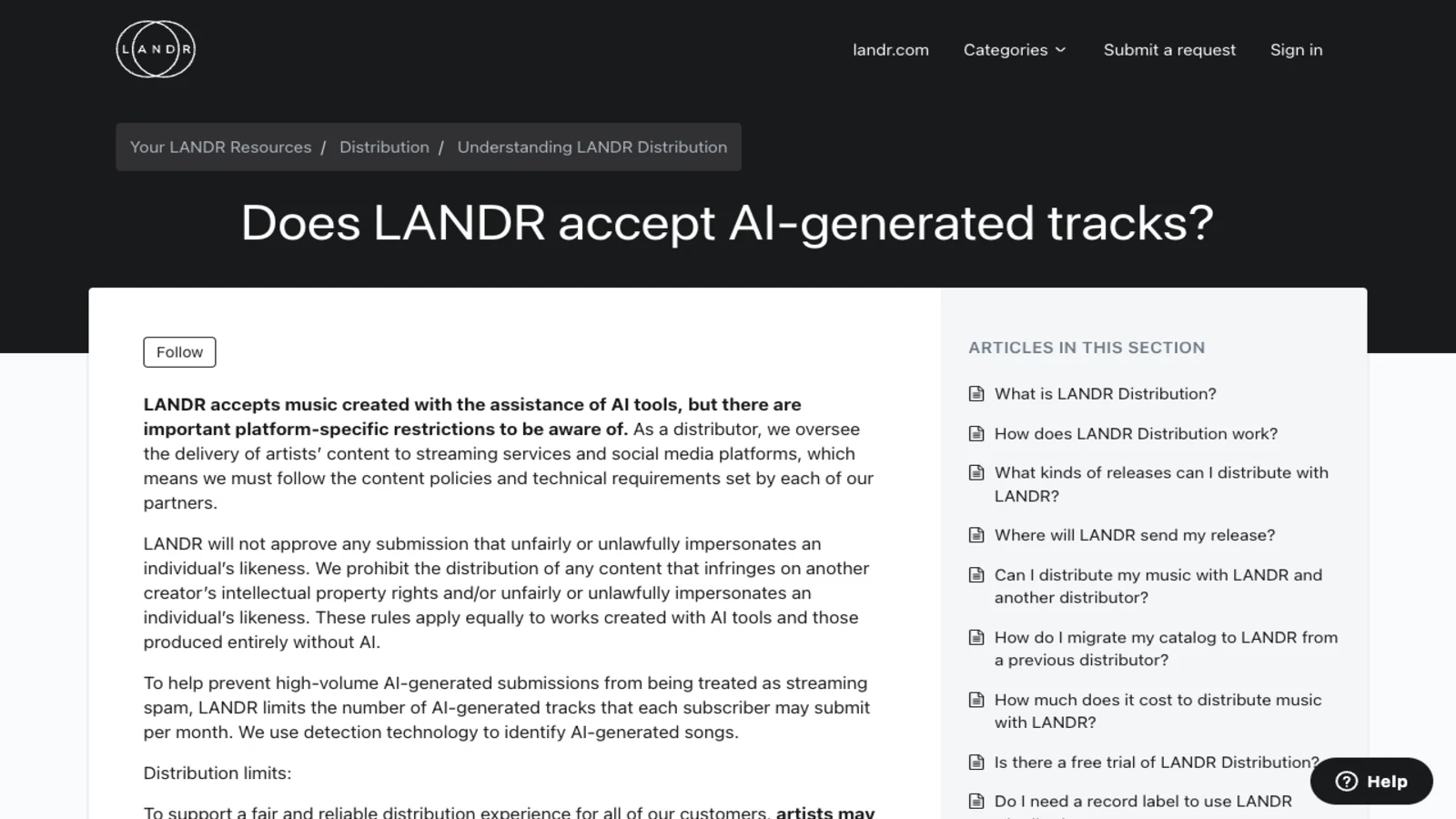
The caps are the part nobody quotes correctly. LANDR's published ceiling is 30 AI-generated songs per calendar month per subscriber, not the 12 that every comparison page still repeats — its help article was updated on the day we checked it.
Promo is the harder gate, not distribution. SubmitHub blocks at 85% with no appeal and MusoSoup bans AI outright, while Playlist Push, Daily Playlists and SoundCampaign publish no AI policy at all, which leaves each curator to decide.
Nobody is banning AI music as a category. Of the fourteen services here, exactly two — MusoSoup and Bandcamp — prohibit it outright. The rest are asking about rights, disclosure and volume.
What changed in September 2026
Three events in eleven days, pulling in opposite directions.
Any list of this kind written before September is now wrong in at least one row, which is the reason to date the rows rather than the page. On 8 September Suno announced a partnership with Believe and TuneCore. Suno's own post is blunt about what it reverses: “Earlier this year, Believe and TuneCore said they would not distribute music made with models that did not meet their standards.” Tracks from Suno's industry-partner model became eligible, alongside watermarking and what the post calls “new download limits designed to prevent mass distribution”.
On 15 September Universal Music Group, Capitol Records and Capitol CMG sued DistroKid in Delaware, alleging it built an “AI-slop pipeline” and naming around a thousand recordings, at statutory damages of up to $150,000 per work. Read the filing's own framing before you panic about it: Universal says the case “is not about the distribution of AI-generated music when clearly disclosed as such”. It is an allegation, days old, that DistroKid has not answered in public.
On 18 September Universal and Sony sued Suno a second time, in Massachusetts, over 60,202 recordings, arguing that because the v6 family was trained on the outputs of earlier models, “training a ‘new’ model on the outputs of an infringing model does not eliminate the infringement; it launders it”. Warner, BMG and Believe have licensed; Universal and Sony have not.
The route widened and narrowed in the same fortnight: the distributor most AI creators use is being sued for taking too much of this music, while the one that refused it opened a door. Neither event closed a gate that was open the week before.
Distributors: who accepts AI music
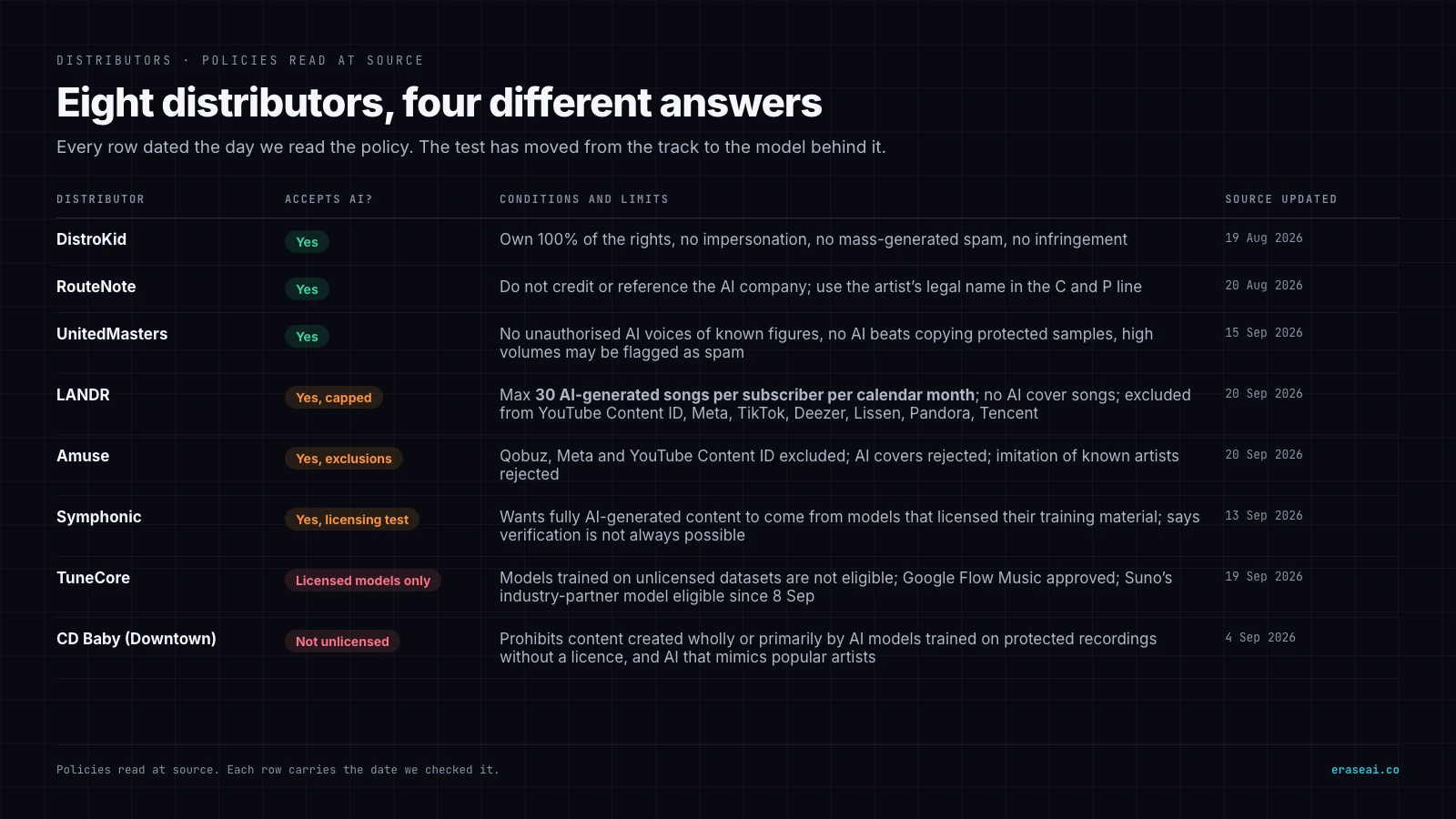
Eight services, each row read from the company's own help centre.
The useful finding across all eight is that the binary is collapsing. The old question was whether a distributor accepts AI music. What three of these now ask is whether the model you used licensed its training data — a test about a company you do not control, applied to a track you made.
| Distributor | Accepts AI? | Disclosure | Conditions and limits | Source updated |
|---|---|---|---|---|
| DistroKid | Yes | Not required as a flag; AI credits apply to some releases | Own 100% of the rights, no impersonation, no mass-generated spam, no infringement | 19 Aug 2026 |
| RouteNote | Yes | Not published as a checkbox | Do not credit or reference the AI company; use the artist's legal name in the C and P line | 20 Aug 2026 |
| UnitedMasters | Yes | Not required; DSPs may label the track anyway | No unauthorised AI voices of known figures, no AI beats copying protected samples, high volumes may be flagged as spam | 15 Sep 2026 |
| LANDR | Yes, capped | Required at upload; detection used as well | Max 30 AI-generated songs per subscriber per calendar month; no AI cover songs; excluded from YouTube Content ID, Meta, TikTok, Deezer, Lissen, Pandora, Tencent | 20 Sep 2026 |
| Amuse | Yes, with exclusions | Amuse identifies AI content at its own discretion | Qobuz, Meta and YouTube Content ID excluded; AI covers rejected; imitation of known artists rejected; no Content ID later | Checked 20 Sep 2026 |
| Symphonic | Yes, moving to a licensing test | Required during SymphonicMS upload, audio and artwork | Wants fully AI-generated content to come from models that licensed their training material; says verification is not always possible | 13 Sep 2026 |
| TuneCore | Only licensed-dataset models | Required; applies if GenAI was used at any point | Models trained on unlicensed datasets are not eligible; Google Flow Music approved; Suno's industry-partner model eligible since 8 Sep | 19 Sep 2026 |
| CD Baby (Downtown) | Not for unlicensed models | Governed by the Downtown content policy | Prohibits content created wholly or primarily by AI models trained on protected recordings without a licence, and AI that mimics popular artists | 4 Sep 2026 |
Does DistroKid accept AI music?
Yes, and its help centre says so in the first sentence: “Yes — DistroKid accepts music created with AI tools, but there are some rules.” The rules are rights, impersonation, spam and infringement, none of which is about the tool. Our DistroKid and AI music guide goes through the upload questions in detail. The Universal suit sits beside that policy rather than replacing it.
Does TuneCore accept AI music?
Conditionally, and the condition is unusual. TuneCore distributes music from generative models “trained on fully licensed datasets” and states that music from models relying on unlicensed datasets is not eligible — explicitly “if GenAI is used at any point in the creation of a track”. That is a question about your generator, not your song. Suno's industry-partner model cleared it in September; a back catalogue made on an earlier model did not, and no announcement has said otherwise.
Does LANDR accept AI music?
Yes, with the tightest published ceiling here: thirty AI-generated songs per calendar month per subscriber, enforced with detection technology rather than trust, plus a long exclusion list and no AI covers. Every comparison page we found still quotes twelve. LANDR's article was updated on 20 September 2026, the day we read it — which is why one page-level “verified” date is not good enough in this category.
Does RouteNote, UnitedMasters, Symphonic or Amuse accept AI music?
All four do. RouteNote publishes no ban at all — its only AI article explains how to format an AI release, which tells you more than a policy statement would. UnitedMasters allows AI-created and AI-assisted work. Symphonic accepts with disclosure while steering toward licensed models. Amuse allows it but drops Qobuz, Meta and YouTube Content ID from delivery. Our walkthrough of the seven walls after the song covers what those exclusions cost you in practice.
Promo and playlist pitching
The half of the question that every comparison page leaves out.
Almost everyone arrives at this question because a pitch was blocked, not because a release was. The two feel identical and have nothing in common: a bounced release is a rights or metadata problem with a fix, while a blocked pitch is a probability score with no appeal. The best comparison pages on this topic cover distributors only.
| Platform | Accepts AI? | Detection and threshold | What it means for you | Checked |
|---|---|---|---|---|
| SubmitHub | Under 85% only | Own detector; pure and hybrid scores weighted roughly 3:1 to the spectral result | Blocked above the line, no appeal; flagged tracks that do get through are approved at 16% against 31% | 20 Sep 2026 |
| Groover | Yes, by design | None. Self-declared via an AI composition checkbox | Declare at step one and curators who accept AI sort to the top; those who refuse carry an AI music tag | 20 Sep 2026 |
| MusoSoup | No | Human review plus stated investment in detection | Fully AI-generated music is not allowed; a campaign found to be AI is removed and the artist may be suspended | 20 Sep 2026 |
| Playlist Push | No published policy | None published | No AI clause in its terms of use; each curator decides, so read the campaign brief rather than assuming | 20 Sep 2026 |
| Daily Playlists | No published policy | None published | Nothing on the site or its public feedback board; curator-by-curator, with no stated rule to appeal to | 20 Sep 2026 |
| SoundCampaign | No published policy | None published | No AI policy page we could find; treat acceptance as per-curator and unwritten | 20 Sep 2026 |
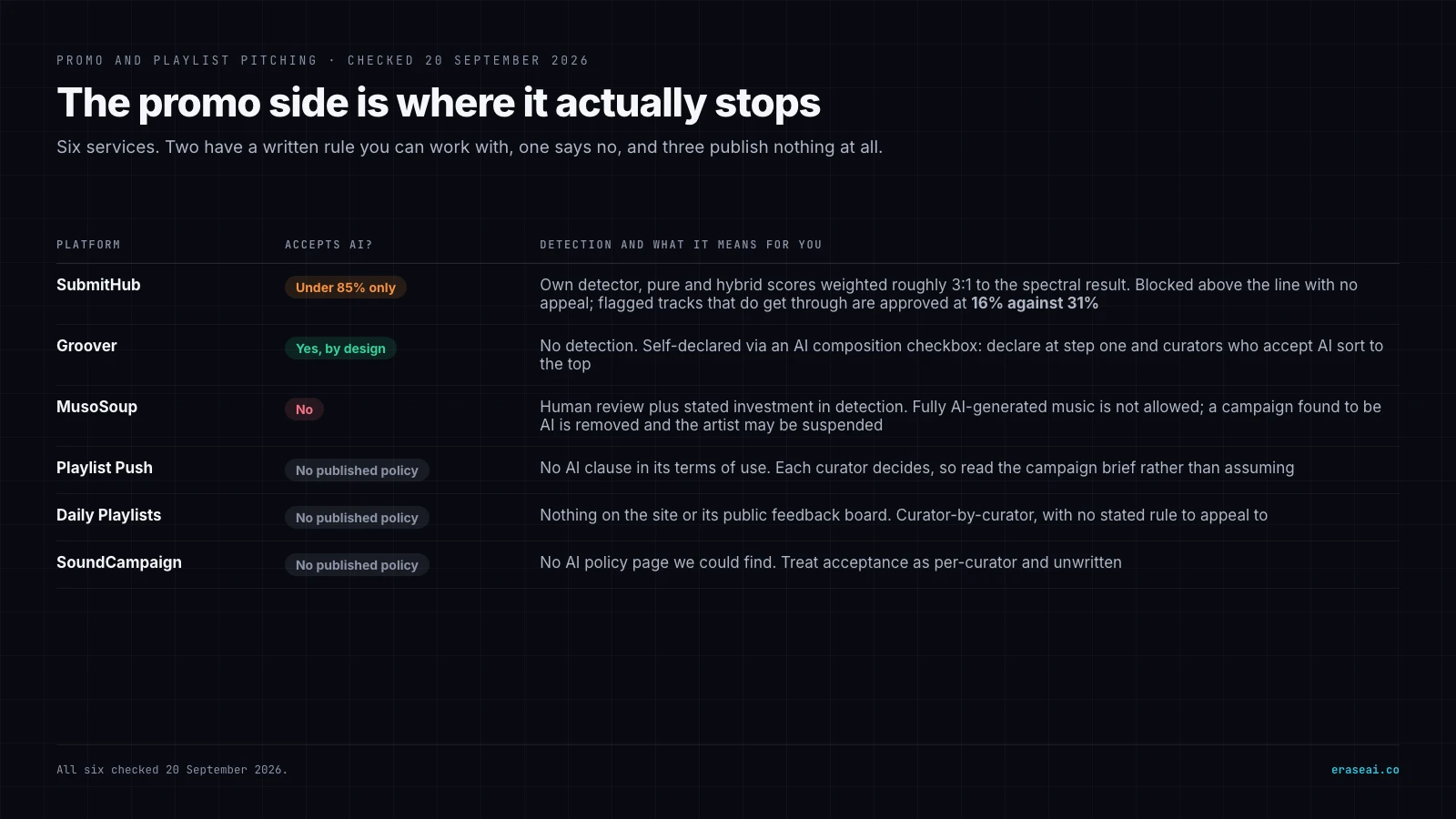
SubmitHub is the one with real published numbers behind it. Around 11% of recent uploads scored at or above the 85% cutoff, making up 9% of submissions, and those tracks were approved by curators at 16% against 31% for everything else. That second figure is the argument: the policy reads less as a moral position than as a refusal to sell promotion likely to fail. It also says plainly that writing the lyrics or composition yourself will not exempt a track, because what it measures is the audio. Our sister site has a closer look at the SubmitHub checker and how its scores behave.
Groover is the structural opposite: it treats AI as an attribute to declare rather than a disqualification, sorts the curators who accept it to the top of your list, and tags the ones who do not. Three of the six publish nothing at all — which is not the same as a yes. It means no rule to point at and no appeal if a curator declines. A platform with a stated 85% line is in one sense easier to work with than one with no line.
What the streaming services do next
Getting distributed is not the end of the decision tree.
Clearing a distributor puts the track in front of platforms with their own positions, and only one is a ban. The rest label, exclude from recommendation, or both — which affects who hears the track rather than whether it exists.
| Platform | Position | The practical cost |
|---|---|---|
| Spotify | No ban; DDEX-based AI disclosure carried in metadata | An AI Persona badge on a profile keeps it out of editorial and algorithmic recommendation by default |
| Apple Music | Transparency tags, declared by the distributor on delivery | A label, applied from what was sent — nothing reads your waveform |
| YouTube | Disclosure of synthetic or altered content required | Monetisation and Content ID eligibility, not takedown, is what is usually at stake |
| Deezer | Tags AI tracks for listeners; excludes them from recommendation | Nearly 90,000 fully AI tracks arrive daily, over half of deliveries on peak days |
| Bandcamp | Prohibits music generated wholly or substantially by AI | The strictest rule here, and the one most likely to break a direct-sales plan |
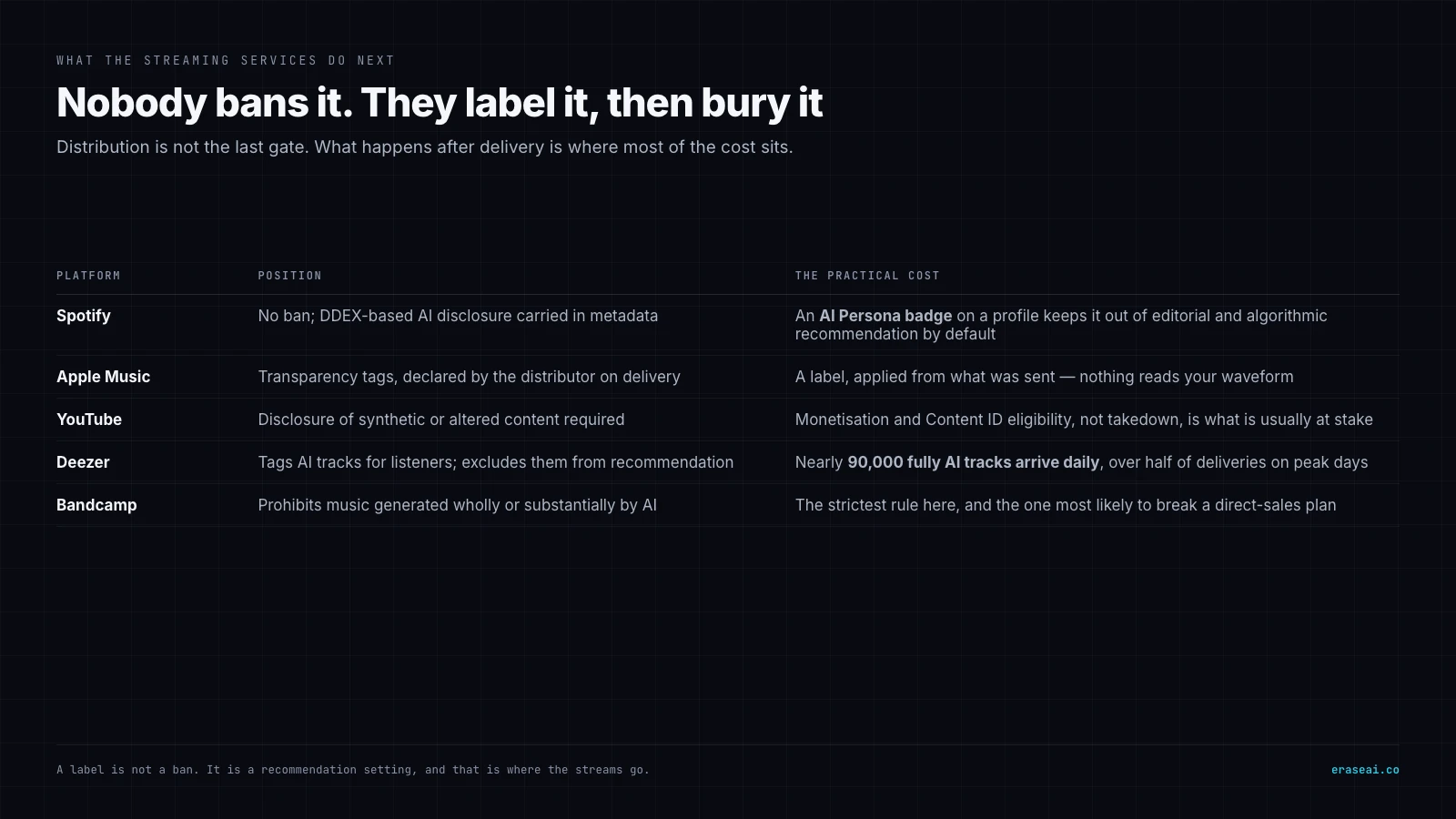
Deezer's numbers are the ones to sit with: AI music makes up more than half of daily uploads but 1% to 3% of streams, and 85% of those streams are detected as fraudulent and demonetised. That is the supply-and-demand picture for the whole category in two figures. Our guide to the Spotify AI Persona badge covers the one label with a real cost attached, and what the Bandcamp ban actually covers is worth reading before you plan around it.
Why tracks actually get rejected
Not because AI is banned — it mostly is not.
Of the fourteen services above, two prohibit AI music outright. The rest accept it or ask about rights, disclosure or volume. So when a release bounces, “they banned AI” is almost never the explanation, and treating it as one sends people to the wrong fix.
What does bounce a release: a rights problem the distributor cannot verify, an upload pattern that trips a spam threshold, a cover or imitation that runs into a specific prohibition, and — the one with a technical answer — automated screening on the delivered file, plus the audible decode artifacts that make a bounce more likely to stick. That last category is what Undetectr is built for: processing a generated track so it clears distributors' automated screening and so the artifacts a listener can hear are gone. It has nothing to say about the other three, and no tool can stop a platform labelling a track as AI, because the labels come from declarations and metadata rather than from the audio. EraseAI is independent and recommends Undetectr; we do not guarantee approval from any distributor.
It is worth knowing how weakly the detectors themselves hold up before you plan around them. We went through the published robustness tests in can you beat AI music detectors, and the short answer is that the transforms which measurably move a verdict are the ones that wreck the recording. Fixing what a listener can hear is the version of this that leaves you with a track worth releasing.
The disclosure question, answered once
Declare it. The platforms that take AI music mostly ask you to.
Half the services above ask for a declaration and several say they detect regardless — Amuse identifies AI content at its own discretion, LANDR uses detection technology to enforce its cap, Symphonic supplements client disclosures with fingerprinting. A false declaration is a risk with no upside, since the thing it would hide is the thing they measure anyway.
The sentiment among creators is less anguished than the discourse suggests. The recurring line in the forums is a version of “happy to disclose and be labelled AI, especially if it means I can still distribute the music” — the label is acceptable, being blocked is not. That position matches what the policies reward. Our guide to disclosure that works covers how narrow the required declaration usually is, and erasy's breakdown of Spotify's policy explains what the platform does with it afterwards.
If nothing on this list works
And the harder problem nobody on this page has solved for you.
Here is what this article cannot fix by listing more platforms. Getting distributed is, for most people reading it, already solved — the largest recent threads in the AI music forums are variations on one complaint, that the release went live and then nothing happened. Against 90,000 AI tracks a day at one service alone, distribution is the cheap part and being heard is the wall. Artifactr's piece on why nobody listens to AI music is the honest version of that.
Which points at the two routes on this page that do not run through a gatekeeper's classifier. The first is paid sync: a human supervisor picking a track against a brief for a show, a game or an ad, where the fee is agreed up front and nothing depends on algorithmic reach. The second is selling directly to the people who already like your work. played.fm is built for both — pitching for sync placements first, and a storefront where you keep 100% and own the relationship second. It is the obvious comparison to Bandcamp, with the difference that matters: Bandcamp prohibits substantially AI-generated music outright, so it is not an option for this catalogue at all.
Neither route makes the streaming numbers better. What they do is stop those numbers deciding whether the work earns at all, which for a category sitting at 1–3% of streams is a structural point rather than a preference. Our own guide to selling AI music works through the mechanics.
Platforms that accept AI music FAQ
Does DistroKid still accept AI music after the UMG lawsuit?
Yes. DistroKid's own help centre still opens with "Yes—DistroKid accepts music created with AI tools, but there are some rules", and that article was last updated on 19 August 2026. Universal filed its complaint on 15 September 2026 and it is an allegation the company has not answered in public, so nothing in it has changed the published policy. Universal's own filing says the case is not about distributing AI music that is clearly disclosed as such.
Can I pitch AI music on SubmitHub?
Only if its detector scores your track under 85% likely AI. Above that line the submission is blocked outright, and SubmitHub states there is no appeal and no workaround. It also says explicitly that writing the lyrics or the composition yourself does not exempt a track, because the measurement is of the audio. Groover is the closest alternative that takes AI tracks by design.
Which distributor is safest for AI music in 2026?
DistroKid, RouteNote and UnitedMasters publish the plainest acceptance and impose no licensing test on the model you used. Symphonic accepts with disclosure but has moved toward wanting AI models to have licensed their training material. LANDR accepts with a 30-track monthly cap. If your track came out of a model with contested training data, those first three are where the published rules ask you the fewest questions.
Does TuneCore accept Suno tracks now?
Some of them, and the distinction matters. TuneCore only distributes music from generative models trained on fully licensed datasets, and that rule applies if AI was used at any point. Suno's partnership with Believe and TuneCore, announced on 8 September 2026, makes tracks from Suno's industry-partner model eligible. A back catalogue made on an earlier model is not covered by that announcement, and Suno's own post describes new download limits designed to prevent mass distribution.
Do I have to disclose AI on every platform?
On most of the ones that take it, yes, and the disclosure is usually a checkbox rather than a confession. Symphonic asks during upload, Groover asks at the first step of a campaign, LANDR asks at submission, and Spotify carries the declaration through as DDEX metadata your distributor sends. Failing to declare does not hide anything useful: Amuse says it identifies AI content at its own discretion, and LANDR says it uses detection technology.
Does Bandcamp allow AI music?
No. Bandcamp's January 2026 policy prohibits music generated wholly or in substantial part by AI, which makes it the strictest position of any major platform in this list. It is worth knowing precisely because Bandcamp is the platform people reach for when they want to sell directly, so any direct-to-listener plan built around it needs a different home for a generated track.
Does Spotify remove AI tracks?
Not for being AI. Spotify's disclosure standard is metadata-driven rather than a ban, and its AI Persona badge is applied to artist profiles whose public identity appears to be AI, which keeps that profile out of editorial and algorithmic recommendation by default. Deezer goes further on labelling and tags AI tracks for listeners. Removal happens for impersonation, infringement and stream manipulation, which are separate rules that apply to human recordings too.
- DistroKid Help Centre — Can I upload music made with AI tools (updated 19 August 2026: acceptance, plus the rights, impersonation, spam and infringement conditions)
- TuneCore — GenAI Music Content Framework (updated 19 September 2026: licensed-dataset eligibility, the “at any point” clause, the Google Flow Music partnership)
- RouteNote Support Hub — How should I format a release containing AI-generated music (20 August 2026: the C and P line guidance and the instruction not to credit the AI company)
- UnitedMasters — Does UnitedMasters distribute music generated by AI tools (updated 15 September 2026: acceptance, the impersonation and sample conditions, the spam caveat)
- LANDR — Does LANDR accept AI-generated tracks (updated 20 September 2026: the 30-song monthly cap, the detection technology, the seven excluded platforms, no AI covers)
- Amuse — What content does Amuse not approve (the Qobuz, Meta and YouTube Content ID exclusions, AI covers rejected, imitation rejected)
- Symphonic — Stance on Generative AI and AI Disclosure: Release & Video Submission (9 and 13 September 2026: the licensing goal, the admission that verification is hard, the upload disclosure)
- CD Baby — Downtown Music content policy rules (updated 4 September 2026: the unlicensed-AI-content prohibition and the AI-manipulation clause)
- SubmitHub — AI policy (the 85% cutoff, the roughly 3:1 spectral weighting, ~11% of recent uploads and 9% of submissions, 16% against 31% approval, no lyric exemption)
- Groover — Can I share AI-generated music on Groover and MusoSoup — Music AI policy (the AI composition checkbox and curator tagging; the ban, campaign removal and possible suspension)
- Suno — Believe and TuneCore partnership (8 September 2026: the reversal, the industry-partner model, watermarking and the new download limits)
- Billboard — UMG sues DistroKid and Variety — Sony and UMG sue Suno again (the 15 and 18 September filings, the “not about clearly disclosed AI” framing, the 60,202 recordings)
- Deezer Newsroom — AI music tops 50% of daily uploads (the daily upload figure, the 1–3% of streams, and the 85% of AI streams detected as fraudulent)
Evidence notes. Every distributor and promo row was read at source on 20 September 2026, not carried over from another comparison page. Six of those help centres — DistroKid, TuneCore, UnitedMasters, LANDR, Symphonic and CD Baby — return 403 to automated readers from our environment, so each was read through its help centre's own public article endpoint, which is also where the update dates in Table 1 come from; the links above are the human-readable pages for the same articles. “No published policy” means we could not find one on that platform's own site, not that it accepts AI music. Two circulating figures we could not confirm are left out: a 12-song LANDR cap, which its own article contradicts, and a 10-release weekly cap at Amuse, which is not on Amuse's published pages. Check any row at source before you act on it.
Related guides
DistroKid and AI music
The published policy, the AI questions at upload, and what genuinely bounces a release.
The 7 walls after the song
Distribution is wall one. Six more sit between a finished track and money.
Beat AI music detectors?
What the published robustness tests show, and why the transforms that work wreck the track.
Spotify AI Persona badge
The one label with a real cost, and what it removes from a release.
AI music disclosure that works
The declaration is narrower than you think, and the caption is the part that moves people.
Sell AI music
The routes to a paying listener that do not run through a recommendation engine.
Or browse every guide on the site.
Most platforms will take the track. Screening still reads the file.
Only two services on this list prohibit AI music outright. What bounces a release is rights, volume and automated screening on the delivered audio — so pick a distributor whose published rules already say yes, declare honestly, and send them a file with the artifacts gone.
▸ Independent · We recommend Undetectr