Your Duet Keeps Swapping Singers Mid-Sentence.
You asked for two voices. Verse one sounds like one singer, verse two sounds like someone else, and somewhere in the chorus a voice changes halfway through a word. Nothing in your prompt asked for that. A duet prompt fails when the song does not know which singer owns which line, and the fix happens on paper before you write a word of the prompt.
By Eddie Mathews · 11 September 2026
The short version
- Assign every line to a named singer before you write the prompt.
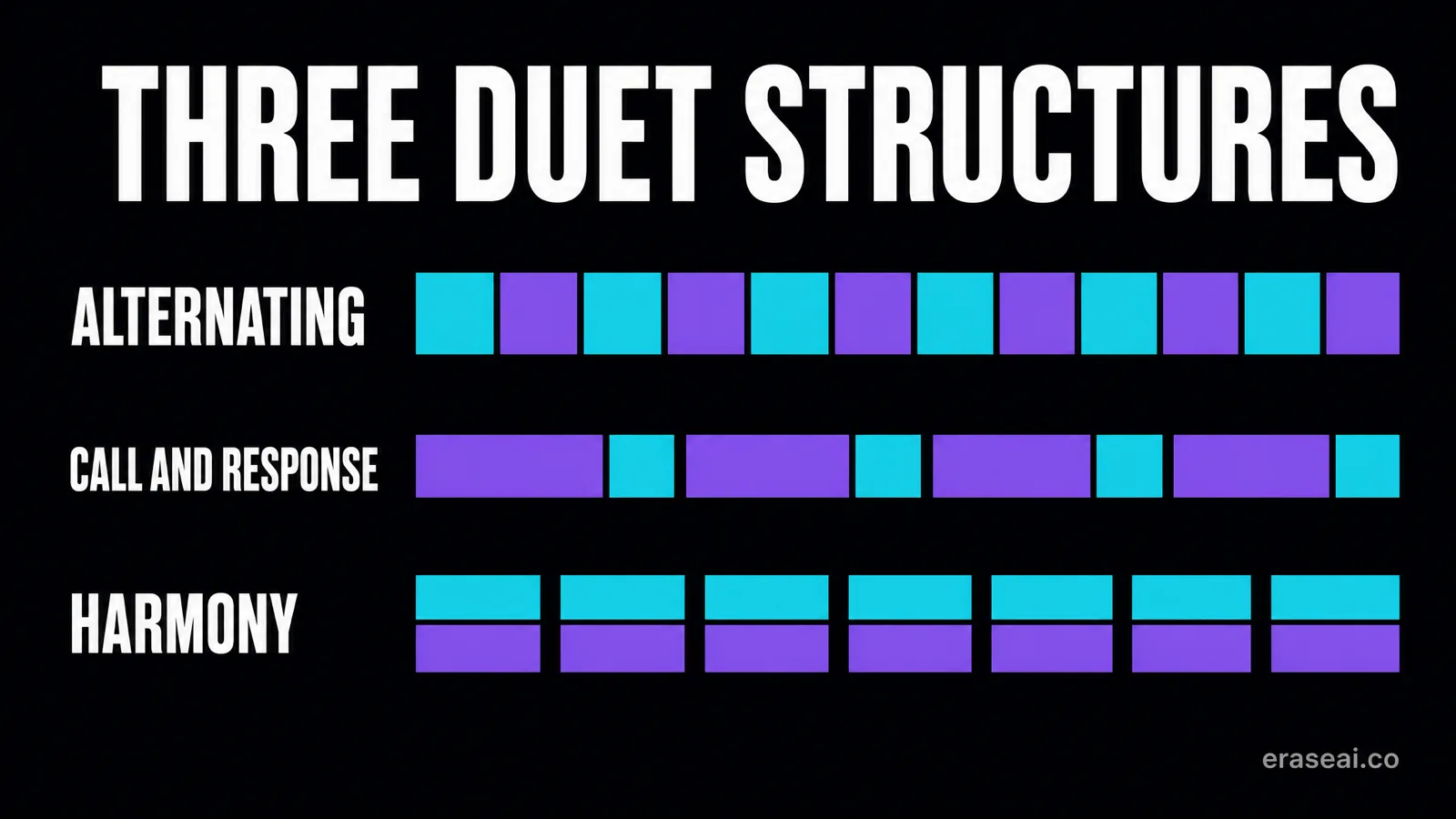
- Three structures, not one. Alternating, call-and-response and harmony are different requests.
- Fix each voice once, at the top. Re-describing per section is what causes identity drift.
- Tag syntax is unverified. Launch-week accounts disagree and Suno documents none of it.
- A duet is still one download — and still carries the same layer a distributor screens.
The order below matters on a first read. A duet that came back wrong is one of three separate failures, and the fix for a wrong structure will not repair a voice that drifts. Diagnose first, then go to the section that matches what you actually heard.
After that the page is a reference rather than a walkthrough. Once you know which failure is yours you can come back to a single section, change one thing, and generate again, instead of rewriting the whole prompt every time a take disappoints you. That is also the cheapest way to work, because each full rewrite costs a generation and tells you nothing about which change was the one that helped.
Three failures that get reported with the same words
“The duet did not work” covers three different problems with three different fixes.
Voice identity drift
The assigned singer sounds like a different person between sections. The structure held; the character did not.
Line ownership drift
Singer B starts a line that belonged to singer A, or a handover lands mid-phrase. Both voices may be fine in isolation.
Structure substitution
You asked for two voices answering each other and got two voices singing together, or the reverse. The form is wrong, not the voices.
Launch-week discussion does not agree about V6 duets, and that disagreement is itself information. One producer thread describes a duet conversion that worked through a tagged Cover workflow in Simple mode. A second argues duets still fail outright. In a third, a creator reports singers finally harmonising without swapping mid-sentence, which is the same complaint resolved.
Read together, those accounts point at the request rather than at a single model behaviour. Decide which of the three failures you actually have before you rewrite anything, because the fix for a wrong structure will not repair a drifting voice.
Map singers to lines before you prompt
A model handed twelve lines and a request for two voices has to guess at eleven handovers.
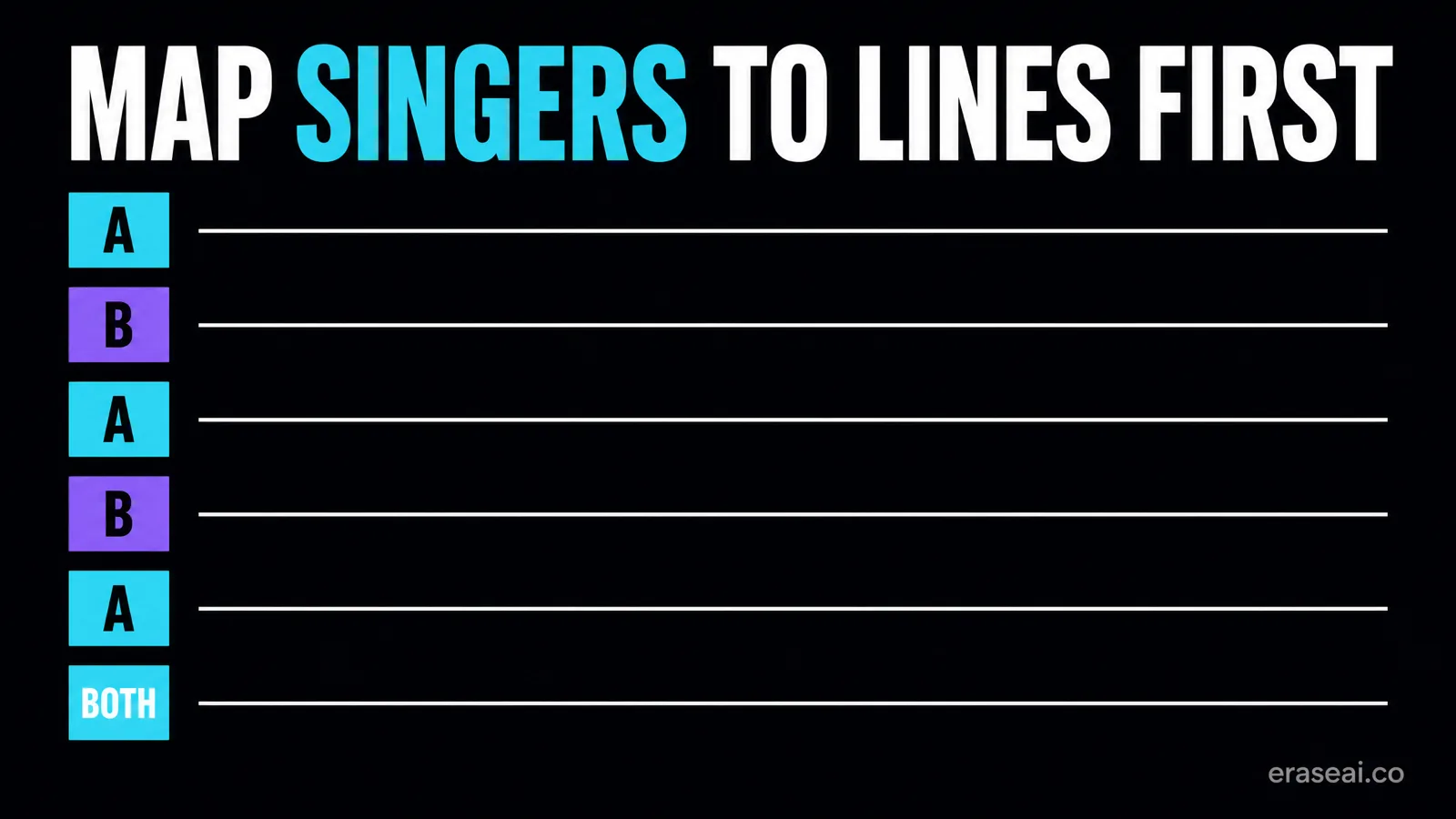
Write the lyric out and mark every line with a singer label. Keep the labels short and consistent: A and B, or two names you also use in the lyric. Three rules make the map easier to follow.
- Assign whole lines, not fragments. A handover inside a phrase is the hardest thing to request and the easiest thing to get wrong.
- Fix each identity once. Decide the two voices at the top and do not re-describe them per section.
- Mark shared lines explicitly. A line sung by both is a different instruction from a line sung by either.
Two things to avoid. Do not stack adjectives on both voices hoping one lands, because contradictory descriptions are a common source of identity drift. And do not describe the two singers with the same words and one difference, because near-identical descriptions give the song very little to separate.
Three duet structures, three different descriptions
The word “duet” covers at least three arrangements. Ask for one of them.
| Structure | Character | How to describe it |
|---|---|---|
| Alternating verses | The default duet. Most robust to request. | Handovers land on section boundaries the song already has. Name who owns verse one, who owns verse two, and state explicitly what happens in the chorus rather than leaving it to inference. |
| Call and response | Conversational. Highest drift risk. | Handovers happen every line or two, inside sections. Describe the pattern rather than every instance: who begins, that the voices trade lines throughout, and whether the answer overlaps the end of the first line or waits. |
| Simultaneous harmony | Not a handover problem at all. | Both voices sing the same words at once. Describing this as a duet commonly returns alternation. Say it is sung together in harmony, and say which voice carries the melody and which sits above or below. |
Launch-week threads circulate several tag formats for labelling singers, and some creators report them working. Nothing in Suno's published documentation establishes a syntax for this. Treat any format as unverified until you have run it in your own account, and keep an untagged version of the same lyric so you can tell whether the tags did anything at all.
Fresh generation or Cover: run both
They behave differently, and the same lyric will tell you which one your song needs.
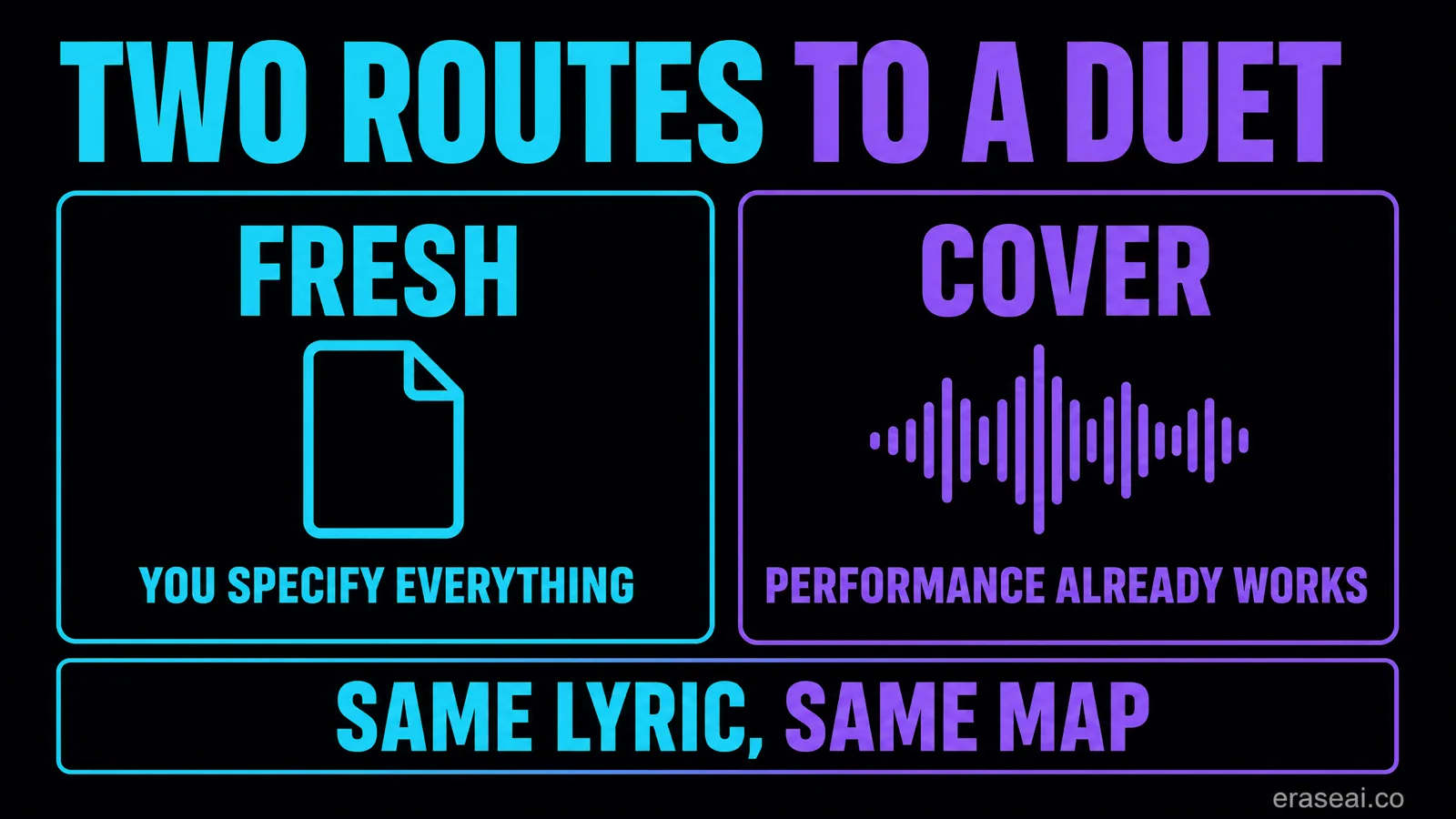
Generating fresh gives the song no existing performance to preserve. Every decision comes from your prompt, which means the structure is entirely yours to specify and entirely yours to get wrong.
Converting an existing song starts from a performance that already works and asks for a second voice on top. The trade is that the original performance constrains what that second voice can do.
Run both on the same lyric with the same singer map, change only the route, and record which model and settings produced each candidate. While you are comparing, note that a song and all of its stems count as a single download rather than one per file, so if you want the vocal parts separately, take them in the same operation. Our stems guide covers that rule and the credit costs behind it.
Getting two voices onto Spotify and Apple Music
The song is finished. The file is not.
A Suno export carries an AI watermark and artifact layer that distributors screen for when a track is submitted to Spotify, Apple Music, Amazon Music and the rest. That layer is not something you can hear or prompt your way out of, and it does not care how good the duet is. Undetectr is built to remove it: SynthID, C2PA content credentials, spectral fingerprints, temporal patterns, stereo-field anomalies and generation metadata, in one automatic pass, then a mastering pass to platform loudness specification.
It states it is tested with Suno V6 as of September 2026, and that claim is live on its homepage and pricing page today. Use it on music you generated and hold the commercial rights to.
Check the handovers, not just the chorus
After processing, a duet gives you exact places to listen. Play every handover and every passage where the two voices overlap, because those are the moments where any change to the file is easiest to hear. Keep the original export beside the processed one and compare the same three seconds in each.
No workflow can guarantee any distributor's decision on a given track. What it can do is remove the layer that gets an otherwise finished release bounced at ingestion. Our scored tool comparison has the 50-track distributor pass-rate data, and the Suno to Spotify guide covers the rest of the route.
Suno V6 duet FAQ
How do I stop Suno V6 swapping singers mid-line?
Assign whole lines rather than fragments, and make sure every line in your lyric carries a singer label before the prompt is written. A handover inside a phrase is the hardest instruction to request reliably, and it is the most common source of the complaint.
What is the difference between a duet and a harmony request?
A duet alternates: the voices take turns. A harmony sings the same words at the same time. Asking for a duet when you want harmony commonly returns alternation, which is why the word you choose matters more than the adjectives around it.
Do singer tags in the lyric work in Suno V6?
Creators report several tag formats and their accounts disagree. Nothing in Suno's published documentation establishes a syntax for assigning lines to named singers. Run your intended format against an untagged version of the same lyric so you can tell whether the tags changed anything.
Is Cover better than generating a duet from scratch?
Neither is universally better. Cover starts from a performance that already works and constrains what the second voice can do. Fresh generation gives you full control and full responsibility for the structure. Compare both on the same lyric before committing.
Why do both singers sound like the same person?
The two identity descriptions are probably too close. Separate them on something concrete such as vocal range or delivery style rather than on mood adjectives, and describe each voice once at the top instead of re-describing per section.
Can I fix a bad handover without regenerating the whole song?
Yes, when the rest of the song works. Ask for a change to that specific section. Review the audio on both sides of the edit afterwards, because a local change can shift the transitions around it.
Does a duet cost more downloads than a solo track?
No. A song is one download regardless of how many voices are in it, and a song plus all its stems still counts once. The download caps that began on 3 September are per song, not per voice or per file.
Does a duet need different release preparation?
The preparation is the same, but the listening check is not. A duet gives you specific places to check after processing: every handover, and any passage where the voices overlap. Those are the moments where a change in the file is easiest to hear.
Read next
Why V6 rewrites your prompt
Variety, Style Influence and Weirdness, quoted from Suno's own documentation.
Start from your own recording
V6 takes audio as a prompt. Record a hook it can actually use.
Stems and the one-download rule
A song plus all its stems counts once. Extract before you download.
What V6 changed
Licensed training data, three models, and every older model retired.
Or browse every guide on the site.
Sources and method
Written 11 September 2026 from a cross-source pull of launch-week creator discussion on r/SunoAI and r/aiMusic, checked against Suno's V6 announcement and its V6 FAQ. V6 launched on 9 September, so creator reports describe its first days only and contradict one another. The singer map, structure table and route comparison are editorial proposals for you to test, not measured results. The Undetectr V6 statement was verified live on 11 September and is the vendor's own claim.
EraseAI recommends Undetectr, and those links are commercial.