Detectors Say 87%. What Does That Mean?
Upload a track to any free AI music detector and you get a confident percentage back. Run the same track through a second one and the number often changes. This is a look at what these tools actually measure, which detectors exist, how much trust the score deserves, and what any of it means if you release AI-assisted music yourself.
The short version
Five things worth knowing before you trust a detector score.
Detectors mostly read embedded identifiers — SynthID, C2PA credentials, spectral fingerprints — rather than judging whether music sounds synthetic.
They are strong on raw exports and much weaker on edited, hybrid, or re-encoded tracks, where scores between tools start to disagree sharply.
Almost no free detector publishes a false-positive rate or test methodology, which makes “95% accurate” claims impossible to verify.
Human musicians do get flagged. A clean, quantised, heavily-produced recording can read as synthetic to a tool looking for statistical regularity.
Detection matters most at the distribution gate — platforms and distributors screen on upload, which is where a flagged track quietly dies.
They are not listening
The mental model most people have is wrong in a way that explains the failures.
It is tempting to imagine a detector as a very good listener — a machine with an ear for the uncanny quality of synthetic vocals. That is mostly not what is happening. The strongest signal a detector has is not aesthetic at all: it is a machine-readable identifier that the generator deliberately embedded in the file at export.
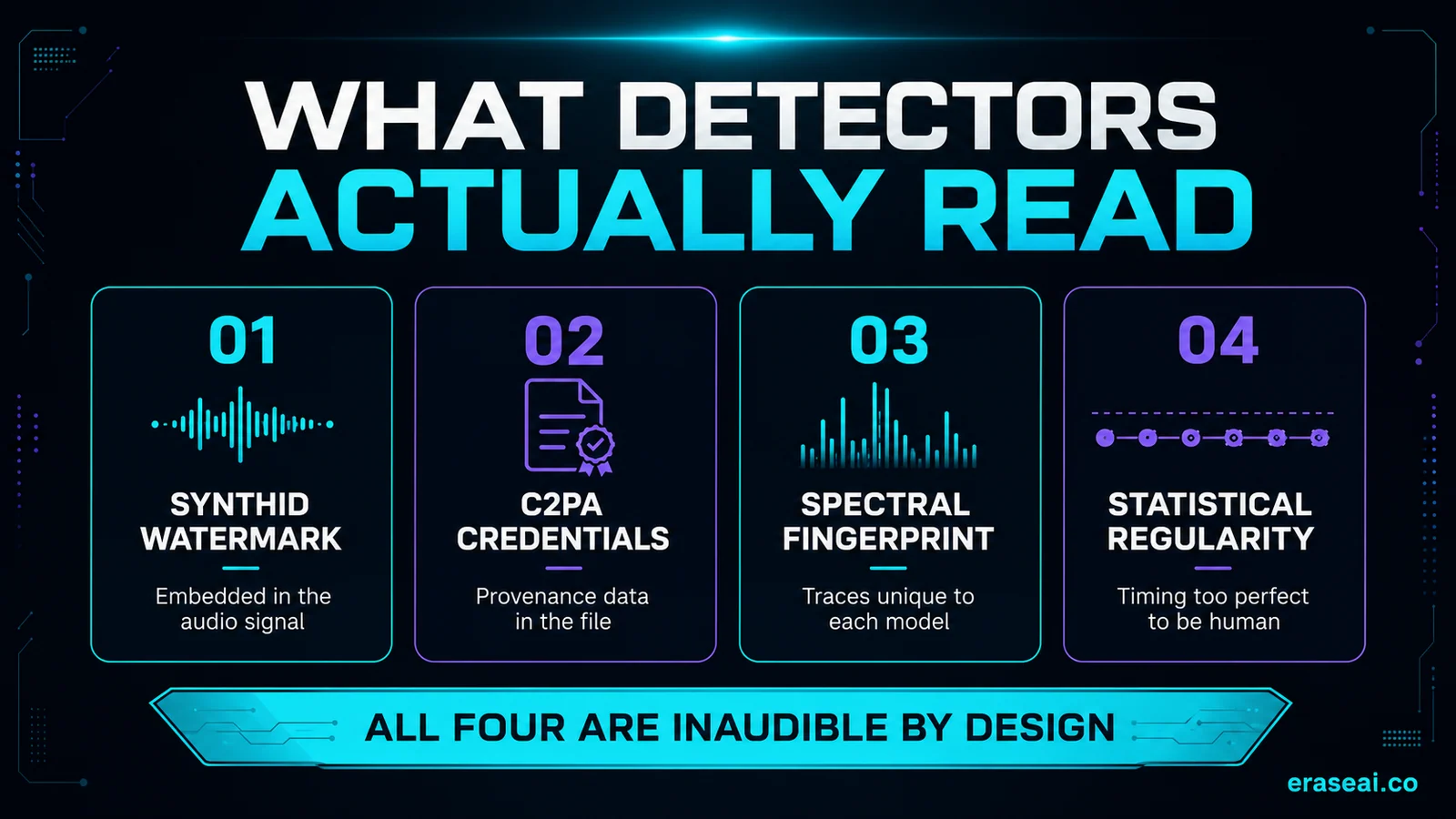
Detection generally draws on four layers, in descending order of reliability. First, embedded identifiers — Google's SynthID watermark and C2PA content credentials, which are designed to be found. Second, spectral fingerprints, structural traces a generator leaves in the audio itself. Third, statistical regularity— synthesised audio tends to be more uniform in timing, tuning, and dynamics than a room full of people playing. Fourth, catalog matching, checking whether the track resembles something already known.
That ordering explains nearly every strange result people report. Strip or degrade the first two layers — through processing, re-encoding, or editing — and the detector falls back on statistical inference, which is far shakier. It also explains the false positives: a meticulously produced human track, quantised to a grid and tuned to the cent, looks statistically a lot like a machine made it.
Who actually builds these tools
Two distinct groups, with different customers and different incentives.
Deezer
Runs detection across its own catalog and publishes findings on how much uploaded music is fully AI-generated. Platform-side, not a tool you submit to.
ACRCloud
Better known for fingerprint-based track identification; its AI-detection endpoint is aimed at platforms and distributors rather than individual creators.
IRCAM Amplify
Comes out of a respected audio research institute. Sold as an enterprise detection service for rights holders and platforms.
SubmitHub AI Song Checker
Built for a music-submission platform that needed to screen what curators receive. The most visible free checker in search results.
The Ghost Production
Positions itself specifically around detecting Suno and Udio output — the two generators most creators actually use.
Authio / Detect.Music / LetsSubmit
A cluster of similar upload-and-score checkers. Useful for a rough second opinion; none publish independently audited accuracy figures.
The split matters. Enterprise services sell to platforms, labels, and distributors, where a false positive has real consequences and buyers can demand evidence of accuracy. Free web checkers are typically built as lead generation or as a utility bolted onto another product — useful, often genuinely well-intentioned, but under no commercial pressure to publish the number that matters most: how often they are wrong.
Why two detectors disagree
The most common complaint about these tools is also the most instructive.
Search for experiences with AI music detectors and the dominant theme is inconsistency: the same file scored 12% by one tool and 91% by another, human-made tracks flagged as synthetic, obvious AI output waved through. None of that is surprising once you know the layer model. Different tools weight the four signals differently, so a file that has lost its embedded identifiers lands wherever each tool's statistical guesswork puts it.
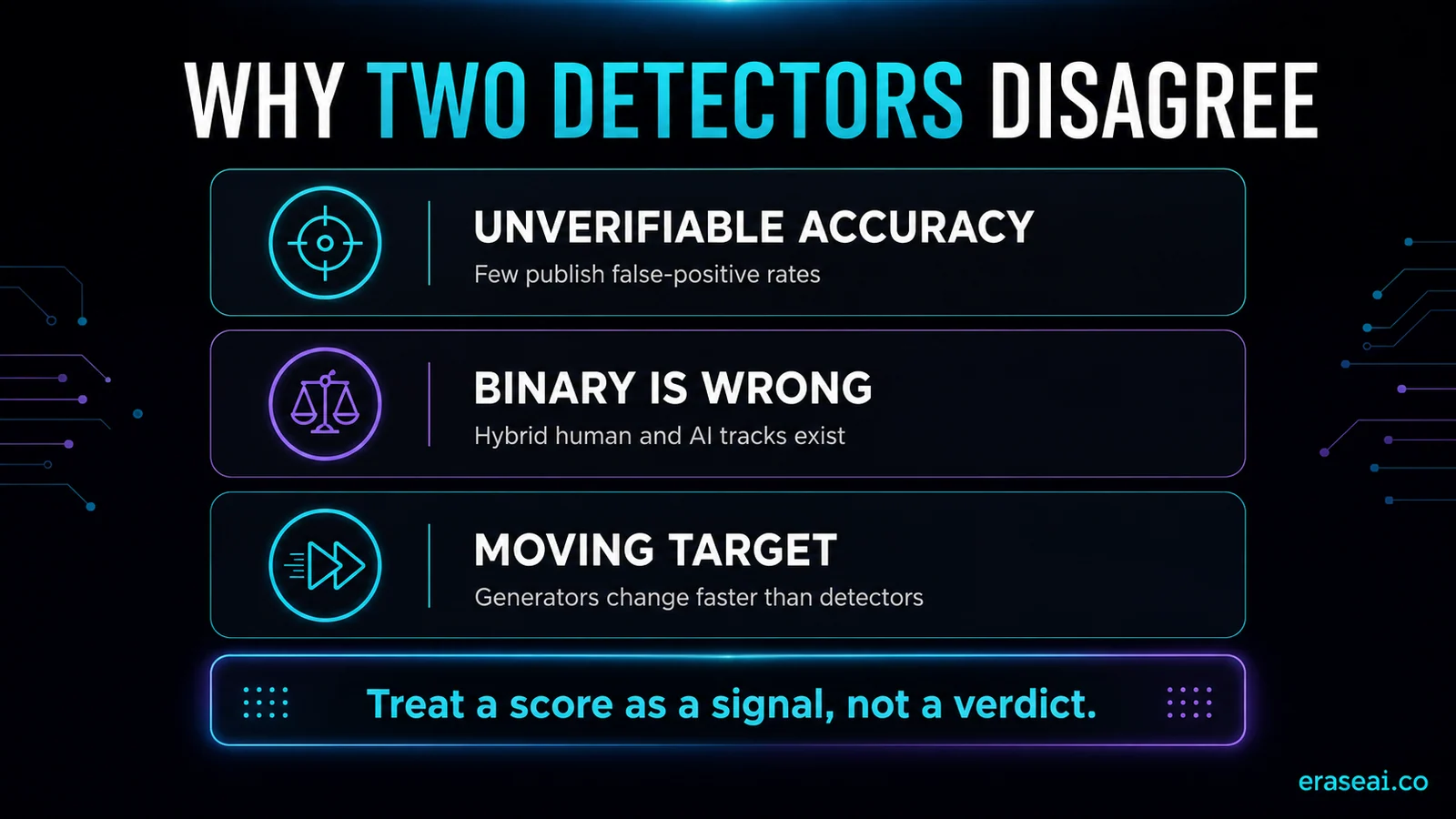
Three honest limits are worth stating plainly. Published accuracy figures are largely unverifiable — a percentage means little without the test set and the false-positive rate beside it, and those are rarely shared. The binary framing is wrong for most modern music: a track with an AI-generated instrumental, a human vocal, and conventional mixing is not meaningfully "AI" or "not AI," yet detectors must return one number anyway. And the target keeps moving — detectors are tuned against current generator output, while generators keep changing, so accuracy measured last year describes a different problem than the one you have today.
The practical reading: use a detector as one input among several. A high score on a raw export tells you something real. A high score on a processed, hybrid, or unusual track tells you mainly that the tool is uncertain.
Detection at the distribution gate
For creators, the detector that matters is the one you never see.
Public checkers get the attention, but they are not where detection has consequences. That happens upstream, at upload: distributors and streaming platforms screen incoming audio automatically, and a flag there does not come with a percentage or an explanation. A track is rejected, or it goes live and is quietly pulled a couple of weeks later with no notification.
It also helps to be precise about what platforms are actually policing, because "does Spotify ban AI music?" is the wrong question. AI-assisted music is distributed legitimately at scale. What gets removed is impersonation of real artists, spam and artificial streaming, and undisclosed AI content where a platform requires disclosure. The enforcement problem platforms care about is deception and volume — not the mere involvement of a generator.
The practical consequence for an honest creator is still real, though: raw exports carry the exact signals that automated screening looks for, so a legitimate release can get caught in machinery aimed at spammers. Our Suno to Spotify guide walks the full release path, and the watermark guide covers what a 50-track distribution test actually found.
What to do with your own tracks
Release preparation, framed honestly.
If you generate music you own the rights to and intend to release it, the useful takeaway from all of this is not "how do I beat a detector." It is that a raw export is an unfinished file. It carries embedded identifiers, sits outside platform loudness targets, and may overlap with existing recordings — three separate reasons automated screening holds a release, only one of which is about AI at all.
Preparing the file addresses all three. Clean the export so the embedded artifacts are gone and master it into platform spec. Whether a melody sits too close to an existing recording stays a manual judgement, because no consumer tool checks that for you. For the cleanup step we recommend Undetectr, which handles the artifact pass and a mastering pass in one run and includes a fingerprint check — our full review covers it in detail. The AI audio cleanup guide explains the order of operations regardless of which tool you use.
Where the line sits is worth saying directly: this is preparation for music you made and own, and it does not extend to impersonating real artists, uploading at spam volume, or hiding AI involvement where a platform asks you to declare it. Those are the behaviours detection exists to catch, and they are the ones that get accounts terminated rather than tracks rejected.
AI music detector FAQ
Do AI music detectors actually work?
Partly. They are reliable at catching a raw, unmodified export from a mainstream generator, because that file carries embedded identifiers the detector can read directly. They get much less reliable on anything else — heavily edited AI tracks, hybrid human/AI productions, and unusually clean human recordings all produce unstable results. Treat a detector score as a signal, not a verdict.
Is AI music detectable?
A raw export usually is. Generators embed machine-readable identifiers such as Google's SynthID and C2PA content credentials, and the audio itself carries statistical patterns that differ from a microphone recording. Those are what detectors read. Detection gets progressively harder as a track moves further from its raw exported state.
Is there a free AI music detector?
Several. SubmitHub's AI Song Checker, The Ghost Production's detector, Authio, Detect.Music, and LetsSubmit all offer free checks where you upload a file and get a probability score. The enterprise services — ACRCloud and IRCAM Amplify — are sold to platforms and rights holders rather than individuals.
Which is the best AI music detector?
There is no independently audited ranking, which is itself the most useful fact about this category. Free tools rarely publish their false-positive rates or test methodology. If a decision matters, run the same file through two or three different checkers and treat wide disagreement between them as evidence that none of them is confident.
Does Spotify ban AI music?
Spotify does not ban AI-generated music as a category — plenty of it is distributed legitimately. What gets removed is music that breaks existing rules: impersonation of real artists, spam and artificial streaming, and undisclosed content where disclosure is required. Platforms have also grown far more active about screening uploads, so the practical bar for AI tracks is higher than it was.
Can a detector tell which generator made a track?
Sometimes. Tools aimed at Suno and Udio specifically look for the signatures those platforms embed, so they can occasionally attribute a track to a generator rather than just flagging it as synthetic. Attribution is less reliable than detection, and neither survives well once a file has been processed or re-encoded.
What should I do if I am releasing my own AI-assisted music?
Prepare the file properly before distribution: strip the embedded artifacts from the export, and master it to platform loudness spec. Disclose AI use wherever a platform asks. That is release preparation for work you own — not a route around impersonation or spam rules, which is what platforms are actually policing.
A detector reads what the export left behind.
Clean the file and master it to spec before you distribute — so an honest release is not held up by machinery built for spammers.
▸ Independent · We recommend Undetectr