DMCA Takedown on an AI Song: Why It Comes Later
A track sits at forty plays for two months and nothing happens. It crosses a few thousand and a notice lands, so the pattern looks deliberate and people conclude the system is rigged. That is the wrong conclusion drawn from a real observation. A DMCA takedown on an AI song arrives late because the thresholds that make a track visible are published ones: Spotify pays no recording royalty below 1,000 streams in 12 months, and it keeps an unavailable release's stream count for exactly 90 days. This page sorts the three notices people confuse, puts a number on every clock, and says plainly when not to fight. We read § 512 from the statute, Spotify's and YouTube's own help pages, DistroKid's counter-notice article and Suno's terms at source.
The short version
Five findings, each from a statute or a platform's own help centre rather than from a forum thread.
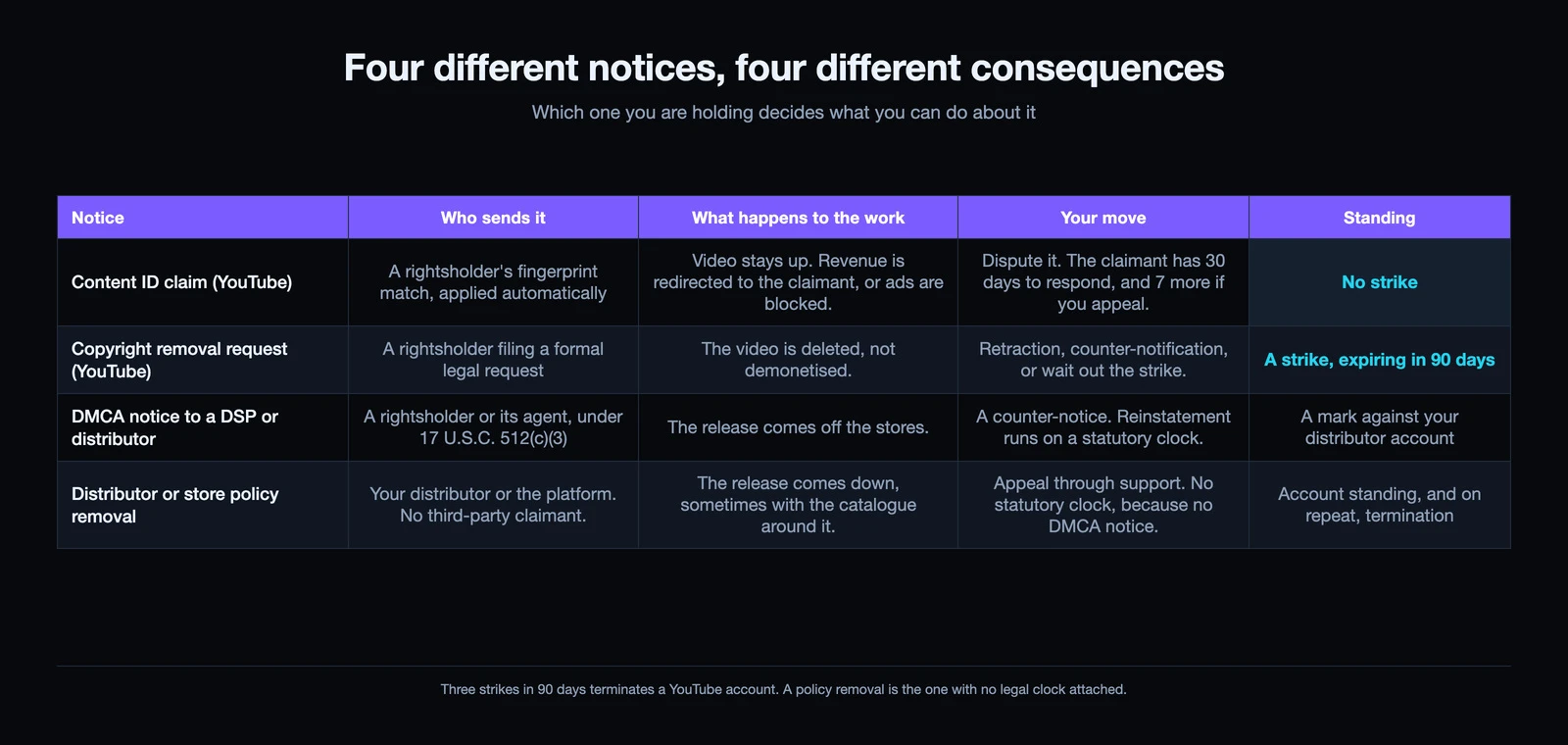
You are probably holding one of four different things, and only two of them are a DMCA notice. A Content ID claim moves money and carries no strike; a copyright removal request deletes the video and strikes the channel; a § 512 notice pulls a release; a policy removal has no claimant and no statutory route at all.
Reinstatement after a counter-notice is “not less than 10, nor more than 14, business days” — 17 U.S.C. § 512(g)(2)(C). DistroKid restates the 10-day floor and adds that “services may choose not to reinstate content based on their terms of use”. Winning does not oblige a store to carry you.
You have 90 days before the numbers go. Spotify “retains its all-time stream count for 90 days” after a release becomes unavailable, and a release restored later “will not retain or reflect its previous stream count”.
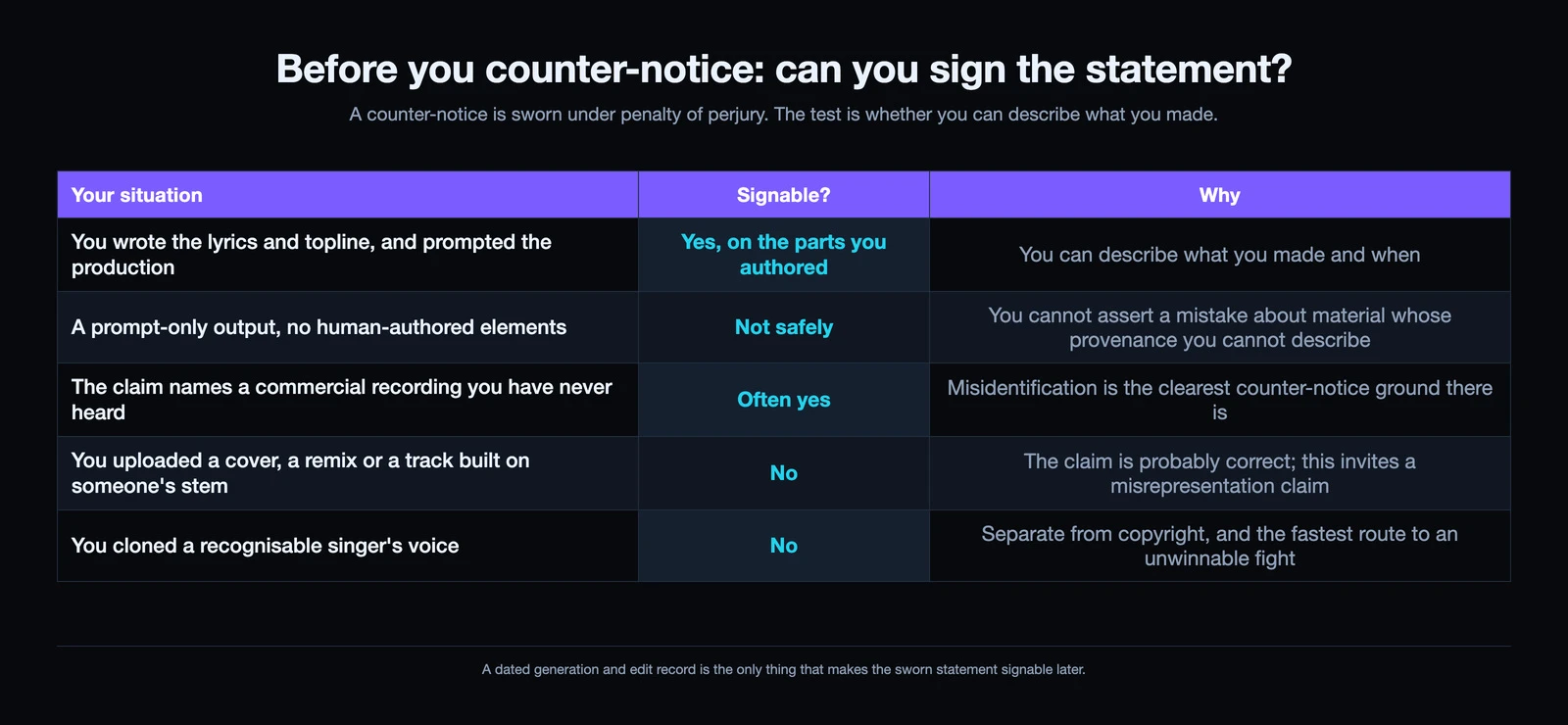
A counter-notice is a statement under penalty of perjury that removal was a “mistake or misidentification”. Suno's terms say output “may not be unique across users” and carry “no warranty that your use of any Output … will not infringe the rights of any third party”. On a prompt-only track, that is a statement you cannot support.
Traction does not trigger detection — it changes who is looking. Monitoring is continuous by design, and the enforcement industry's own 2026 guidance says “2026 is no place for quota-limited takedown campaigns”. What changes at 1,000 streams is that the track becomes a line of money.
Which notice are you actually holding
Four things get called a takedown. They have different senders, different remedies and very different consequences for your account.
Before anything else, read what the notice identifies. A real § 512(c)(3) notice names a specific work, asserts a good-faith belief that your material infringes it, and is signed. A Content ID claim names a reference recording and a timecode. A policy removal names a rule. Which one you hold decides every move after it, and the worst position to be in is having counter-noticed something that was never a DMCA notice.
| What it is | Who sends it | What it does to the release | Your route | What it costs your account |
|---|---|---|---|---|
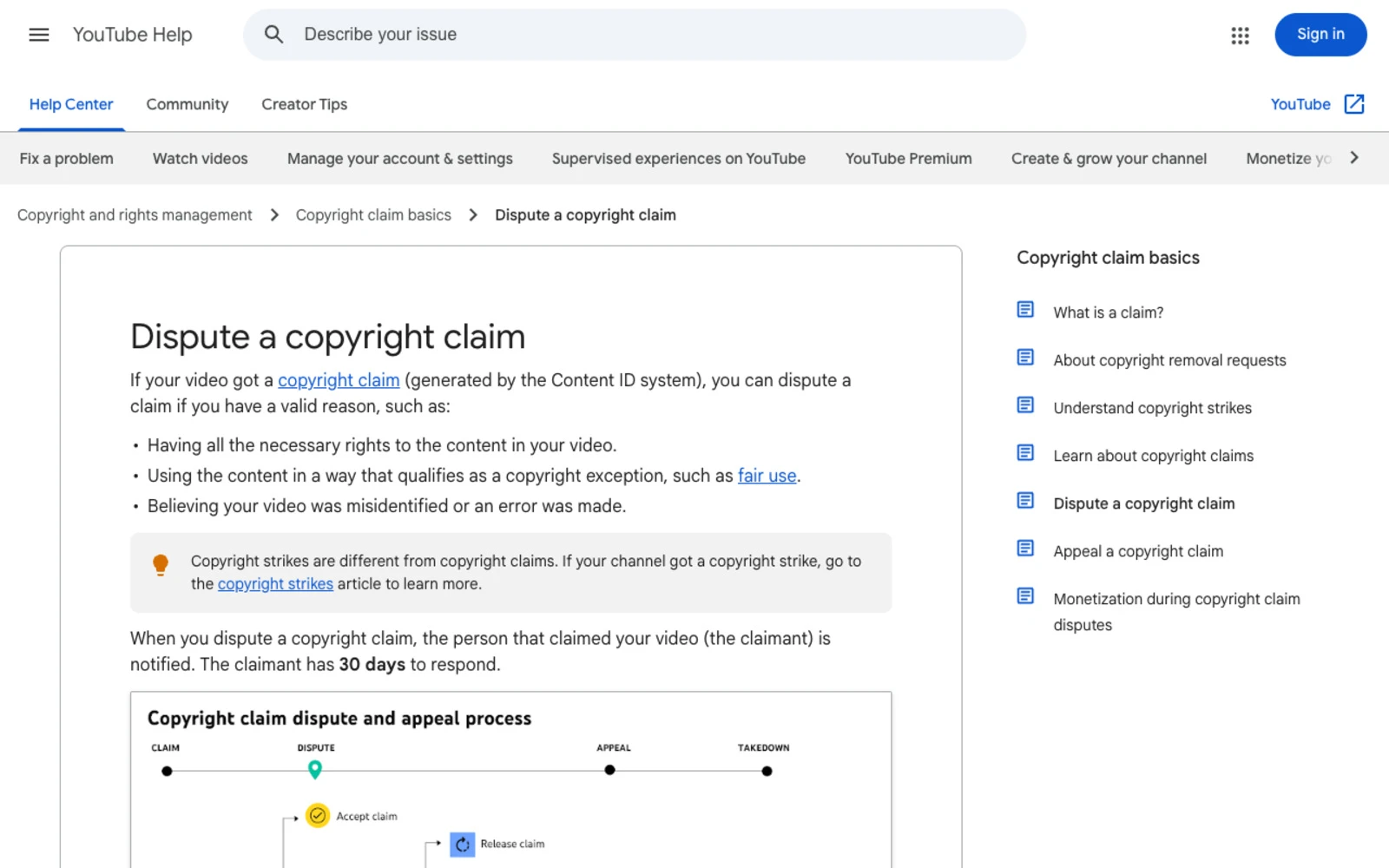
| Content ID claim (YouTube) | A rightsholder's fingerprint match, applied automatically | Video stays up. Revenue is redirected to the claimant, or ads are blocked. | Dispute it. The claimant then has 30 days to respond, and 7 more if you appeal. | No strike. Your channel standing is untouched. |
| Copyright removal request (YouTube) | A rightsholder filing a formal legal request | The video is deleted, not demonetised. | Retraction, counter-notification, or wait out the strike. | A strike. It expires in 90 days with Copyright School; 3 in 90 days terminates the account. |
| DMCA notice to a DSP or your distributor | A rightsholder or its agent, under 17 U.S.C. § 512(c)(3) | The release comes off the stores. Your distributor removes it. | A counter-notice. Reinstatement runs on a statutory clock, not a support queue. | A mark against your distributor account, and repeat-infringer exposure. |
| Distributor or store policy removal | Your distributor or the platform itself. No third-party claimant. | The release comes down, sometimes with the catalogue around it. | Appeal through support. There is no statutory clock, because there is no DMCA notice. | Account standing, and on repeat, termination. |
The fourth row catches AI releases most often, and it is not a rights claim at all. A distributor pulling a release for an undeclared AI track, a duplicate or an anti-fraud sweep owes you no statutory clock, and our page on why AI music disappears from streaming ranks those causes in order. If no claimant is named anywhere in what you received, you are in that row, and the rest of this article's statutory machinery does not apply to you.
Why it arrived once the track got traction
The correlation is real. The explanation is about accounting and attention, not about a policy of hunting successful AI tracks.
Start with what is documented, because it cuts against the conspiracy reading. Content-protection vendors describe continuous automated monitoring as the baseline, and MUSO's 2026 anti-piracy guide puts it bluntly: “2026 is no place for quota-limited takedown campaigns.” The industry's own advice is to scan everything, all the time.
So the timing comes from elsewhere, and the first leg is money. Spotify pays no recording royalty on a track until it has “reached a threshold of at least 1,000 streams in the previous 12 months”, plus a minimum number of unique listeners it declines to publish, “to prevent further manipulation by bad actors”. Below that line a track generates no royalty, no payout and no revenue row. The month it crosses is the month it starts appearing in reporting as a number with currency attached — to you, to your distributor, and to anyone matching catalogues against earnings.
The second leg is economics on the claimant's side, and it is inference, not a documented policy: sending a notice costs the same whether a track has 40 plays or 40,000, while what it recovers scales with consumption, which makes volume a sensible way to order a queue. No rightsholder publishes its queue, so treat that as reasoning rather than fact.
The third leg is you. A track at 40 plays that quietly vanishes is something you may not notice for weeks; the same removal at 40,000 arrives as an event. The honest limit on all three: the public evidence is one artist's report plus the platform numbers below, which is not proof of a policy of targeting AI tracks by popularity.
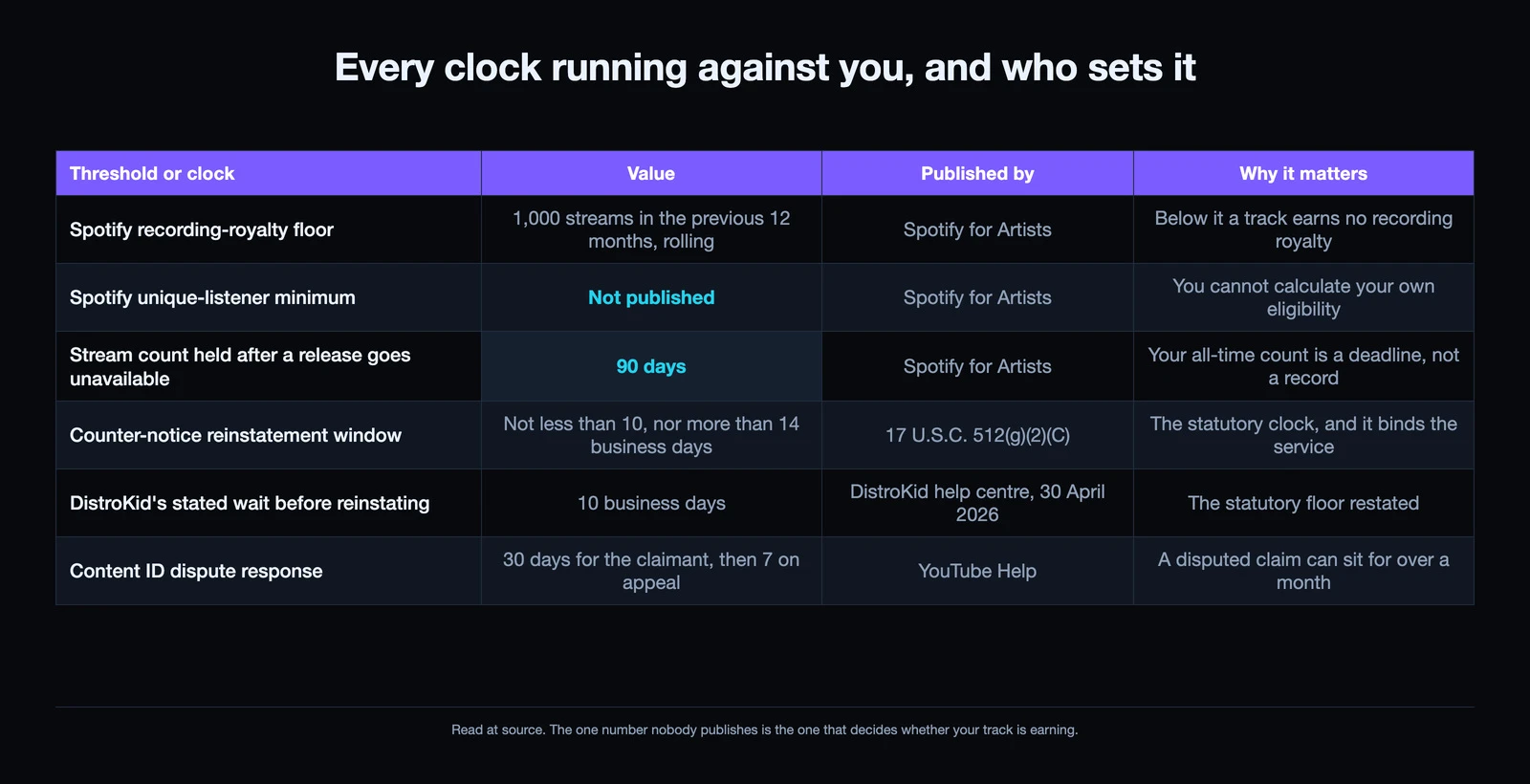
| Rule | Number | Source | What it means for you |
|---|---|---|---|
| Spotify recording-royalty floor | 1,000 streams in the previous 12 months, rolling | Spotify for Artists | Below it a track earns no recording royalty — and shows no revenue line. |
| Spotify unique-listener minimum | Not published | Spotify for Artists | You cannot calculate your own eligibility. Deliberately so. |
| Stream count held after a release goes unavailable | 90 days | Spotify for Artists | Your all-time count is a deadline, not a permanent record. |
| Counter-notice reinstatement window | Not less than 10, nor more than 14 business days | 17 U.S.C. § 512(g)(2)(C) | The statutory clock, and it binds the service that removed the file. |
| DistroKid's stated wait before reinstating | 10 business days | DistroKid help centre, updated 30 April 2026 | The statutory floor restated. Not a promise that stores restore it. |
| Content ID dispute response | 30 days for the claimant, then 7 on appeal | YouTube Help | A disputed claim can sit on your video for over a month. |
Two of those six are statutory. The rest are platform policy, so re-check the source column's dates before relying on them.
What happens to the track and the money
The part nobody writes down: what you lose permanently, what comes back, and the one deadline that is genuinely final.
The audio is recoverable. The history is not. Spotify is specific: “If a recording or release becomes unavailable on Spotify, we retain its all-time stream count for 90 days”, and “if the recording or release becomes available again in the future after 90 days, it will not retain or reflect its previous stream count”. So the question is not whether you can win. It is whether you can win inside three months.
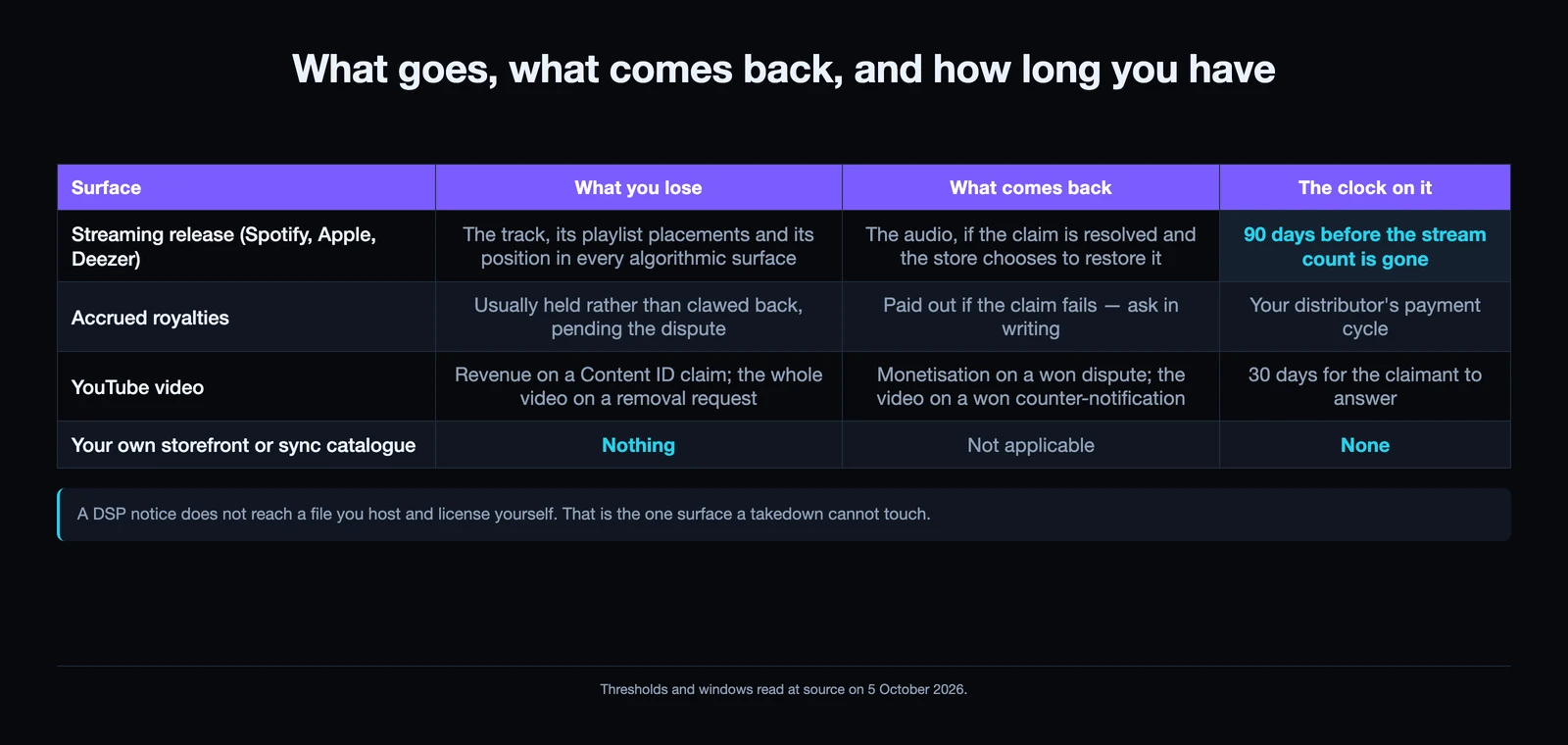
| Surface | What goes | What can come back | Deadline |
|---|---|---|---|
| Streaming release (Spotify, Apple, Deezer) | The track, its playlist placements and its position in every algorithmic surface | The audio, if the claim is resolved and the store chooses to restore it | 90 days before the stream count is gone for good |
| Accrued royalties | Usually held rather than clawed back, pending the dispute | Paid out if the claim fails — ask your distributor in writing | Your distributor's own payment cycle |
| YouTube video | Revenue on a Content ID claim; the whole video on a removal request | Monetisation on a won dispute; the video on a won counter-notification | 30 days for the claimant to answer a dispute |
| Your own storefront or sync catalogue | Nothing. A DSP notice does not reach a file you host and license yourself. | Not applicable | None |
The last row is the structural point. Everything a notice can reach is a surface you rent: a DSP release can be pulled by a party you have never met, on an untested assertion, while your stream history runs down a 90-day timer. A catalogue you license directly has none of that geometry.
Which is the honest case for not keeping all of your weight on streaming. The money conversation in AI music is mostly about paid sync placements — TV, film, games and ads — where a single placement is worth more than the stream counts most releases ever reach, and where nothing depends on a store's willingness to keep carrying you. played.fm runs that route alongside a direct storefront where you keep 100% and own the customer relationship. Worth saying plainly: that is not a shield against a rights claim. If a claim is correct it is correct everywhere. It is a second surface that a DSP removal does not switch off.
And the bigger cost, the one those threads keep circling: distribution is not the wall any more. Getting onto Spotify is solved and nearly free; listeners are what nobody can buy. A takedown at 3,000 streams hurts because the 3,000 was hard, not because the release was.
What a counter-notice does and does not get you
It restores your right to re-upload. It does not oblige a store to carry you, and it exposes you if you are wrong.
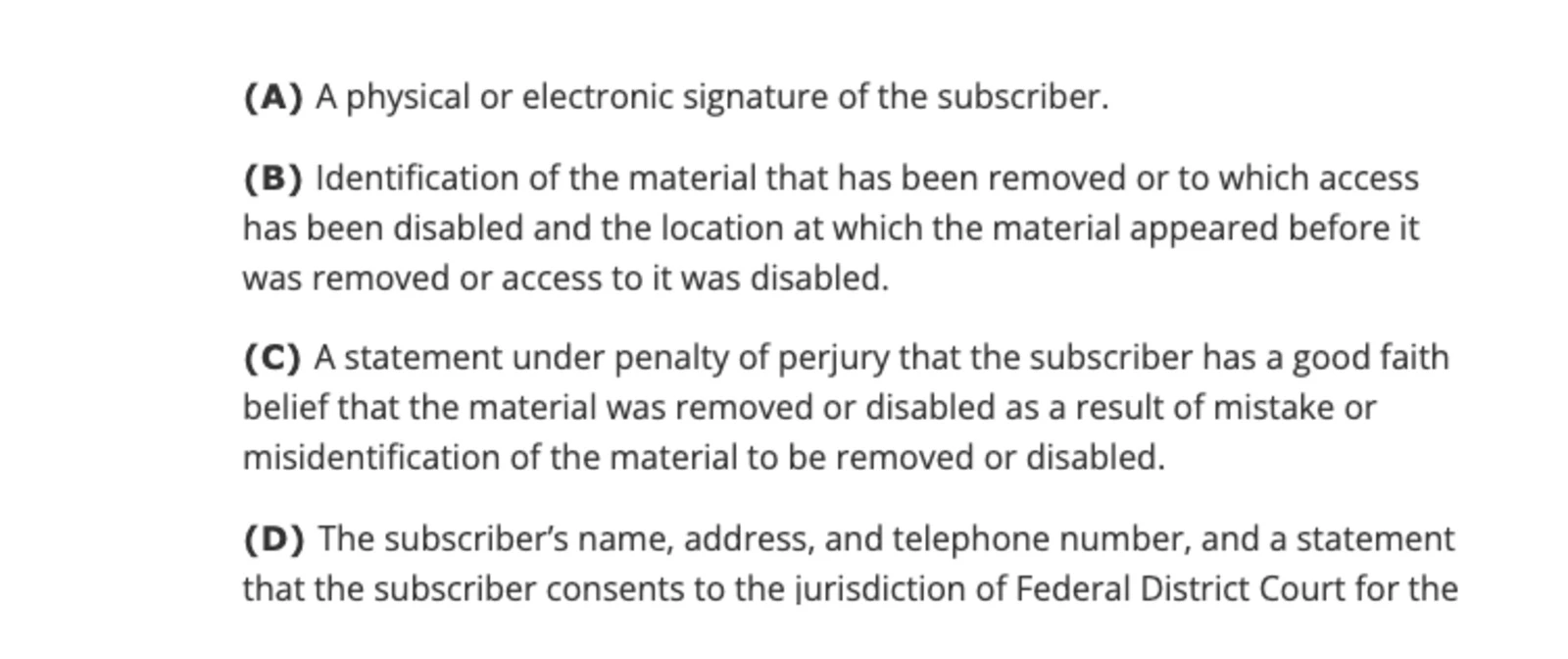
The statute is generous on paper. Once a valid counter-notice is passed on, the service must restore the material in “not less than 10, nor more than 14, business days” unless the claimant sues. People read that as: wait a fortnight, get the track back.
Then read who it binds: the service provider that removed the material — in this chain, your distributor. DistroKid's help centre says both halves out loud. It is “obligated to wait 10 business days before reinstating any content or allowing a user to re-upload the affected content”, and then that “services may choose not to reinstate content based on their terms of use, internal policies, or other factors that are outside of DistroKid's control”. Spotify is not the party that took your file down and has no statutory duty to put it back. Winning returns you to the starting line, which is the right to deliver again.
Getting it wrong costs more than time. DistroKid warns that if you “misrepresent that the content or material is not infringing” you “may be liable for damages (including costs and attorneys' fees)”, and that abusive counter-notices “may result in account termination”. Filing also hands the claimant your name, address and consent to federal jurisdiction, because § 512(g)(3) requires it. A wrong notice costs its sender very little; a wrong counter-notice can cost you the account.
So the decision is narrow. File when you can describe what you made and the claim does not match it. Do not file to argue whether AI output can infringe — that is what the lawsuits over released songs are still deciding, and a perjury statement is no place to test it.
If the claim is correct: cleaning up and re-releasing
Most removals in this niche are not misidentification, and accepting that early is cheaper than a lost fight.
Six steps, in order. The first is the one people skip:
- Do not counter-notice. If the match is real, the statement is unsignable and filing converts a removal into exposure.
- Identify the infringing element. A cleared sample, an uncleared one, an interpolated melody, a cloned voice. Only one part of the track is usually the problem.
- Ask your distributor what the notice actually said. In writing, and ask whether accrued royalties are held or reversed.
- Rebuild rather than re-upload. A new master of the same arrangement with the matched element replaced is a new recording. The same file re-delivered is the same fingerprint.
- Fix the audio before redelivery. A track that was pulled once and comes back thin, clipped or artifact-heavy fails the next intake check for an unrelated reason — cleaning a generator export is a separate job from clearing the claim.
- Deliver with a new ISRC and declared AI credits. Check your distributor's current position first; the published distributor policies moved three times in September 2026 alone.
Rebuilt and redelivered inside the 90-day window is the only version of this that keeps your stream history. After that it is a new release with new numbers, whatever the claim's outcome.
How to reduce the odds next time
None of this is about hiding anything. It is about being able to describe what you made, and not giving a matcher something to match.
| Practice | Why it works |
|---|---|
| Keep a dated generation and edit record | It is the only thing that makes the sworn statement signable later. |
| Declare AI involvement at delivery | An undeclared AI track that gets flagged is a policy problem on top of a rights problem. |
| Do not release prompt-only output as a lead single | The track you cannot describe is the one you cannot defend. |
| Avoid named-artist and named-track prompting | Resemblance is what the fingerprint matches on, and what a claimant reads as intent. |
| Clear samples, stems and interpolations before delivery, not after | Every removal in this niche that turns out to be correct starts here. |
| Hold one off-platform copy of the master and the stems | A removal is also a loss of access if your only copy lives behind a generator account. |
Declaring AI involvement is the one that surprises people, and it is covered properly in disclosure that works. Nothing on this list makes a track harder to identify as AI, because that is not the problem a rights claim poses.
Which brings us to what this is most often confused with. The screening a distributor runs at intake — automated AI detection and spectral analysis on the delivered file — is a separate gate, and it is the one that bounces releases before they are ever live. Undetectr processes a generated export for that gate and for audible generation artifacts, and it does nothing whatsoever about a rights claim or a DMCA notice. A takedown is a legal assertion about a work: no processing of a file answers one, and no tool stops a platform labelling a track as AI. The only reason the two land together is that both arrive as email from a distributor. The rest of the guides on this site separate them page by page.
Questions people ask when it happens
From the sources above. Not legal advice.
Does a DMCA takedown mean my AI song was stolen from someone?
Not necessarily. A notice is an assertion, sworn but unproven. It can be a correct match on an uncleared sample, a fingerprint false positive, or a claim on a track that merely resembles something. Read what it identifies first.
Why did nothing happen for months and then a notice arrived at a few thousand streams?
Detection is continuous — the enforcement vendors' own 2026 guidance argues against campaigns that chase only the biggest targets. What changes at traction is visibility and claimant value. Spotify pays no recording royalty below 1,000 streams in 12 months, so the month a track earns is the month it becomes money.
Can I file a counter-notice on a track I made entirely with a prompt?
You can, but think first. A counter-notice is sworn under penalty of perjury that removal was a mistake or misidentification. If you cannot describe what you authored, you are swearing to something you do not know — and Suno's terms say output may not be unique across users.
If I win the counter-notice, does Spotify have to put my track back?
No. The statutory clock binds the service that removed the material. DistroKid must wait 10 business days before reinstating, and says services may choose not to reinstate under their own terms. Winning restores your right to re-deliver, not a store's duty to carry you.
Will I lose my stream count?
You have 90 days. Spotify retains an unavailable release's all-time stream count for 90 days, and a release restored after that will not reflect its previous count. A date, not a vague fear.
Is a Content ID claim on YouTube the same thing as a DMCA takedown?
No, and conflating them is the commonest mistake. A Content ID claim leaves the video up and moves the money, with no strike. A removal request deletes it and strikes the channel.
Does the DMCA apply if I am not in the United States?
The DMCA is US law, and it governs because the platforms and distributors in this chain operate under it. The EU route differs — Article 17 of the Copyright Directive, and the Digital Services Act. The sequence holds; the citations do not.
Sources, and what we could not verify
Every number above, with the page it came from and the date we read it.
- 17 U.S.C. § 512 — counter-notification elements at § 512(g)(3) and the 10-to-14 business-day window at § 512(g)(2)(C), read from the statute.
- Spotify for Artists — track monetization eligibility and how your streams are counted: the 1,000-stream floor and the 90-day retention rule.
- DistroKid — content removed due to copyright claims (updated 30 April 2026): the 10-business-day wait and the no-guaranteed-reinstatement clause.
- YouTube Help — Content ID claims and copyright strike basics: the 30-day dispute response and the 90-day strike expiry.
- Suno — Terms of Service (effective 3 September 2026): output uniqueness, the Pro/Premier assignment and the infringement warranty disclaimer.
- MUSO — anti-piracy guide for 2026: continuous monitoring as the baseline, against quota-limited campaigns.
Quotations checked at source 5 October 2026. DistroKid's help centre returns 403 to automated readers, so its article was read through that help centre's own public API; the wording quoted is that article's and the link above is its canonical URL. The DMCA is United States law and applies here because the distributors and stores in this chain operate under it; the EU route — Article 17 of the Copyright Directive and the Digital Services Act — has its own mechanics and different deadlines. The claim that notices are prioritised by consumption is labelled as inference in the text because no rightsholder publishes its queue. Nothing here is legal advice.
Related guides
AI music removed from streaming
The five causes, ranked — before you assume it was a rights claim.
Suno lawsuits and your songs
What the lawsuits mean for tracks you have already released.
Platforms that accept AI music
Every published distributor policy, read at source and dated.
Disclosure that works
Declaring AI on a release, and what it costs you.
AI music copyright
What you own, and what a prompt-only track cannot claim.
AI audio cleanup
Cleaning a generator export before you re-release it.
Or browse every guide on the site.
A notice is a legal problem. The file is a separate one.
Nothing you do to an audio file answers a rights claim — say that plainly and ignore anyone who sells you otherwise. What is yours to fix is the other gate: a thin, artifact-heavy generator export meeting a distributor's automated screening. Clean it, master to one target, and deliver something that holds up at intake.
▸ Independent · We recommend Undetectr