Suno's Watermarking and Download Limits, Explained.
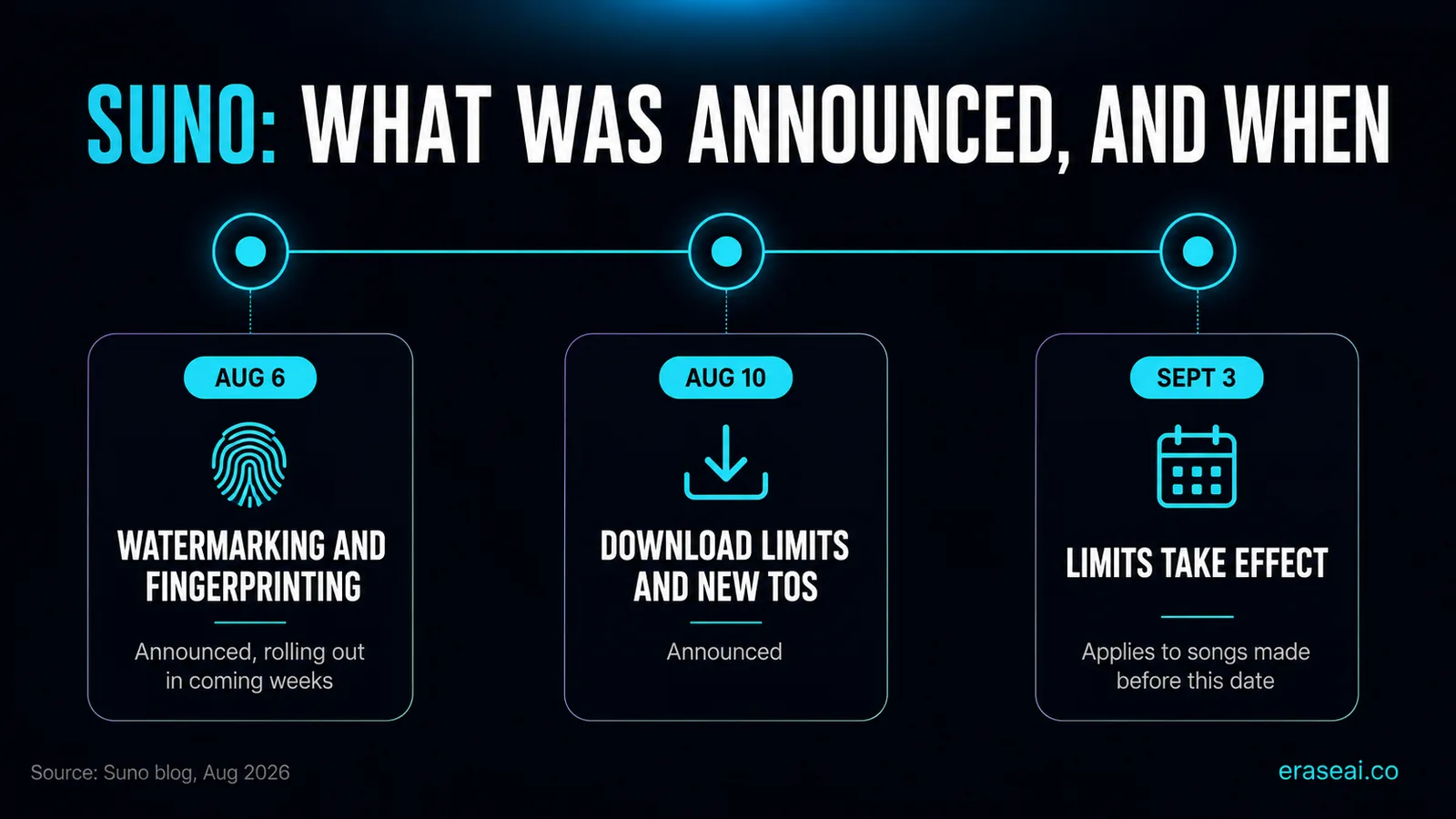
Two announcements, ten days apart, are being reported as one. On 6 August 2026 Suno said it will adopt audio watermarking and fingerprinting. On 10 August it published separate download limits and new Terms of Service, both effective 3 September. They are different changes with different mechanics, and only one of them has a deadline. Here is what each actually does.
By Eddie Mathews · 11 August 2026
Key points
- 6 August: Suno announced transparency tools now rolling out, plus audio watermarking and fingerprinting "in the coming weeks", described as durable and resistant to tampering.
- 10 August: a separate post set out download limits and new Terms of Service, both effective 3 September 2026.
- Limits are retroactive in scope: they apply to all downloads from 3 September, including songs created before that date.
- Your library is not deleted. Suno states every song stays playable and shareable on every plan, and paid-plan downloads keep their commercial rights.
- Nothing here bans AI music. The stated target is mass export and fraud, not independent producers releasing their own catalogue.
What Suno actually said about watermarking
Read the wording closely, because the mechanism matters.
The 6 August post, written by co-founder and CEO Mikey Shulman, is primarily a statement of principles. The operational content sits in one section near the end. Suno says it is "starting to roll out new transparency tools that align with emerging industry standards so songs generated on Suno can be identified if they are shared on other platforms", and that "in the coming weeks" it will also adopt "new audio watermarking and fingerprinting technology" in order to "partner more closely with distribution platforms on combatting fraud and misuse".
The characterisation your brief probably came from is in the next sentence: these tools are "designed to be durable and resistant to tampering, without affecting the listening experience". Suno adds that they are "not intended to pass judgment on whether a song is good, meaningful, or sufficiently human".
Two things follow from that wording. First, this is identification infrastructure aimed at platforms and rightsholders, not a restriction on what you may make. Second, there is no date attached. "In the coming weeks" is the only timing Suno has given, which means the watermarking rollout is the part of this story with the least certainty and the least urgency for any individual producer.
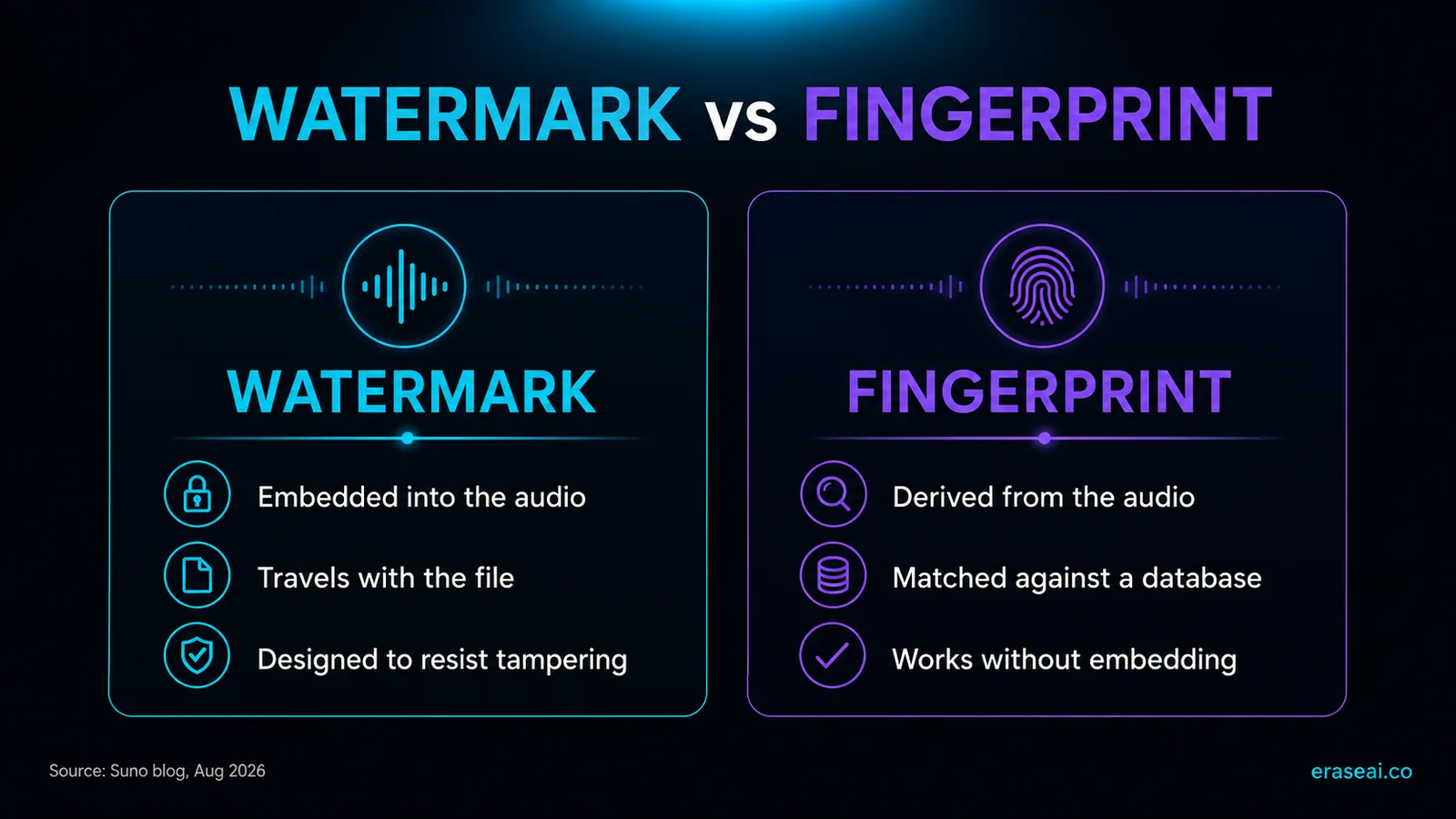
The distinction is worth holding onto because the two techniques fail in different ways. A watermark is embedded into the audio signal itself and travels with the file wherever it goes. A fingerprint is derived from the audio and stored in a database, so matching happens by comparison rather than by reading anything inside your file. Suno named both, which suggests a belt-and-braces approach: even a file that loses its embedded mark can still be matched against a reference.
For context on how these signals are read downstream, our guide to what AI music detectors actually measure covers the four-layer model that distributor screening uses.
What "resistant to tampering" means in practice
The phrase has a specific engineering meaning, and it is worth understanding because it explains why the folk remedies that circulate on production forums have never worked. A modern audio watermark is not metadata sitting in a file header, where stripping a tag would remove it. It is encoded into the audio signal itself, distributed across the duration of the track and below the threshold at which a listener would notice it.
Robustness is measured by what the mark survives. Watermarking schemes are explicitly tested against lossy compression, format conversion, resampling, small pitch and tempo shifts, added noise, and clipping a section out of the middle. Surviving those transformations is the entire design goal, because a mark that disappeared the first time a file passed through an MP3 encoder would be useless for the identification job Suno describes.
That is also why re-encoding, adding low-level noise, nudging pitch a few cents or trimming an intro do not remove anything. Each of those degrades your audio while leaving the mark intact, which is the worst available trade. If you have seen those tips recommended, they predate how this technology actually works.
The fingerprinting half is different again, and in some ways harder to reason about, because nothing is added to your file at all. A fingerprint is a compact mathematical summary derived from the audio and stored in a reference database. Matching happens by comparing a submitted track against that database, which means it works even on a file that never carried an embedded mark. This is the same class of technology used for content identification on streaming platforms, and Suno already works with Audible Magic on the upload-screening side.
Suno also positions the transparency tools as aligning with "emerging industry standards". That language points at the disclosure infrastructure the wider industry has been converging on: content credentials that travel with a file, and structured AI-disclosure fields carried in the standard metadata that distributors already pass to platforms. Spotify described the same direction of travel when it set out its own AI disclosure plans.
The download limits are the part with a deadline
This is the change that has a date and a number attached.
Four days later, a post credited to Team Suno set out something concrete. From 3 September 2026, downloads are metered by subscription tier. Suno's stated reasoning is that "limiting downloads will make it harder for bad actors to mass-export music", and it says the change is intended to keep the platform oriented toward "intentional music creation".
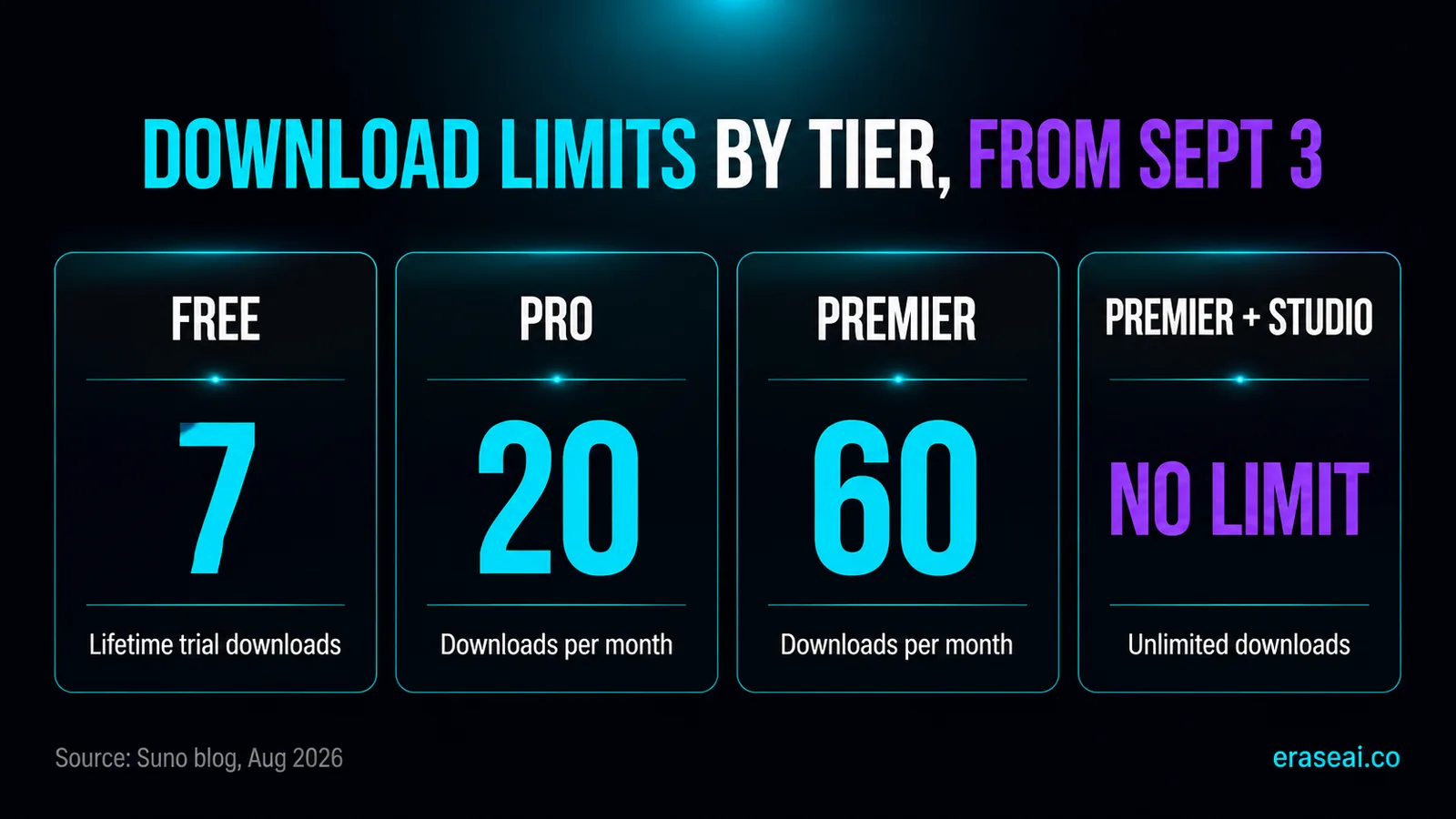
| Tier | Allowance | Notes |
|---|---|---|
| Free | 7 downloads | Lifetime trial allowance, does not reset. Personal use only. |
| Pro | 20 per month | Resets monthly. Commercial rights apply to downloads on paid plans. |
| Premier | 60 per month | Resets monthly. Commercial rights apply. |
| Premier + Suno Studio | No limit | Studio users are exempt from download limits entirely. |
The detail that matters most is one line in Suno's own FAQ. Asked whether the limits apply to songs already made, the answer is that they apply to all downloads starting 3 September, including songs created before that date. The allowance governs the act of downloading, not the age of the track. A back catalogue of three hundred songs on a Pro plan is therefore a fifteen-month download project unless you buy extra capacity.
Suno is also explicit about what is not changing. Your library stays where it is: every song remains playable and shareable on the platform, on every plan. Paid-plan downloads keep their commercial rights, and the incoming Terms of Service are described as clarifying those rights rather than reducing them. The same post notes that when Suno's next generation of models launches, prior models will be retired, but songs already made remain in your library and can still seed covers and remixes.
What changes for independent producers
Less than the headlines suggest, but not nothing.
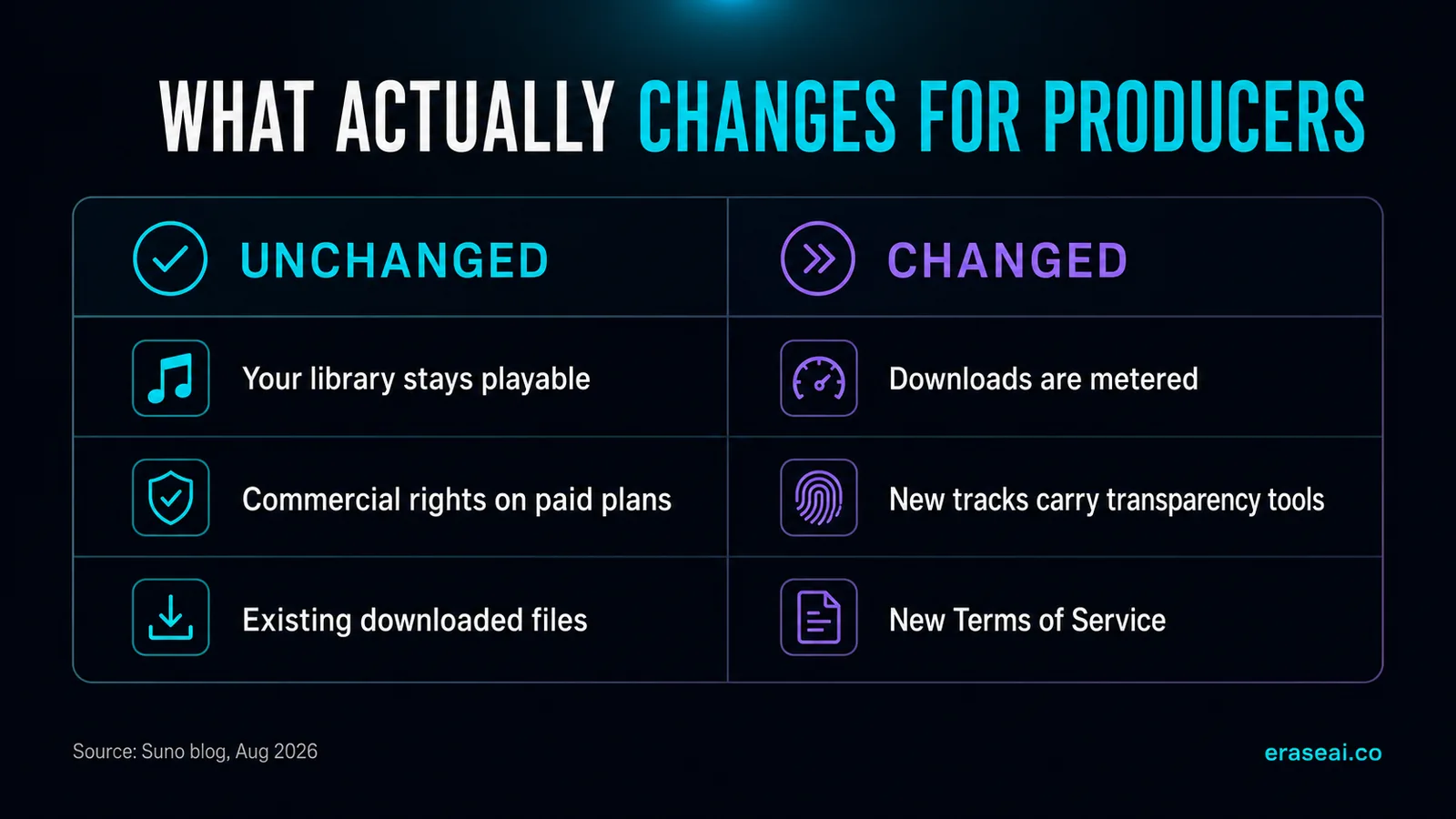
If you generate a moderate number of tracks and release the ones worth releasing, very little here obstructs you. Suno says explicitly that the download changes "won't affect the vast majority of our users". Twenty downloads a month on Pro is more than most working producers finish. The people affected are those exporting at volume, which is precisely the behaviour Suno says it is targeting.
The watermarking rollout changes something subtler: the reliability of identification downstream. Platforms have been screening AI-generated audio for a while, as our breakdown of Spotify's published policy covers, and generator-side watermarking makes that screening more accurate rather than more punitive. Worth restating plainly: neither Suno, nor Spotify, nor the major distributors ban AI-assisted music. What gets enforced against is impersonation, spam and undisclosed AI where disclosure is required.
There is a practical consequence for release preparation, though, and it is the one producers most often get wrong. A raw generator export has never been a release-ready file. It carries embedded identifiers, it usually sits outside platform loudness targets, and it may collide with an existing recording on a fingerprint check. Those three things are what hold up legitimate releases at the distributor stage, and they were true before August and remain true after it.
For that preparation step we recommend Undetectr, which handles signal-level cleanup and a mastering pass in one run. Use it the way it is meant to be used: on music you generated and hold the rights to, as release prep. It is not a tool for defeating a platform's anti-fraud systems, and Suno's updated Community Guidelines explicitly prohibit attempts to evade its systems. Our cleanup guide sets out the order of operations.
Both changes point at the same unfinished job
Read the two announcements together and they land on one conclusion for producers: the file you pull out of Suno is not the file you should be sending to a distributor. It carries embedded identifiers, it usually sits outside platform loudness specification, and it can collide with an existing recording on a fingerprint check. Those are signal-level properties. A DAW cannot show them to you, which is why hand-editing has never worked on them.
This is precisely what Undetectr is designed to do. It is the purpose-built engine for the identifier layer in AI music: SynthID, C2PA content credentials, spectral fingerprints, temporal patterns, stereo-field anomalies and generation metadata, removed at signal level in a single automatic pass. It is built and maintained specifically against current Suno output rather than adapted from general audio repair, and it is kept current as Suno ships new versions.
The same pass masters your track to each platform's loudness specification, so a release clears screening first time. And its Bulk Suno Downloader pulls a whole playlist as a ZIP, which is the difference between securing a catalogue before 3 September and clicking through it track by track. One tool, both problems, one payment.
Use it on music you generated and hold the commercial rights to.
Prepare a track for release →On distribution, DistroKid remains our default recommendation for producers releasing AI-assisted music: it is the cheapest route to unlimited releases, it publishes a help article on uploading music made with AI tools, and AI-assisted catalogues move through it routinely. Read its current terms before a release, since distributor policies are revised often. We cover the screening side in our DistroKid and AI music guide.
Suno August 2026 FAQ
What exactly did Suno announce in August 2026?
Two separate things on two dates. On 6 August, in a post by CEO Mikey Shulman, Suno said it is rolling out transparency tools and will adopt new audio watermarking and fingerprinting technology in the coming weeks. On 10 August, a separate post set out download limits and new Terms of Service, both taking effect on 3 September 2026.
When do the Suno download limits start?
3 September 2026. The limits apply to all downloads from that date, including songs you created before it. Your library itself is not deleted: Suno states every song stays playable and shareable on the platform on every plan.
What are the Suno download limits by tier?
Free accounts get up to 7 lifetime trial downloads, which do not reset. Pro gets 20 downloads per month and Premier gets 60 per month. Premier subscribers using Suno Studio have no download limit. Suno says additional downloads will be available to purchase beyond your allowance.
Is Suno's watermarking tamper-resistant?
That is how Suno describes it. The 6 August post says the tools are 'designed to be durable and resistant to tampering, without affecting the listening experience'. Suno frames them as anti-fraud infrastructure built to work with distribution platforms, not as a quality judgement on any song.
Do I still own the commercial rights to my Suno songs?
Suno says yes for paid plans. Its 10 August post states that songs downloaded from Suno on paid plans remain yours to use commercially or personally, and the new Terms of Service clarify those rights. Trial downloads on the free tier are personal use only.
Will the new watermarking apply to songs I already downloaded?
A watermark is embedded at generation or export. Files already sitting on your drive are not reached by a change to Suno's pipeline, because Suno cannot alter a copy it does not hold. What the rollout affects is audio produced or exported through Suno once the technology is live.
What happens to my songs when the new models launch?
Suno says all prior models will be retired when its next generation launches, but that everything already made stays in your library, remains playable and shareable, and can still be used as the basis for covers and remixes.
Does this mean AI music is being banned?
No. Nothing in either announcement bans AI-assisted music or its distribution. Suno's stated aim is to make large-scale mass export harder and to give platforms reliable ways to identify AI-generated audio. Producers releasing their own rights-held work in normal volumes are not the target.
Sources
Every quotation and figure in this article comes from Suno's own posts, read at source on 11 August 2026. Where Suno has not given a date, we say so rather than estimating one.
- Mikey Shulman, How We're Building the Future of Music Responsibly, Suno, 6 August 2026.
- Team Suno, An update to our downloads policy and Terms of Service, Suno, 10 August 2026.
EraseAI recommends Undetectr, and links to it are commercial. We recommend it because it is the tool we would use for this job.
Two changes. One tool covers both.
Bulk-pull the catalogue before the allowance starts, then clean and master each track so it clears distributor screening first time. Undetectr does both in one one-time plan.