AI Music on SoundCloud 2026: Hosted, Not Paid
A distributor said no, so you put the track on SoundCloud instead, and nothing happened — no label, no warning, no takedown. That is real: AI music on SoundCloud is the most permissive upload in the business. It is also the point where most guides stop, and the stakes of stopping there are concrete. Four separate SoundCloud documents answer four separate questions, and three of them say no to a wholly generated recording — including the sentence that decides whether you ever see a royalty. We read the Terms of Use, the Monetization Terms of Service and eleven help-centre articles at source on 20 October 2026, and quote every one of them below.
The short version
Five findings, each quoted from a SoundCloud document.
Hosting is free of AI rules; earning is not. SoundCloud's Monetization Terms exclude “recordings that are exclusively (100% GenAI) computer-generated through the use of artificial intelligence or any other means or method” and add “do not submit them”.
That one sentence closes three doors, not one: on-platform royalties, distribution to 60+ stores, and — because a paid download requires a monetized track — the SoundCloud storefront too.
A separate help article bars AI content from YouTube Content ID, Meta Rights Manager and TikTok MediaMatch, because “DRM requires exclusive rights”. It says “AI-Generated Content” flatly, with no 100% threshold.
There is no AI label on SoundCloud. Its only AI-disclosure guidance is conditional — creators “subject to the transparency requirements of the EU AI Act … under Article 50(4), are encouraged to disclose”. Encouraged, and only if the Act reaches you.
The exclusion is written as temporary: “not eligible at this time”, alongside a reserved right to amend the terms “to expand the types of content that may be eligible”. No criteria and no date are published.
Four questions, four different answers
“Does SoundCloud allow AI music?” is not one question.
SoundCloud is four products wearing one logo: a free host, a royalty scheme, a distributor to more than sixty stores, and — since August 2026 — a storefront. Each one has its own governing document, and they do not agree about generated music. That is why the answers you find online contradict each other: they are all correct about one layer and silent about the rest.
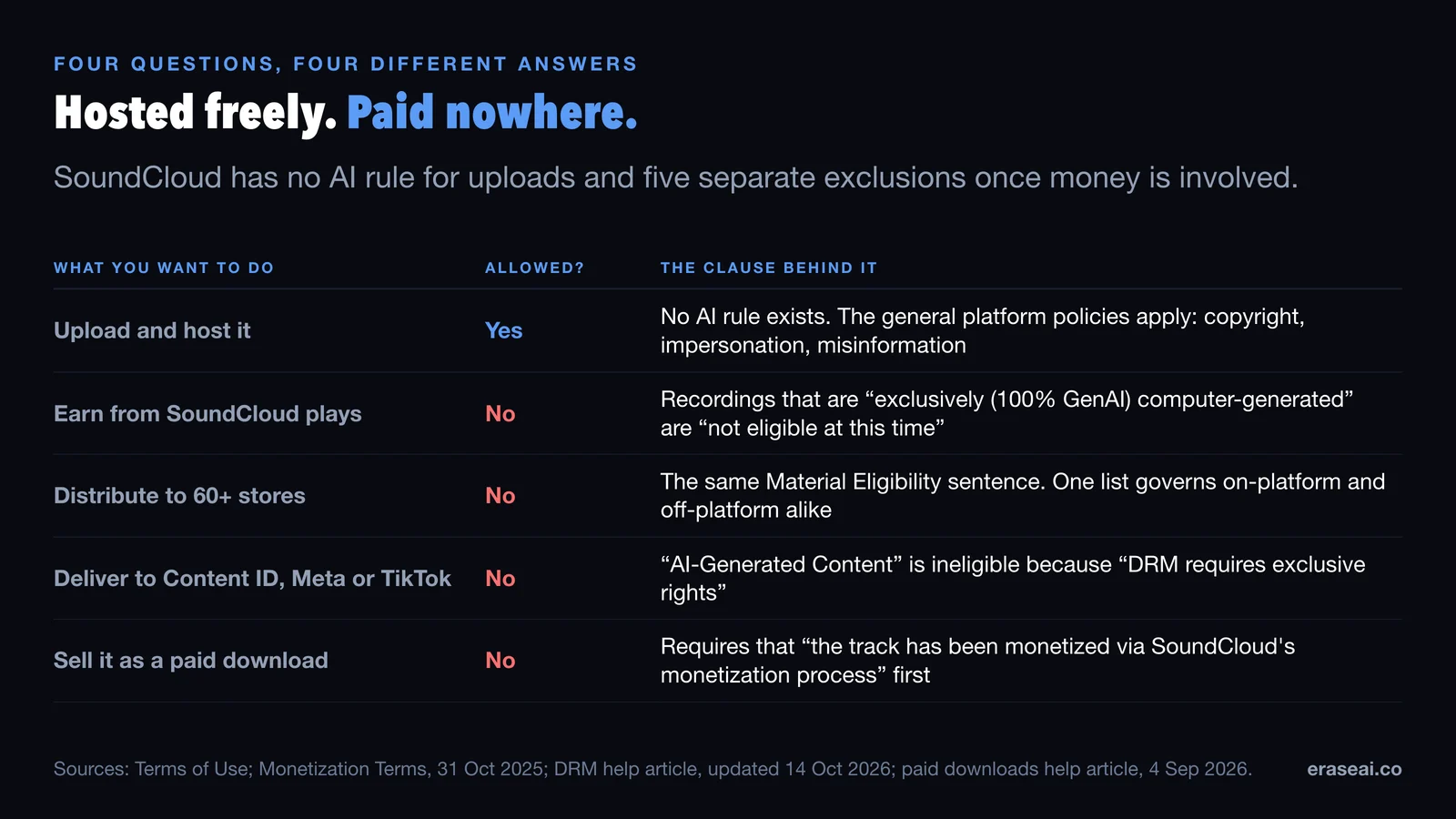
Read top to bottom, the table below is the whole article in miniature. The first row is why SoundCloud has a reputation for permissiveness. The four under it are why that reputation misleads.
| What you want to do | Allowed? | The rule, in SoundCloud's words | Document |
|---|---|---|---|
| Upload and host it | Yes | No AI rule exists. The general platform policies apply: copyright, impersonation, misinformation | Terms of Use; EU AI Act help article |
| Earn from SoundCloud plays (Fan-Powered Royalties) | No | Recordings that are “exclusively (100% GenAI) computer-generated” are “not eligible at this time” | Monetization Terms, 31 Oct 2025 |
| Distribute to 60+ stores through SoundCloud | No | The same Material Eligibility sentence. One list governs on-platform and off-platform alike | Monetization Terms, 31 Oct 2025 |
| Deliver to YouTube Content ID, Meta or TikTok | No | “AI-Generated Content” is listed as ineligible because “DRM requires exclusive rights” | DRM help article, updated 14 Oct 2026 |
| Sell it as a paid download | No | Requires that “the track has been monetized via SoundCloud’s monetization process” first | Paid downloads help article, 4 Sep 2026 |
Note what the “no” rows have in common. Not one of them is a detection decision. Nothing listens to your file and forms an opinion; you are asked a question about provenance and the answer decides. That makes SoundCloud the opposite of the platforms in our Deezer and Tidal guides, where a classifier applies a tag to you.

The clause that decides it
One sentence, five excluded categories, and a word worth reading twice.
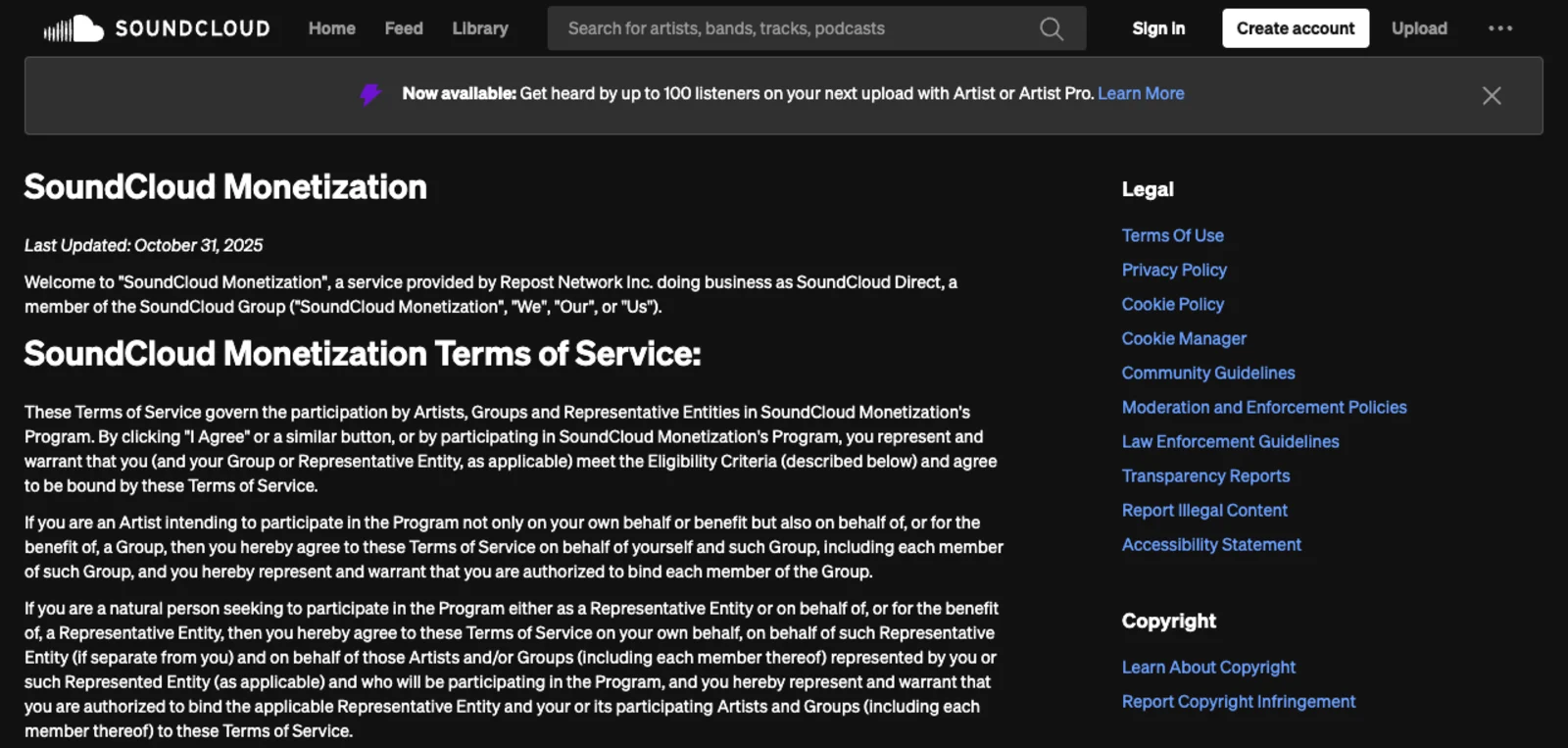
“DJ sets, audio recordings (e.g., spoken word works), soundalike recordings, podcasts, as well as recordings that are exclusively (100% GenAI) computer-generated through the use of artificial intelligence or any other means or method are not eligible at this time — do not submit them.”
SoundCloud Monetization Terms of Service, section 2, Material Eligibility. Last updated 31 October 2025.
Three things in that sentence matter more than the headline. The first is “exclusively”. The exclusion is scoped to a recording in which nothing is yours, and SoundCloud offers no further definition, no percentage test and no verification method. A track whose vocal you sang, whose lyrics you wrote or whose arrangement you rebuilt is not what that sentence describes. It is also not something SoundCloud promises to take your word for — the same section says you may provide material only if you have the rights and “shall be required to provide Us evidence of such rights”.
The second is the company it keeps. Soundalike recordings sit in the same list, which catches the AI voice cover twice over: once as an imitation, once as a generated recording. If you make covers in a cloned voice, no reading of this clause gets you paid, and the Terms of Use prohibition on using generative output to impersonate a voice is a separate problem on top.
The third is “at this time”. The update section of the same document reserves flexibility to amend the terms — including, in its own example, “to expand the types of content that may be eligible”. So this is a current position, not a principle, and it was last restated in the 31 October 2025 revision that also cut the distribution fee to zero. Nobody publishes what would have to change.
What SoundCloud asks you to disclose
Less than two popular guides claim, and from a narrower source.
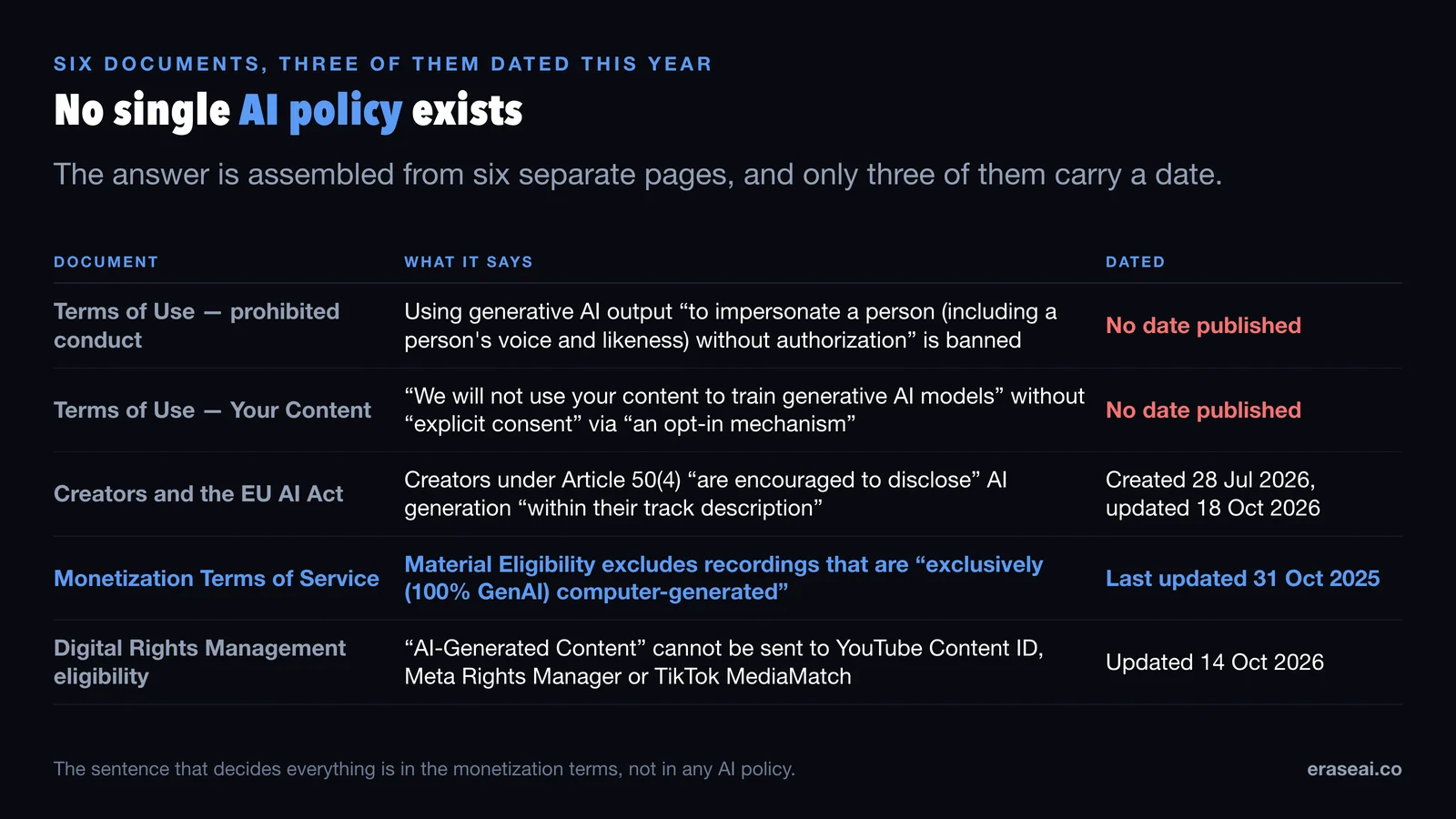
Search this question and you will be told that SoundCloud requires AI disclosure at upload. It does not. There is no AI toggle, no checkbox and no badge; we looked in the Terms of Use, the Monetization Terms and the help centre, and the only document that addresses creator disclosure at all is an article about European law.
| Document | What it says about AI | Date |
|---|---|---|
| Terms of Use — prohibited conduct (xi) and (xvii) | Using “the output of generative artificial intelligence to impersonate a person (including a person’s voice and likeness) without authorization” is banned | No date published on the page |
| Terms of Use — Your Content | “We will not use your content to train generative AI models that aim to replicate or synthesize your voice, music, or likeness without your explicit consent, which must be affirmatively provided through an opt-in mechanism” | No date published on the page |
| Creators and the EU AI Act | Creators “subject to the transparency requirements” of the Act “under Article 50(4), are encouraged to disclose” AI generation “within their track description” | Created 28 Jul 2026, updated 18 Oct 2026 |
| Monetization Terms of Service | Material Eligibility excludes recordings that are “exclusively (100% GenAI) computer-generated” | Last updated 31 Oct 2025 |
| Digital Rights Management eligibility | “AI-Generated Content” cannot be sent to YouTube Content ID, Meta Rights Manager or TikTok MediaMatch | Updated 14 Oct 2026 |
| Artwork Guidelines for Digital Distribution | “Original AI-generated images are allowed, but must also be accompanied by valid license documentation” | Updated 20 Oct 2026 |
The wording of that third row is the finding. Creators “subject to the transparency requirements” of the Act “are encouraged to disclose” — a conditional recommendation, not a platform rule. And the condition is doing real work, because Article 50(4) is about deep fakes and about text published to inform the public on matters of public interest. An instrumental that imitates nobody is not obviously either. We are not your lawyers and this is our reading of a regulation applicable since 2 August 2026, not advice — our EU AI Act guide works through the obligations properly.
What SoundCloud does prohibit outright is impersonation, and it names the method: using generative output to imitate “a person's voice and likeness” without authorisation appears twice in the prohibited conduct list. So the honest summary is narrow and worth stating plainly. Nobody at SoundCloud is asking you to announce that a model made your song. Everybody at SoundCloud will act if the model made it sound like somebody else.
Barred from Content ID, Meta and TikTok
The consequence no guide on this query mentions.
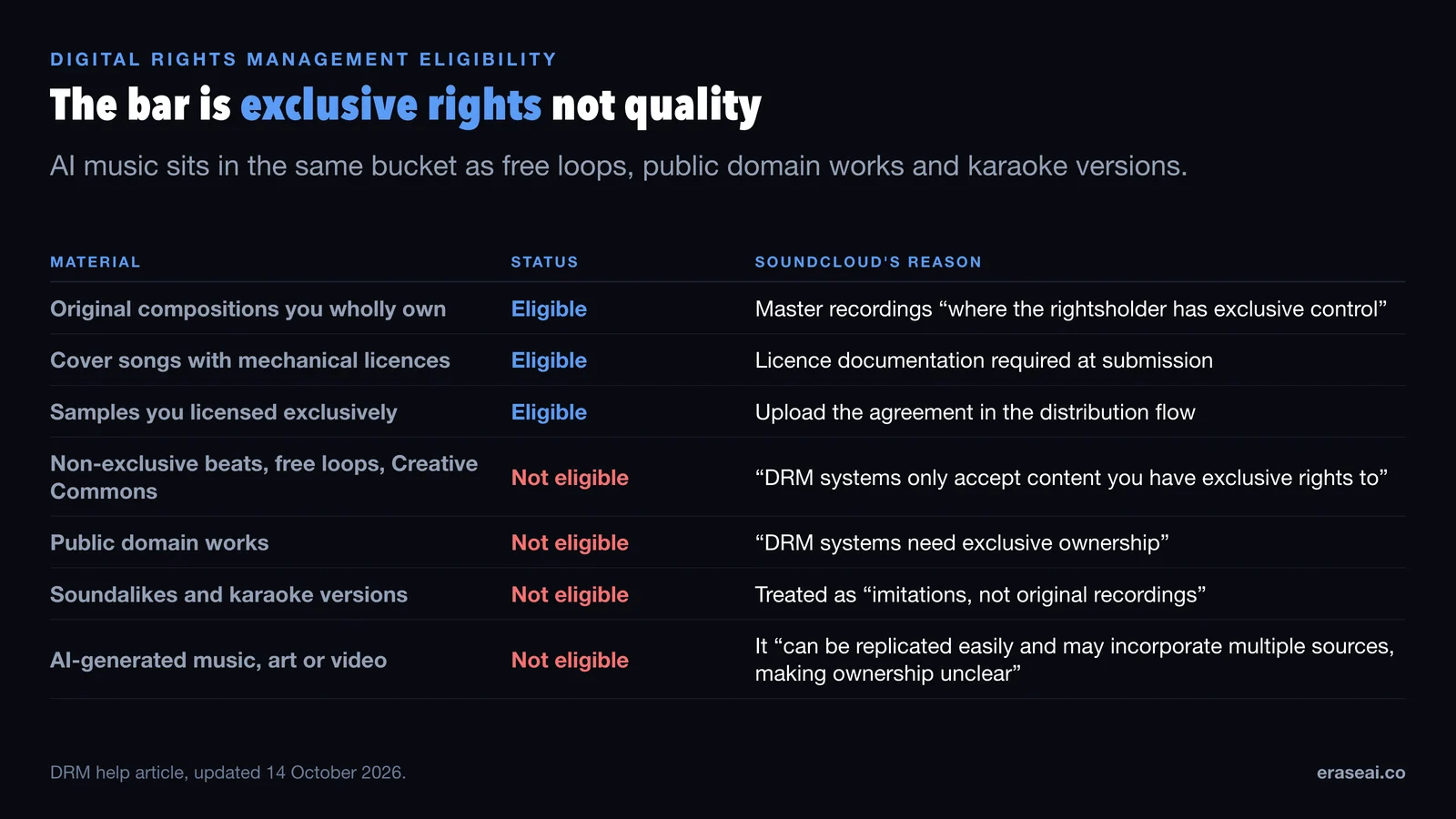
SoundCloud's distribution product can register your recording with three fingerprinting systems: YouTube Content ID, Meta Rights Manager and TikTok MediaMatch. They are how a track earns from other people's videos, and for a lot of independent releases that is the larger half of the income. SoundCloud publishes an eligibility list for them, and AI is on the wrong side of it.
| Content | Status | SoundCloud's stated reason |
|---|---|---|
| Original compositions you wholly own | Eligible | Master recordings “where the rightsholder has exclusive control” |
| Cover songs with mechanical licences | Eligible | Licence documentation required at submission |
| Samples you licensed exclusively | Eligible | Upload the agreement in the distribution flow |
| Non-exclusive beats, free-to-use loops, Creative Commons | Not eligible | “DRM systems only accept content you have exclusive rights to” |
| Public domain works | Not eligible | “DRM systems need exclusive ownership” |
| Soundalikes and karaoke versions | Not eligible | Treated as “imitations, not original recordings” |
| AI-generated music, art or video | Not eligible | It “can be replicated easily and may incorporate multiple sources, making ownership unclear” |
Two details make that last row sharper than it looks. First, the instruction is operational: if your track uses non-exclusive material you must “remove YouTube Content ID and uncheck TikTok and Meta from your selected platforms before submitting”, because “only 100% original or exclusive content can be delivered to these platforms”. That is a thing you do in the release flow, not a thing that happens to you.
Second, the two documents disagree, and we are not going to smooth it over. The Monetization Terms exclude only recordings that are exclusively generated; the DRM article lists “AI-Generated Content” with no threshold at all. So for a part-AI track that is eligible to distribute, whether fingerprinting registration is available is genuinely undocumented. If it matters to your release, ask support before you pick your platforms rather than after.
The subscription tier that gates it
Before any AI rule applies, a plan has to let you through.
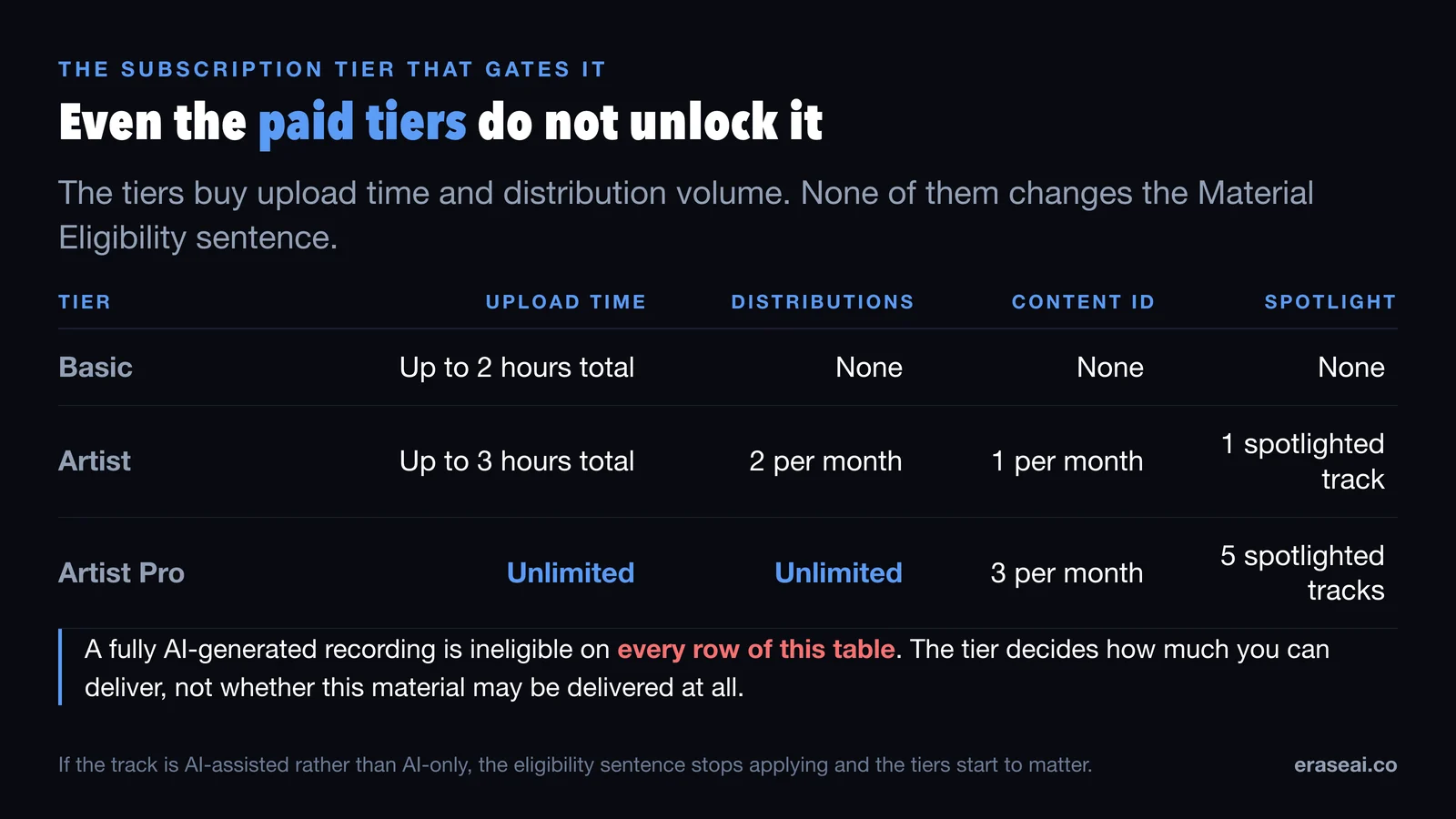
Monetization requires an active Artist subscription, and cancelling it counts as notice that you have left the programme. The quotas below are the part people discover late: on the middle tier, distribution is rationed to two tracks a month.
| Plan | Upload allowance | Distributed + monetized tracks | Mastering credits | Spotlight |
|---|---|---|---|---|
| Basic | Up to 2 hours total | None | None | None |
| Artist | Up to 3 hours total | 2 per month | 1 per month | 1 spotlighted track |
| Artist Pro | Unlimited | Unlimited | 3 per month | 5 spotlighted tracks |
Those credits “reset at the start of each new month” and do not carry over, and SoundCloud says there is no screen showing how many you have left. The Artist plan is also “currently available only in select territories”; SoundCloud's own announcement puts it at $3.25 a month, without stating the billing basis on that page, and Artist Pro's price sits behind a checkout we could not read. Premier, the old invite-only programme, is closed: “Premier is now a legacy offering, and we are no longer taking new applications.”
The mechanical requirements are worth knowing before you plan a release date. Distribution wants lossless WAV or FLAC at 16 or 24 bits, artwork exactly 3000 × 3000 pixels, and a release date four to six weeks out rather than next Friday. Uploads themselves expire if you leave them for more than three days before attaching them to a track.
The storefront the rule closes
SoundCloud started selling downloads in August 2026. Not yours.
On 26 August 2026 SoundCloud opened a beta allowing “a select group of Artist Pro creators to sell tracks directly from their SoundCloud profiles”, taking “no commission on purchases”. The reasoning it published is the discovery problem in numbers: more than 250,000 artists have linked over 2.4 million tracks to external music platforms, and each year SoundCloud sends more than half a million users elsewhere to buy music.
Here is the chain that closes it. Paid downloads require an eligible Artist Pro plan, a supported region — the United States, in the help article's words — and, decisively, that “the track has been monetized via SoundCloud's monetization process”. Monetization is the door the 100% GenAI clause already shut. So the sentence that costs you a royalty also costs you the sale, and it does it silently: the option simply never appears.
Which leaves the real problem where it always was. Distribution was never the wall for AI music — finding anyone to listen is, and a storefront you cannot open does not help. The money conversation in this niche is about paid sync placements, where a brief is a brief and nobody asks your streaming numbers; that is why we point people at played.fm's sync route first, with selling direct to your own listeners as the second leg rather than the pitch. If you want the arithmetic rather than the argument, our earnings guide runs the numbers.
If it is AI-assisted, not AI-only
The eligible path, and the screening that waits at the other end.
Everything above has an exit, and it is not a trick: build a recording that is genuinely not exclusively generated, and keep the evidence. SoundCloud accepts beat licences, purchase receipts for sound packs, collaboration agreements and mechanical licences as documentation, and tells you to upload them with the submission because “providing this upfront helps speed up the review process”. Your own stems, session files and a written account of what you played are the same kind of record, and they are free to keep.
SoundCloud also names three AI tools it partnered with in January 2024 — Fadr, Soundful and Voice-Swap — and the help centre states the condition for two of them bluntly: Soundful and Voice-Swap both “require users to purchase a license to monetize or distribute content”. A licence from the tool is not the same as a human contribution to the recording, and neither substitutes for the other.
One warning before you ship. Buying plays will cost you more here than almost anywhere: SoundCloud reserves the right to exclude artificial plays from your revenues, to forfeit those revenues and to reset the play count, and it notes that Spotify now charges distributors a fee for every track flagged for artificial streams. Its own guidance says plainly that “your entire catalog could be taken down”.
And once an eligible release leaves SoundCloud for those sixty-odd stores, you meet a different kind of gate: the automated AI screening and spectral checks the stores and distributors run for themselves, plus whatever generation artifacts survived your export. That is the stage Undetectr is built for, and the boundary needs saying out loud: it does nothing whatsoever about SoundCloud's eligibility clause, which is a declaration-and-documents rule, and nothing about how any platform chooses to label a release. For what the published detectors actually measure, our detector guide and list of platforms that accept AI music are the next two pages to read.
Questions people ask about this policy
Seven answers, from the documents below.
Does SoundCloud allow AI-generated music?
Yes, as an upload. No SoundCloud document bars AI music from the platform, and its only AI-specific guidance merely encourages disclosure in the track description. What it bars is paying you for it: fully AI-generated recordings are excluded from monetization.
Can I monetize a Suno or Udio track on SoundCloud?
Not if every sound in it was generated. The Monetization Terms exclude recordings that are “exclusively (100% GenAI) computer-generated through the use of artificial intelligence or any other means or method” and say “do not submit them”.
What counts as 100% GenAI?
SoundCloud does not define it further, and the word that matters is “exclusively”. A recording with genuine human contribution is not caught by the sentence as written, but you may be asked for “evidence of such rights”, so keep your session files.
Is the AI exclusion permanent?
It is written as temporary. The clause says “not eligible at this time”, and the update section reserves the right to amend the terms “to expand the types of content that may be eligible”. No date or criteria are published, so treat it as current rather than final.
Does SoundCloud put an AI label on tracks?
No. We found no AI badge, tag or toggle in the Terms of Use, the Monetization Terms or the help centre as of 20 October 2026. SoundCloud differs from Deezer, Tidal and YouTube Music here: disclosure, where it happens, is something you write yourself.
Must I disclose AI use when I upload?
SoundCloud says creators subject to EU AI Act Article 50(4) “are encouraged to disclose”. That is conditional and not mandatory. Two widely read guides describe an obligatory disclosure field; no SoundCloud document we read creates one.
Can I use AI-generated cover art?
Yes, with paperwork. The artwork guidelines say “original AI-generated images are allowed, but must also be accompanied by valid license documentation”, and reused or single-colour artwork is rejected outright.
Sources, and what we could not verify
Everything quoted above, dated, and what this page refuses to state.
- SoundCloud — Monetization Terms of Service (last updated 31 October 2025): the Material Eligibility sentence, the Artist Subscription requirement, “evidence of such rights”, the artificial-streaming remedies, the 100% revenue shares and the reserved right to expand eligibility. Plus the summary of that revision for the 0% distribution fee.
- SoundCloud Terms of Use: prohibited conduct (xi) and (xvii) on generative impersonation, and the AI-training commitment with its opt-in mechanism. The page publishes no “last updated” date, so none is quoted.
- Help centre — Creators and the EU AI Act (28 July 2026, updated 18 October 2026), DRM eligibility (14 October 2026), Artwork Guidelines (20 October 2026), Verify your Rights (18 October 2026), Artist & Artist Pro Subscriptions (12 October 2026), paid downloads (4 September 2026), 6 Ways to Get Paid (12 October 2026), Upload Requirements, Your first release, Artificial Streaming, Premier Eligibility and the 2024 AI-partner announcement.
- SoundCloud Introduces Direct Music Purchases with Zero Commission, 26 August 2026: the beta scope, the zero-commission statement and the 2.4 million external links figure. Article 50(4) is quoted from the published text of the AI Act.
All of the above read at source on 20 October 2026. SoundCloud's help-centre pages return 403 to automated readers, so the articles were read through that help centre's own public API; the wording is SoundCloud's and the links above are the canonical URLs its API returns, which open normally in a browser. We do not claim that tracks uploaded through the Fadr, Soundful or Voice-Swap integrations carry a “made with” tag — press coverage of that 2024 announcement says so, SoundCloud's own announcement does not, and we could not confirm it. No price is stated for Artist Pro and the $3.25 Artist figure is SoundCloud's own headline with no billing basis published beside it. The reading of Article 50(4)'s scope is ours and is not legal advice. Table 1 is our arrangement of five documents; the quotations in it are theirs. Policies and beta scopes change without notice. Last updated 20 October 2026.
No audio tool clears a declaration rule.
SoundCloud's AI gate is paperwork, not a classifier. Nothing you do to the file changes whether a recording is “exclusively generated”, and any product implying otherwise is selling you something it cannot deliver. What cleanup is genuinely for is the next gate along: the automated screening and audible artifacts that meet an eligible release once it leaves for the stores.
Independent guide · partner links · nothing here changes SoundCloud's eligibility rule
Related guides
Platforms that accept AI music
Every published distributor policy, read at source and dated.
AI music on Deezer
Where a classifier applies the tag instead of a form you fill in.
AI music on Tidal
The platform whose AI rule withholds royalty attribution.
Disclosure that works
What to say about your process, and what saying it costs you.
Selling AI music
Routes to a paying listener that do not need a distributor's blessing.
Human track flagged as AI
When the problem is a classification rather than a declaration.
Or browse every guide on the site.