Apple Music Never Banned AI. It Started Labelling It.
Most creators find out about this the wrong way round — a release goes out, and a tag they never saw gets attached to it by their distributor. Apple made AI disclosure a delivery requirement in March 2026, and the resulting Made With AI labels reach listeners later this year. Two systems, two dates, and one field on an upload form that almost nobody reads. We went through Apple's partner announcements and the trade coverage of both to work out what a release actually has to carry.
The short version
Five things worth knowing before your next Apple Music delivery.
AI music is not banned on Apple Music. Apple published a disclosure requirement, not a prohibition, and nothing in it makes generated audio ineligible.
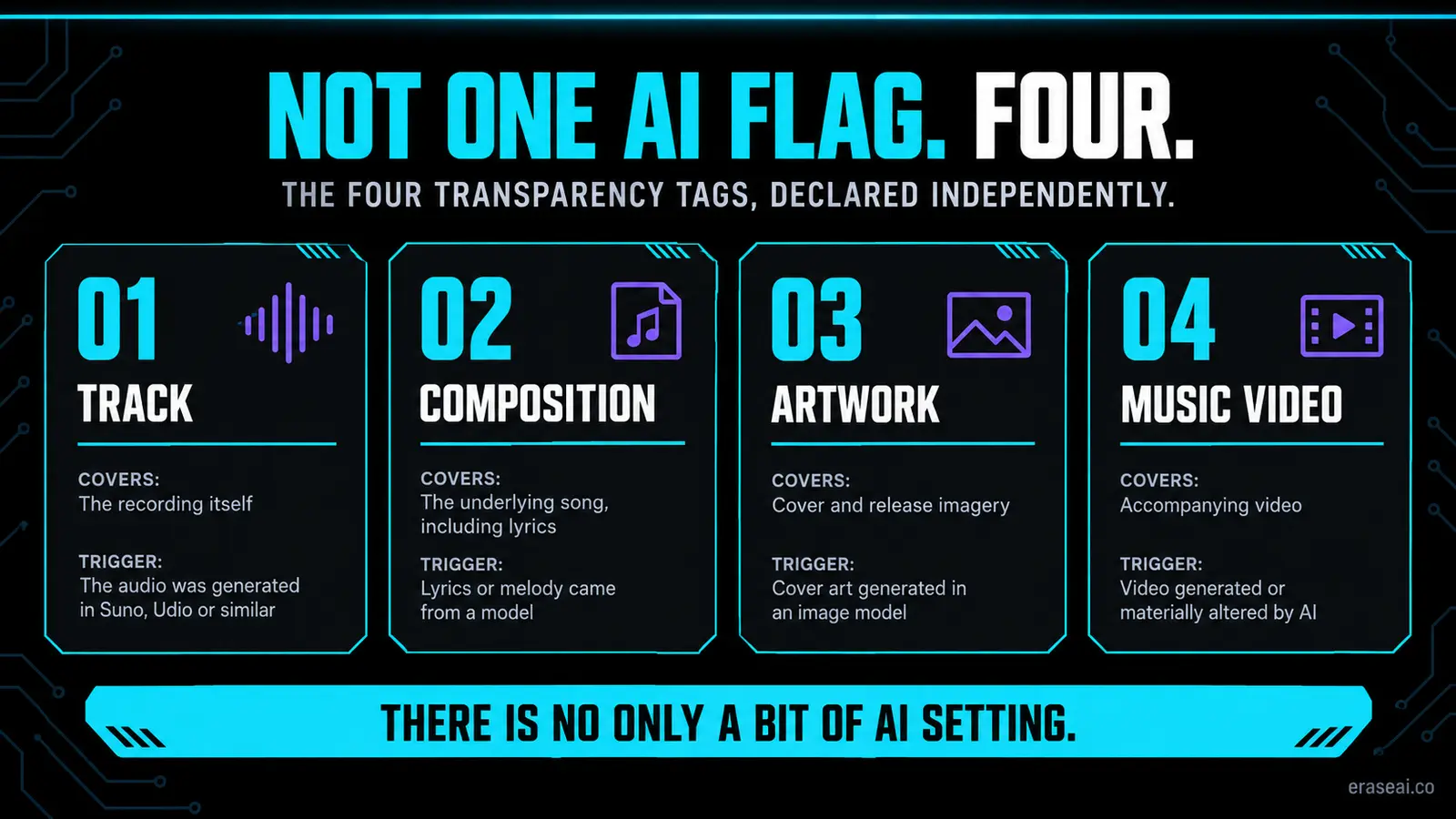
Four Transparency Tags exist — artwork, track, composition and music video — and they became a delivery requirement for labels and distributors from March 2026.
The trigger is that AI created “a material portion” of the work. Apple has published no percentage, and explicitly defers to content providers to decide what qualifies.
Apple announced Made With AI labels to partners on 20 August 2026. They surface the tags already being submitted, and Apple says they arrive later this year.
Apple's scheme is not Spotify's. Spotify's AI credits run on the DDEX standard; Apple built its own four tags. Deliver to both and both have to be satisfied — in your distributor's upload form.
Two dates that changed what a release carries
One made disclosure a requirement. The other made it visible.
The confusion in this topic comes from treating one story as two, or two stories as one. They are genuinely separate events, six months apart, and they do different jobs.
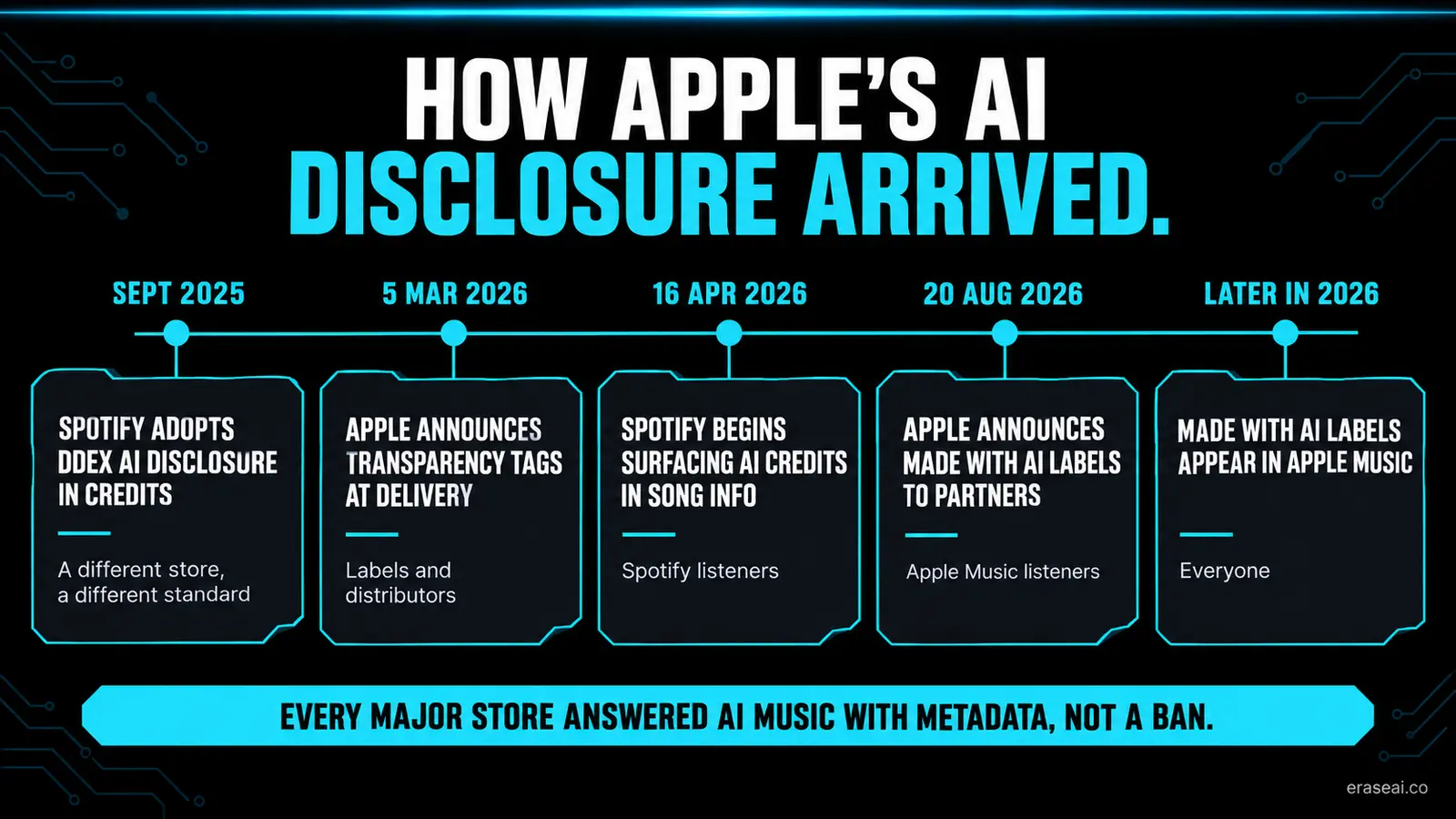
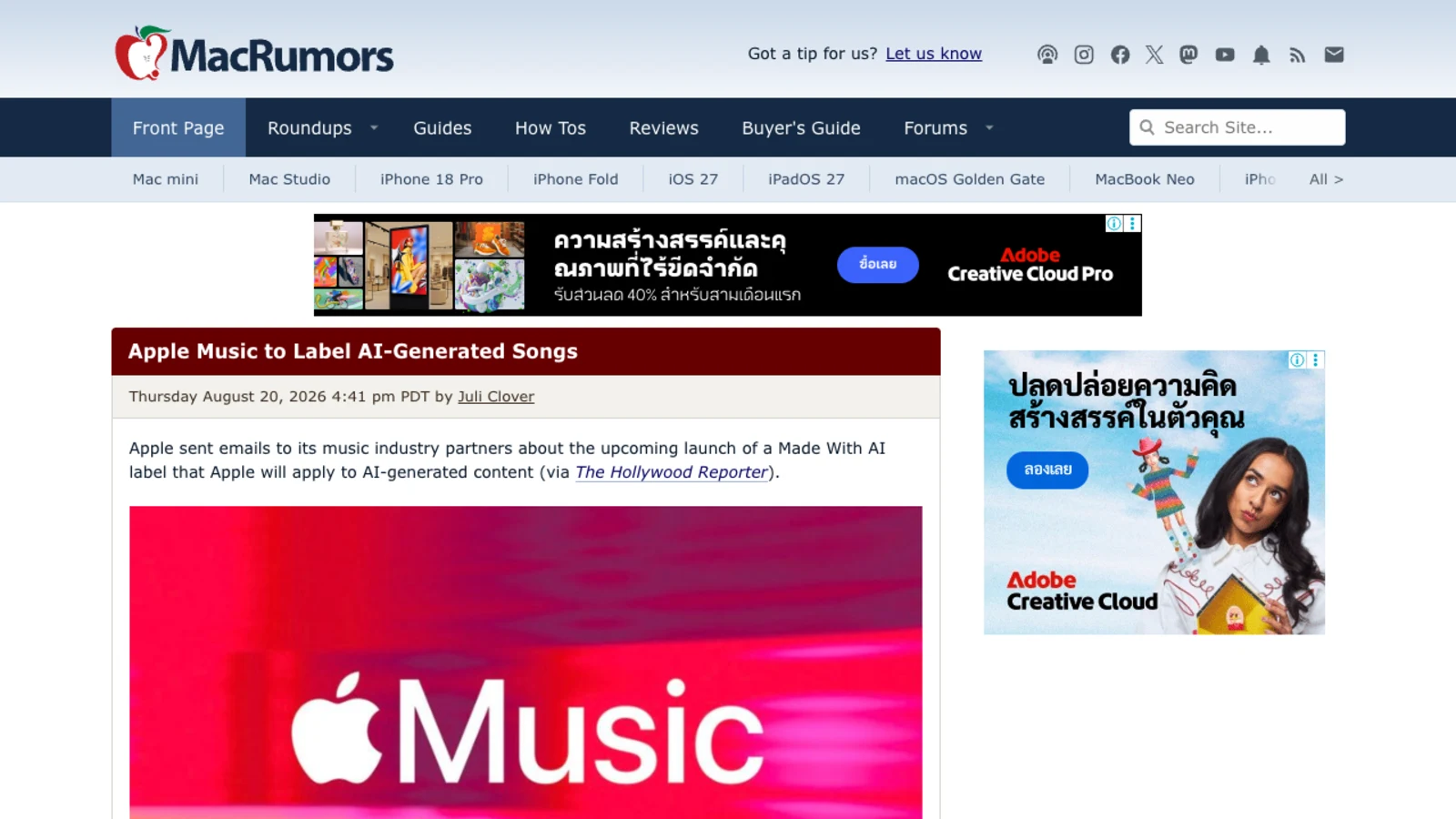
On 5 March 2026 Apple told partners it was adding Transparency Tags to its music delivery system, letting labels and distributors declare where AI had been used. On 20 August 2026 Apple emailed partners again to say that the information collected by those tags would become visible to listeners as Made With AI labels later in the year. The second announcement added no new obligation. It changed who gets to see what the first one collected.
| Date | What happened | Who it affected |
|---|---|---|
| Sept 2025 | Spotify adopts DDEX AI disclosure in credits | A different store, a different standard |
| 5 Mar 2026 | Apple announces Transparency Tags at delivery | Labels and distributors |
| 16 Apr 2026 | Spotify begins surfacing AI credits in song info | Spotify listeners |
| 20 Aug 2026 | Apple announces Made With AI labels to partners | Apple Music listeners |
| Later in 2026 | Made With AI labels appear in Apple Music | Everyone |
Read down that column and the shape of the sector in 2026 is obvious. Every major store has decided the answer to AI music is metadata rather than a ban — and each one is building its own.
Three words doing all the work
“A material portion” is the whole test, and Apple left it open.
Apple's trigger is that a tag should be applied when a material portion of the content was created using AI. There is no published percentage, no stem count, no duration threshold. People keep looking for the number. There isn't one.
That reads like an oversight until you notice how Apple framed it: similar to genres, credits, and other metadata, Apple defers to content providers to determine what qualifies as AI content. Genre is the giveaway. Nobody has ever published a percentage for when a track becomes house rather than techno; the person delivering it decides, and the store takes them at their word. Apple has put AI disclosure in that same category deliberately.
Which leads to the part worth being blunt about: nothing in this system inspects your audio. Apple is not running a classifier over deliveries to catch undeclared AI. Trade coverage at the time of the March announcement noted that how Apple would detect undeclared AI use was unclear, and nothing published since has clarified it. Every label on the platform is only as accurate as the person who submitted it.
- The recording generated from a text prompt
- Lyrics or topline written by a model
- A cloned or synthesised lead vocal
- Cover artwork produced in an image model
- Compression, EQ and other standard processing
- Automated mastering on a recording you already had
- Noise reduction and artifact cleanup on a bounce
- Stem separation of your own recording
That right-hand column is not Apple's published list — Apple has not published one — but it follows the logic of the wording, and it matches how YouTube draws the same line, where “using effects to enhance previously recorded audio” is explicitly outside the disclosure requirement. Two platforms, two schemes, the same instinct: generation is disclosable, processing is not.
Apple's system is not Spotify's system
The single most expensive assumption a creator can make here.
A lot of coverage has flattened these into one story called “streaming services are labelling AI music now”. They are, but not with the same machinery, and the difference is the thing a releasing artist actually has to act on.
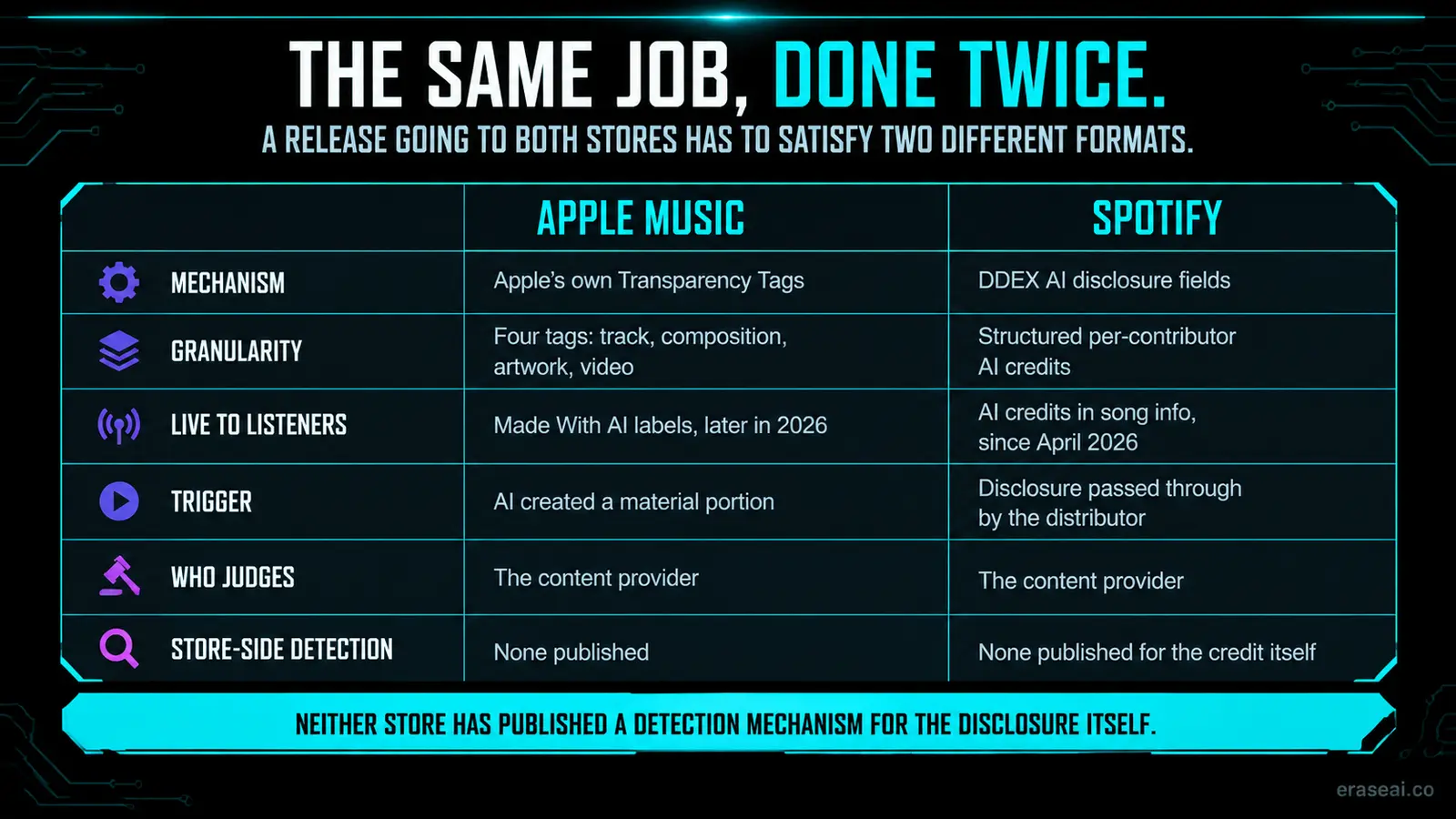
Spotify's route runs through DDEX, the standards body whose members include Apple, Spotify, Amazon and the major labels. Spotify adopted DDEX AI disclosure in its credits in September 2025 and began surfacing those credits in the song info panel in April 2026 — a structured format where you can say the vocals were generated while a human wrote the lyrics and played guitar. Apple, despite being a DDEX member, built its own four-tag scheme for delivery.
| Apple Music | Spotify | |
|---|---|---|
| Mechanism | Apple's own Transparency Tags | DDEX AI disclosure fields |
| Granularity | Four tags: track, composition, artwork, video | Structured per-contributor AI credits |
| Live to listeners | Made With AI labels, later in 2026 | AI credits in song info, since April 2026 |
| Trigger | AI created “a material portion” | Disclosure passed through by the distributor |
| Who judges | The content provider | The content provider |
| Store-side detection | None published | None published for the credit itself |
Two conclusions fall out of that table. The first is that a single release going to both stores has to satisfy two different disclosure formats. The second is the row at the bottom: neither store has published a detection mechanism for the disclosure itself. What each has instead is screening further upstream — which is a different system with different triggers, covered in our guide to how AI music detectors work. Our guide to AI music on Spotify covers that store's policy in full.
Both tags are set in one place
You have no Apple Music account for this. Your distributor does.
Here is the structural fact that makes this whole topic easier to act on. Apple's Transparency Tags are part of the delivery specification — the package a label or distributor sends to Apple. An independent artist has no interface to Apple Music in which to set them. Neither does Spotify's DDEX credit reach the store any other way.
So both disclosures come down to fields in your distributor's upload form, and whether that distributor supports them yet. If those fields are absent, or you leave them blank, your release goes out undeclared — not through any decision of yours, but because nobody asked. This is the failure mode worth checking for before your next delivery rather than after it.
It is also why distributor choice quietly became the most consequential decision in AI music releasing. DistroKid was the first distribution partner for Spotify's AI credits in April 2026 and publishes explicit written rules for AI content; we go through what its screening accepts and rejects in the DistroKid and AI music guide. The mechanics of getting a generated track through that pipeline are in our Suno to Spotify walkthrough.
What the label does and does not do
Less than the panic suggests. More than nothing.
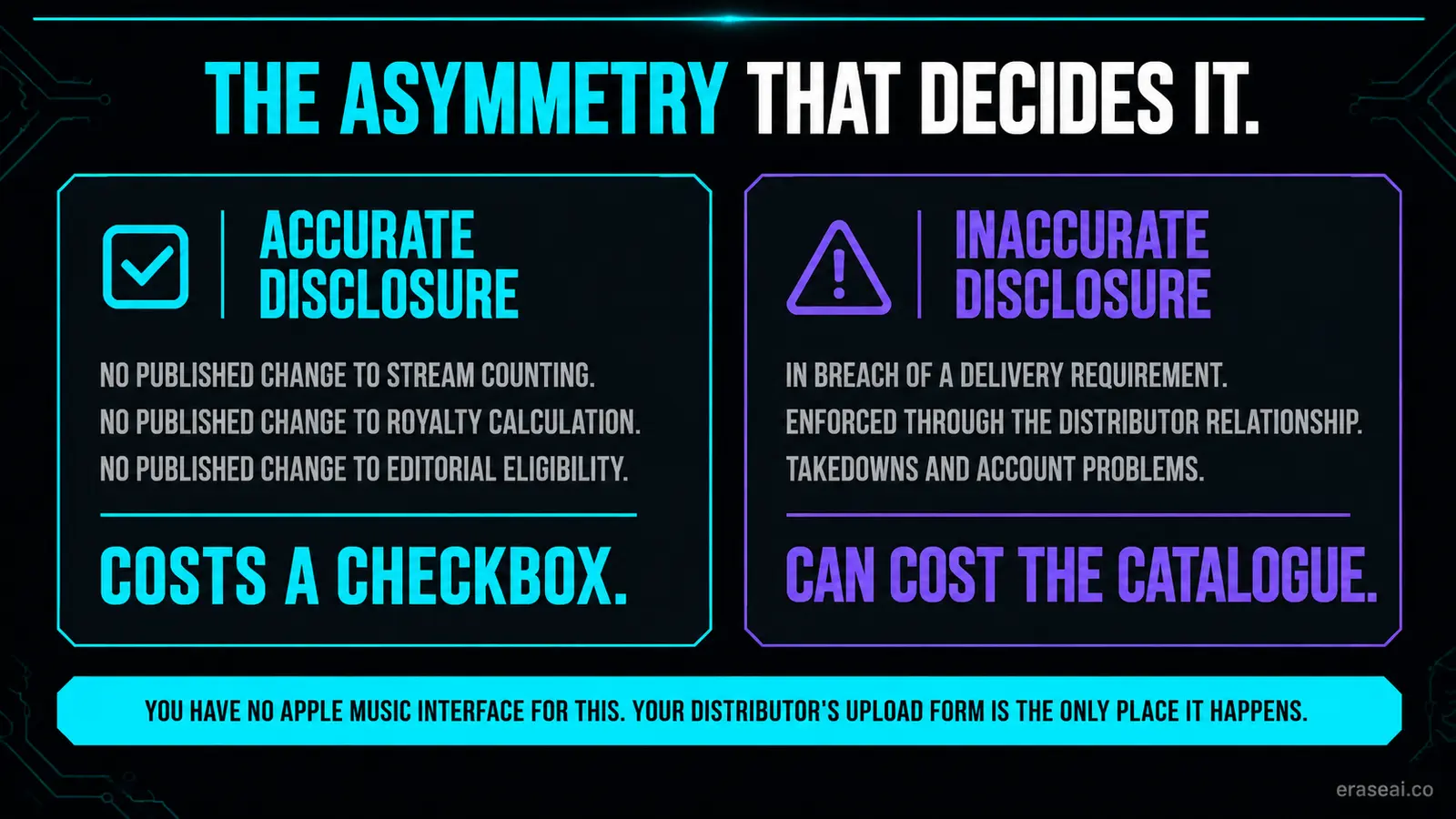
The fear attached to Made With AI labels is that they function as a demotion — a scarlet letter that costs you playlists, plays and royalties. There is no published basis for that. The tag is a metadata field surfaced next to a track. Apple has described no mechanism by which it changes stream counting, royalty calculation or editorial eligibility, and a labelled track remains a track that plays, charts and earns.
What genuinely changes is that listeners can see it. That is a marketing consideration, not a compliance one, and creators will reasonably weigh it differently — a producer whose audience already knows the work is AI-assisted loses nothing at all.
The asymmetry here is worth sitting with, because it decides the right answer. Accurate disclosure has no published downside. Inaccurate disclosure puts you in breach of a delivery requirement, and delivery requirements are enforced through the distributor relationship — where the consequences are takedowns and account problems rather than a line of small text. One side of that trade costs a checkbox. The other can cost the catalogue.
A separate question sits underneath all of this and does not go away when you tick the box: who owns a generated track at all. That one is genuinely unsettled, and we cover it in the AI music copyright guide.
What to do before your next release
Four steps, in this order.
Find the AI fields in your distributor
Before anything else, open an upload form and look for the AI disclosure section. If your distributor does not have one, it cannot pass Apple's tags or Spotify's DDEX credits, and every release you send through it goes out undeclared.
Declare per component, not per release
Apple's four tags are independent. Work out separately whether the track, the composition, the artwork and any video were AI-created, and tag each one honestly. Partial AI use is normal and the scheme is built to express it.
Clean and master the file
Separate job, same release. Distributor screening reads loudness, artifacts and the identifier layer in a raw generator export — none of which the disclosure tags touch. We recommend Undetectr, which runs the artifact pass and mastering together. This is release prep, not a way around disclosure: the tag is still required.
Check the label after it goes live
The tags travel through a distributor, which means they can be set wrong or dropped without you seeing it. Once Made With AI labels are live, look at your own release page and confirm what it says matches what you declared.
Step three is the one creators most often collapse into step two, so it is worth stating plainly: cleaning a file has no effect on whether it must be disclosed. Disclosure attaches to how the music was made. Cleanup attaches to how the file sounds and whether it passes a distributor's technical screening. They are different problems that happen to land in the same week, and the guide to AI audio cleanup covers the second one properly.
AI music on Apple Music FAQ
Is AI music allowed on Apple Music?
Yes. Nothing Apple has published bans AI-assisted or AI-generated music as a category. What Apple introduced in March 2026 is a disclosure requirement — Transparency Tags that labels and distributors must apply when AI created a material portion of the work. Disclosure is not prohibition.
What is the Apple Music “Made With AI” label?
It is the listener-facing version of the Transparency Tags. Apple told partners on 20 August 2026 that the AI information already being submitted at delivery will surface to users as Made With AI labels later in 2026. The label is generated from the tag your distributor supplied; it is not a separate submission you make.
Who decides whether my track counts as AI content?
You and your distributor do. Apple's wording is that, similar to genres and credits, it defers to content providers to determine what qualifies as AI content. Apple is not scanning your audio to make the call, which means the accuracy of every label on the platform rests on self-declaration.
What does “a material portion” actually mean?
Apple has not published a percentage or a threshold, and that ambiguity is deliberate — it is the same judgement call as deciding a genre. The practical reading is that generating the track, the composition or the artwork in Suno, Udio or a similar tool is material, while using a compressor, a stock plugin or a mastering service on a recording you already had is not.
Does the Made With AI label hurt streams or royalties?
There is no published mechanism by which the tag changes how streams are counted or how royalties are paid. It is a metadata field surfaced to listeners, not a penalty or a demotion signal. The risk in this system sits with inaccurate disclosure, not with accurate disclosure.
Is Apple using the DDEX AI disclosure standard like Spotify?
No — they are separate systems. Spotify's AI credits are built on the DDEX consortium's disclosure fields, while Apple built its own four-tag scheme and declined the separate industry proposal from bodies including the IFPI and RIAA. If you deliver to both stores, both have to be satisfied, and your distributor's upload form is the only place that happens.
Does cleaning or mastering my track remove the need to tag it?
No, and treating it that way would be a mistake. Disclosure attaches to how the music was created, not to what you did to the file afterwards. Cleanup and mastering fix loudness and artifacts so a release passes distributor screening — they have nothing to do with whether the composition was AI-generated, and the tag is still required.
What happens if I do not tag an AI track?
Apple has not published a penalty schedule, and reporting at the time of the announcement noted that how Apple will detect undeclared AI use is unclear. What is clear is that the tags are a delivery requirement, and delivery requirements are enforced through the distributor relationship — which is where takedowns and account problems in this sector usually start.
- Music Ally — Apple Music adds transparency tags for uses of AI with music (5 March 2026: the four tags, the “material portion” wording, Apple deferring to content providers)
- Music Ally — Apple Music to add Made With AI labels (21 August 2026: the listener-facing labels, and Apple declining the IFPI/RIAA proposal)
- MacRumors — Apple Music to label AI-generated songs (20 August 2026 partner email, “later this year”)
- Billboard — Spotify launches AI credits for music (the DDEX route, for the comparison)
- Apple — Music Package Specification (the delivery spec Apple pointed partners to; a JavaScript-rendered partner portal)
Apple announced both changes by email to partners rather than in a public policy page, so the dates and wording above come from trade reporting of those announcements, quoted rather than paraphrased where it matters. Apple's own package specification is behind a JavaScript-rendered partner portal we could not read directly, and we have not characterised its contents beyond what Apple told partners. Policies in this area are moving quickly — confirm the current position with your distributor before a release. EraseAI earns from links to Undetectr, the tool recommended above.
Related guides
AI music on Spotify
The other half of the disclosure story — DDEX credits, the spam filters, and what Spotify removes.
AI music on YouTube
A third scheme again: mandatory disclosure at upload, and the monetization clause that decides payouts.
DistroKid and AI music
The distributor that carries your tags to Apple and Spotify, and what its own screening rejects.
AI music copyright
Who owns a generated track once it is labelled — the question disclosure does not answer.
AI audio cleanup
The four layers in a raw generator export, and which of them a distributor's screening reads.
How AI music detectors work
What automated systems measure in a generated file — a separate mechanism from any disclosure tag.
Or browse every guide on the site.
Declare it honestly. Then fix the file.
The tag says how the music was made. It says nothing about whether the export is ready for a distributor's screening — and that part is still on you.
▸ Independent · We recommend Undetectr