Suno Lawsuits 2026: What Happens to Songs You Released
The question underneath every lawsuit thread is never really about the law. It is whether the songs already on Spotify are about to vanish. The second Suno lawsuit of September 2026 names 60,202 recordings at up to $150,000 each, and a German court has already ruled against the company with fines of up to EUR 250,000 per breach behind it. So we read the four live filings, the Munich judgment, Suno's terms of 3 September 2026 and the one case where AI creators genuinely lost something overnight. Not one of those filings asks for your release to come down, and the real risk sits where almost nobody is looking.
The short version
Five findings, each from a filing, a judgment or a company's own published page.
Every live claim is against Suno. The two US suits, the Canadian SOCAN claim and the decided German case all target training, the models and the service. None names a user, and none asks a court to remove tracks from stores.
The Munich judgment is the only decision so far, and it is not final. It prohibits four acts, is backed by fines of up to EUR 250,000 per breach, and is under appeal.
The creators who have actually lost something lost it to a settlement, not a verdict. Udio disabled downloads of audio, video and stems on 29 October 2025, gave a 48-hour recovery window from 3 November, and they are still off eleven months later.
Suno ended support for its older models alongside the v6 launch on 9 September 2026, and its terms let it discontinue any part of the service, and discard account content, without prior notice.
What actually pulls a live release is mundane: a rightsholder's DMCA notice, a lapsed subscription, or a platform rule on impersonation or artificial streaming. A counter-notice carries a 10-business-day wait, and stores can still decline to reinstate.
What the four live cases actually ask for
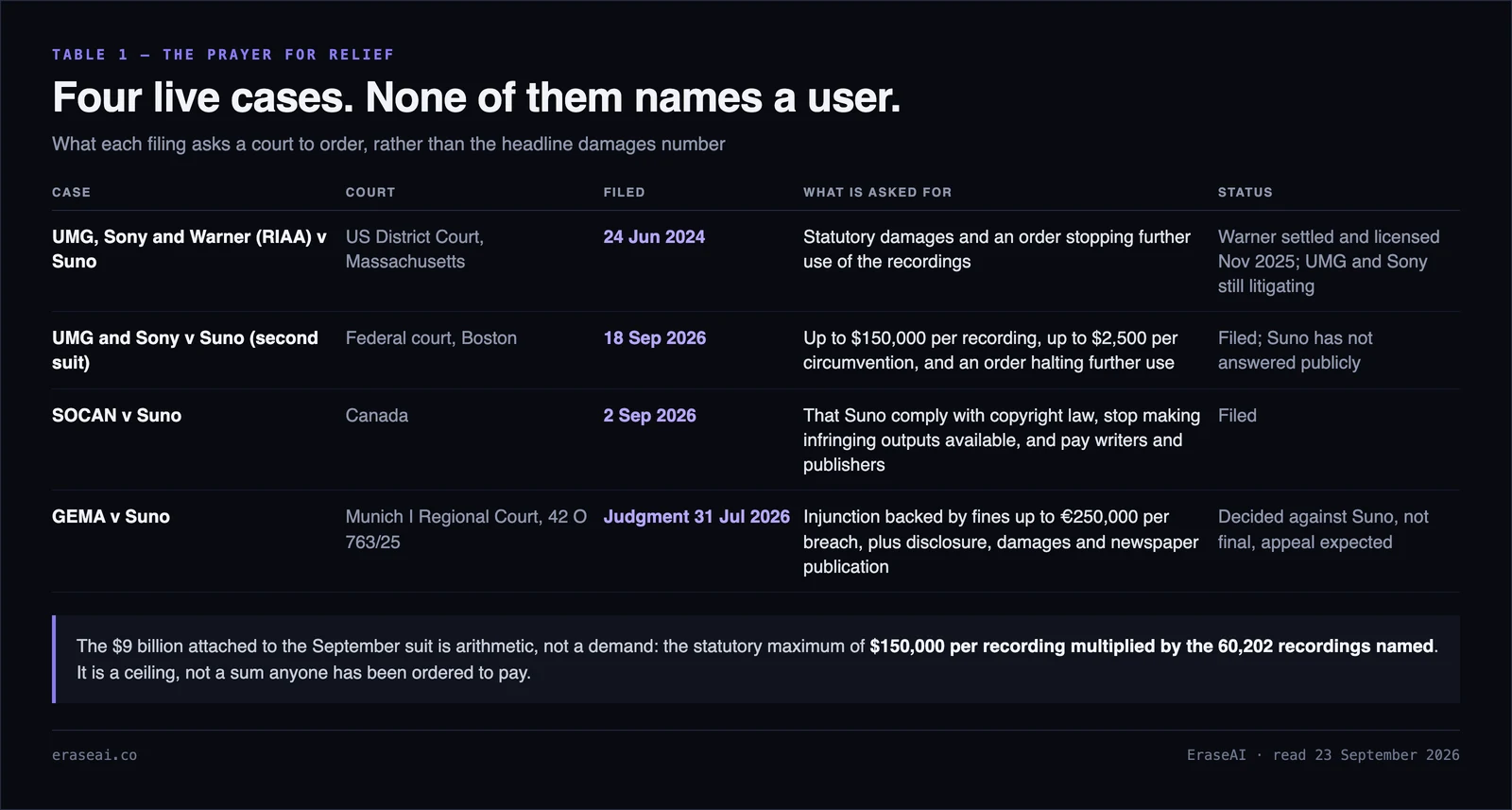
Read the prayer for relief, not the headline number.
Four claims are live against Suno on two continents, and every report of them is written for the music industry rather than the person who made forty songs last year. What a complaint asks a court to do decides whether it can reach you, and in all four the orders sought run against the company, the training and the models.
The $9 billion figure attached to the September suit is arithmetic rather than a demand: the statutory maximum of $150,000 per recording, multiplied by the 60,202 recordings named. It is a ceiling, not a sum anyone has been ordered to pay.
| Case | Court | Filed | What is claimed | What is asked for | Status |
|---|---|---|---|---|---|
| UMG, Sony and Warner (RIAA) v Suno | US District Court, Massachusetts | 24 Jun 2024 | Training on unlicensed recordings; reported as expanded in May 2026 to 61,026 of them | Statutory damages and an order stopping further use of the recordings | Warner settled and licensed in Nov 2025; UMG and Sony still litigating |
| UMG and Sony v Suno (second suit) | Federal court, Boston | 18 Sep 2026 | That v6, launched 9 Sep, inherits the earlier models through knowledge distillation and preference data; 60,202 recordings named | Up to $150,000 per recording, up to $2,500 per circumvention, and an order halting further use | Filed; Suno has not answered publicly |
| SOCAN v Suno | Canada | 2 Sep 2026 | That the outputs themselves infringe; 150 generated tracks named | That Suno comply with copyright law, stop making infringing outputs available, and pay writers and publishers | Filed |
| GEMA v Suno | Munich I Regional Court, 42nd Civil Chamber (42 O 763/25) | Judgment 31 Jul 2026 | Four acts prohibited: training reproduction in the US, memorisation inside the model, offering the model in Germany, and the outputs | Injunction backed by fines up to EUR 250,000 per breach, plus disclosure, damages and newspaper publication | Decided against Suno, not final, appeal expected |
The second US suit is the sharpest of the four because it attacks the fix rather than the original sin. Suno says v6 was trained on licensed content from its partners plus community creations and preference signals. Universal and Sony call that laundering: “training a ‘new’ model on the outputs of an infringing model does not eliminate the infringement; it launders it”. That is an allegation, filed days ago and unanswered in public.
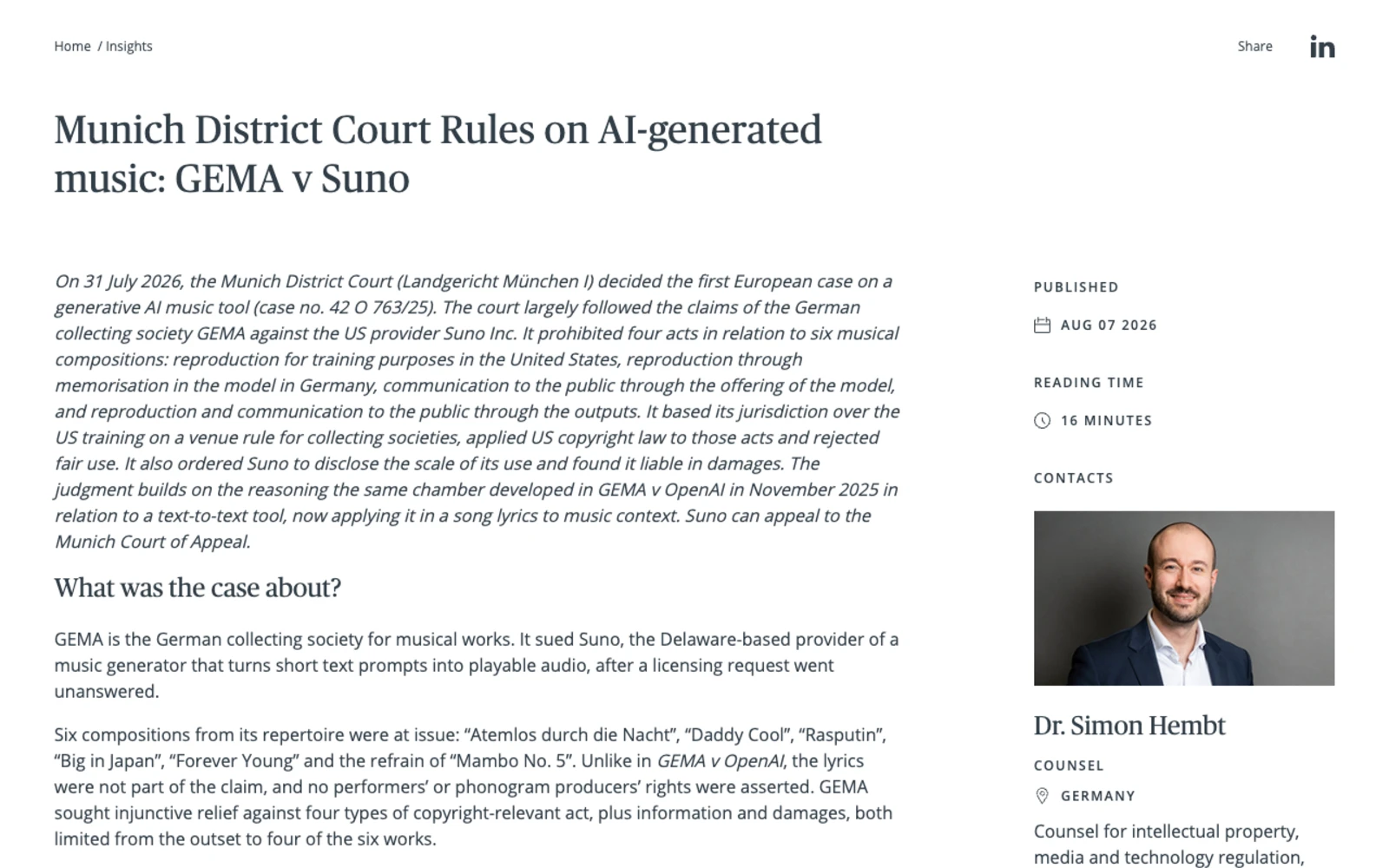
The German case is the one that has been decided, and it shows the shape of a loss: four acts prohibited in relation to six compositions, disclosure and damages on a narrower set, and publication of the judgment in a national newspaper. It said nothing about tracks users had generated, and it is not final.
The one time creators really lost something
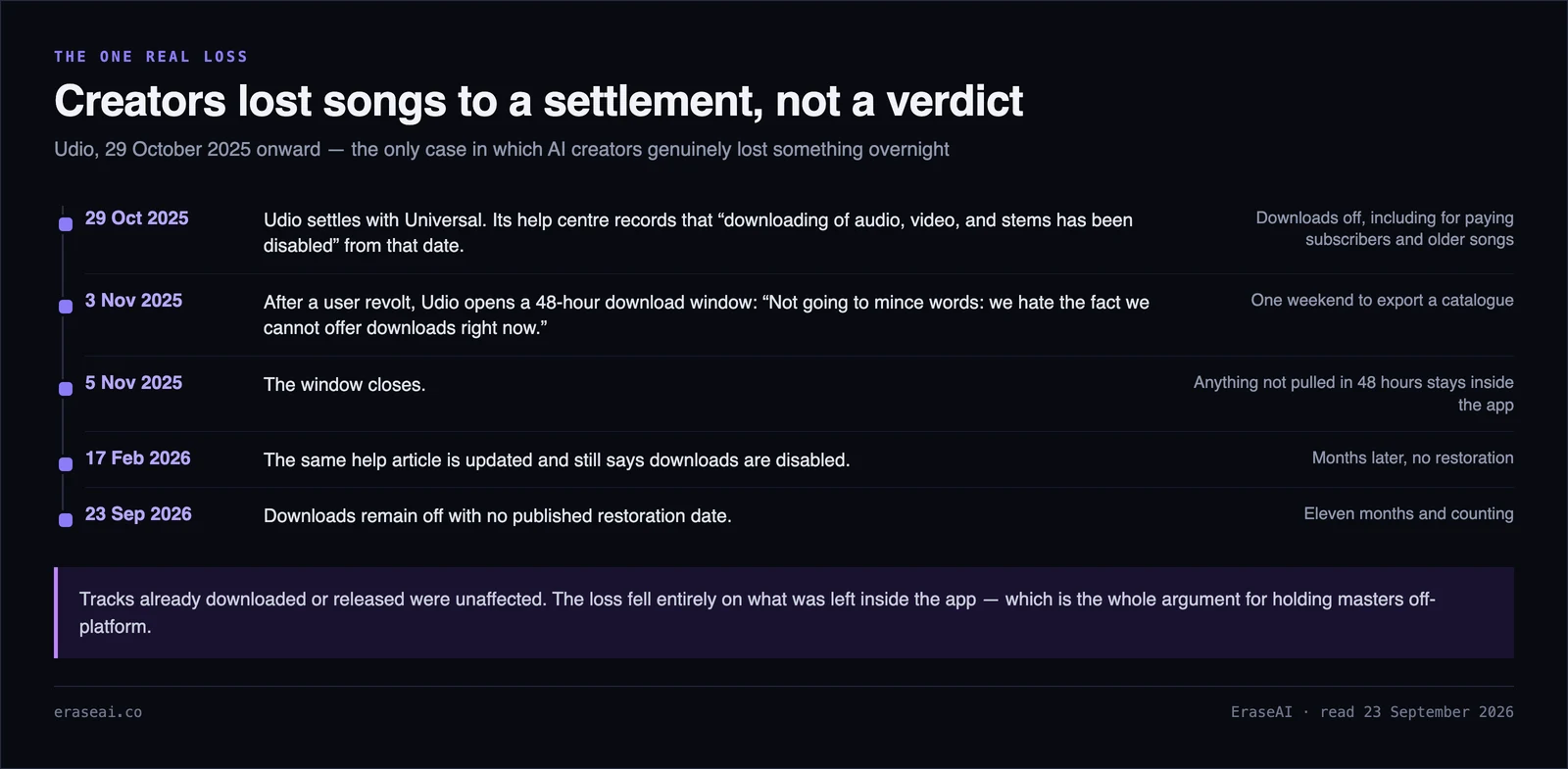
It was not a verdict. It was a settlement, and it took one day.
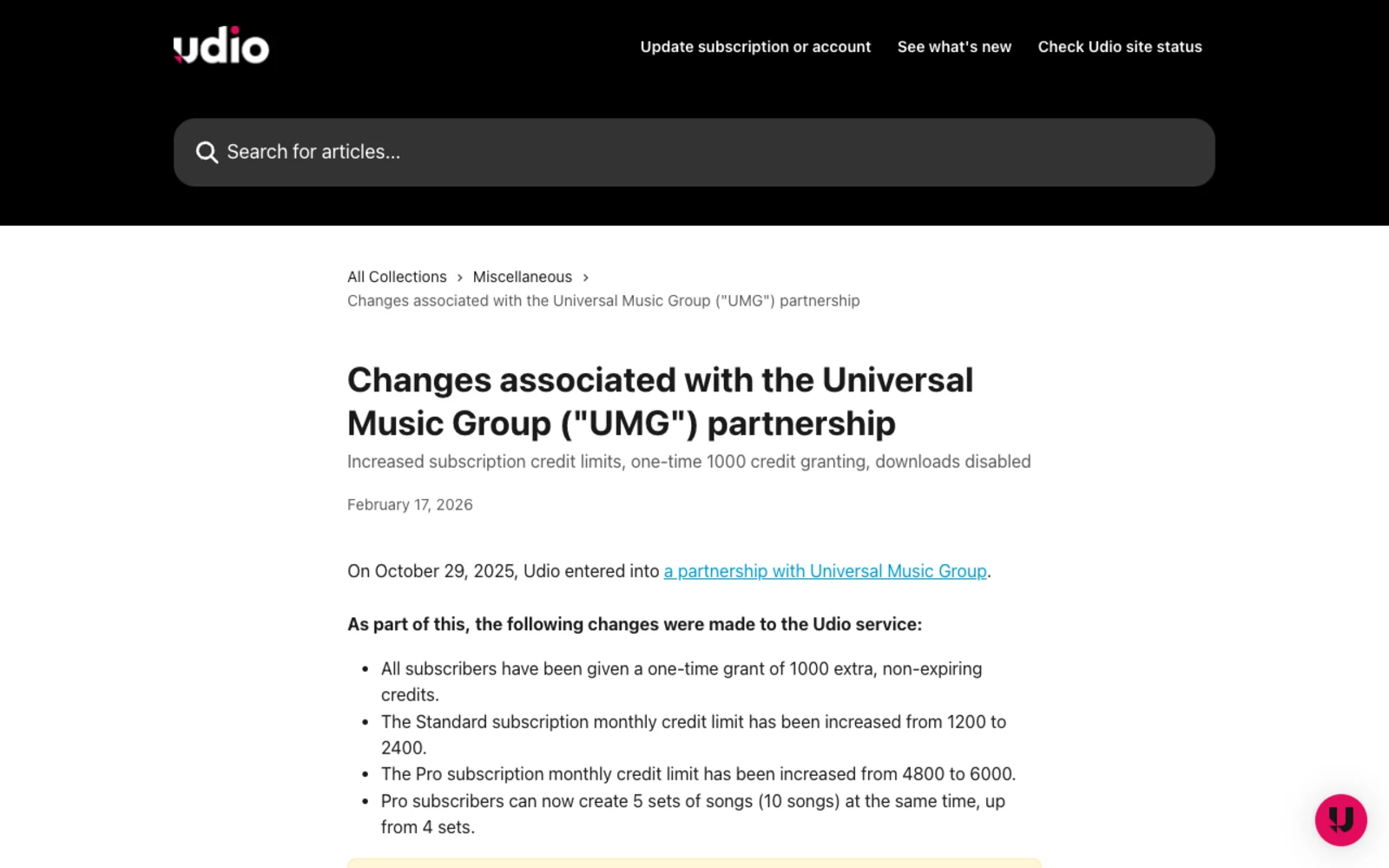
Ask what a bad outcome looks like for a creator and the honest answer is not hypothetical. It happened to Udio users in October 2025, and the mechanism was the opposite of what everyone fears: peace, not war. Udio settled with Universal, signed licences, and the price was a walled garden. Its help centre records the consequence in one line: “downloading of audio, video, and stems has been disabled”.
That applied to paying subscribers and to songs generated long before the deal. After a public revolt, Udio opened a 48-hour window and said so without spin: “Not going to mince words: we hate the fact we cannot offer downloads right now.” Two days to export what you might have spent a year making.
| Date | What happened | Effect on a creator |
|---|---|---|
| 29 Oct 2025 | Udio settles with Universal and announces licensing deals. Its own help centre records that “downloading of audio, video, and stems has been disabled” from that date. | Downloads off, including for paying subscribers and older songs |
| 3 Nov 2025 | After a user revolt, Udio opens a 48-hour download window: “Not going to mince words: we hate the fact we cannot offer downloads right now.” | One weekend to export a catalogue |
| 5 Nov 2025 | The window closes. | Anything not pulled in 48 hours stays inside the app |
| 17 Feb 2026 | The same help article is updated and still says downloads are disabled. | Months later, no restoration |
| 23 Sep 2026 | Downloads remain off with no published restoration date. | Eleven months and counting |
Two details matter for anyone with a Suno library. Tracks already downloaded and already released were untouched: the loss fell on what was left inside the app. And none of it required a court. A commercial decision removed a feature thousands had paid for, and the terms they had accepted permitted it.
So the risk to your catalogue is not the litigation. It is the settlement that ends it, and the product change that comes with it.
Your generator changes under you
Three changes in three weeks, none of which needed your consent.
September 2026 made the point twice over. Suno launched v6 on 9 September and, alongside it, ended support for its older models. The models that made your best songs are not waiting for you to regenerate a stem. Whatever you kept is what you have.
Six days earlier, download caps landed: a rationed number of exports per tier rather than the open downloads people had budgeted around. Our catalogue checklist for the download limits covers how to spend that ration in the right order, and the detail worth repeating is that a song plus its stems counts as one download rather than one per file.
Then on 8 September came the Believe and TuneCore partnership, which opened a route Suno tracks did not previously have. Read what it covers before assuming it covers you: tracks made with Suno's industry-partner model became eligible, after both companies had said earlier in the year that they would not distribute music from models that did not meet their standards. A v5 back catalogue is not what that announcement is about. Which services take generated music at all sits in our list of platforms that accept AI music, where several distributors still publish a plain yes.
Who can actually pull a released track
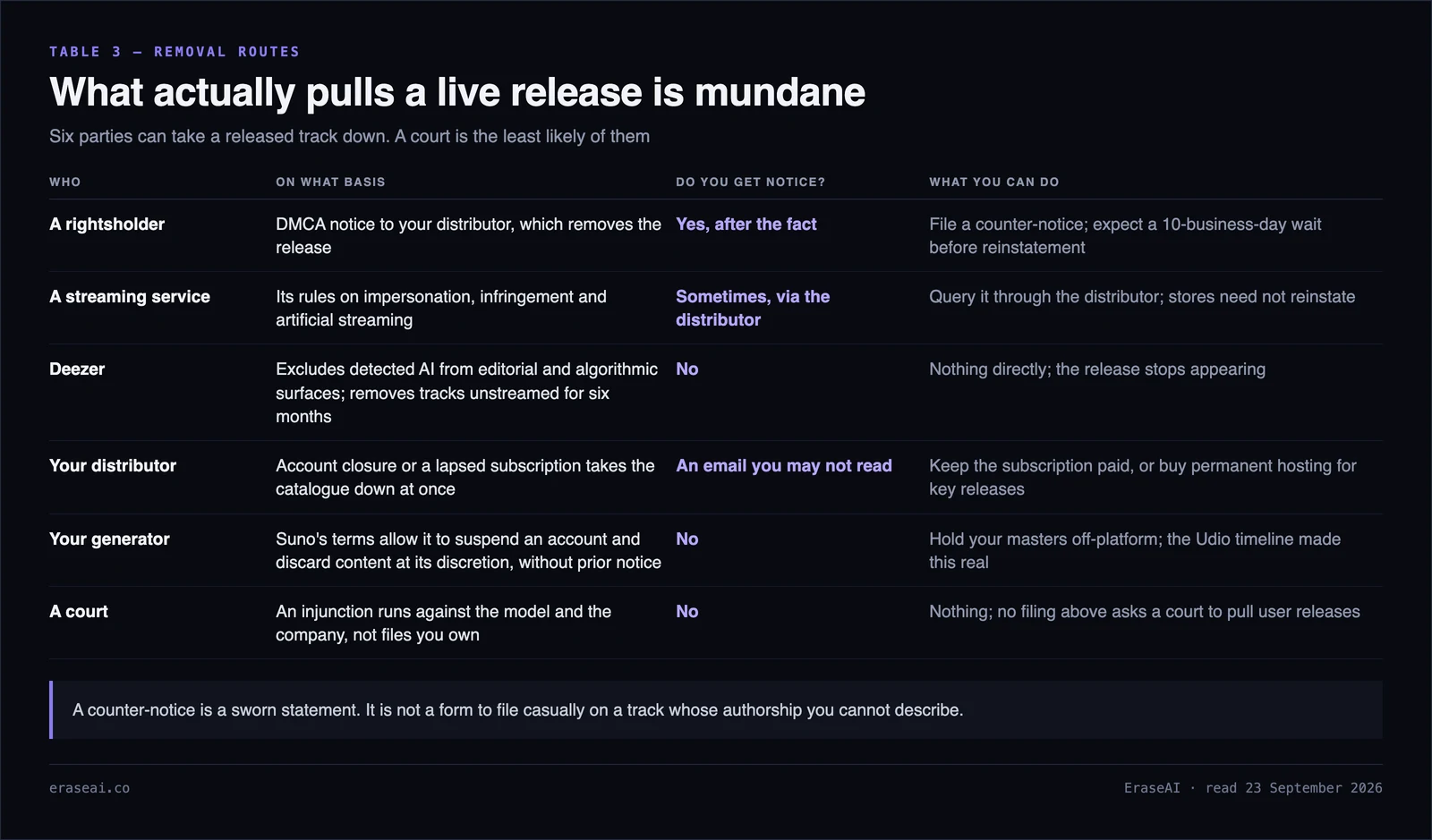
Six actors, and the courtroom is the least likely of them.
A release that disappears has a cause, and in practice it is procedural: a notice arrived, a subscription lapsed, or a platform rule fired. We mapped the five ordinary causes in AI music removed from streaming; this table adds the litigation column people assume is the dangerous one.
| Who | Mechanism | Do you get notice? | What you can do |
|---|---|---|---|
| A rightsholder | DMCA notice to your distributor, which removes the release | Yes, after the fact | File a counter-notice; expect a 10-business-day wait before reinstatement |
| A streaming service | Its rules on impersonation, infringement and artificial streaming | Sometimes, via the distributor | Query it through the distributor; stores need not reinstate |
| Deezer | Excludes detected AI from editorial and algorithmic surfaces; removes tracks unstreamed for six months | No | Nothing directly; the release stops appearing |
| Your distributor | Account closure or a lapsed subscription takes the catalogue down at once | An email you may not read | Keep the subscription paid, or buy permanent hosting for key releases |
| Your generator | Suno's terms allow it to suspend an account and discard content at its discretion, without prior notice | No | Hold your masters off-platform; the Udio timeline made this real |
| A court | An injunction runs against the model and the company, not files you own | No | Nothing; no filing above asks a court to pull user releases |
Notice what is missing: a route by which a label winning against Suno reaches into your distributor and cancels your release. A rightsholder who believes a specific recording infringes has always been able to send a notice about it, and none of the four cases changes that.
The screening gate is separate, and the one place where the file itself decides the outcome. That is automated checks rather than law, covered in the seven walls after the song.
What Suno's terms give you
Effective 3 September 2026, and more candid than the summaries suggest.
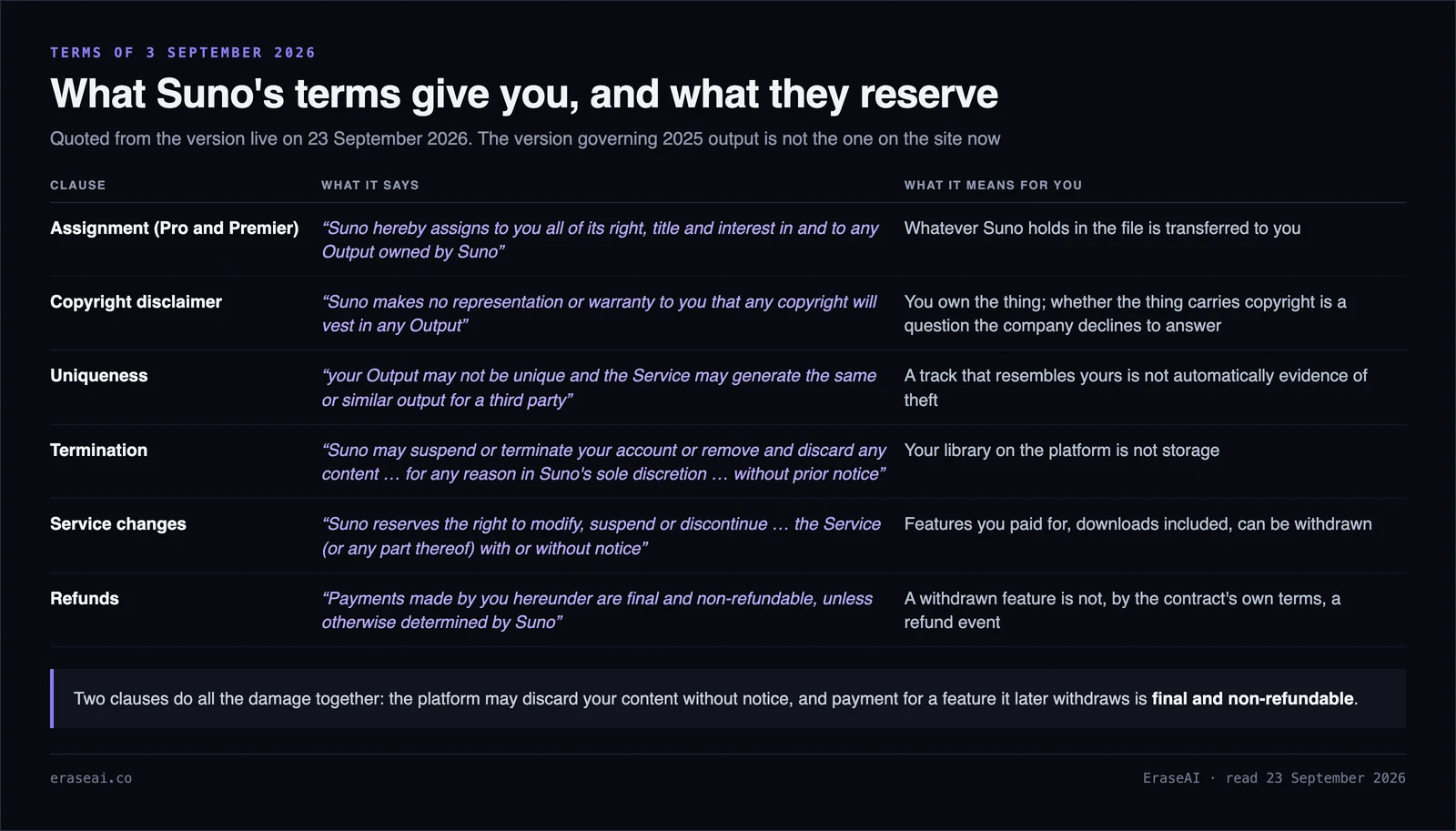
The contract says two things at once, and reading them together is the only way the ownership argument makes sense. Suno assigns you its interest in the output, then declines to promise copyright exists in it. Both are true, which is why “do I own my Suno songs” gets such contradictory answers online. Our guide to AI music copyright takes the authorship half further.
| Clause | What it says | What it means for you |
|---|---|---|
| Assignment (Pro and Premier) | “Suno hereby assigns to you all of its right, title and interest in and to any Output owned by Suno” | Whatever Suno holds in the file is transferred to you |
| Copyright disclaimer | “Due to the nature of machine learning, Suno makes no representation or warranty to you that any copyright will vest in any Output” | You own the thing; whether the thing carries copyright is a question the company declines to answer |
| Uniqueness | “your Output may not be unique and the Service may generate the same or similar output for a third party” | A track that resembles yours is not automatically evidence of theft |
| Termination | “Suno may suspend or terminate your account or remove and discard any content … for any reason in Suno's sole discretion … without prior notice” | Your library on the platform is not storage |
| Service changes | “Suno reserves the right to modify, suspend or discontinue, temporarily or permanently, the Service (or any part thereof) with or without notice” | Features you paid for, downloads included, can be withdrawn |
| Refunds | “Payments made by you hereunder are final and non-refundable, unless otherwise determined by Suno” | A withdrawn feature is not, by the contract's own terms, a refund event |
The clause that should change your behaviour is not the copyright disclaimer everyone argues about. It is the pair at the bottom: the service can be discontinued in whole or in part without notice, and payments are final. That is the combination Udio subscribers met in October 2025, and it is in every generator's terms.
If a claim lands on your release
The process is fixed, the clock is real, and the form is not casual.
Takedowns run on the same machinery for AI tracks as for anything else: a rightsholder sends a notice, your distributor removes the content, and you find out afterwards. DistroKid's guidance is the clearest of the majors on what comes next, and two details in it change how you should react.
The first is the clock. If you file a counter-notice, DistroKid states it is “obligated to wait 10 business days before reinstating any content”. Two weeks, minimum, with the release dark. The second is the ceiling on what winning buys you: “services may choose not to reinstate content based on their terms of use, internal policies, or other factors that are outside of DistroKid's control”. A cleared counter-notice does not oblige Spotify to put the track back.
A counter-notice is a sworn statement, and a false one carries liability for damages and costs. Where you wrote the lyrics, arranged the sections and can describe the work you did, it is a form you can sign honestly. On a prompt-only output whose contribution you could not describe to a judge, it is not. That asymmetry is why the record of what you did matters.
The archive protocol
Six things to hold, and none of them live inside the generator.
Everything above points at one habit rather than a legal strategy. If a settlement, a terms change or an account decision can put a wall between you and your library, the library cannot be the only copy. That is the difference between a 48-hour window being an inconvenience and a catastrophe.
| What | Format | Where | Why |
|---|---|---|---|
| Master audio for every track you care about | The best bounce the platform gives you, as WAV or FLAC | A local drive and one off that machine | Downloads can be switched off overnight, as Udio's were on 29 October 2025 |
| Stems, where you have them | The stem set that came with the song | Beside the master, in the same folder | Suno counts a song plus its stems as one download, so pulling them costs nothing extra |
| Prompts, lyrics and edit notes | Plain text, dated | In your own files, not only in the generator | Human authorship is judged on what you contributed, and the record lives with you |
| Release metadata | ISRC, UPC, release date, artwork and credits, in a spreadsheet | Your own drive | Re-delivering through another distributor is easy with these and painful without |
| Distribution paperwork | Invoices, the distribution agreement, any AI declaration made | Your own drive | If a claim lands, the record of what you did and when is your answer |
| The terms you agreed to | A PDF or screenshot of the generator's terms on the day you generated | Your own drive | Suno's terms changed on 3 September 2026; the version governing your 2025 output is not the one on the site now |
Do the audio first and the paperwork second, because the audio is what gets switched off. If you are working through a backlog, our bulk export guide covers the order that gets the most out of a rationed allowance.
One release-readiness step belongs in the same pass, and it is a different problem. Screening reads the delivered file, so a track going out again through another distributor is better sent as a clean master than a glassy generator bounce. Undetectr is the tool we recommend for that pass, and its limit belongs in the same breath: it processes audio for artifacts and automated screening, and does nothing about a lawsuit, a rightsholder claim, or how a platform labels or credits a release. No processing touches those.
Where this leaves selling and pitching
The thing most likely to end a catalogue is not a court. It is nobody hearing it.
Keep the proportions honest. Most people reading this are not fighting off a label; they are struggling to get a hundred people to listen. The litigation is loud, the discovery problem is quiet, and only one of them is costing you anything today.
Both point the same way. A route that does not depend on a recommendation engine also does not depend on one platform's policy holding. played.fm leads with pitching for paid sync placements in TV, film, games and ads, where a brief is answered by a person rather than an algorithm, and pairs it with a storefront where you keep 100%. Neither fixes the streaming numbers; they stop those numbers being the only way the work can earn.
And a buyer who already has your files is unaffected by every row in Table 3.
Suno lawsuits and your catalogue FAQ
If Suno loses, will my released songs be taken down?
Nothing in the four live filings asks a court to remove tracks users have already released. The claims run against Suno: its training, its models, its outputs as offered by the service. The Munich judgment, the only decision so far, prohibits four specific acts and does not address existing user tracks. An individual recording can still draw a rightsholder complaint on its own facts, but a loss by Suno is not a mechanism that empties your discography.
Can I still sell music I made on Suno v5?
Your commercial rights come from the subscription you held when you generated the track, and Suno's terms assign the company's interest in that output to Pro and Premier subscribers. What changed in September 2026 is distribution eligibility, not your licence: the Believe and TuneCore route covers Suno's industry-partner model, so a v5 back catalogue is not what it is about. DistroKid, RouteNote and UnitedMasters accept plainly, with no test on the model you used.
Has anyone actually lost their AI songs to a lawsuit settlement?
Yes, and it is the case that matters here. When Udio settled with Universal on 29 October 2025 it disabled downloads of audio, video and stems the same day, including for paying subscribers and songs made long before. A 48-hour recovery window ran from 3 to 5 November 2025, and downloads remain off. Tracks already downloaded or released were unaffected; the loss fell on what was left inside the app.
Do I own the songs I generated?
Two questions sit inside that one. Suno assigns you whatever interest it holds in the output if you subscribe to Pro or Premier, so in contract terms the file is yours. Whether copyright exists in it is separate, and Suno makes no warranty that any will vest. The US Copyright Office's position is that prompting alone does not make you the author, while your creative selection, arrangement and modification can be protected. Lyrics you wrote are the clearest case.
What happens if a DMCA claim hits my release?
Your distributor removes the content first and asks questions later, which is what the safe harbour requires of it. If you believe the claim is a mistake you can file a counter-notice, and DistroKid states it is then obliged to wait 10 business days before reinstating anything, while warning that stores may decline to reinstate under their own policies regardless. A counter-notice is a sworn statement, so it is not a form to file casually on a track whose authorship you cannot describe.
Should I stop releasing AI music until the cases are resolved?
The German case took eighteen months to a first-instance judgment already under appeal, and the US cases have run since June 2024. Waiting for legal certainty means waiting years. The proportionate response is to keep masters and paperwork off-platform, prefer distributors whose rules already accept generated music, disclose honestly where asked, and treat any generator as a service that can change its terms rather than a place to store a catalogue.
Does cleaning up the audio protect me legally?
No, and it is worth saying bluntly. Artifact cleanup addresses how a track sounds and how automated screening reads the file. It has nothing to do with copyright in the training data, a rightsholder's claim on a specific recording, or how a platform labels a release. Those are contract and law questions, and no audio processing answers them.
- Bird & Bird — Munich District Court rules on AI-generated music, GEMA v Suno (31 July 2026, case 42 O 763/25: the four prohibited acts, the penalty, and that it is not final)
- Music Business Worldwide — Universal and Sony sue Suno for a second time (18 September 2026: the 60,202 recordings, the laundering quote, the relief sought)
- Udio Help Centre — Changes associated with the Universal Music Group partnership (downloads disabled from 29 October 2025; article updated 17 February 2026)
- Music Ally — Udio opens up downloads for 48 hours to stem its user revolt (3 November 2025, and Udio's wording to users)
- Suno — Terms of Service (effective 3 September 2026: every clause in Table 4)
- Suno — Believe and TuneCore partnership (8 September 2026: eligibility for the industry-partner model)
- Billboard Canada — SOCAN sues Suno (2 September 2026: 150 outputs named, and the orders sought)
- US Copyright Office — Copyright and Artificial Intelligence, Part 2: Copyrightability (January 2025: prompts alone do not make the user the author)
- DistroKid Help Centre — DMCA Takedowns and Counterclaims (updated 19 August 2026) and My Content or Material Was Removed from DistroKid Due to Copyright Claims (updated 30 April 2026): the counter-notice route and the 10-business-day wait
Evidence notes. Every filing, judgment and clause above was read on 23 September 2026 from the source named beside it, not from a news roundup. The two DistroKid help articles return 403 to automated readers from our environment, so they were read through the help centre's public article endpoint and are cited rather than linked. The US cases are allegations Suno has not answered publicly and the German judgment is under appeal, so nothing here is a settled legal position. This is reporting on public documents, not legal advice.
Related guides
AI music removed from streaming
The five ordinary causes of a vanished release, and which of them you can reverse.
Can you copyright AI music?
The authorship half of the ownership question, and what a registration can cover.
Suno download limits checklist
How to spend a rationed export allowance on the tracks that matter first.
Platforms that accept AI music
Eight distributors and six promo services, each policy read at source and dated.
The 7 walls after the song
Screening, caps, credits and payout floors, in the order you hit them.
Sell AI music
The routes to a paying listener that do not run through a recommendation engine.
Or browse every guide on the site.
The filings are about Suno. Your masters are about you.
No case in front of a court asks for your release to come down, and the one real loss so far came from a settlement that switched downloads off overnight. Export what you have, keep the paperwork, and send a clean master when a track goes out again.
▸ Independent · We recommend Undetectr