Three Different Rights. Only One Is Easy.
"Are AI covers legal?" has no single answer because an AI cover can touch three separate things: the song itself, an existing recording of it, and a performer's voice. One of those is routine to licence. One is expensive. One is the reason viral AI covers keep vanishing. Here is how to tell them apart before you release anything.
Not legal advice. A plain-language guide for creators, focused on the US framework. Rules differ by country and this area is changing quickly. For anything commercial or contested, consult a qualified music lawyer in your jurisdiction.
The short version
Five things before you post an AI cover.
A cover licences the composition — melody and lyrics. Mechanical licences are routine, affordable, and available to independent artists.
The sound recording is a separate copyright. Copying or closely replicating an existing recording is not covered by a mechanical licence.
Cloning a named artist's voice is the risky part: right-of-publicity exposure plus platform impersonation policies, independent of the song rights.
Takedowns usually come from content-identification matching or an artist complaint — and repeated ones escalate to your account, not just the track.
Public domain compositions are the cleanest material for AI-assisted covers, because the underlying song needs no licence at all.
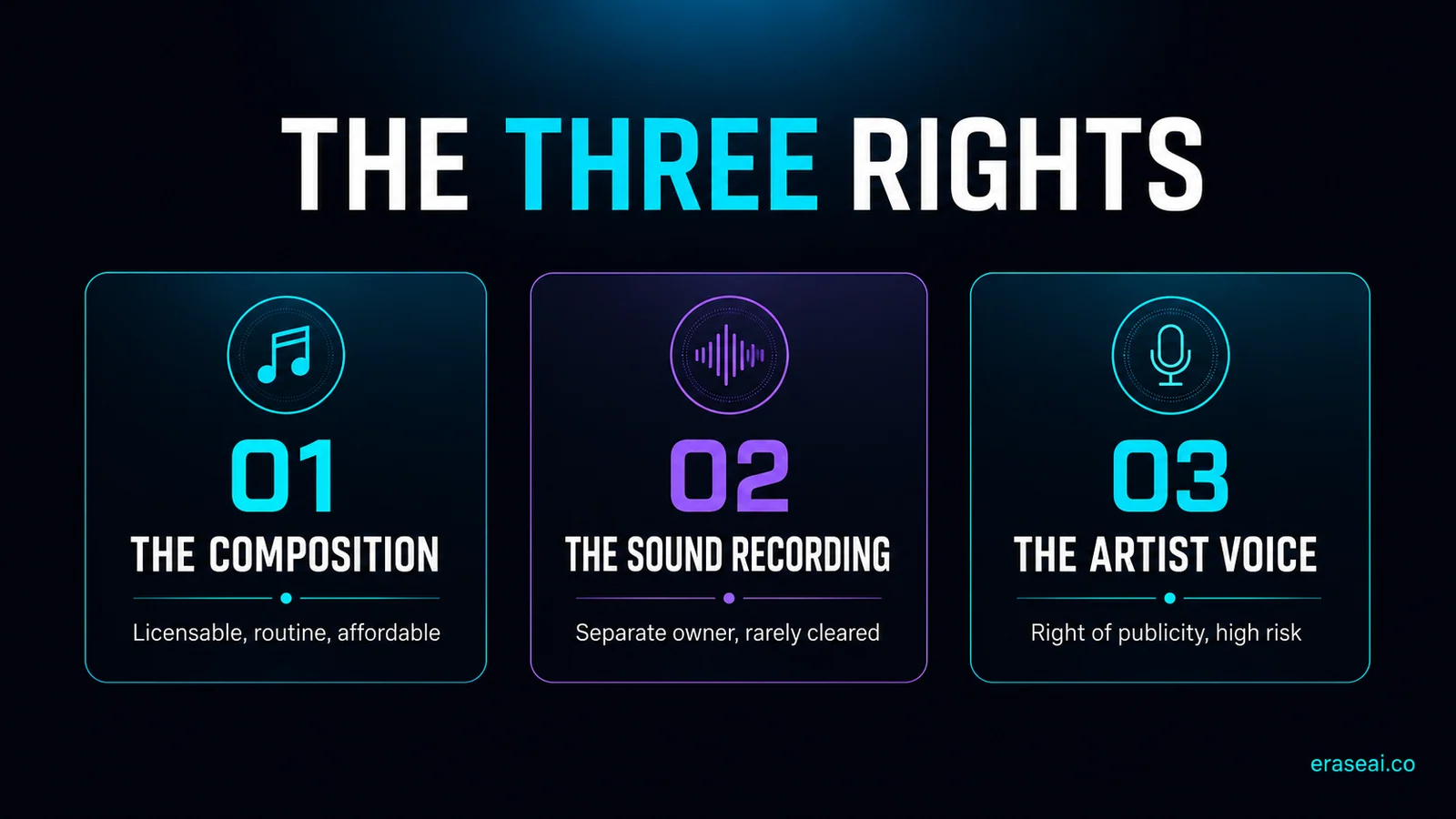
What your AI cover actually touches
The composition
Melody and lyrics, owned by songwriters and publishers. A mechanical licence gives you the right to record and release your own version — standard practice, and services exist to handle it for independent artists.
The sound recording
The specific captured performance, usually owned by a label. A mechanical licence does not cover it. Replicating or sampling an existing master needs its own permission, which is rarely cheap or quick.
The artist's voice
Not a copyright at all, but protected through right of publicity and emerging digital-replica law — and treated as impersonation by every major platform. This is what gets viral AI covers pulled.
Almost every confused argument about AI covers comes from mixing these three together. "Covers have always been legal" is true — of the composition. "AI covers are obviously illegal" is closer to true of voice clones. The technology did not create a new legal category; it made it trivially easy to do all three at once without noticing.
Why the viral ones disappear
The format that gets the most attention is the least releasable.
The AI cover that goes viral is nearly always the same shape: a famous singer's voice performing a song they never recorded. It travels because it is uncanny, and it disappears because it is indefensible on three fronts at once — an unlicensed composition, often a replicated backing recording, and a voice presented as a performance the artist never gave.
Voice is the part people underestimate, because it is not a copyright question at all. Right of publicity protects a person's name, likeness, and in many jurisdictions their voice, from unauthorised commercial use — and legislation specifically addressing unauthorised digital replicas has been advancing precisely because of this technology. Meanwhile platforms have made impersonation an explicit policy violation, which means removal does not require anyone to win a legal argument first.
For a creator building a catalog, the practical calculus is simple. A voice-cloned cover cannot be commercially released through normal distribution, cannot be reliably monetised, and risks your distributor account rather than just the track. Our guide to distributor policies covers how that escalation works.
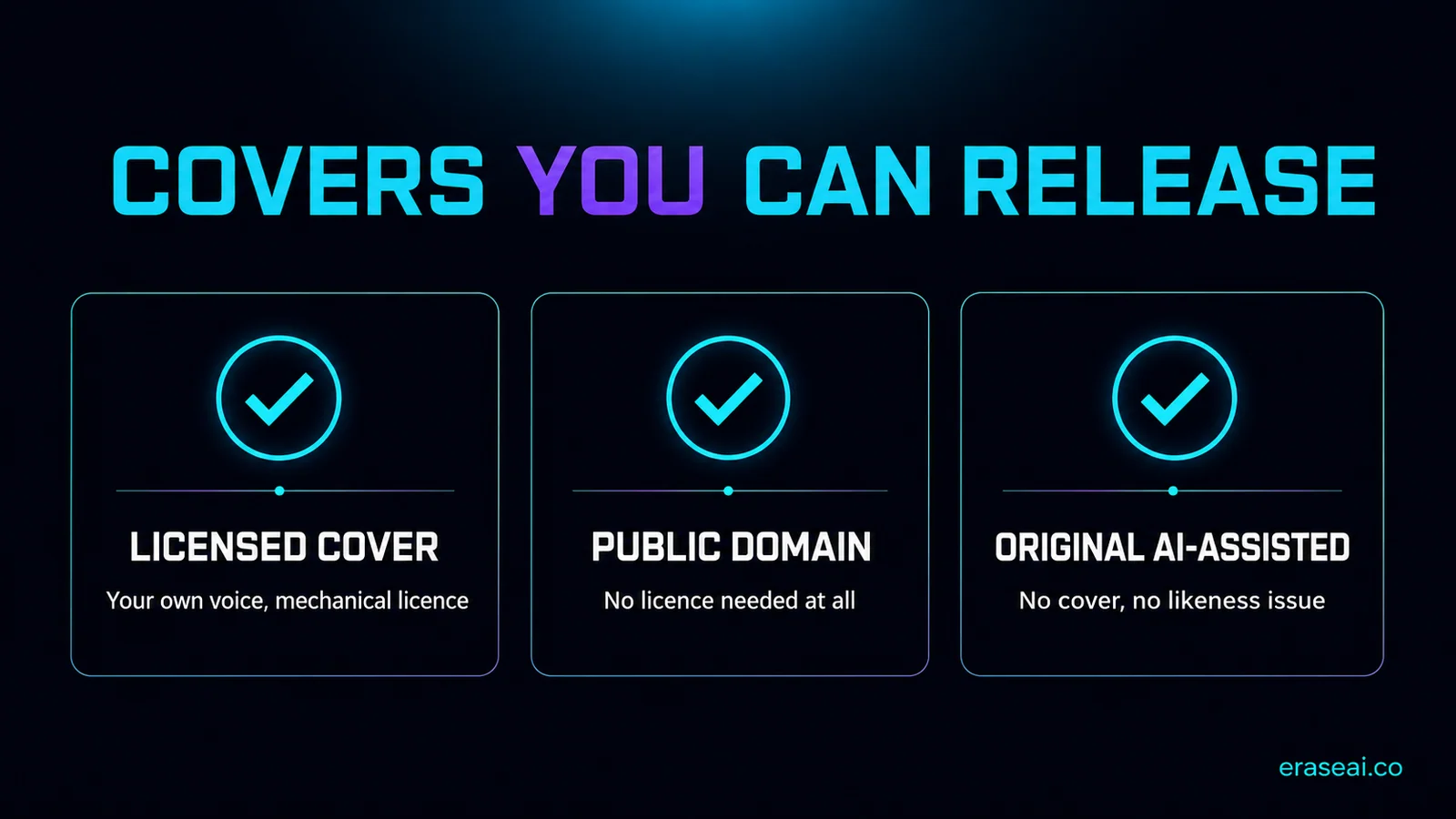
AI covers you can actually release
Three approaches that survive contact with a distributor.
Licensed cover, your own voice
Obtain a mechanical licence for the composition, then record your own vocal over AI-generated or original instrumentation. This is a normal cover release with modern production tools — fully distributable and monetisable.
Public domain material
Compositions out of copyright need no licence at all. A large catalog of traditional and classical material is free to reinterpret, which pairs well with AI production and carries the least risk of anything here.
Original work, AI-assisted
No cover licence, no likeness issue, and the fewest moving parts. You own the commercial rights through your generator plan and answer only to the ordinary release requirements.
Whichever route you take, the release mechanics are the same as any AI-assisted track. Your file still carries generator identifiers and off-spec loudness that distributor screening reads, and it can still collide with an existing recording on a fingerprint check — which matters more than usual for a cover, since you are working near material that already exists. Cleaning and checking the file before submission handles all three; we recommend Undetectr for that step, and our copyright guide explains what you own in the result.
AI cover songs FAQ
Are AI cover songs legal?
It depends which kind you mean, and the distinction matters enormously. A cover where you perform someone else's song using AI-generated instrumentation sits in the same legal territory as any cover — it needs a mechanical licence to be released commercially, and those are routine to obtain. A cover that clones a named artist's voice is a completely different matter, raising right-of-publicity and likeness claims on top of the underlying song rights.
Can you use AI to make a cover of a song?
Making one privately is generally low-risk. Releasing or monetising it is where obligations attach: you need to licence the composition, and you must not present the result as a performance by an artist who was not involved. The technology being new does not change the underlying rules — it just makes it far easier to produce something that breaks them.
Why do AI covers get taken down?
Usually one of three reasons. The recording matches copyrighted material and gets flagged by content identification systems. The composition was never licensed for release. Or the track uses a cloned voice and the artist or label files a complaint on likeness or impersonation grounds. Platforms have also become explicit that impersonation is a policy violation independent of copyright.
Is voice cloning a real artist illegal?
Using a real performer's voice without permission exposes you to right-of-publicity claims in many US states, and specific legislation targeting unauthorised digital replicas has been advancing. Even where the legal position is unsettled, every major platform treats artist impersonation as a removal-worthy violation. Practically speaking, releasing a track that presents itself as a named artist's performance is the single riskiest thing you can do in this space.
What is the difference between the song and the recording?
Two separate copyrights. The composition — melody and lyrics — is owned by songwriters and publishers, and a mechanical licence covers your right to record your own version of it. The sound recording is a distinct copyright owned typically by a label, covering that specific captured performance. A cover licences the first; sampling or replicating the second requires separate permission.
Can I monetise an AI cover on Spotify or YouTube?
A properly licensed cover of a composition can be distributed and monetised through normal channels, and services exist specifically to handle cover licensing for independent artists. What will not survive is an unlicensed cover or a voice-cloned impersonation — those get removed, and repeated attempts put your distributor or channel account at risk rather than just the individual track.
What about AI covers of public domain songs?
That is the cleanest route available. When a composition has entered the public domain, no mechanical licence is needed to record your own version of it. You still cannot clone a living artist's voice or copy an existing recording, but the underlying song is free to use — which makes public domain material genuinely attractive for AI-assisted work.
Licence the song. Skip the voice.
A cleared cover with your own performance is a normal release. Prepare the file properly and it goes live like any other track.
▸ Independent · We recommend Undetectr