Undetectr Review: 98 of 100 Tracks Accepted
You have a folder of generated tracks, a distributor account and a nagging worry that the upload will come back rejected. This Undetectr review is built on the one thing worth measuring about a tool like this: whether the releases got delivered and stayed delivered. We prepared a 100-track catalogue with it, submitted it through DistroKid, TuneCore and Amuse, and followed what happened afterwards — 98 accepted, all 98 still live at the five-month checkpoint, with royalty activity and playlist placements. Below is what it does, what it costs in euros read off the page today, and the one gate it cannot reach no matter what you pay.
The short version
Five findings — four from our own distribution test, one from the vendor’s pricing page read today.
The short version: we submitted 100 tracks prepared with Undetectr through DistroKid, TuneCore and Amuse and recorded 98 accepted and delivered — a 98% acceptance rate for that catalogue, not a guarantee for your next release.
At the five-month checkpoint in our report all 98 were still live, with royalty and payout activity and Release Radar and Discover Weekly placements for eligible tracks. Our six-month follow-up conclusion is that it still works.
Lifetime is EUR 39 one-time with unlimited processing — euros, not dollars. The EUR 99 beside it is a struck comparison inside a value breakdown. The page says “Limited-time founder pricing” and announces no increase and no end date.
There are three gates and processing reaches one of them. Distributor screening is what the tool is aimed at. A detector’s score is a separate measurement. The platform AI label is a declaration field, and nothing you do to audio can reach it.
Two of our 100 tracks were flagged, both on metadata or audio-format compliance. DistroKid’s published AI rules are about rights, impersonation, spam and infringement — four things no audio pass touches.
Who Undetectr is actually for
The honest version, including the readers who should close this tab.
Most audio repair tools were built for recorded music — real rooms, real microphones, real noise. Undetectr is aimed at a newer and narrower problem: the synthetic residue a generator leaves in its output, and the automated screening that sits between that file and a store. That focus is why it earns a place in our recommended release workflow, and why this review keeps coming back to delivery rather than to plugin menus.
It is for you if you have finished generated tracks, you intend to release them through a distributor, and you would rather run one repeatable pass than assemble an EQ and denoiser chain per track. It earns its keep fastest across a catalogue, because the lifetime tier is one payment and unlimited passes.
It is not for you if the track is not finished. Undetectr is not a mastering suite, not an arrangement tool and not a substitute for picking a better generation — a weak hook stays weak. It is also not an approval service: it cannot promise a distributor will accept a release, and our own catalogue had two tracks flagged. And if your real problem is that nobody is listening, this is the wrong purchase; that is a distribution-is-solved, audience-is-not problem, and we say so at the end.
What Undetectr does to a file
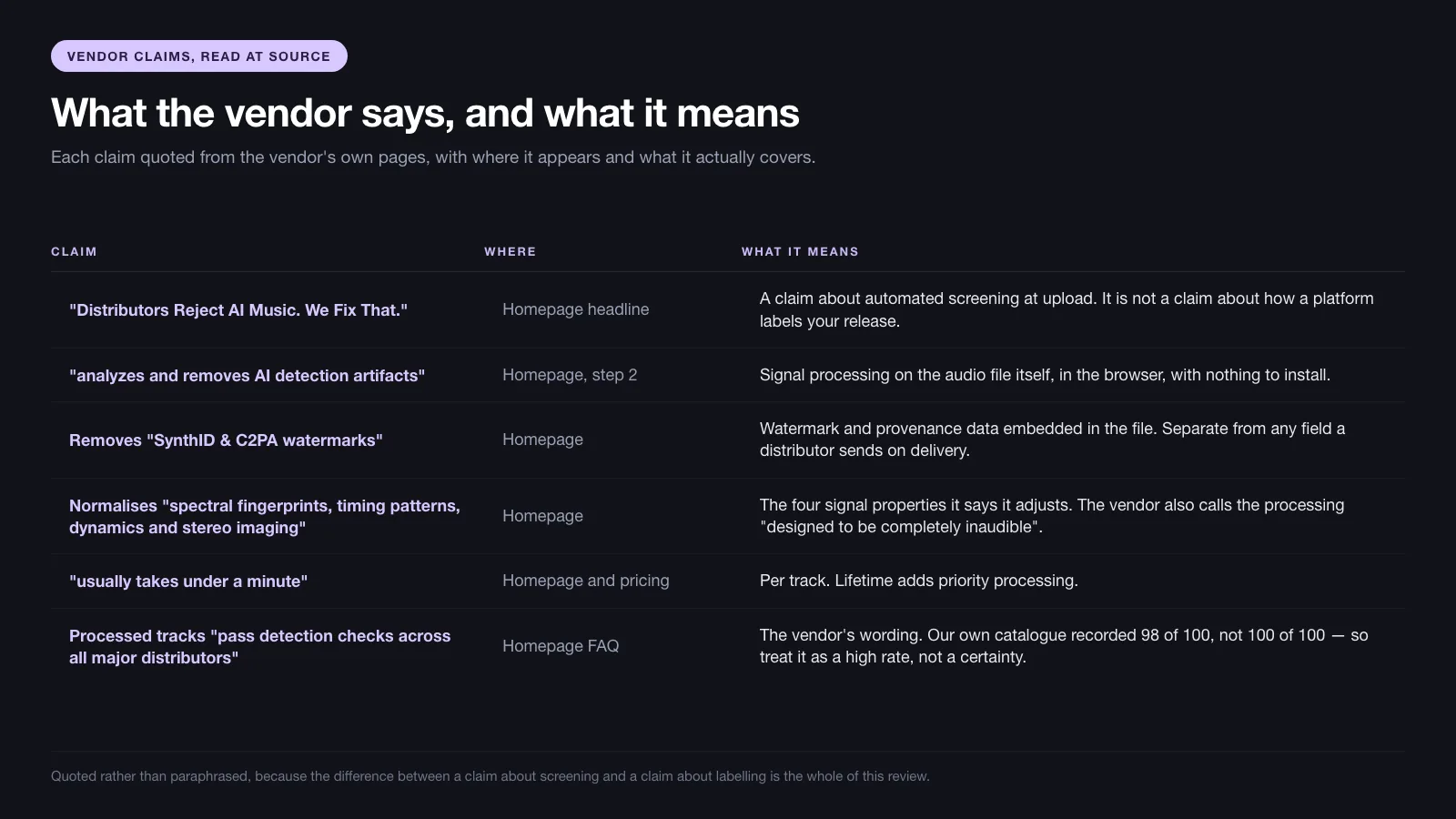
Every row below is the vendor’s own wording, read off undetectr.com on 30 October 2026, with what it means for a release beside it. A product’s description of itself is a claim, not a measurement, and this table keeps the two apart.
| Undetectr’s own claim | Where it appears | What it means for your release |
|---|---|---|
| “Distributors Reject AI Music. We Fix That.” | Homepage headline | A claim about automated screening at upload. It is not a claim about how a platform labels your release. |
| “analyzes and removes AI detection artifacts” | Homepage, step 2 | Signal processing on the audio file itself, in the browser, with nothing to install. |
| Removes “SynthID & C2PA watermarks” | Homepage | Watermark and provenance data embedded in the file. Separate from any field a distributor sends on delivery. |
| Strips embedded metadata, “AI generator tags and model hashes” | Homepage | File-level tags. Your distributor’s AI declaration is a different field entirely — see the labels section. |
| Normalises “spectral fingerprints, timing patterns, dynamics and stereo imaging” | Homepage | The four signal properties it says it adjusts. The vendor also calls the processing “designed to be completely inaudible”. |
| “usually takes under a minute”; “Under 60 seconds processing” | Homepage and pricing page | Per track. Lifetime adds priority processing. |
| MP3, WAV or FLAC in and out | Homepage FAQ | The FAQ recommends WAV or FLAC for distribution, which matches what distributors ask for. |
| Processed tracks “pass detection checks across all major distributors” | Homepage FAQ | The vendor’s wording. Our own catalogue recorded 98 of 100, not 100 of 100 — so treat it as a high rate, not a certainty. |
The workflow is three steps and no install: drop in a file, the engine processes it in the browser, you download the result and send it to your distributor. That makes it easy to slot into an existing routine, which matters more than it sounds — the tools people abandon are the ones that need a session open.
Worth noticing what the mechanism is and is not. Everything in the table operates on the file: its waveform, its embedded watermarks, its tags. Nothing in it operates on the fields your distributor transmits, which is the distinction the next three sections are about. For which defect each route actually fixes, our artifact remover guide maps the four routes against the six common defects.
What our 100-track test recorded
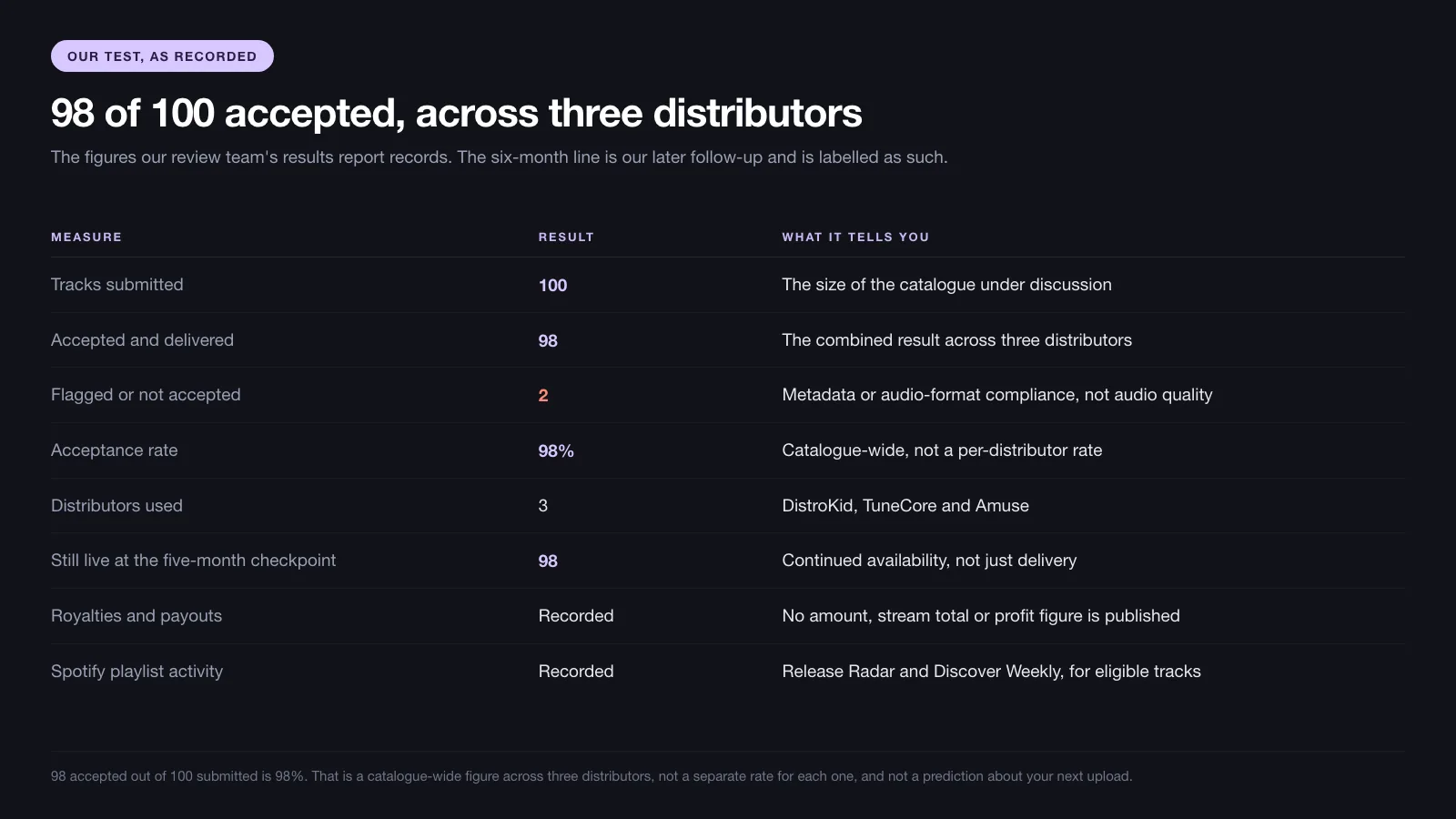
Our review team prepared the catalogue, submitted it and followed the releases after delivery. The figures below come from that results report; the six-month line is our later follow-up and is labelled as such.
| Measure | Result | What it tells you |
|---|---|---|
| Tracks submitted | 100 | The size of the catalogue under discussion |
| Accepted and delivered | 98 | The combined result across three distributors |
| Flagged or not accepted | 2 | Metadata or audio-format compliance, not audio quality |
| Acceptance rate | 98% | Catalogue-wide, not a per-distributor rate |
| Distributors used | 3 | DistroKid, TuneCore and Amuse |
| Still live at the five-month checkpoint | 98 | Continued availability, not just delivery |
| Royalties and payouts | Recorded | No amount, stream total or profit figure is published |
| Spotify playlist activity | Recorded | Release Radar and Discover Weekly, for eligible tracks |
| Six-month follow-up | Still works | Our latest conclusion, reported separately from the measured table |
The arithmetic is simple enough to check: 98 accepted out of 100 submitted is 98%. That is a catalogue-wide figure across three distributors, not a separate rate for each one, and not a prediction about your next upload.
The part we find more useful than the acceptance number is what came after it. A release that is accepted has cleared one stage; a release that is still live five months later, generating royalty and payout activity, has cleared several. We have not published an earnings total, a stream count or a profit calculation, so take the royalty line as evidence that the catalogue progressed past delivery — not as an income forecast.
The two exceptions are the most instructive rows in the table. Both were flagged on metadata or audio-format compliance, not on how the audio sounded. Processing a file does not fill in a release form. Our longer six-month follow-up covers the availability, royalty and playlist findings in detail.
Three gates, and processing touches one
This is the thing no review of this product says, and it is the reason people end up disappointed by a tool that worked exactly as described.
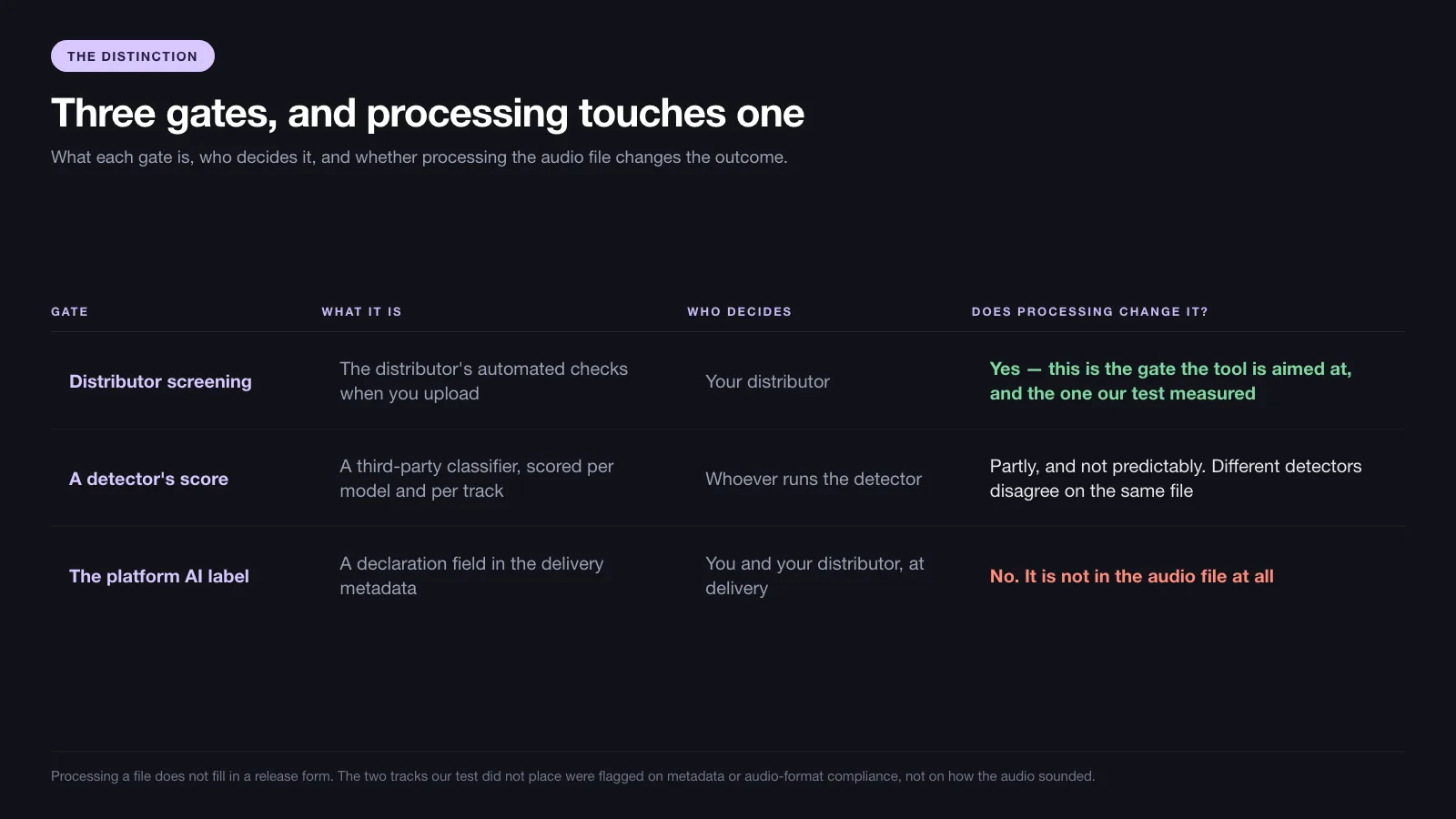
| Gate | What measures it | Who decides | Can audio processing reach it? |
|---|---|---|---|
| Distributor screening | The distributor’s automated checks when you upload | Your distributor | Yes — this is the gate the tool is aimed at, and the one our test measured |
| A detector’s score | A third-party classifier, scored per model and per track | Whoever runs the detector | Partly, and not predictably. Different detectors disagree on the same file |
| The platform AI label | A declaration field in the delivery metadata | You and your distributor, at delivery | No. It is not in the audio file at all |
Three different questions get collapsed into one word, “undetectable”. Did the distributor accept the release? What score does some classifier give the file? And does the platform show an AI label? Those are three measurements with three different owners, and a tool that moves the first does not thereby move the other two.
The middle gate is the slipperiest, because detector scores are not a single quantity. The ISMIR 2025 paper A Fourier Explanation of AI-music Artifacts traces the identifiable signature of generated audio to deconvolution modules in the generator and calls it inherent to the model architecture, clearing high accuracy on that cue alone. A signature that comes from how the audio was built is not a sticker you peel off, which is why we describe this gate as reachable “partly, and not predictably” rather than solved. If you want the detector side on its own, we cover what actually moves a detector separately.
Why no audio tool changes an AI label
The third gate, in the platforms’ own documentation. We are being blunt here because the marketing around this whole category is not.
An AI label is not a property of your audio file. It is a declaration that travels with the delivery. YouTube’s guidance for music partners sets out three designations — Fully Gen AI, Partly Gen AI and No Gen AI — and a CSV field named contains_ai whose accepted values are all, partly, none and unknown. The party that fills it in is the music partner delivering the release, which in practice means your distributor.
Two consequences follow, and both cut against the way these tools are sold. First, you may never see the field — somebody answers the AI question on your behalf at delivery. Second, omitting it does not make it go away: YouTube treats a missing value as unknown and says it may label the content from its own signals regardless. There is a published route to correct a misdeclaration, which is what the unknown value is for.
So be clear about what you are buying. Undetectr processes audio, and on our catalogue that audio got through screening. It does not reach a metadata field, and no tool that edits a waveform can. Spotify’s AI badge works on a similar principle — it describes an artist’s public identity rather than the method behind a recording — which we unpack in our AI Persona badge guide, alongside the AI credit fields DistroKid actually sends.
What DistroKid actually screens for
Read at source on 30 October 2026, from a help-centre article last updated 19 August 2026.
Start with the sentence that undercuts most of the panic in this niche. DistroKid’s help centre opens its AI article with “Yes—DistroKid accepts music created with AI tools, but there are some rules.” Distributors broadly do not ban AI music. What creators actually run into is automated screening flagging and rejecting an individual release, which is a narrower and more fixable problem than a ban.
The rules it then lists are worth reading closely, because of what they are about. You must own 100% of the rights, including the right to distribute work made with AI tools. No impersonation of someone’s voice, likeness or identity without permission. No mass-generated spam built to game streaming algorithms. No infringement. And a closing caution that streaming services may still reject or remove releases that do not meet their own guidelines.
Not one of those four is an audio-quality rule. They are rights and metadata questions, and no processing pass touches any of them — which is exactly why our two flagged tracks were flagged on compliance rather than on sound. Keep a separate checklist for them; our platform-by-platform policy map covers who accepts what, and the appeal routes cover what to do when a human track gets flagged by mistake.
What EUR 19 and EUR 39 actually buy
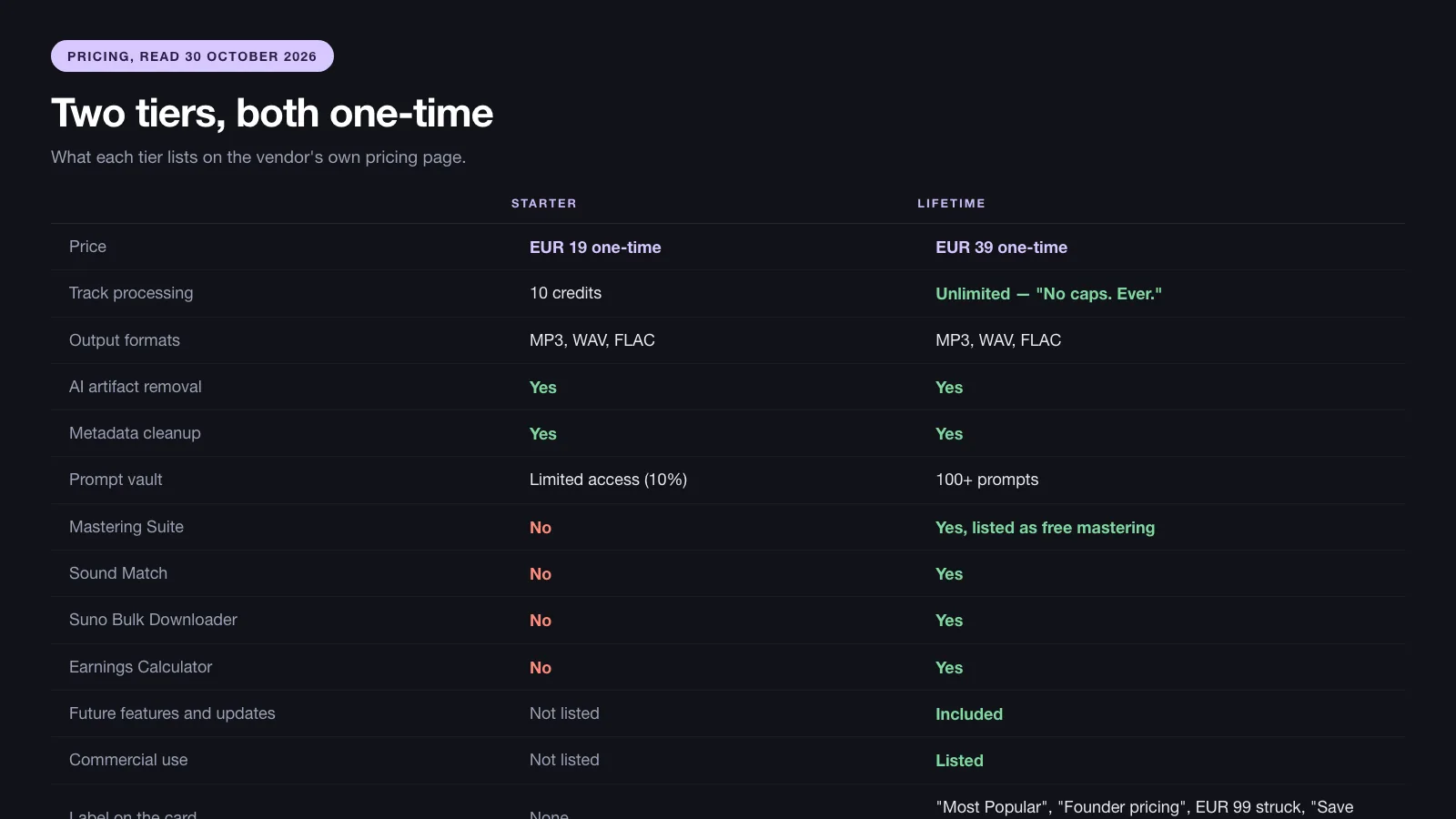
Read off undetectr.com/pricing on 30 October 2026. Check it yourself before you buy — this product changes its offer.
| What you get | Starter | Lifetime |
|---|---|---|
| Price | EUR 19 one-time | EUR 39 one-time |
| Track processing | 10 credits | Unlimited — “No caps. Ever.” |
| Output formats | MP3, WAV, FLAC | MP3, WAV, FLAC |
| AI artifact removal | Yes | Yes |
| Metadata cleanup | Yes | Yes |
| Prompt vault | Limited access (10%) | 100+ prompts |
| Mastering Suite | No | Yes, listed as free mastering |
| Sound Match | No | Yes |
| Suno Bulk Downloader | No | Yes |
| Earnings Calculator | No | Yes |
| Future features and updates | Not listed | Included |
| Commercial use | Not listed | Listed |
| Label on the card | None | “Most Popular”, “Founder pricing”, EUR 99 struck, “Save 60€” |
Two corrections to what the rest of the web says about this page. First, the prices are in euros, not dollars; pages quoting “$19” and “$39” are transcribing the numerals and dropping the currency. Second, the EUR 99 is a comparison, not a deadline. It appears struck through beside the Lifetime price and again as a line item inside a “EUR 264 of tools” value breakdown. The page carries a “Limited-time founder pricing” label and announces no increase and no end date, so anyone telling you the clock is ticking has invented the clock.
On which tier: Starter’s 10 credits make it a trial, and the table shows how much sits behind the Lifetime line — unlimited processing, the mastering suite, Sound Match, the prompt vault, the bulk downloader and the earnings calculator. At one payment for unlimited passes, anyone with a catalogue rather than a single track is choosing Lifetime, and that is the tier our test used. Purchases are one-time rather than subscriptions, which also means there is no renewal to forget.
Where it fits, and what comes after
The order matters more than the settings, and the step after distribution is the one most creators get wrong.
Pick the generation you actually want to release first, because no processing chain rescues a take you do not like. Keep the untouched export beside the processed version under a clear version name, and work in WAV or FLAC end to end. Then process, then listen to the downloaded file — the opening, the transitions, the vocal passages, the ending, at a matched playback level. Master after cleanup rather than before, which is the sequence our mastering order guide exists to argue. Only then fill in the release form, where the rights, credits, artwork, format and AI declaration live.
Then the honest part. Getting a release delivered is the step this niche has largely solved, and it is not the step people are stuck on. The wall is listeners: an accepted catalogue sitting at a handful of plays each is the normal outcome, not a failure of your upload. Clearing screening buys you a shelf, not an audience.
Which is why the thing to plan next is a route to money that does not depend on algorithmic discovery. The most realistic one for generated music is paid sync placement — getting a track into a show, a game or an ad, where a music supervisor is actively looking and one placement pays more than six figures of streams. Played.fm’s sync route is built for that, and selling direct to the listeners you already have sits alongside it. Our earnings guide does the arithmetic on both.
Clean the file, then do the paperwork.
Undetectr is aimed at one gate: the automated screening between your generated track and a store. On our 100-track catalogue it cleared 98. It does not change how a platform labels a release, and it does not fill in your rights or credits — keep those on your own checklist.
▸ Independent · We recommend Undetectr
Questions readers ask about Undetectr
Seven answers, each tied to a source below.
Is Undetectr worth it?
On our own evidence, for the job it is aimed at, yes: a catalogue we prepared with it recorded 98 acceptances from 100 submissions through three distributors, and the accepted tracks were still live five months later with royalty activity. At EUR 39 one-time for unlimited processing, the arithmetic is easy for anyone releasing more than a handful of generated tracks. It is not worth it if your problem is composition, mixing or finding listeners.
How much does Undetectr cost?
Read off the pricing page on 30 October 2026: Starter is EUR 19 one-time with 10 track processing credits, and Lifetime is EUR 39 one-time with unlimited processing. The prices are in euros. A EUR 99 figure appears struck through beside the Lifetime price and again inside a “EUR 264 of tools” value breakdown, under a “Limited-time founder pricing” label. No increase and no end date are announced, so do not treat the EUR 99 as a deadline.
Does Undetectr stop Spotify or YouTube labelling my track as AI?
No, and no tool can. The AI declaration travels as delivery metadata, not inside the audio. YouTube documents a music-partner declaration of “Fully Gen AI”, “Partly Gen AI” or “No Gen AI”, and a CSV field called contains_ai whose values are all, partly, none and unknown — filled in by the partner delivering the release. Leave it out and YouTube treats it as unknown and may label the content from its own signals anyway.
Do distributors ban AI music?
Broadly, no. DistroKid’s help centre says plainly that it accepts music created with AI tools, subject to rules on rights, impersonation, mass-generated spam and infringement. What creators run into is automated screening flagging and rejecting individual releases, which is a different thing from a ban. Several other distributors accept AI-assisted releases openly too.
Will processing guarantee my release is accepted?
No. Two of our 100 tracks were flagged, both for metadata or audio-format compliance rather than audio quality, and distributors keep their own requirements regardless of what you ran the file through. Treat the 98% as a catalogue result and keep rights, credits, artwork, formats and declarations on your own checklist.
Which file format should I upload and download?
Undetectr accepts MP3, WAV or FLAC and returns the same set, and its own FAQ recommends WAV or FLAC for distribution. That matches what distributors ask for, so work in lossless end to end and keep the untouched original export beside the processed version.
Does it remove the Suno watermark?
The vendor says it removes embedded watermark and provenance data, naming SynthID and C2PA, and strips file-level AI generator tags and model hashes. That is a claim about data inside the file. It is not a claim that a platform will stop identifying a track as AI, because identification can also come from a declaration you or your distributor made, or from the platform’s own analysis.
Read at source, 30 October 2026
- Undetectr and its pricing page — every vendor claim in Table 1 and every figure in Table 4.
- DistroKid help centre, Can I Upload Music Made With AI Tools to DistroKid? — the acceptance sentence and the four rules. Last updated 19 August 2026.
- YouTube Help, disclosing Gen AI content as a music partner — the three designations, the
contains_aivalues, and what an omitted value does. - Afchar et al., A Fourier Explanation of AI-music Artifacts (ISMIR 2025) — why a generated file is identifiable from its architecture.
The 100-track distribution figures on this page are our own review team’s recorded results, reported as ours. We publish no earnings total, stream count or profit calculation, and the acceptance rate is a catalogue result rather than a guarantee. Undetectr links are partner links; EraseAI is independent and says so next to every one.
Related guides
The six-month follow-up
Availability, royalties and playlist placements across the same 100-track catalogue.
AI music artifact remover: what fixes what
Four routes against six defects, and which ones are regenerations rather than repairs.
Which platforms accept AI music
Distributors and promo services, mapped, with the rules each one publishes.
The alternatives, ranked
What else is in this category, and where a general-purpose tool is enough.
The walls after the song
Everything between a finished track and a release that stays up.
Or browse every guide on the site.