Best Suno Alternatives 2026: WaveQuake First, Two to Skip
Most lists of Suno alternatives run to eight or ten tools. This one ranks three and tells you which to buy. We downloaded and measured every song in WaveQuake's listening room, read Udio's help centre and both companies' pricing pages, and checked what each one's paying customers report. WaveQuake comes first: one payment, files you can keep, and eight full-length examples that hold up under measurement. The other two do not earn a recommendation, and the reasons are on their own pages. Everything below was read or measured on 28 October 2026.
The short version
Five findings, each traceable to a page you can open.
WaveQuake is the Suno alternative to buy: $149.99 once for 3,000 creation minutes, unlimited MP3 and WAV downloads, mastering and a full commercial licence, with nothing renewing.
All eight WaveQuake examples measured consistently: −12.3 to −13.9 LUFS, every true peak at or below −1.0 dBTP, a clean ending on every track, and seven of eight hooks transcribed intact.
Udio switched off downloads of audio, video and stems with its Universal deal in October 2025, and its help centre still says so. A song you cannot export is a song you cannot release.
Mureka's Pro plan downloads MP3 only; WAV, stems and MIDI need Premier at $288 a year. Its Trustpilot score is 1.4 from 217 reviews, 88% of them one-star.
Over two years, a releasable-file workflow costs $149.99 on WaveQuake against $576 on Suno Premier or Mureka Premier, if 3,000 minutes covers your output.
The ranking at a glance
Prices are the vendors' own, in USD, read 28 October 2026.
| # | Tool | Price | Downloads | Commercial use | Verdict |
|---|---|---|---|---|---|
| 1 | WaveQuake | $149.99 once | Unlimited MP3 and WAV | Full licence, 0% royalties | Buy |
| 2 | Udio | $10 or $30 a month | Disabled since Oct 2025 | Moot without files | Avoid |
| 3 | Mureka | $10 or $30 a month | MP3 on Pro; WAV on Premier only | Paid plans only | Avoid |
The ranking turns on one question before sound quality enters into it: can you leave with a file you are allowed to release? WaveQuake answers yes on every count. Udio answers no on every plan. Mureka answers yes for MP3 and only at the top tier for WAV, and a large share of its customers say the bigger problem is getting out of the subscription.
WaveQuake: the one to buy
A browser studio priced like an instrument, not a utility bill.
WaveQuake's pricing page is short because the offer is simple: $149.99 once, a founder price it says will rise to $499.99. That buys a 3,000-minute creation bank with no song-count limit, 2,000 writing requests for its Songwriter and Soundprint tools, and two versions of every successful generation, of which only the longer counts against your minutes. Nothing renews. When the bank runs low, top-ups are optional one-time purchases.
The part Suno users will notice first is downloads. WaveQuake allows unlimited MP3 and WAV downloads of every completed take while it is stored, where Suno Premier caps you at 60 songs a month. Mastering is built in — Natural, Warm or Punch, delivered as a separate 24-bit WAV so the original survives — and the commercial licence lets you release, sell and license the music, client work included, with no ownership share and 0% royalties to WaveQuake.
On sound, WaveQuake publishes a model benchmark run on the same 192 prompts across 17 model settings. It leads Suno V6 on five of nine automatic measures: song quality 6.73 to 6.56, musicality 5.91 to 5.66, production quality 8.26 to 8.13, style match and prompt following. Suno V6 edges ahead on the other four, including lyric error rate. WaveQuake states plainly that these “are not human preference scores”, which is why we went to the songs themselves.
Know before you buy. Purchases under its current terms are final, with no change-of-mind refunds. Files are kept for 30 days in 10 GB of storage, so download what you want to keep. And music creation makes vocal songs: instrumental-only mode is not included. None of these changes the ranking, and our full WaveQuake review walks through the studio step by step.
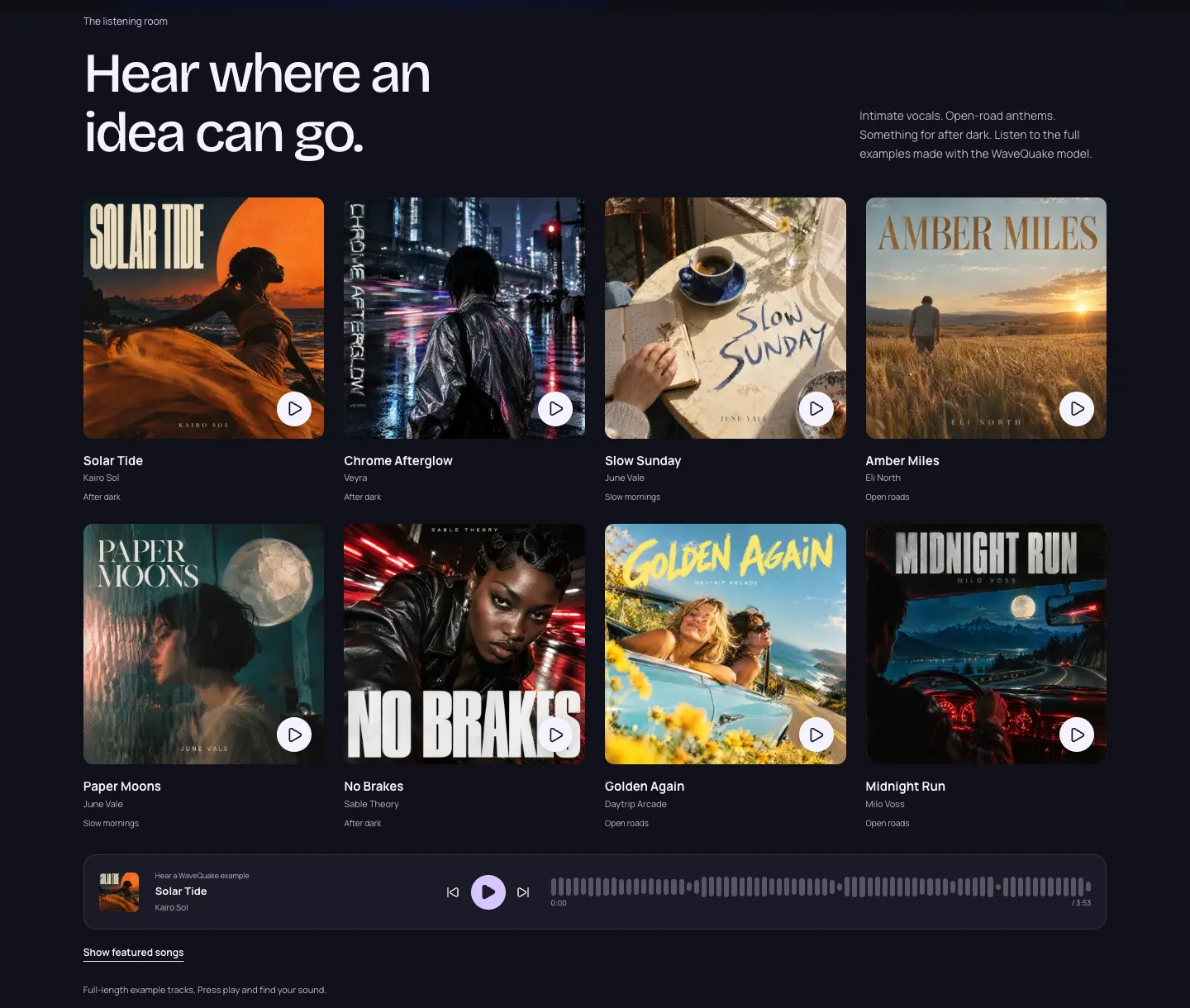
All eight WaveQuake songs, measured
Every track in the listening room, not a favourite or two.
The listening room holds eight full-length songs across three moods: after dark, slow mornings and open roads. We downloaded each one as served, 192 kbps MP3 at 48 kHz, and ran the same checks on all eight: integrated loudness, true peak and loudness range under ITU-R BS.1770, stereo width, how each track ends, and how much of the lyric a speech recogniser could follow. That is 30 minutes 55 seconds of music.
| Song | Artist | Length | LUFS | True peak | Range (LU) | Words heard | Hook, as transcribed |
|---|---|---|---|---|---|---|---|
| Solar Tide | Kairo Sol | 3:53 | −12.9 | −1.3 | 2.3 | 320 | “Red dot, red dot, don’t make me wait” |
| Chrome Afterglow | Veyra | 4:14 | −13.2 | −1.9 | 3.3 | 265 | “This is life, this is life, hold on tight” |
| Slow Sunday | June Vale | 3:40 | −12.5 | −1.7 | 4.0 | 274 | “Coffee on your lip, coffee in my head” |
| Amber Miles | Eli North | 3:44 | −13.9 | −1.3 | 4.4 | 229 | “Wheat fields, wheat fields, keep me here” |
| Paper Moons | June Vale | 3:22 | −13.5 | −1.6 | 6.8 | 261 | “Paper skin, paper skin” |
| No Brakes | Sable Theory | 2:52 | −13.4 | −2.5 | 2.5 | 243 | “Run it, run it, run it back again” |
| Golden Again | Daytrip Arcade | 4:28 | −12.3 | −1.4 | 5.4 | 308 | “Happy sad then happy again” |
| Midnight Run | Milo Voss | 4:38 | −13.0 | −1.0 | 3.3 | 0 | None recognised |
Consistency is the first thing the numbers show. All eight sit within 1.6 LU of each other, between −12.3 and −13.9 LUFS, so nothing jumps out or drops away when one song follows another. Every true peak is at or below −1.0 dBTP, so none of them clips on playback. Loudness range runs from 2.3 LU on Solar Tide to 6.8 LU on Paper Moons, the slow-mornings ballad, which is the dynamic movement you would want from that pairing.
Every song ends; none just stops. In all eight, level falls by 15 LU or more over the final three seconds, from Midnight Run's drop to near-silence to Amber Miles' four-second fade. An abrupt cut-off is one of the easiest flaws to hear in generated music, and none of these has one. The stereo side signal sits 9.5 to 14.8 dB below the centre, a real width that still folds safely to mono on a phone speaker.
The vocals carry the words. Diction is where generated vocals most often slip, so this is the check we weighted most. Run in 30-second sections through Whisper, seven of the eight gave up between 229 and 320 words each, and all seven came back with their chorus hook intact, from Solar Tide's “red dot, red dot, don't make me wait” to Golden Again's “happy sad then happy again”. The recogniser found no words in Midnight Run, which may mean its vocal is wordless or sits deep in the mix; it is the one track to judge by ear.
Solar Tide — Kairo Sol
After dark · 3:53
Chrome Afterglow — Veyra
After dark · 4:14
Slow Sunday — June Vale
Slow mornings · 3:40
Amber Miles — Eli North
Open roads · 3:44
Paper Moons — June Vale
Slow mornings · 3:22
No Brakes — Sable Theory
After dark · 2:52
Golden Again — Daytrip Arcade
Open roads · 4:28
Midnight Run — Milo Voss
Open roads · 4:38
Players stream from WaveQuake's own listening room. Listening grants no reuse rights.
Udio: you cannot take your song out
A capable model behind a door that has been shut for a year.
Udio was once the obvious second choice to Suno. Then, on 29 October 2025, it signed its partnership with Universal Music Group, and its own help centre records the consequence in one line: “Note that downloading of audio, video, and stems has been disabled.” That article was last updated in February 2026. A year after the switch, no plan restores downloads.
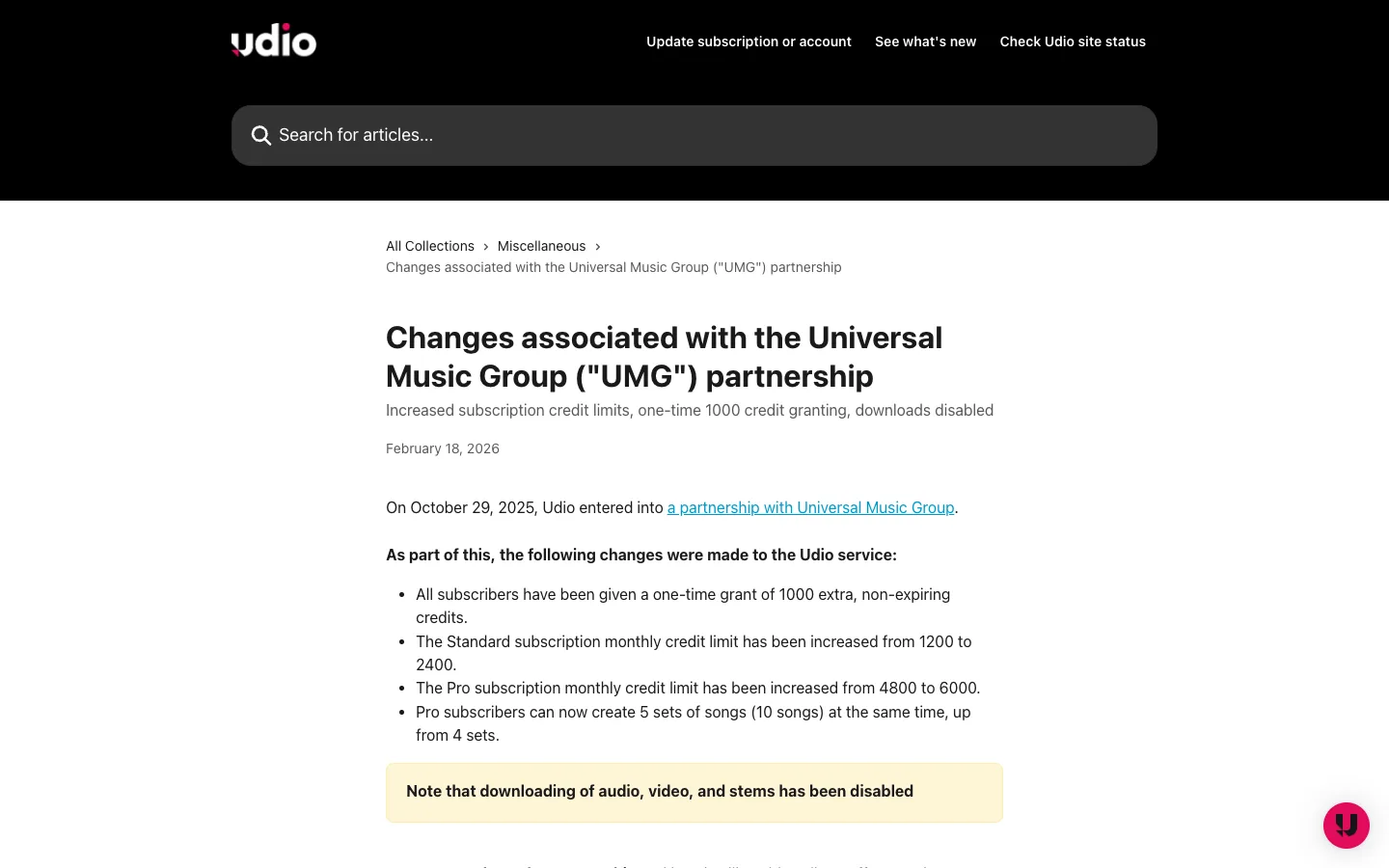
For anyone who makes music to release, that ends the comparison. Udio's Warner partnership note confirms that sharing now runs through udio.com links only, and lists the same v1, v1.5 and v1.5 Allegro models creators already had. Its changelog dates Allegro to March 2025 and lists nothing major since Voices in September 2025. Meanwhile the subscriptions still cost $10 or $30 a month ($96 or $288 a year), with credits that do not roll over and each generation running to about two minutes before you extend it.
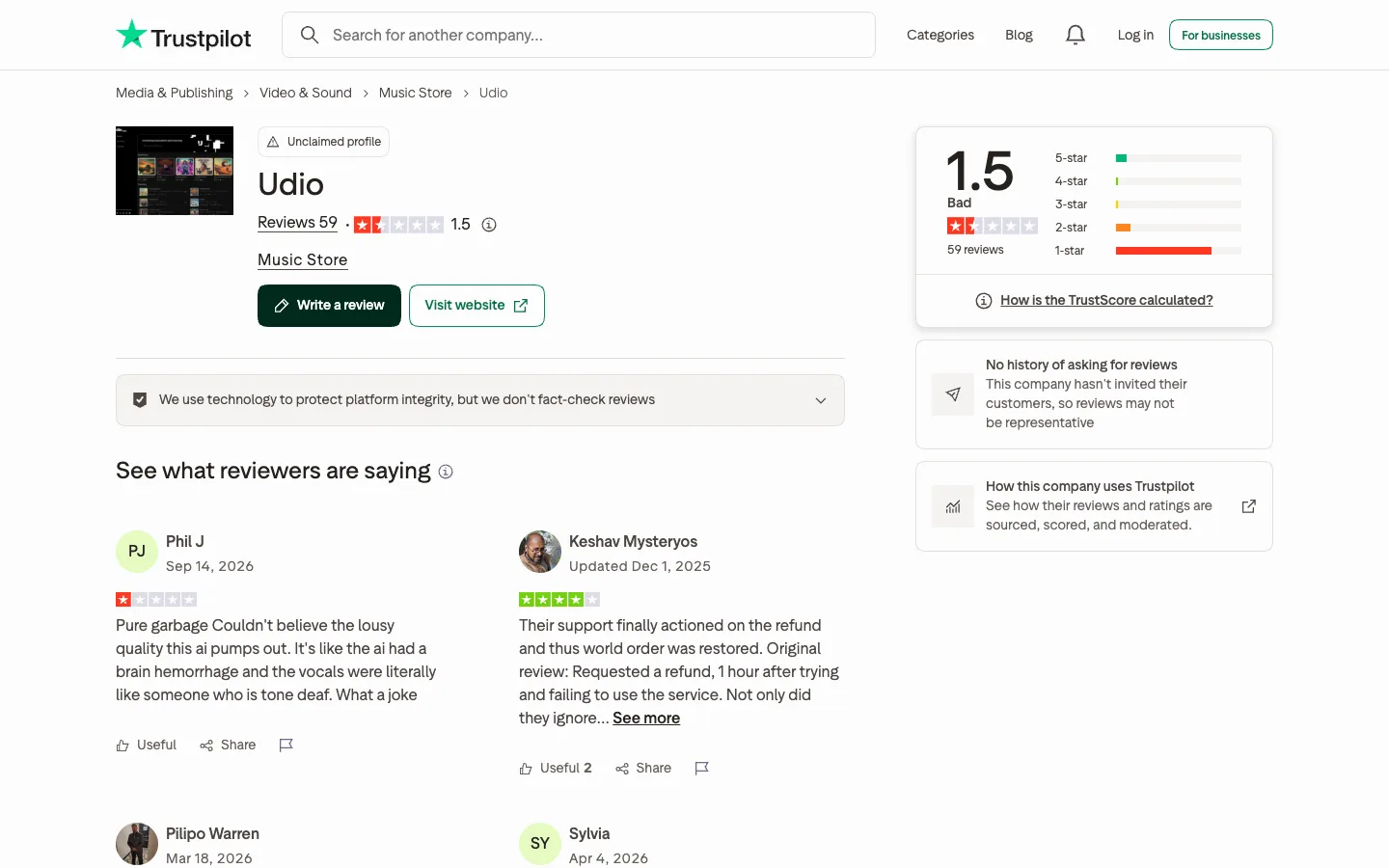
Customers have noticed. Udio's Trustpilot profile scores 1.5 from 59 reviews, 76% one-star. Even the fairest of them makes our case:
“…the platform itself is solid and the sound quality is impressive but the terms are way too restrictive for anyone serious about music.”
Pilipo Warren, Trustpilot, 18 March 2026
Verdict: avoid. If Udio's licensed relaunch brings downloads back, it will deserve a fresh look. Today you would be paying a subscription to make songs that live only on Udio's servers.
Mureka: cheap to join, costly to leave
A low entry price that buys MP3s and a hard exit.
Mureka's subscription page leads with $8 a month, which is Pro billed at $96 a year ($10 month to month). Pro gets its V9.5 model, commercial rights and “unlimited MP3 downloads”. The files a distributor or mix engineer wants — WAV, stems, MIDI and a DAW session — are listed as Premier exclusives at $24 a month, billed $288 a year. A releasable master therefore costs the same $288 a year as Suno Premier.

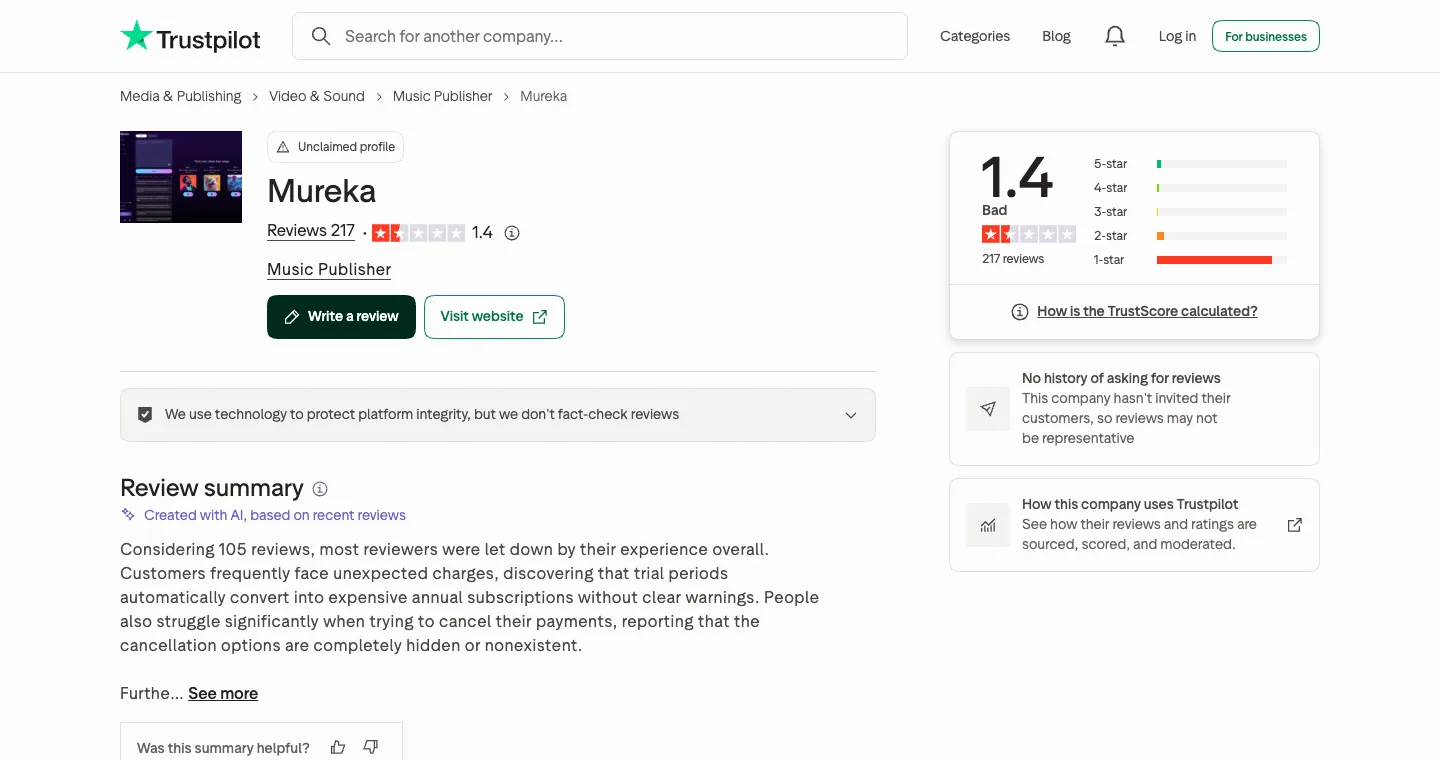
The bigger problem is what customers report about leaving. Mureka's Trustpilot profile scores 1.4 from 217 reviews, 88% one-star, and Trustpilot's own summary of 105 recent reviews says customers “frequently face unexpected charges”, with trials converting “into expensive annual subscriptions without clear warnings” and cancellation options described as “completely hidden or nonexistent”.
“Be cautious of the monthly subscriptions; they actually charge for a full year and are non-refundable.”
Josephine, Trustpilot, 26 January 2026
Verdict: avoid. Mureka can produce a usable song, but the plan that gives you release-grade files costs as much as Suno Premier, and the volume of billing complaints is a risk no feature list offsets.
What a releasable file costs in year one
The cheapest plan on each that downloads WAV, at annual prices.
| Tool | Plan needed for WAV | Year one | Two years | Renews |
|---|---|---|---|---|
| WaveQuake | Any purchase | $149.99 | $149.99 | No |
| Suno (for reference) | Premier, 60 downloads a month | $288 | $576 | Yearly |
| Mureka | Premier (Pro is MP3 only) | $288 | $576 | Yearly |
| Udio | No plan | Not available | Not available | — |
The comparison has one honest condition. WaveQuake's 3,000 minutes are a single bank, and only the longer take of each pair counts. At four minutes a generation that is about 750 generations, or 1,500 takes, before a top-up. A writer releasing an album a month will get through that eventually; most people making songs alongside a job will not get close. Suno's figures come from its own pricing page; our Suno download limits checklist shows what 60 downloads a month means in practice.
How we ranked them
What we measured, what we read, and what we did not do.
We ranked on four things in order: whether you can export your music, what the licence lets you do with it, what it costs to get a releasable file, and what paying customers report. Sound quality decides between tools that pass those tests, which is why the WaveQuake examples were measured track by track.
Loudness, true peak and loudness range come from ffmpeg's EBU R128 meter; stereo width from the mid and side levels; lyric intelligibility from an open-source Whisper model run locally. We did not run a blind listening panel, and Trustpilot carries its own caveat: neither Udio nor Mureka invites reviews, and Suno's profiles score 1.6 and 1.7, so AI music services draw unhappy reviewers. We cite those scores for the patterns in the complaints, not the number alone.
Questions readers ask about Suno alternatives
Short answers, drawn from the sections above.
What is the best Suno alternative in 2026?
WaveQuake. It costs $149.99 once instead of a subscription, allows unlimited MP3 and WAV downloads while files are stored, includes mastering and a full commercial licence, and publishes eight full-length examples you can hear before paying.
Can you still download songs from Udio?
No. Udio's help centre says “downloading of audio, video, and stems has been disabled”, a change made with its Universal Music Group deal on 29 October 2025. The article was last updated in February 2026 and no download route has returned on any plan.
Is Mureka a good Suno alternative?
Not on our evidence. WAV, stems and MIDI need Premier at $288 a year, and its Trustpilot profile stands at 1.4 from 217 reviews, 88% one-star, with recurring reports of trials turning into annual charges.
Does WaveQuake sound better than Suno?
WaveQuake publishes model benchmarks in which it leads Suno V6 on five of nine automatic measures, including song quality, 6.73 to 6.56. It states these are not human preference scores. Play the eight examples above and judge with your own ears.
Is WaveQuake really a one-time payment?
Yes. $149.99 buys a 3,000-minute creation bank that does not refill or renew. Extra minutes are optional one-time top-ups. Sales under its current terms are final, so listen to the examples first.
Can I release WaveQuake songs commercially?
Yes. The licence covers releasing, selling and licensing your music, including client work, with no ownership share or royalties taken. You remain responsible for anything you bring in and for distributor rules.
Sources and dates
Every page quoted above, read 28 October 2026.
- WaveQuake — homepage, listening room and model benchmarks, pricing and refund terms, commercial licence and music creation. The eight MP3s were downloaded from the listening room and measured locally.
- Udio — UMG partnership changes, WMG partnership, changelog, pricing and Trustpilot.
- Mureka — subscription plans and Trustpilot. Suno — pricing and download allowances.
WaveQuake's benchmark figures are WaveQuake's own; the measurements in Table 2 are ours. Prices change without notice. Last updated 28 October 2026.
Hear it first. Then pay once.
Eight full songs are free to play before you spend anything, and the price is the whole price. That is the strongest case any Suno alternative makes in 2026.
Independent review · ranked on the evidence above
Related guides
WaveQuake review
The studio, the Songwriter and the mastering stage, step by step.
Suno download limits checklist
What Suno's monthly download caps cost a release, per plan.
Suno V6 after two minutes
Where long Suno generations lose the thread, and why.
Suno lawsuits and your songs
What the label settlements mean for music already released.
Suno mastering
Loudness targets and what a remaster does and does not do.
Platforms that accept AI music
Where an AI-assisted song can be released, read at source.
Or browse every guide on the site.