Suno V6 Just Deleted Every Model That Made Your Best Songs.
The headline everyone else is running is that V6 is bigger, cleaner and trained on licensed music. All true. The line buried at the bottom of Suno's own announcement is the one that actually costs you something: as v6 rolls out, we will retire our previous models. Every model that made your catalogue is going away, and the loudest verdict on the replacement is that it sounds better and feels worse.
By Eddie Mathews · 10 September 2026
The short version
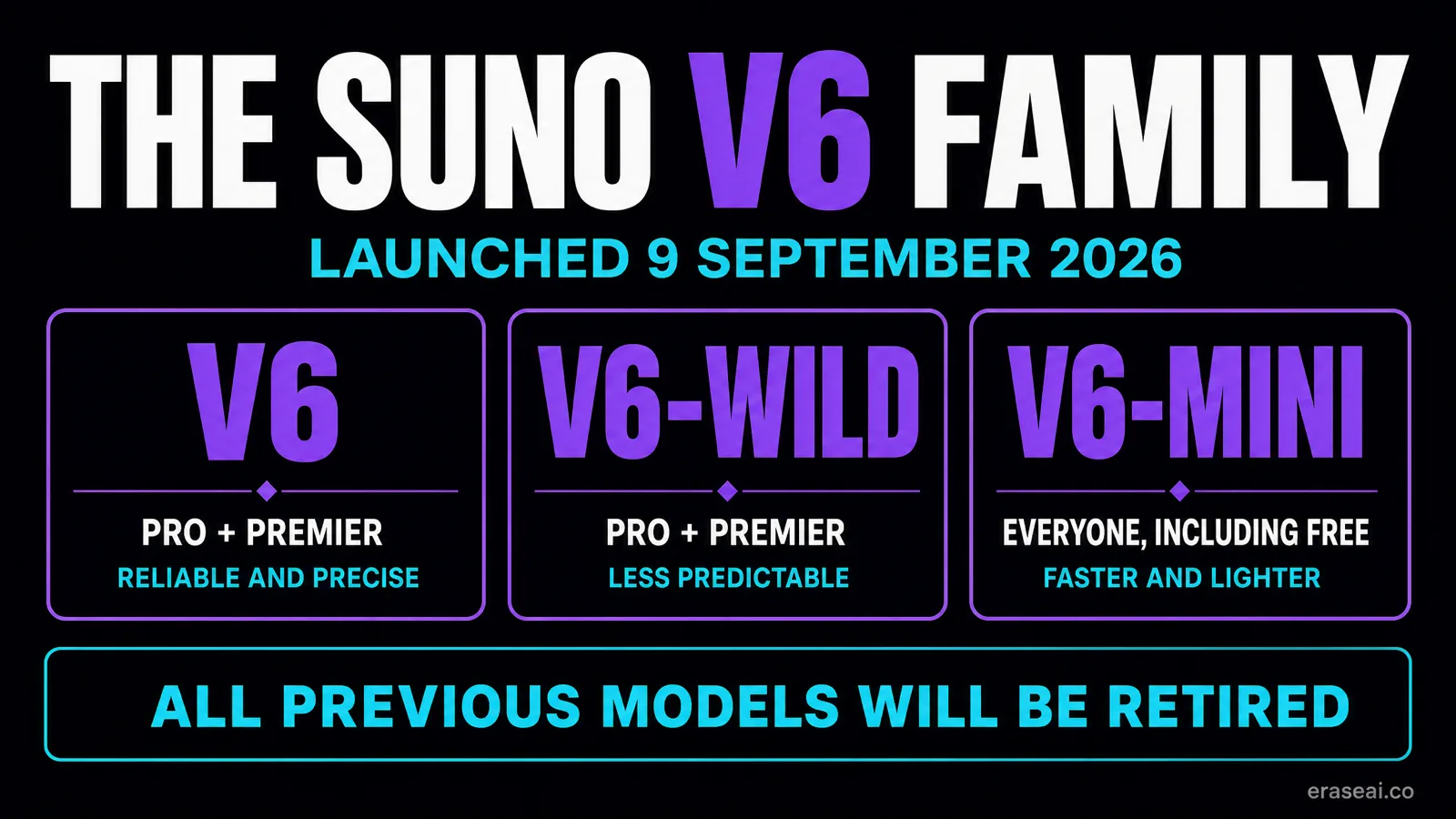
- Three models. v6 and v6-wild for Pro and Premier, v6-mini for everyone.
- Trained from scratch on licensed catalogue from Warner Music Group, BMG and Believe, with revenue sharing from day one.
- Every previous model is being retired. Suno says it is moving entirely onto the V6 generation.
- The community split is fidelity versus feel. Cleaner audio, deeper control, and a widely upvoted complaint that the output sounds synthetic.
- Download caps are unchanged and already live. V6 does not touch them. Together, the two changes make an unexported catalogue a genuine risk.
What V6 actually is
Three models, one training set, and the deepest set of controls Suno has shipped.
| Model | Who gets it | What it is for |
|---|---|---|
| v6 | Pro and Premier | The flagship. Suno calls it reliable and precise, and says it consistently delivers polished music. |
| v6-wild | Pro and Premier | Built for exploration. Less predictable, more varied, deliberately less tuned to average user preference. |
| v6-mini | Everyone, including free | Faster and more efficient. Suno claims it beats any free model on any music creation platform. |
Source: Suno, Introducing v6, 9 September 2026. Read at source 10 September 2026.
Partial song editing
Change one section in plain language while everything else stays put. Update a single lyric without regenerating the whole track.
Multi-source mashups
Combine elements from several of your own songs in a single request, with a new lyrical direction on top.
Isolation and sampling
Sample a riff at a timestamp, isolate the guitar, and build a new beat around it in one workflow.
Multimodal prompting
Prompt from text, audio, images or video. Photos, clips and voice memos can all become the seed of a track.
None of that is marketing fluff. The editing model is a genuine structural change: you can tell it to change the chorus so it is sung by a gospel choir, or point it at a riff at 0:45 and ask for a beat built around the isolated guitar. Suno's own launch video, which took nearly forty thousand views in its first day, spends most of its runtime on how much creative direction the model absorbs in one request.
Cleaner audio, deader music
The launch threads did not go the way launch threads usually go.
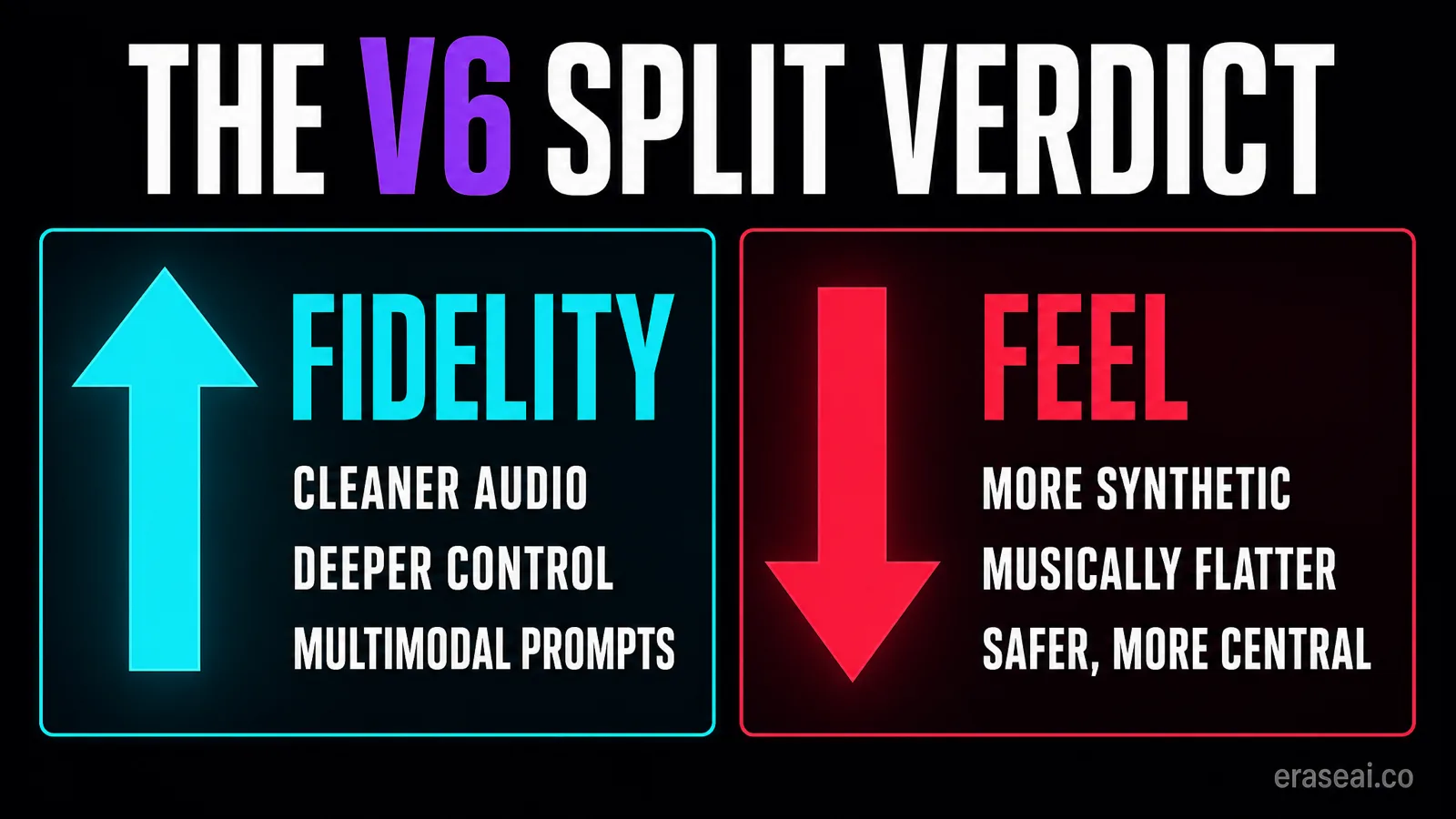
The single most upvoted technical verdict in the launch-day threads was blunt. “Can confirm v6 is atrocious. Musically lifeless and sounds the most synthetic. Despite sounding better fidelity wise, the feel of everything sounds fake.” That is not a complaint about bitrate. It is a complaint that the model got technically better and musically worse at the same time, which is a strange thing for a new generation to do.
The second theme was the retirement itself, and it was angrier. One thread on r/SunoAI was titled simply “Suno has hurt its most loyal users”. Another, reacting to a message from Warner Music Group's chief executive, pulled 260 comments in a day. The most upvoted answer to “why remove the models people actually liked?” was a single dry line: “because they had best uncontrolled sources.”
And the shortest explanation of the whole release came from a commenter with ninety-one upvotes, responding to the question of why any of this was happening at all: “It's called complying to a lawsuit.”
It is worth saying plainly that this is launch-day sentiment on a staged rollout, and early reaction to any new model skews negative because the people who post on day one are the power users whose workflows just broke. Suno also shipped v6-wild specifically for the people who valued the older models' unpredictability, which is a tacit acknowledgement that the flagship would land as more conservative. None of that makes the complaint wrong. It makes it early.
The blandness is not a bug. It is the deal.
Every other explanation for why V6 feels safer misses the sentence in Suno's own filing cabinet.
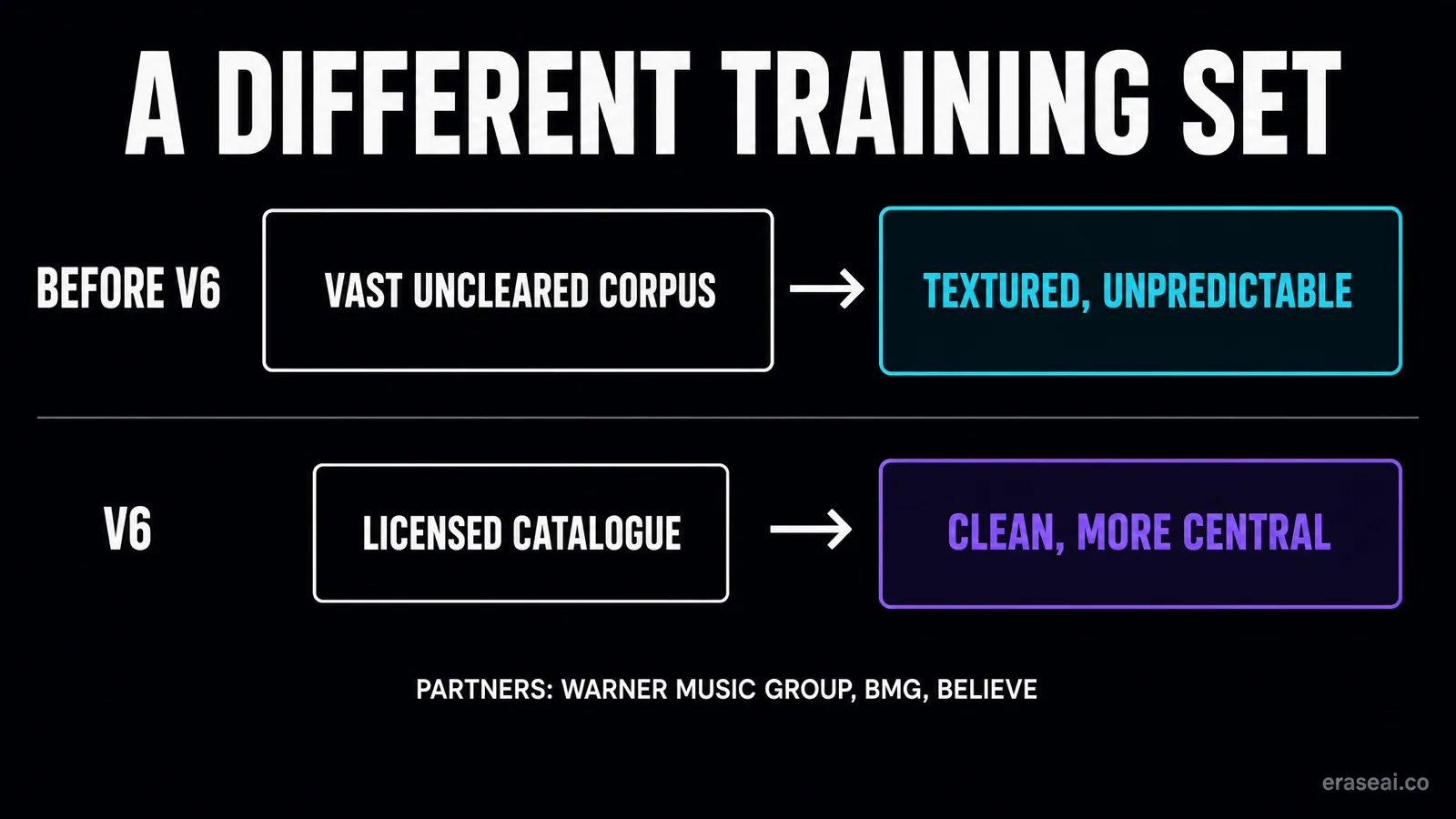
Here is the fact that reframes every quality complaint above. Suno told TechCrunch that V6 is not trained using the data it used to train previous versions. It was built from scratch on licensed data from Warner Music Group, BMG and Believe. Music Ally reports the same thing and adds the framing Suno is using internally: a clean legal boundary between V6 and everything from the pre-licensing era.
Read those two facts together and the community's complaint stops being mysterious. The models people are mourning were trained on a corpus nobody had cleared. That corpus was enormous, messy, and full of exactly the specific, weird, texturally rich recordings that made older Suno output feel alive. The new corpus is a licensed catalogue negotiated with three rightsholders. It is legally clean and it is narrower. A narrower training set produces a more central sound.
Music Ally names the second mechanism, which compounds it: as a model tunes on user preference it drifts toward mainstream taste. Suno's answer is v6-wild, which is explicitly held back from that tuning. When a company ships a model whose entire purpose is to be less optimised, it is telling you what it thinks the optimised one lost.
So the honest summary is not “V6 is worse”. It is that Suno traded a portion of its output's character for the right to keep operating. Warner, BMG and Believe are partners now and take a share of revenue from launch day. Sony and Universal are not partners, and their lawsuits continue, as do claims from individual artists. V6 is what the survivable version of this company sounds like.
Your back catalogue just became un-remakeable
This is the part with an actual deadline attached, and it is the part nobody is covering.
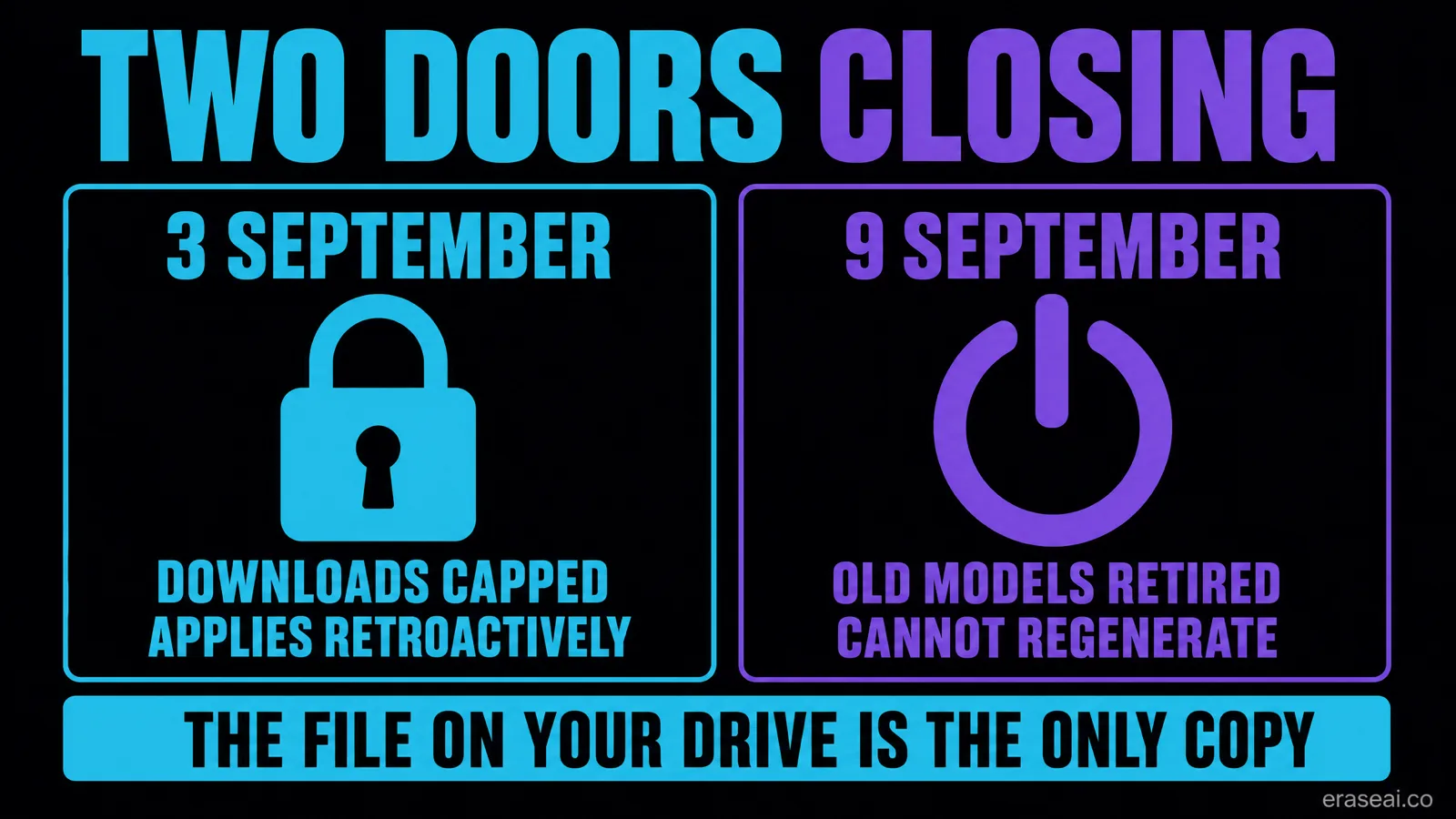
Your songs are not being deleted. Suno has been consistent that your library stays playable. What is going away is the machine that made them. Once a model is retired you cannot ask it for another take, a longer version, a cleaner vocal, or a variation on the one bar that never sat right. The specific character of a track was the model, and the model is the thing being removed.
Now put that next to the other change. Since 3 September, downloads are metered by plan and the caps apply retroactively to everything already in your library. Free accounts get seven lifetime downloads. Pro gets twenty a month, Premier sixty. So the file you never exported is now behind a queue, and the model that could regenerate it is being switched off.
That is the genuine urgency in this story, and it has nothing to do with whether you like how V6 sounds. If you have finished work with commercial value that exists only inside Suno, the cost of getting it out has gone up and the option to remake it is expiring. Our bulk export guide covers pulling a whole library as ZIP archives, and the catalogue checklist covers deciding which tracks are worth the allowance.
One more thing worth knowing if you are about to spend downloads: extract any stems you want before you download a track. A song and all of its stems count as a single download rather than one per file, which our stems guide explains in full. On a retiring model, that is your last chance to take the parts as well as the whole.
A new model means a new artifact profile
This is the part that matters if you release rather than just generate. A model trained from scratch on a different corpus does not carry the same signal characteristics as the one before it, and cleanup tooling tuned to V5 output is looking at something new. Undetectr states it is tested with Suno V6 as of September 2026, and that claim is live on its homepage and pricing page today. It removes the identifier layer that distributor screening reads, SynthID, C2PA content credentials, spectral fingerprints, temporal patterns, stereo-field anomalies and generation metadata, in one automatic pass, then masters to platform loudness specification.
Being straight about the evidence: that is the vendor's own claim, verified as live and current, not an independent test result from us. Run your first V6 track through and listen before you commit a catalogue to it. Its Bulk Suno Song Downloader is the other half of this week: it pulls a playlist, or the whole library, as ZIP archives while the older models are still there. Use it on music you generated and hold the commercial rights to.
Suno V6 FAQ
When did Suno V6 come out?
9 September 2026. Co-founder and CEO Mikey Shulman announced it on Suno's blog as a new generation of models developed with industry partners. It is a staged rollout rather than a single switch, and Suno has not published a per-account timetable.
What are the three Suno V6 models?
v6 is the flagship for Pro and Premier subscribers, described by Suno as reliable and precise. v6-wild is also Pro and Premier, built for exploration and deliberately less predictable. v6-mini is available to everyone including free accounts and is the faster, more efficient option.
Is Suno V6 better than V5?
It depends entirely on what you mean by better. On measurable fidelity, yes — the audio is cleaner and the control is far deeper. On feel, a large part of the community says no. The most upvoted verdict in the launch-day threads was that V6 sounds better technically while feeling more synthetic than the models it replaced.
Are the old Suno models really being retired?
Yes. Suno's own launch post says that as V6 rolls out it will retire its previous models and move Suno entirely onto the V6 generation. This is not a deprecation warning with a long tail — it is a stated plan to remove every earlier model.
Can I still regenerate a song I made on V5?
Not once the model that made it is gone. Your existing songs stay in your library, but the specific model that produced a track is what gave it its character, and you cannot ask a retired model for another take. If a V5 track matters to you commercially, the file on your own drive is now worth more than the ability to remake it.
Why is Suno V6 trained on licensed music?
Suno says V6 is not trained on the data used for previous versions. It was built from scratch using licensed data from Warner Music Group, BMG and Believe, with revenue sharing effective from launch. Sony Music and Universal Music Group are not partners and their litigation continues, as do claims from individual artists.
Does the V6 change affect the download limits?
The download caps are separate and already live. Suno introduced tier-based download limits from 3 September 2026 — 7 lifetime downloads on free, 20 a month on Pro, 60 on Premier — and those apply retroactively to songs made before that date. V6 does not change them. The two things together are what make an unexported back catalogue a real problem.
Does Undetectr work with Suno V6?
Undetectr states that it is tested with Suno V6, dated September 2026, and that claim is live on its homepage and pricing page. That is the vendor's own claim rather than an independent test result, and we have not run our own V6 measurements yet. Treat it as a supported-and-current statement from the tool, and check your own first track before you process a catalogue.
Read next
Bulk download your Suno catalogue
Export the whole library as ZIP archives while the older models are still around.
Suno stems and the one-download rule
A song plus all its stems counts once. Extract before you download.
The download caps explained
What changed on 3 September, and why it applies to songs you already made.
Artifact removal tools, scored
What actually clears distributor screening, with 50-track pass-rate data.
Or browse every guide on the site.
Sources
- Mikey Shulman, Introducing v6, Suno, 9 September 2026. Source of the three models, the capability list, and the retirement statement.
- Ivan Mehta, Suno replaces its AI models with a new one trained on licensed music, TechCrunch, 9 September 2026. Source of the training-data statement and the ongoing Sony and UMG litigation.
- Suno launches its v6 AI-music models, Music Ally, 9 September 2026. Source of the revenue-sharing detail, the clean-legal-boundary framing and the overfitting note.
- Community reaction sampled from r/SunoAI and r/aiMusic launch threads, 9-10 September 2026, via a 128-item cross-source pull covering Reddit, YouTube, Hacker News, GitHub and the web.
- Undetectr V6 claim verified live on undetectr.com and its pricing page, 10 September 2026.
Read at source on 10 September 2026. Community quotes are reproduced as written. EraseAI recommends Undetectr, and those links are commercial.
The models are going. The files do not have to.
Pull the catalogue while the older generation is still live, take the stems in the same operation, and process what you intend to release.
Export my Suno back catalogue →