Yes, It Allows AI Music. Screening Is The Catch.
DistroKid does not have a rule against making music with a generator, and plenty of AI-assisted catalogs are distributed through it. But "allowed" and "accepted on upload" are two different things, and the gap between them is where creators lose tracks. Here is what distributors actually check, why AI releases get held, and what to fix before you pay for one.
The short version
Five things worth knowing before your next distribution run.
DistroKid does not ban AI-assisted music. It enforces rights ownership, no impersonation, and no spam — the same rules that apply to every release.
Rejections are overwhelmingly technical and automated, not editorial judgements about AI. Embedded identifiers, off-spec loudness, and fingerprint overlap are the usual causes.
A successful upload is not final approval. Screening continues downstream, and tracks can be pulled weeks after going live with no notification.
Repeated flags escalate from a track problem to an account problem — the real reason not to push raw exports at volume.
No distributor has a laxer AI policy worth switching for. Choose on price and terms, and fix the file instead.
What the rules actually say
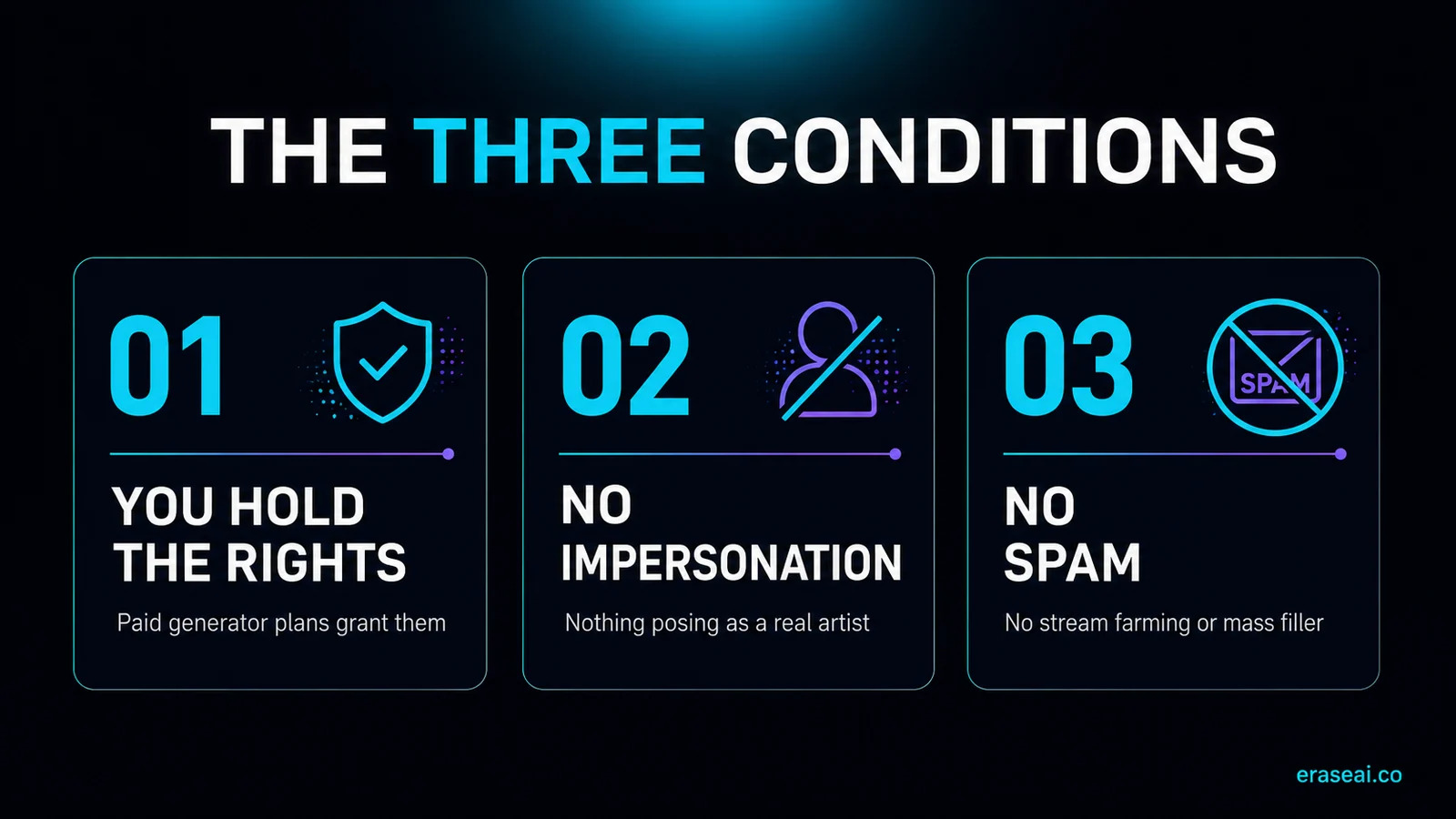
Three conditions, none of them about generators.
You hold the rights
You must own or license what you upload. Suno and Udio grant commercial rights to your output on paid plans — check your plan, because free tiers generally do not.
No impersonation
Nothing presented as the work of a real artist who was not involved. Voice clones passed off as a named performer are the fastest route to removal and account action.
No spam or stream farming
Mass uploads engineered to harvest payouts, and any artificial streaming. Generators make volume trivial, so this is the area under the most active enforcement.
Meet those three and you are, on paper, a legitimate customer distributing legitimate music. That is genuinely the position most AI-assisted creators are in — which makes it all the more confusing when releases start failing anyway.
Worth stating plainly: distributor terms are revised regularly, and the same is true of the platforms they deliver to. Confirm DistroKid's current AI policy before a release rather than relying on any third-party summary, this one included.
Allowed by policy, blocked by machine
The rejection almost nobody expects, because no rule was broken.
Every distributor runs automated screening on incoming audio before it goes anywhere near a store. That system is not reading your terms-of-service compliance — it is reading the file. And a raw generator export hands it three separate reasons to hesitate.
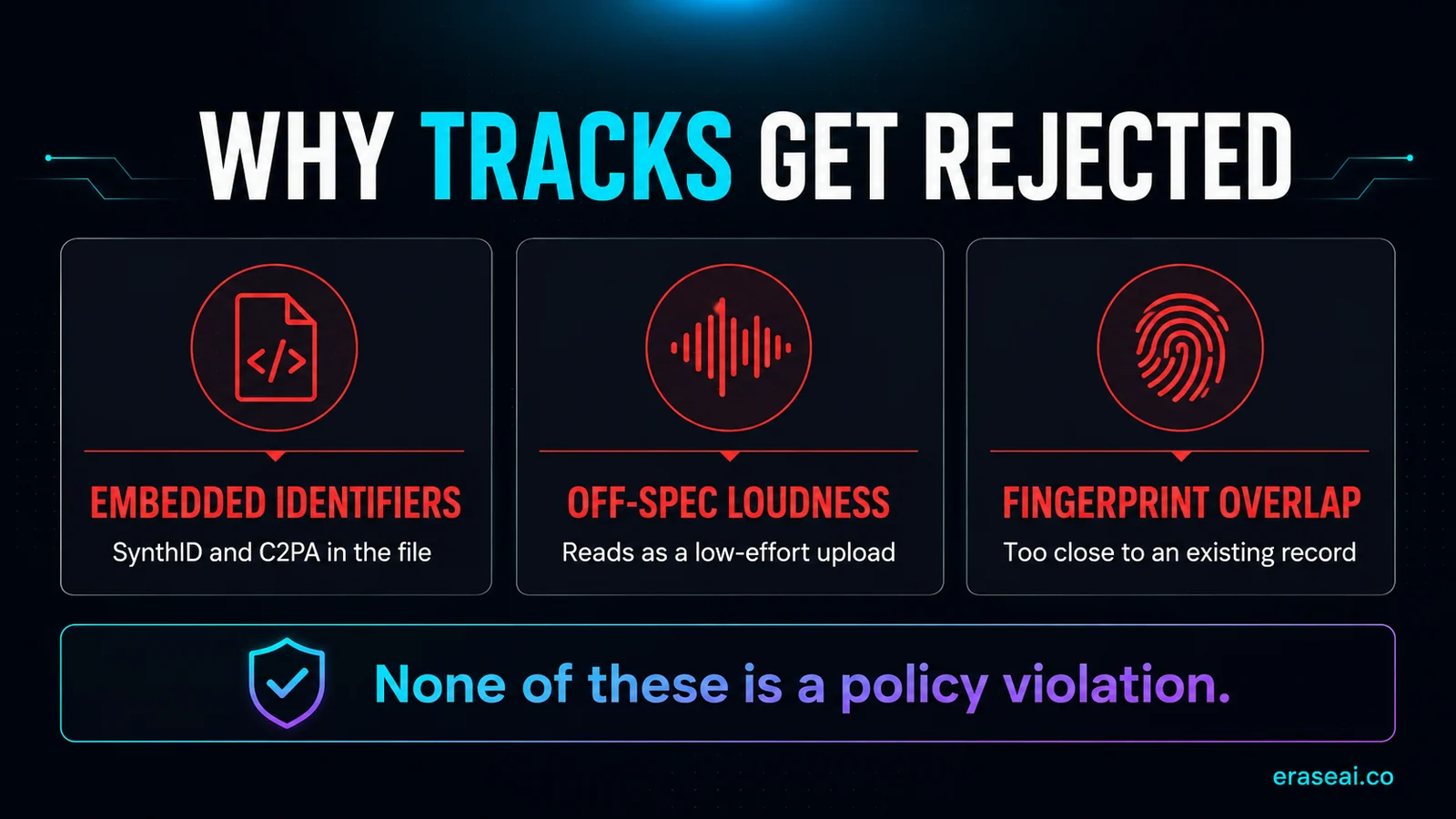
The first is embedded identifiers: SynthID watermarks, C2PA content credentials, and spectral fingerprints that generators write into the export deliberately. The second is loudness outside specification, which screening treats as a marker of low-effort uploads — precisely the pattern spam filters are tuned to catch. The third is fingerprint overlap, where output lands close enough to an existing recording to trip a similarity check.
None of those is a policy violation, and all three produce policy-shaped outcomes: a rejection with a generic message, or a release that reaches stores and quietly disappears a fortnight later. Creators reasonably conclude the distributor is anti-AI. Usually it is just a machine reading a file that was never prepared for it. Our guide to AI music detectors breaks down exactly what those systems measure.
When a track problem becomes an account problem
The part that makes volume uploading genuinely risky.
A single rejected track costs you a submission. A pattern of them costs you standing. Distributors monitor accounts for repeated flags and removals, because that pattern is exactly what a spam operation produces — and an automated system cannot easily distinguish an honest creator uploading fifty raw exports from someone farming payouts with fifty pieces of filler.
A controlled 50-track experiment we cover in the watermark guide showed both halves of this: raw uploads went live and were then muted or pulled within two weeks, while every properly prepared track in the same batch stayed live across all five platforms. The lesson was not that one distributor is friendlier. It was that preparation decides the outcome.
Preparing a release that passes
Four steps, in this order, before you pay for distribution.
Check your rights
Confirm your generator plan grants commercial use. This is the one genuine policy requirement, and it is a plan-level question worth settling before anything else.
Clean and master the export
Strip the embedded identifiers and bring loudness into spec. We recommend Undetectr for this — it runs the artifact pass and mastering in one go.
Disclose AI involvement
Fill in your distributor's AI metadata fields honestly. Structured disclosure is where the industry has landed, and omitting it is an avoidable reason for removal.
Upload with clean metadata
Artist names that imply a real performer's involvement invite exactly the impersonation review you want to avoid. Keep credits accurate and unambiguous.
DistroKid & AI music FAQ
Does DistroKid allow AI music?
DistroKid does not prohibit AI-assisted music outright, and large numbers of AI-generated tracks are distributed through it. What it does enforce is the same set of rules that apply to every release: you must hold the rights to what you upload, you must not impersonate another artist, and you must not use it for spam or artificial streaming. Distributor policies change, so confirm the current terms before paying for a release.
Can you upload AI music to DistroKid?
Yes, provided you own the commercial rights to the output — Suno and Udio grant these on paid plans — and the audio passes automated screening. The upload itself is no different from any other release. The friction, when it appears, is almost always the screening step rather than a policy objection.
Why did DistroKid reject my AI track?
Rejections are usually automated and rarely explained in detail. The common technical causes are embedded generator identifiers in the file, loudness sitting outside platform specification, and fingerprint overlap with an existing recording. Policy-based rejections happen too, most often for metadata that implies a real artist's involvement or for uploads that pattern-match spam.
Why did my track go live and then disappear?
Screening continues after publication, and platforms feed removals back to distributors. A track can clear the initial check, reach stores, and be pulled weeks later once a downstream system flags it. There is often no notification, which is why creators describe tracks 'vanishing' — it is worth preparing files properly rather than treating a successful upload as final approval.
Do repeated rejections affect my DistroKid account?
They can. Individual rejected tracks are a nuisance, but a pattern of flagged or removed uploads is treated as a signal about the account rather than the release. That escalation is the real risk of uploading raw exports at volume: what starts as a per-track problem can become an account-level one.
Which distributor is best for AI music?
There is no distributor that waves AI-generated audio through, because the screening that matters happens at the platform end as well. DistroKid, TuneCore, CD Baby, and their competitors all accept AI-assisted material under broadly similar conditions — rights, no impersonation, no spam. Choose on price, payout terms, and catalog size rather than hoping for a laxer AI policy.
Do I need to disclose AI use when distributing?
Declare it wherever your distributor provides a field for it. The industry has standardised on carrying AI involvement through structured metadata in track credits, and undisclosed AI content is one of the specific things platforms enforce against. Disclosure costs nothing and removes an avoidable reason for removal.
The policy said yes. The scanner said no.
Clean the export and master it to spec — then upload once and have it stay up.
▸ Independent · We recommend Undetectr