AI Music on Deezer Tagged, Not Banned
Most pages about AI music on Deezer leave you thinking the platform punishes it, and the number doing the work is always the same one: 85%, quoted as if Deezer demonetises AI releases. That is a misreading of a fraud statistic, and the real policy is both narrower and stranger — a tag your listeners see, a total cut from every recommendation surface, and the same royalty rate as anybody else. We read Deezer's newsroom posts from January, April and July 2026, its labelling page, and a July interview with the executive who runs the detection system, then wrote down the four things Deezer does, the rule that decides which side of the tag you land on, and the two conditions that take a track down.
The short version
Five findings, each from a Deezer source you can open yourself.
Being flagged is not being banned or demonetised. Deezer's Chief Innovation Officer, Aurélien Hérault, said in July 2026 that a flagged track “isn't removed, isn't blocked, and is paid the same royalty rate as anything else”. The single consequence is exclusion from recommendations.
The 85% figure is about fraudulent streams, not about AI. It is the share of streams on AI tracks that Deezer detects as fake, and “fraudulent streams are cleared from the royalty pool” is what it does for any track. Nothing in it says an AI release earns a lower rate.
Classification is decided at the output, not by how much of the work was yours. A melody you hummed with lyrics you wrote, rendered by Suno, is fully AI-generated “because it's the output of the tool”. AI stems built into your own production are “an artistic usage” and are not flagged.
Two things get a track removed, and neither is the tag: streams used for fraud, and six months with no streams. Deezer announced both on 21 July 2026, which puts every release without an audience on a clock.
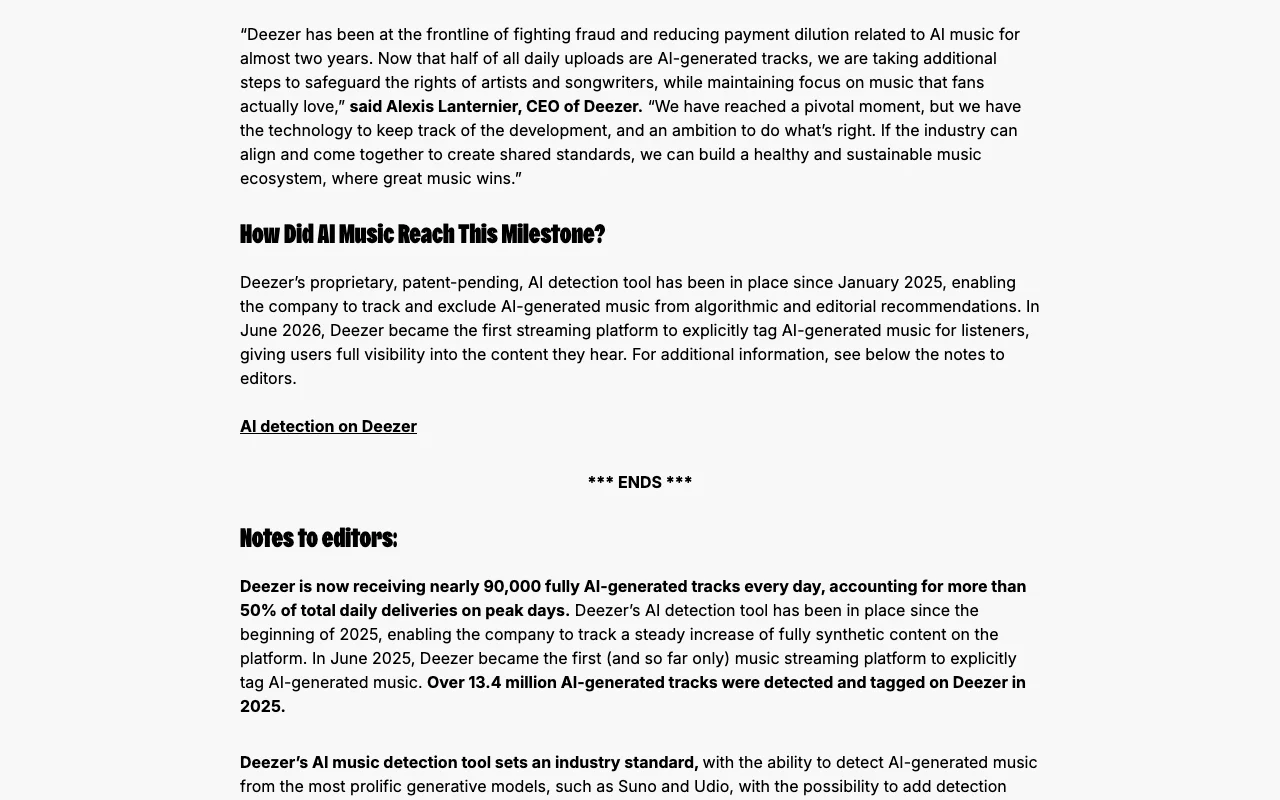
The scale is why the exclusion bites. Roughly 90,000 AI tracks arrive daily and AI passed half of all new deliveries at the June 2026 peak, up from about 10,000 a day in January 2025 — while consumption stayed at 1-3% of streams.
- What the Deezer AI tag actually is
- Being flagged is not being banned
- The rule that decides whether you are flagged
- Where the 85% figure comes from
- The two ways a track comes off Deezer
- What the exclusion actually costs
- Deezer's tag is not the first gate you meet
- Deezer next to Spotify, Apple, Tidal and Bandcamp
- What to do before you deliver
- FAQ
What the Deezer AI tag actually is
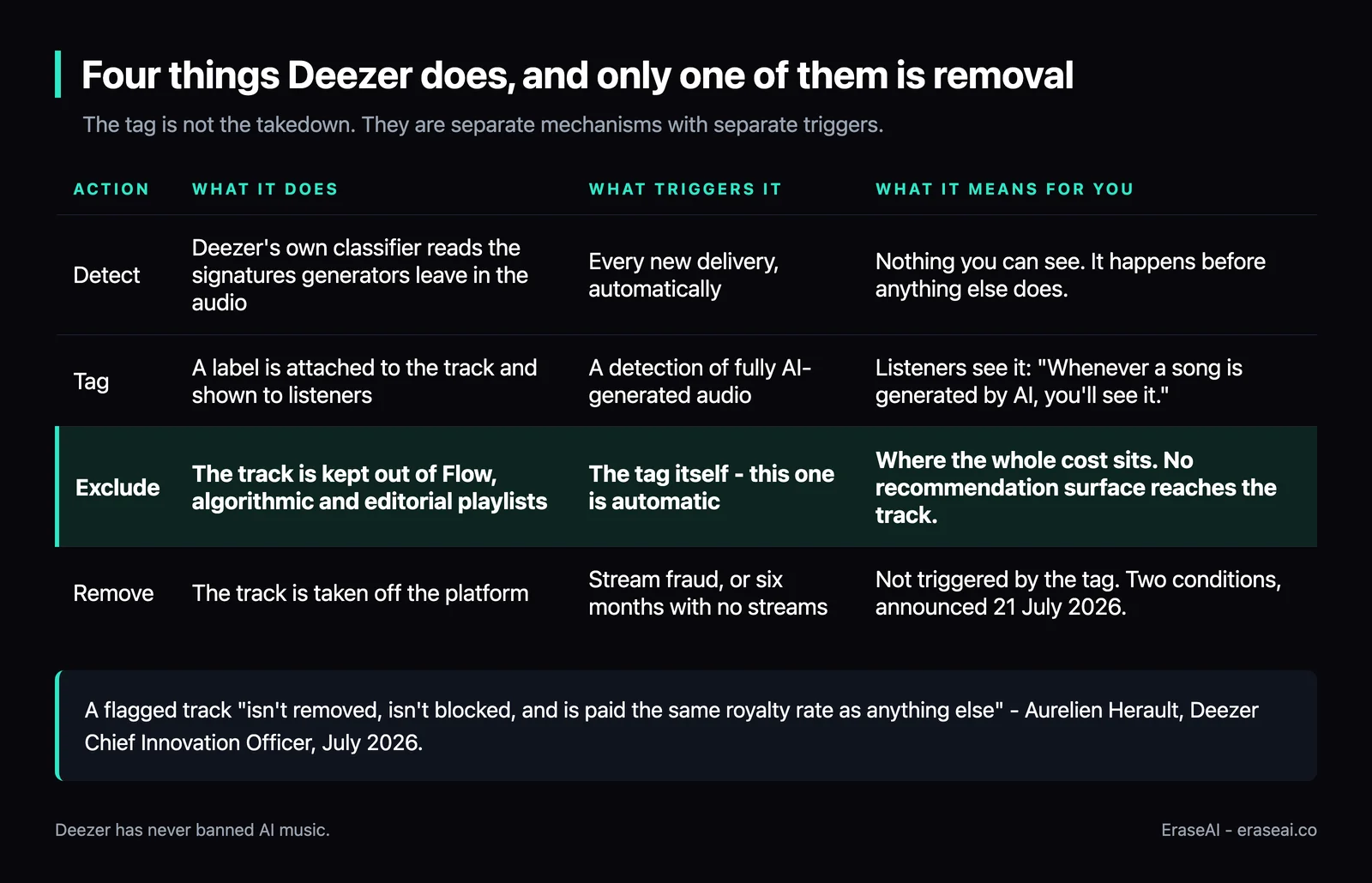
Detection, labelling, exclusion and removal are four separate things with four separate triggers.
Almost every article about AI music on Deezer collapses the policy into one verb, and that is where the confusion starts. Deezer was the first streaming service to detect, tag and exclude AI-generated music, in 2025, and it runs those steps independently. Its classifier reads the signatures generators leave in the audio — the same family of identifiers covered in the watermark and signature research on sunowatermark.com — and the label follows from the detection automatically.
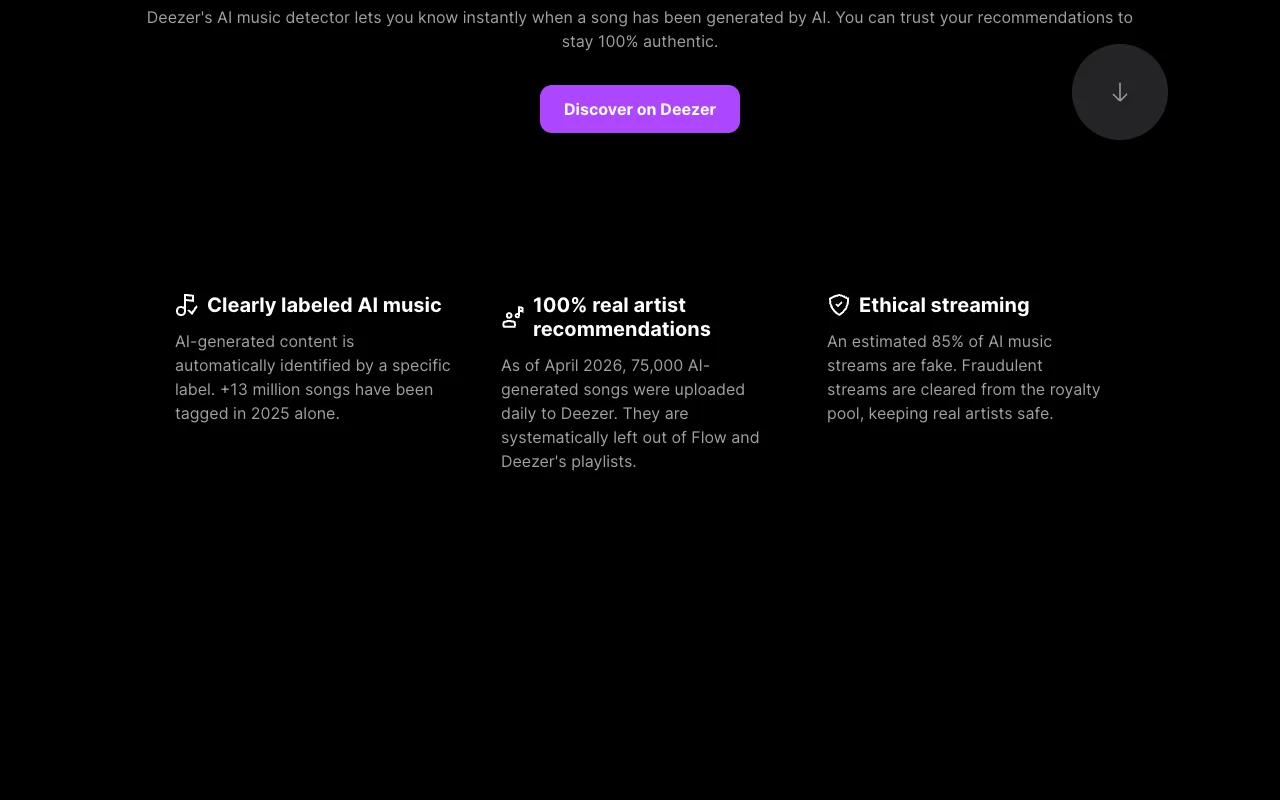
What follows the label is worth being precise about. Deezer's listener-facing page says flagged AI music is “systematically excluded from Flow, recommendations, personalized and editorial playlists”. It does not say the track is removed, blocked or paid less.
| Action | What it does | What triggers it | What it means for you |
|---|---|---|---|
| Detect | Deezer's own classifier reads the signatures generators leave in the audio | Every new delivery, automatically | Nothing you can see. It happens before anything else does. |
| Tag | A label is attached to the track and shown to listeners | A detection of fully AI-generated audio | Listeners see it: “Whenever a song is generated by AI, you'll see it.” |
| Exclude | The track is kept out of Flow, algorithmic and editorial playlists | The tag itself — this one is automatic | Where the whole cost sits. No recommendation surface reaches the track. |
| Remove | The track is taken off the platform | Stream fraud, or six months with no streams | Not triggered by the tag. Two conditions, announced 21 July 2026. |
Read down the trigger column and the policy's shape is obvious: three of the four happen automatically and only one is about conduct. Deezer's chief executive, Alexis Lanternier, framed the intent as listener choice — “we detect and tag AI-generated music and remove it from algorithmic recommendations, so that our users have a clear choice”.
Being flagged is not being banned
The most consequential fact on this topic is one no competing page states.
In an interview published on 24 July 2026, Deezer's Chief Innovation Officer Aurélien Hérault was asked directly what happens to a flagged track. His answer, quoted in that piece, is that it “isn't removed, isn't blocked, and is paid the same royalty rate as anything else”, and that there is “no difference in how these artists get paid”. The only consequence he names is that flagged content is “not included in the algorithmic recommendations”.
He also said Deezer can reverse a flag if it later finds evidence a track should not have been tagged — so the label is treated as a classification that can be wrong, not a verdict.
It does not mean AI releases earn normally on Deezer. Payment parity applies to the rate on a genuine stream, and an estimated 85% of streams on AI tracks are detected as fraudulent and cleared from the royalty pool. The rate is the same; the surviving stream count usually is not.
One caveat on sourcing, because it changes how much weight to put on this. The payment-parity line and the classification rule below both come from an interview with Deezer's own executive rather than from published policy text; Deezer's creator-support article on AI tagging sits behind a bot wall we could not read. Treat the quotes as authoritative about intent, and check your distributor's documentation before planning around edge cases.
The rule that decides whether you are flagged
Not how much AI you used. Where in the pipeline the tool sat.
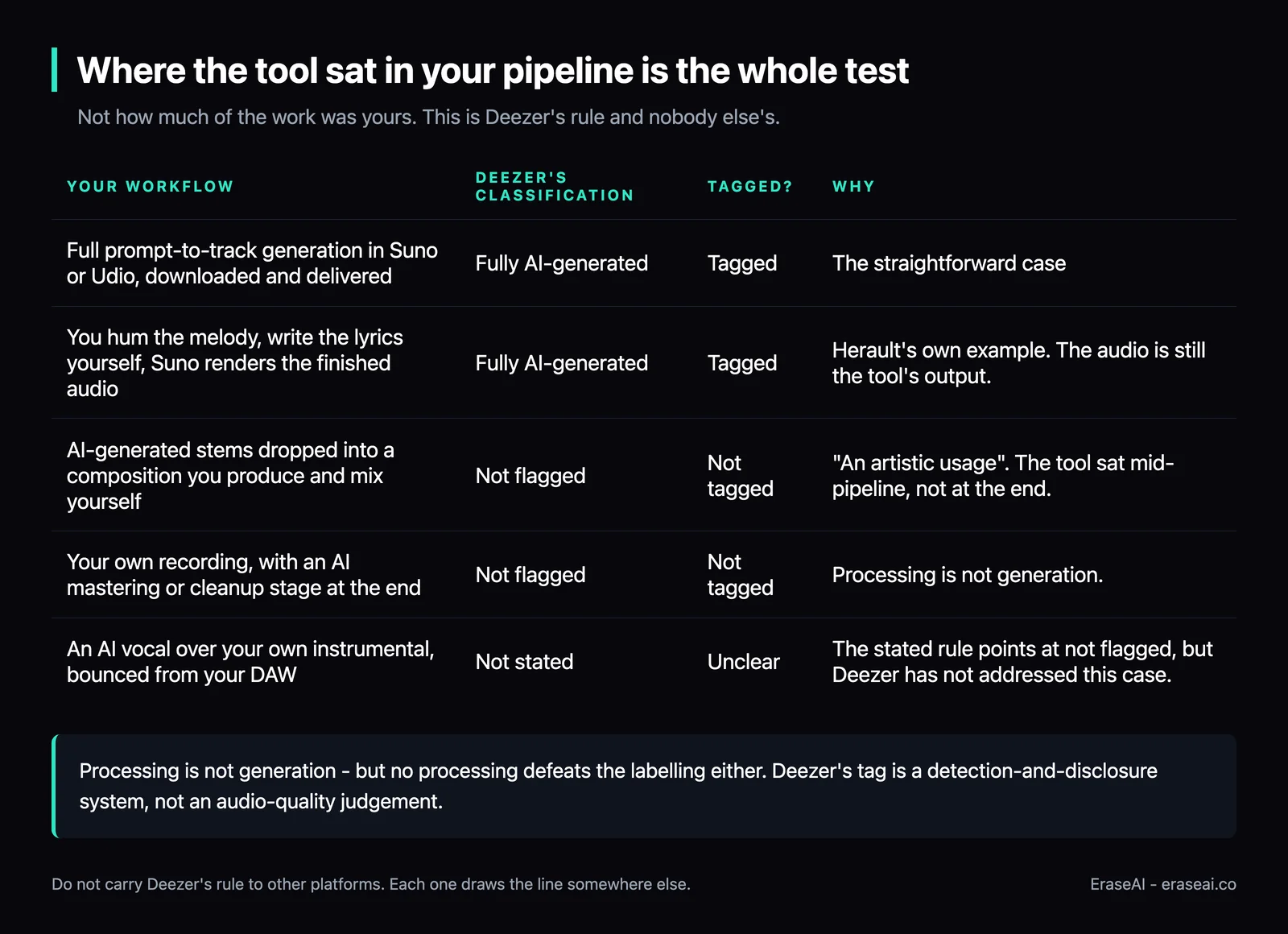
This is the question people actually ask — some version of “if the drums came from Suno and everything else is mine, am I AI?” — and Deezer has answered it more clearly than any other platform. Hérault described a writer who hums a melody, writes their own lyrics and has Suno render the finished audio. That track is fully AI-generated, “because it's the output of the tool”. The human contribution is real and it changes nothing.
Now invert it. A track built from AI-generated stems that the artist arranges, produces and mixes into their own composition “isn't flagged at all” — “an artistic usage”. Same tool, same machine-made audio, opposite outcome, because the finished master came out of the artist's session rather than the generator.
| Workflow | Classification | Tagged? | Why |
|---|---|---|---|
| Full prompt-to-track generation in Suno or Udio, downloaded and delivered | Fully AI-generated | Tagged | The straightforward case, and the one most readers are shipping. |
| You hum the melody, write the lyrics yourself, and Suno renders the finished audio | Fully AI-generated | Tagged | Hérault's own example. Human input does not change it: the audio is still the tool's output. |
| AI-generated stems dropped into a composition you produce and mix yourself | Not flagged | Not tagged | “An artistic usage”. The tool sat mid-pipeline, not at the end. |
| Your own recording, with an AI mastering or cleanup stage at the end | Not flagged | Not tagged | Processing is not generation. |
| An AI vocal over your own instrumental, bounced from your DAW | Not stated | Unclear | The stated rule points at not flagged, but Deezer has not addressed this case. Do not plan around it. |
Two warnings about that table. The last row is genuinely unresolved and marked so rather than guessed: an AI vocal over your own instrumental is the case readers ask about most and Deezer has not addressed it. And this rule is Deezer's alone. Spotify labels an invented identity and separately labels the recording through delivery metadata; Apple tags on delivery from what the provider declares; Tidal draws its line at “wholly” AI recordings and says partly-AI work is untouched. Carrying Deezer's output test elsewhere will get you the wrong answer, so read the per-platform acceptance rules before you deliver anywhere else.
The practical consequence is a workflow decision, not a disclosure one. To stay out of the tag honestly, stop bouncing the generator's master and start exporting parts — stem splits into your own session, your own mix, your own bounce. That is more work than a prompt, and it is the only version of “partly AI” that Deezer's stated rule actually recognises.
Where the 85% figure comes from
Four dated Deezer disclosures, and what each one actually measures.
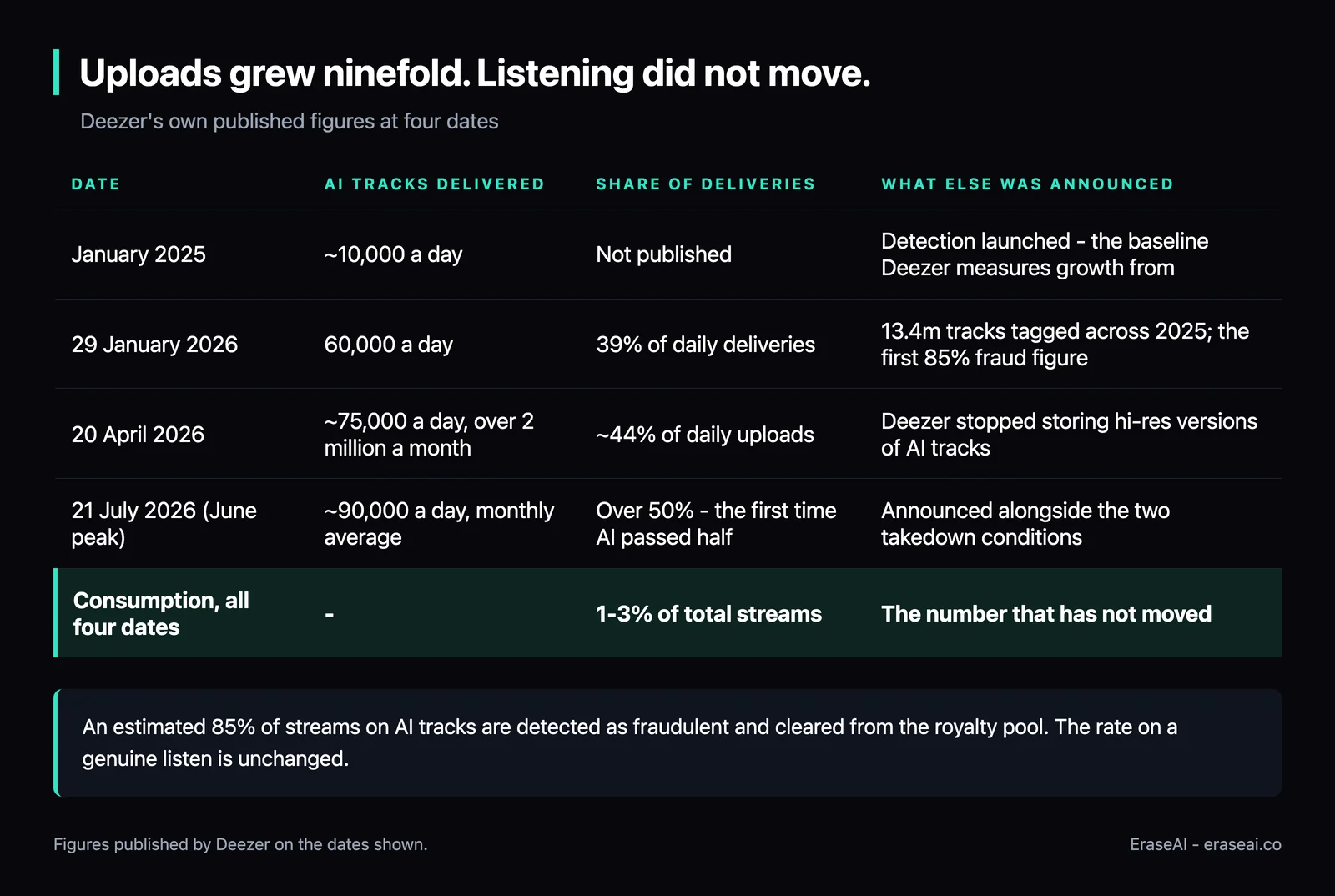
The 85% has been restated so often that its subject has been lost. It is not the share of AI tracks that are demonetised. It is the share of streams on AI-generated tracks that Deezer detects as fraudulent — bot traffic pointed at those tracks. Deezer's phrasing for the consequence is that “fraudulent streams are cleared from the royalty pool”, which is what it does on any release. For scale, Deezer puts the fraud rate across its whole catalogue at around 8%.
| Date | Uploads | Share of deliveries | What else that post said |
|---|---|---|---|
| January 2025 | ~10,000 AI tracks a day | Not published | Detection launched — the baseline Deezer measures growth from |
| 29 January 2026 | 60,000 a day | 39% of daily deliveries | 13.4m tracks tagged across 2025; the first 85% fraud figure |
| 20 April 2026 | ~75,000 a day, over 2 million a month | ~44% of daily uploads | Same post: Deezer stopped storing hi-res versions of AI tracks |
| 21 July 2026 (June peak) | ~90,000 a day, monthly average | Over 50% — the first time AI passed half | Announced alongside the two takedown conditions |
| Consumption, all four dates | — | 1-3% of total streams | The number that has not moved. Uploads grew ninefold; listening did not. |
The bottom row is the one to sit with. Daily AI uploads went from about 10,000 to about 90,000 in eighteen months while AI's share of listening stayed at 1-3%. That gap is not a policy problem, it is the supply side of the streaming market behaving exactly as the numbers predict, and it is the context for every decision further down this page.
One detail from the April 2026 post deserves more attention: Deezer stopped storing hi-res versions of AI tracks. It costs you nothing directly, but it shows how the platform is budgeting for this catalogue.
The two ways a track comes off Deezer
Neither of them is the tag, and one of them is a deadline.
Alongside the June upload figures on 21 July 2026, Deezer said it would take down generative-AI tracks used to generate fraudulent streams, and fully AI-generated tracks unstreamed for six months or more. Those are the two conditions. Being tagged is not one.
The fraud condition is the one people expect and the least likely to catch an honest release — though buying promotion from a service that delivers bot traffic can put you on the wrong side of it unintentionally.
The six-month rule is the one that will actually reach you, and it interacts badly with everything above. A flagged track is excluded from Flow, from personalised recommendations and from editorial playlists — every mechanism Deezer has for putting an unfamiliar track in front of a listener. Then it needs a stream inside six months to stay up. You are asked to find an audience with the discovery surfaces switched off, and Deezer is the only platform that has put a published clock on that.
What the exclusion actually costs
Losing recommendations is losing the only thing that finds you listeners.
Set the numbers side by side. Fully AI-generated music is over half of what arrives at Deezer daily and 1-3% of what gets played. Within that 1-3%, up to 85% of streams are fraudulent and cleared from the pool. What is left is paid at a normal rate — good news, and almost irrelevant at that volume.
The honest reading is that a flagged Deezer release is not being robbed, it is being ignored — structurally, not punitively. This is the same wall creators hit everywhere and it has little to do with AI policy: getting distributed has been solved for years and nobody can find an audience. Deezer's tag makes the problem measurable, not new.
Which changes what is worth doing next. If the recommendation surfaces are closed and the royalty on a real stream is fractions of a cent either way, the routes that pay are the ones that do not need algorithmic reach. Paid sync placements in TV, film, games and advertising are where the money conversation in this niche actually is, and selling direct to listeners you already have keeps 100% of a real transaction. Neither needs a playlist, which is the point on a platform that has taken playlists away from you.
Keep expectations calibrated. Money from AI music is real — two creators earned a reported $15,000 in a month in early 2026 — but that is the top of a distribution whose median outcome is a handful of plays, and a storefront does not create demand any more than a playlist does.
Deezer's tag is not the first gate you meet
Distributor screening happens earlier and asks a different question.
Before Deezer sees your track, your distributor does. That is a separate automated check with a separate purpose, and creators do report tracks being flagged and rejected by it. It is not a ban on AI music — six distributors accept it openly — but it is the step where a release actually stalls, and audible generation artifacts are part of what it reacts to. The full delivery path lays out the order these checks happen in.
That distinction is worth being blunt about, because the two are marketed as one thing. Nothing you do to an audio file changes how a platform labels it. Deezer's tag is a detection-and-disclosure system and Spotify's badge is disclosure-driven; no processing step makes either go away, and any tool suggesting otherwise is selling something it cannot deliver. What disclosure actually costs is covered separately in disclosure that works.
What processing does reach is the screening step and the listening experience — the thin, over-compressed, band-limited exports generators produce, a real problem worth fixing on its own terms. Cleaning those artifacts and sending a properly levelled master is what Undetectr is for, and its honest value is exactly that: artifacts and automated screening, not platform labels. Our cleanup walkthrough covers the order to work in. EraseAI earns a commission if you subscribe through our links, which does not change what we say about what the tool can and cannot do.
Deezer next to Spotify, Apple, Tidal and Bandcamp
Five platforms, five different answers to the same question.
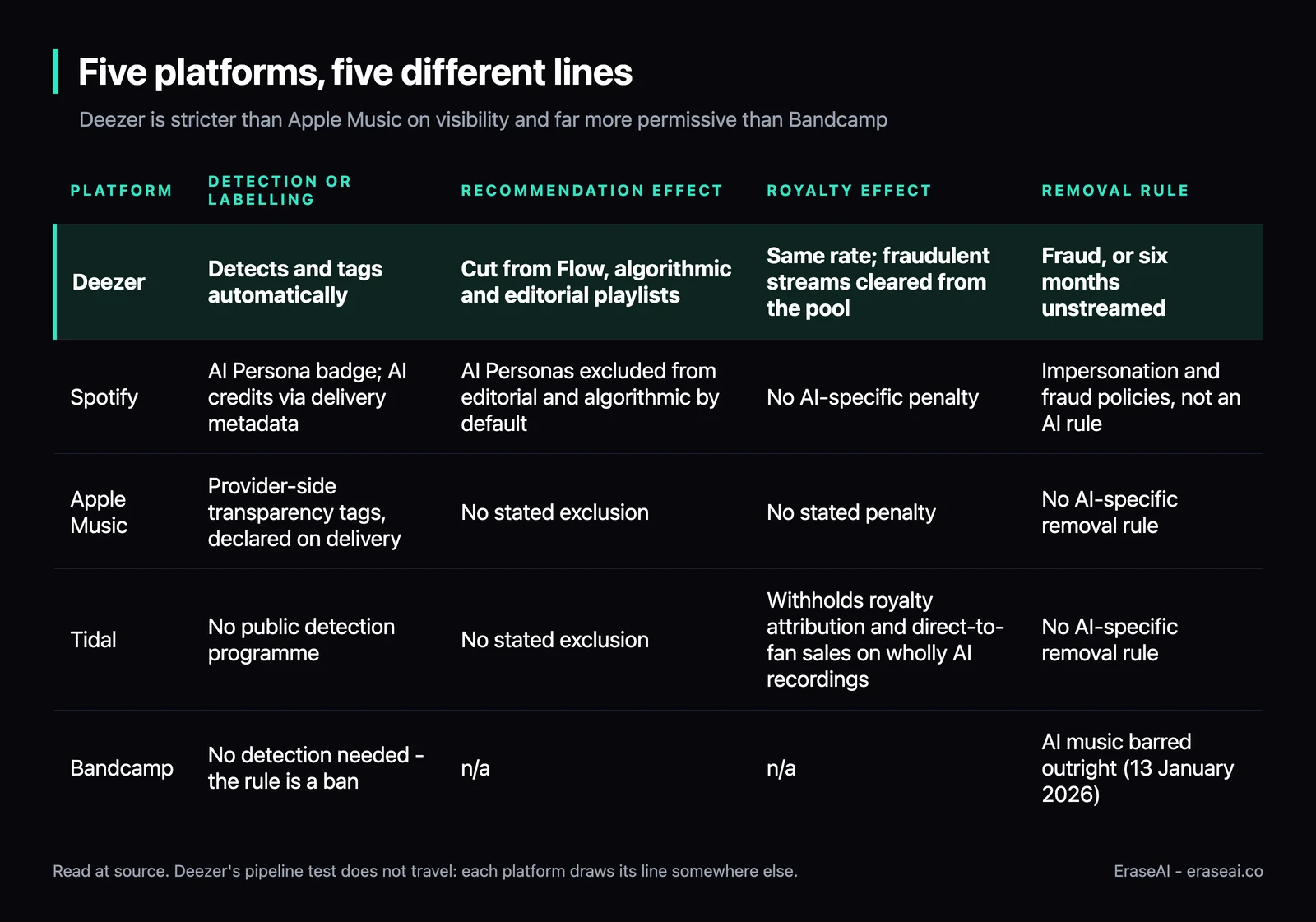
Deezer is usually called the strictest platform on AI music. On visibility that is true. On payment it is more permissive than Tidal, and on whether your music is allowed at all, far more permissive than Bandcamp, which bars it.
| Platform | Labelling | Discovery | Money | Removal |
|---|---|---|---|---|
| Deezer | Detects and tags automatically | Cut from Flow, algorithmic and editorial playlists | Same rate; fraudulent streams cleared from the pool | Fraud, or six months unstreamed |
| Spotify | AI Persona badge labels the identity; AI credits label the recording via delivery metadata | AI Personas excluded from editorial and algorithmic recommendations by default | No AI-specific penalty | Impersonation and fraud policies, not an AI rule |
| Apple Music | Provider-side transparency tags, declared on delivery | No stated exclusion | No stated penalty | No AI-specific removal rule |
| Tidal | No public detection programme | No stated exclusion | Withholds royalty attribution and direct-to-fan sales on wholly AI recordings; partly-AI untouched | No AI-specific removal rule |
| Bandcamp | No detection needed — the rule is a ban | n/a | n/a | AI music barred outright (13 January 2026) |
Which column matters depends on what you are optimising for. For reach, Deezer is the worst of the five for a flagged track and Apple Music the most indifferent. For revenue attribution on a wholly AI recording, Tidal is the one to read carefully. Our platform pages go through each in detail — Spotify, including how the AI Persona badge differs from an AI credit, and Apple Music.
What to do before you deliver
Five decisions, in the order they actually come up.
Decide which side of the output rule you are on, honestly. If the generator produced your master, expect the tag and plan for the exclusion. If you will work in stems and bounce your own mix, you are in what Deezer calls artistic usage — but only if that is genuinely what you did.
Keep your evidence. Session files, stem exports and project files are what a reversal request rests on; the audio alone will not show where your master came from.
Fix the audio for its own sake. Clean generation artifacts and master to one sane loudness target because a thin, squashed export is worth fixing and because distributor screening reacts to it — not as a labelling tactic, which does not work.
Plan for the six-month clock before release, not after. A track with no recommendation surface and no audience needs a stream inside six months. Decide now where that first listen is coming from.
Do not build the release's economics on streaming. With recommendations closed and most AI streams filtered as fraud, sync placements and direct sales are the routes that do not need discovery you cannot get.
One closing reason to care about Deezer even if you never release there. In January 2026 it said it would make its detection technology commercially available to industry partners, and reported successful tests with the French collecting society SACEM. The classifier deciding whether your track is “fully AI-generated” on one platform is being packaged to sell to others.
Which makes Deezer's output rule a preview rather than a quirk: it is the clearest test any platform has published for where AI sat in your process, and the one most likely to turn up somewhere else next.
AI music on Deezer FAQ
Is AI music allowed on Deezer?
Yes. Deezer has never banned it. It detects fully AI-generated tracks, attaches a label listeners can see, and keeps those tracks out of its recommendation surfaces. Its Chief Innovation Officer, Aurélien Hérault, put the rest plainly in a July 2026 interview: a flagged track “isn't removed, isn't blocked, and is paid the same royalty rate as anything else”. That makes Deezer stricter than Apple Music on visibility and far more permissive than Bandcamp, which bars AI music outright.
Does Deezer pay less for AI-generated music?
No, not for being AI. The same interview states there is “no difference in how these artists get paid”. What is withheld is payment on fraudulent streams, which Deezer clears from the royalty pool for any track, AI or human. Because an estimated 85% of streams on AI tracks are detected as fraudulent, an AI release loses far more to fraud filtering than a human one — but the rate on a genuine listen is the same.
Will Deezer flag my track if I only used AI for part of it?
On Deezer the test is where the tool sat in your pipeline, not how much of the work was yours. AI stems built into a composition you produce and mix are “an artistic usage” and are not flagged. A track whose finished audio came out of a generator is fully AI-generated even when you wrote the lyrics and hummed the melody. That is Deezer's rule and nobody else's — do not carry it to other platforms.
Can a Deezer AI tag be removed or appealed?
Deezer says it can reverse a flag if it later finds evidence a track should not have been tagged, so the label is not permanent by design. There is no published self-service appeal form; the route in practice is your distributor's support channel. Keep session files, project files and stem exports — an artistic-usage claim is only as good as the evidence that the finished audio came out of your own mix.
How many AI tracks are uploaded to Deezer every day?
Around 90,000 as a monthly average, and AI passed half of all new daily deliveries for the first time at the June 2026 peak. The progression is steep: about 10,000 a day when detection launched in January 2025, 60,000 by January 2026, roughly 75,000 by April. Consumption has not followed — AI music is still 1-3% of streams.
Does Deezer delete AI tracks that nobody plays?
Yes, and it is the removal rule most releases actually run into. In July 2026 Deezer said it would take down generative-AI tracks used for fraudulent streams, and fully AI-generated tracks unstreamed for six months or more. A release with no audience is on a clock, and being cut from every recommendation surface is what makes that clock hard to beat.
Does cleaning up generation artifacts stop Deezer tagging a track?
No, and treat any tool implying otherwise with suspicion. Artifact cleanup and mastering improve how a track sounds and how it fares in a distributor's automated screening, which is a different gate. Deezer's labelling is a detection-and-disclosure system and no processing defeats it. Clean your audio because a thin, over-compressed export is worth fixing, not as a labelling strategy.
- Deezer Newsroom — AI music tops 50% of daily uploads (21 July 2026): the June peak, the ~90,000 average and both takedown conditions.
- Deezer Newsroom — AI fraud detection and licensing (29 January 2026): 60,000 a day at 39%, 13.4m tagged in 2025, the 85% and 1-3% figures, the SACEM tests and the Lanternier quote.
- Deezer — AI labelling: the listener-facing page, and the source for the Flow and editorial-playlist wording.
- Interview with Aurélien Hérault (24 July 2026): payment parity, flag reversal and the output-based classification rule.
Figures checked at source on 30 September 2026. Deezer's creator-support article on AI tagging was unreachable behind a bot challenge, so the policy statements here come from the newsroom, the listener-facing page and the interview above. Nothing here is legal advice.
Related guides
AI music on Spotify
The badge, the credits, and the 1,000-stream threshold underneath both.
AI music on Apple Music
Provider-side transparency tags, declared on delivery rather than detected.
AI music on YouTube
Disclosure, Content ID and what a claim on an AI track actually does.
Platforms that accept AI music
Distributors and promo services, with the written rule for each.
When AI music gets removed
Every removal route across the services, and which ones you can appeal.
Disclosure that works
What saying so up front costs you, and where it pays.
Or browse every guide on the site.
Deezer will tag the track. Make it worth playing.
No tool changes how a platform labels a release — but a thin, over-compressed generator export is a real problem, and it is the one thing between you and a clean pass through distributor screening. Clean the artifacts, master to one target, and send something that holds up to the last bar.
▸ Independent · We recommend Undetectr