AI Music on Tidal 2026: Tagged and Unpaid
Every write-up of this policy stops at the headline. AI music on Tidal is allowed, gets a visible label, and earns nothing — but the consequence that actually decides whether the release is worth delivering is one no coverage mentions: a listener can turn AI-labelled recordings off in Settings, and then your track will not play for them at all. Five separate consequences, triggering on different things. We read Tidal's AI Policy, its Upload and Direct-to-Fan Sales articles and its content-integrity rules at source on 10 October 2026, through the help centre's own API, and quote them rather than the press release.
The short version
Five findings, every one of them from Tidal's own help centre rather than from the June announcement cycle.
Not a ban, and not one penalty. A wholly AI-generated recording is labelled, loses royalty attribution, loses direct-to-fan eligibility, and will not play for any listener who switches AI music off. Removal is a separate finding about fraud.
The listener switch is the part nobody reported, and it is live: “You can turn off AI-labeled recordings in Settings. Once it's off, AI-labeled recordings won't play.” Labelled tracks also leave that listener's recommendations.
The two dates are different and almost every page merges them: demonetisation from publication on 29 June 2026, the “AI” badge from 15 July. The help-centre article behind both was created 23 June and last revised 20 July 2026.
Tidal acts on recordings, not songs: “We will be taking no actions as to AI-generated compositions.” Partly-AI recordings are untouched for now “to avoid false positives”, and Tidal admits “some partially AI-generated content may remain unlabeled”.
A wrong tag is appealable through a path Tidal publishes and nobody quotes: the support form, then “I want to file an AI flag review”, then “This track was wrongly tagged as AI”. The same form lets listeners report an untagged AI track — so labelling is not purely automatic.
- What Tidal does to a wholly AI track
- “Wholly AI” means the recording, not the song
- The listener switch nobody reported
- Tidal Upload: the tier the policy closes
- Who can sell direct, and what it costs
- Tagged wrong? The exact appeal path
- AI music on Tidal next to Spotify, Deezer and Bandcamp
- The other rule that stops royalties
- Before you deliver AI music to Tidal
- FAQ
- Sources
What Tidal does to a wholly AI track
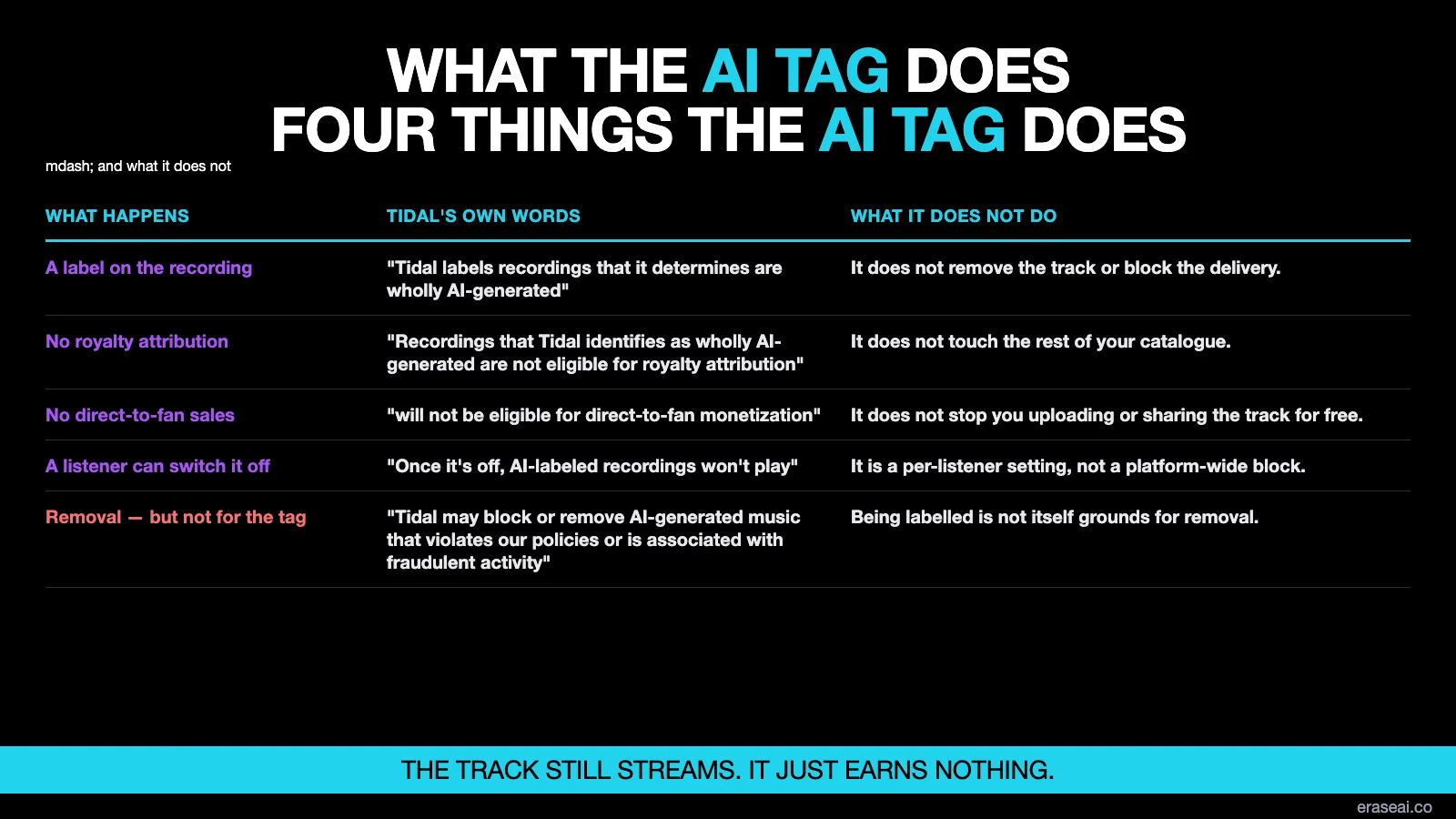
Five consequences, five different triggers. Reading them as one event is why so much advice about this policy is wrong.
Start with what does not happen. The track is not rejected at delivery, not pulled from the app, and it keeps streaming to anyone who has not opted out. Tidal's own first answer is that it “allows AI-generated music on the platform, provided it complies with our AI Policy”. What it withholds is money and, through the listener setting, reach.
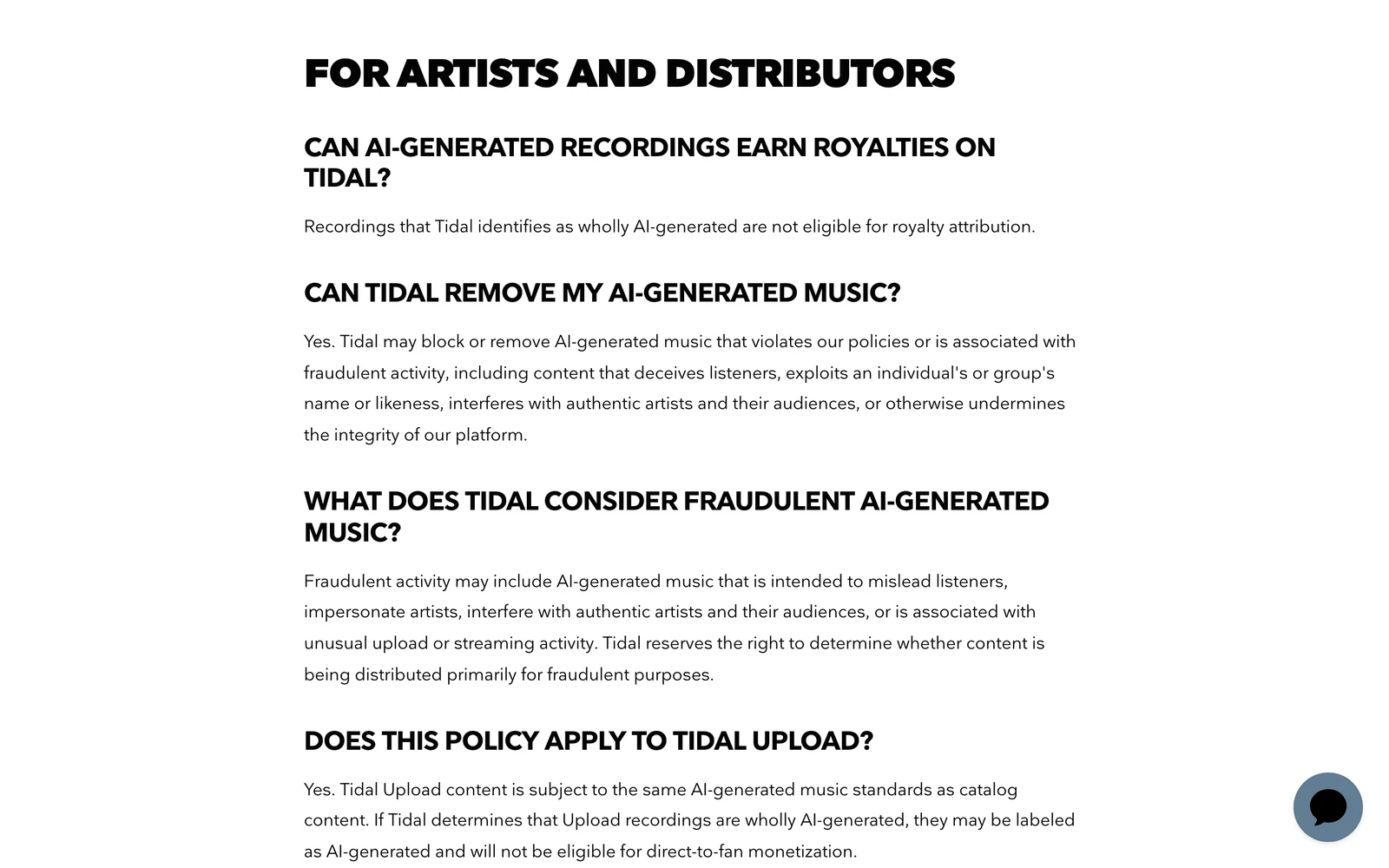
The money sentence is narrower than “no royalties”, and the wording matters on a statement: “Recordings that Tidal identifies as wholly AI-generated are not eligible for royalty attribution”. Attribution is the step where a stream is matched to a payee: the play count still moves, and nothing is attributed to it.
| Consequence | What Tidal does | Tidal's wording | What it is not |
|---|---|---|---|
| A label on the recording | An “AI” badge is attached and shown to listeners | “Tidal labels recordings that it determines are wholly AI-generated” | It does not remove the track or block the delivery. |
| No royalty attribution | The track streams, and earns nothing | “Recordings that Tidal identifies as wholly AI-generated are not eligible for royalty attribution” | It does not touch the rest of your catalogue. |
| No direct-to-fan sales | The paid tier on Tidal Upload is closed to the track | “will not be eligible for direct-to-fan monetization” | It does not stop you uploading or sharing the track for free. |
| A listener can switch it off | Playback is blocked for any listener who turns AI-labelled music off | “Once it's off, AI-labeled recordings won't play” | It is a per-listener setting, not a platform-wide block. |
| Removal — but not for the tag | Blocked or taken down for policy breach or fraud | “Tidal may block or remove AI-generated music that violates our policies or is associated with fraudulent activity” | Being labelled is not itself grounds for removal. |
The last row gets misquoted into something frightening. Blocking and removal hang off “violates our policies or is associated with fraudulent activity” — impersonation, deceiving listeners, interfering with authentic artists and their audiences, or “unusual upload or streaming activity”. Worth noticing if your release plan involves volume: a hundred generated tracks in a week is exactly that pattern.
“Wholly AI” means the recording, not the song
Tidal's category is the master, and one sentence in that definition decides whether your workflow is in scope.
The definition reads: “Tidal defines AI-generated recordings as recordings that are wholly generated using generative artificial intelligence”, followed by a limit nobody quotes — “Due to limitations in AI-detection technology, and to avoid false positives, we will only be taking action with respect to wholly AI-generated recordings” — and the carve-out that settles half the questions people ask: “We will be taking no actions as to AI-generated compositions.”
So an AI-written song that humans perform and record sits outside this policy, while a human-written song rendered as audio by a generator sits squarely inside it — the opposite of how most people rank the two.
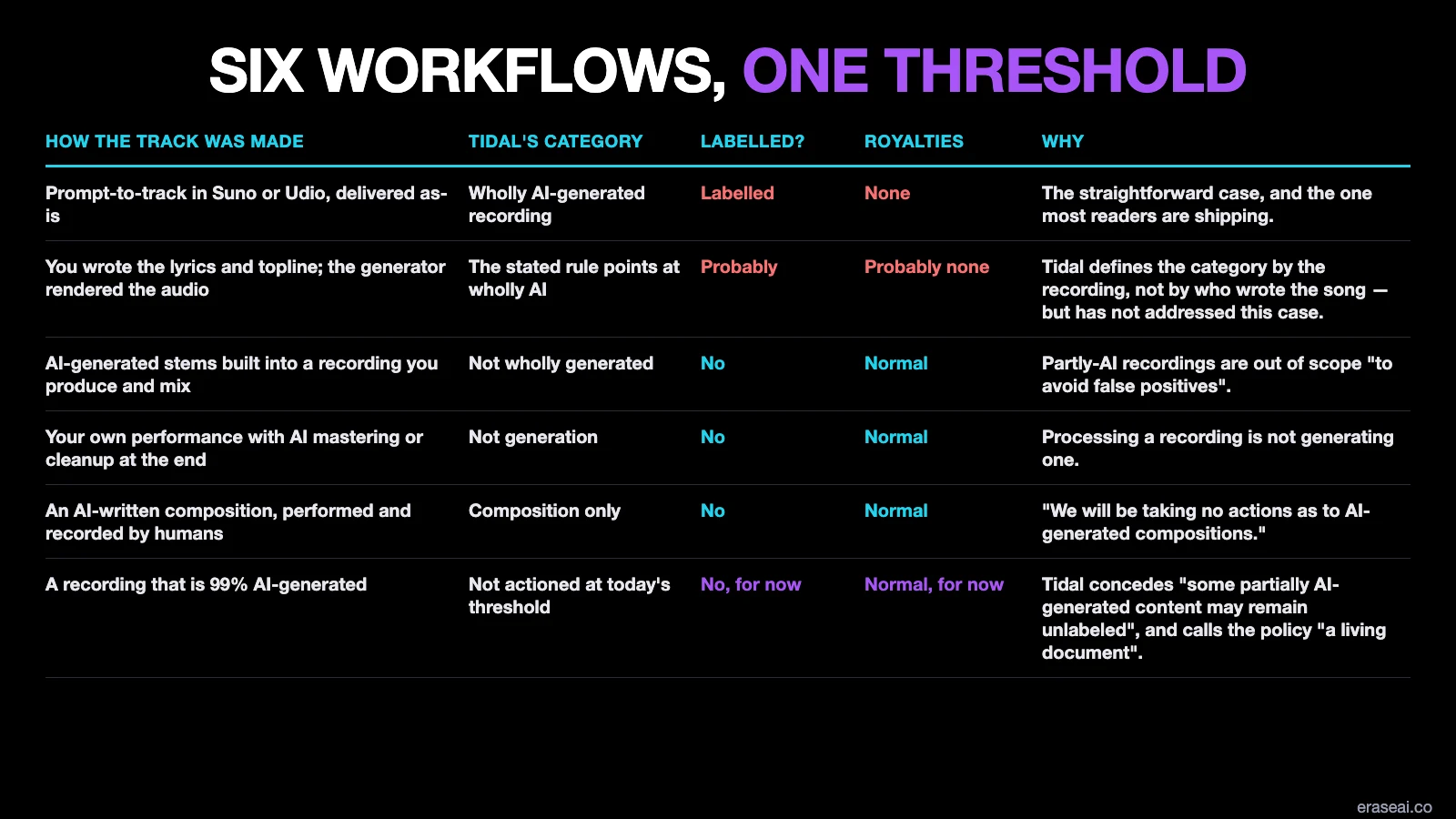
| What you did | Tidal's category | Labelled? | Royalties | Why |
|---|---|---|---|---|
| Prompt-to-track in Suno or Udio, downloaded and delivered as-is | Wholly AI-generated recording | Labelled | None | The straightforward case, and the one most readers are shipping. |
| You wrote the lyrics and the topline; the generator rendered the finished audio | The stated rule points at wholly AI | Probably | Probably none | Tidal defines the category by the recording, not by who wrote the song — but has not addressed this case. Do not plan around it. |
| AI-generated stems built into a recording you produce and mix yourself | Not wholly generated | No | Normal | Partly-AI recordings are out of scope “to avoid false positives”. |
| Your own performance with an AI mastering or cleanup stage at the end | Not generation | No | Normal | Processing a recording is not generating one. |
| An AI-written composition, performed and recorded by humans | Composition only | No | Normal | “We will be taking no actions as to AI-generated compositions.” |
| A recording that is 99% AI-generated | Not actioned at today's threshold | No, for now | Normal, for now | Tidal concedes “some partially AI-generated content may remain unlabeled”, and calls the policy “a living document”. |
Two warnings about that table. The second row is an inference from Tidal's definition, not a published answer — Tidal has never addressed a human-written song with generated audio. And none of this transfers: Deezer answers the part-AI question differently, by where the tool sat in your pipeline, and reaches the opposite verdict on a track you wrote and had rendered. One platform's rule is not a standard.
The listener switch nobody reported
Tidal is the only major platform that hands the decision to the listener — and one ranking page says the feature does not exist.
The help centre asks “Can I block all AI-generated recordings?” and answers: “Yes. You can turn off AI-labeled recordings in Settings. Once it's off, AI-labeled recordings won't play. They will also be removed from your personalized recommendations as they're refreshed.” Most recommendations update daily, albums can take a few days, and until then labelled tracks show “greyed out” and will not play.
Blocked outright. Not skipped, not deprioritised — it will not play.
Labelled tracks leave that listener's personalised surfaces as they refresh.
Unaffected. A per-account preference, so your audience splits rather than disappears.
Why it matters more than the royalty line: this is a switch on reach, and reach is the problem that actually defines this niche — not distribution, which is solved and nearly free, but the walls that come after the song is finished. A listener who has opted out is not an algorithm you can work around.
The mirror of that switch tells you something about how tracks get tagged. A listener who thinks a track was “created entirely using AI but is not currently tagged” can report it through the same support form. The label is not purely a detection output; it can be prompted by someone who does not believe you.
Tidal Upload: the tier the policy closes
Upload is Tidal's artist-direct route. The AI rule shuts one of its three access settings.
Upload puts your own audio on Tidal without a distributor: up to 200 tracks per account, 5 GB per track, for users 18 and over in the US, UK, EEA, Switzerland and Canada. Uploads are Unlisted by default, anyone with a link can listen whether or not they subscribe, and the dashboard shows lifetime streams plus unique listeners from the past 30 days.
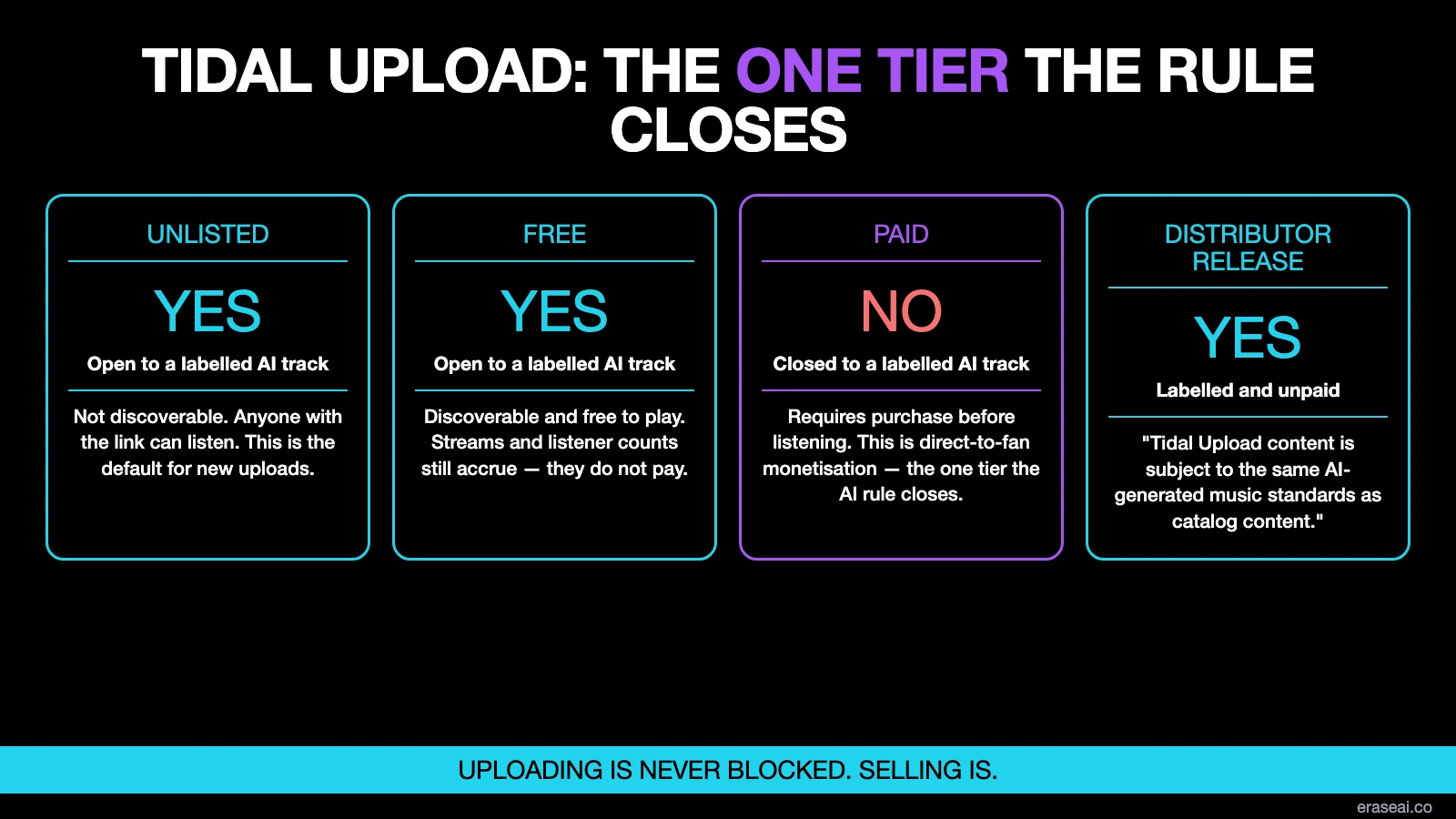
The AI rule lands on it with one sentence — “Tidal Upload content is subject to the same AI-generated music standards as catalog content” — and one consequence: wholly AI-generated uploads “may be labeled as AI-generated and will not be eligible for direct-to-fan monetization”. That is the Paid setting. Nothing else changes.
| Access setting | What it does | Open to a wholly-AI track? | Note |
|---|---|---|---|
| Unlisted (the default) | Not discoverable. Anyone with the link can listen, subscription or not. | Yes | New uploads are Unlisted unless you choose otherwise. |
| Free | Discoverable on Tidal, free for anyone to play. | Yes | Streams and listener counts still accrue. They do not pay. |
| Paid | Discoverable, and requires purchase before listening. | No | This is direct-to-fan monetisation — the one tier the AI rule closes. |
| A normal release through a distributor | Full catalogue delivery to the Tidal app. | Yes, labelled and unpaid | “Tidal Upload content is subject to the same AI-generated music standards as catalog content.” |
Read as a release plan, that is oddly workable: Tidal stays a place to host and share a generated track — a link that plays for people without a subscription is a real thing to have — and closes as a place to be paid, by either route. Coverage of this policy leaves Upload unmentioned; the specific tier is the whole of the difference.
Who can sell direct, and what it costs
Worth knowing even though a generated track cannot use it: the gates in front of it stop most readers anyway.
Tidal's direct-to-fan terms are unusually good where they apply: “Tidal does not charge artists a platform fee for Direct-to-Fan Sales”, and buyers pay no service fee at checkout. The artist carries Square's processing, deducted before payout, and Tidal publishes no figure for it.
| Requirement | Tidal's rule | Where it bites |
|---|---|---|
| Where you live | You must be based in the United States | A hard gate, before the AI question arrives |
| Where your fans live | The US, Canada, the UK, Switzerland and the EEA | The same markets as Upload itself |
| Payments | A free Square account, identity verification completed | Payouts run through Square, not Tidal |
| Tidal's cut | “Tidal does not charge artists a platform fee for Direct-to-Fan Sales” | The genuinely attractive part of the offer |
| Processing fees | Square's, deducted from proceeds before payout | Where the actual cost sits; Tidal publishes no rate |
| Buyer fees | No Tidal service fee at checkout | The displayed price is what the fan pays |
| Refunds | “Final and non-refundable … except where required by law” | Under the Upload Marketplace Terms |
| Rights you must hold | Recording, composition, lyrics, samples, artwork — all of them | Covers without licences and uncleared samples cannot be sold |
| A wholly AI-generated recording | Not eligible | The second consequence of the tag, and the one coverage skips |
So a generated release meets two closed doors here, and the first is geography: you must be based in the United States before the AI question is asked at all. If selling to listeners is the plan, it has to happen somewhere that allows it.
Which is the honest argument against planning around streaming platforms at all. The money actually discussed in this niche is paid sync placements — TV, film, games, ads — where one placement is worth more than the stream counts most releases ever see, and no platform's view of how the audio was made enters into it. played.fm runs that route alongside a storefront where you keep 100%. Said plainly: that is not a way round Tidal's label, it is a surface the label does not reach.
Tagged wrong? The exact appeal path
None of the three ranking pages mentions an appeal. Tidal publishes the route, down to the dropdown.
Read the eligibility sentence before you file: the route is for an artist who believes a track “was incorrectly identified as wholly AI-generated” and “did not use AI to create the recording”. It is a false-positive channel, not a reconsideration of the policy.
Open Tidal's support form and choose “I need help with a copyright or trademark violation or AI tagging”.
Choose “I want to file an AI flag review”.
Choose “This track was wrongly tagged as AI”. The mirror option, “This track wasn't tagged as AI but should be”, is the listener-report route.
What Tidal does not publish is who or what made the original call: no named detection vendor, no stated method, no accuracy figure, no turnaround for a review. Some coverage of the June announcement asserts an external detection partner; that appears nowhere in Tidal's own sources, so treat it as unconfirmed. So an appeal is an assertion against an unexplained decision — a reason to keep session files, project exports and dated drafts, the same evidence that makes a disclosure you write yourself more credible than one a classifier writes for you.
AI music on Tidal next to Spotify, Deezer and Bandcamp
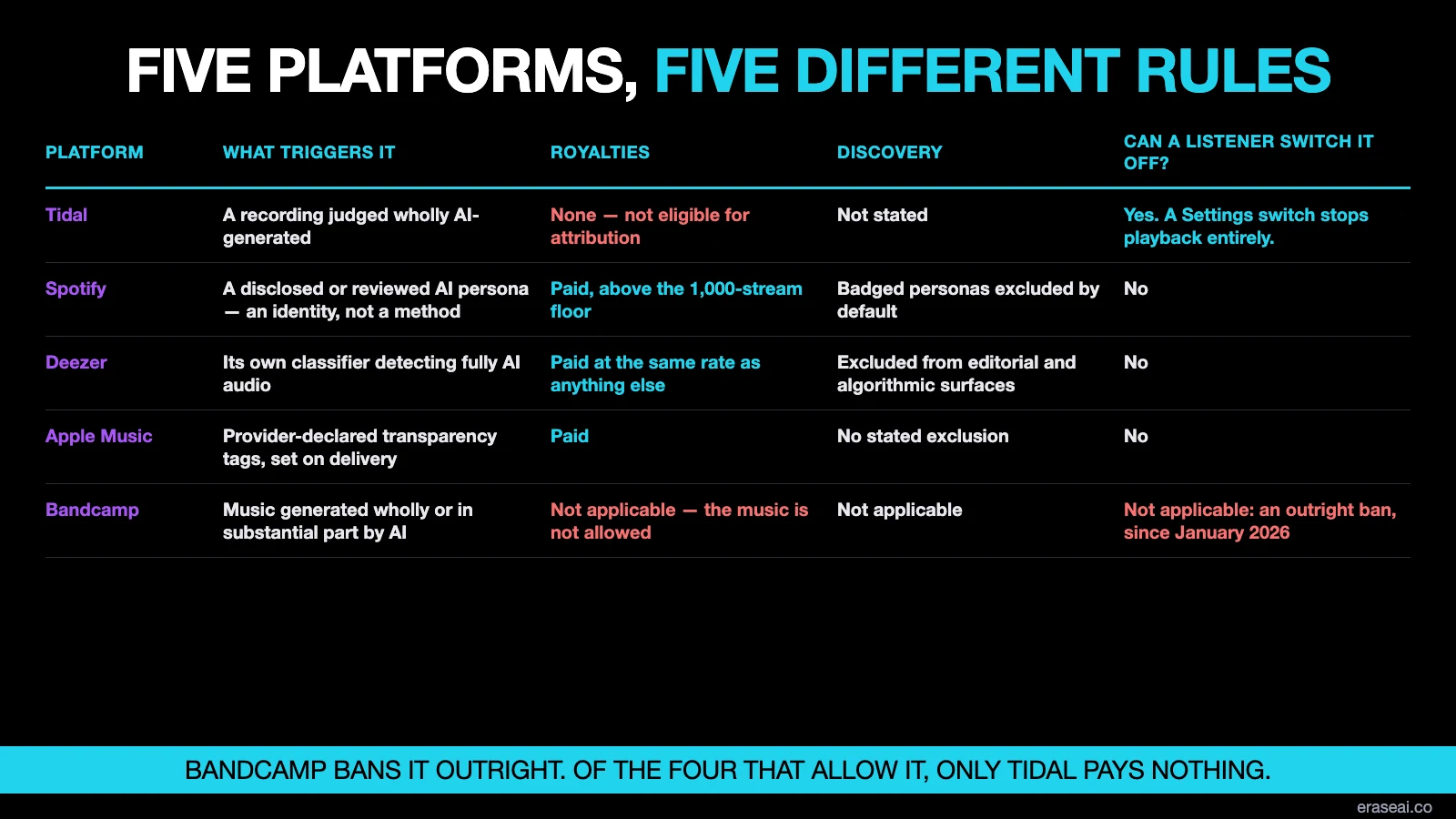
Five platforms, five rules, and only one takes the money.
| Platform | What triggers it | Royalties | Recommendations | Can a listener block it? |
|---|---|---|---|---|
| Tidal | A recording judged wholly AI-generated | None — not eligible for attribution | Not stated | Yes. A Settings switch stops playback entirely. |
| Spotify | A disclosed or reviewed AI persona — an identity, not a method | Paid, above the 1,000-stream floor | Badged personas excluded by default | No |
| Deezer | Its own classifier detecting fully AI audio | Paid at the same rate as anything else | Excluded from editorial and algorithmic surfaces | No |
| Apple Music | Provider-declared transparency tags, set on delivery | Paid | No stated exclusion | No |
| Bandcamp | Music generated wholly or in substantial part by AI | Not applicable — the music is not allowed | Not applicable | Not applicable: an outright ban, since January 2026 |
The table is the argument against reading one platform's policy as the industry's position. Deezer tags the same audio and pays it the same rate as anything else, taking recommendations instead. Spotify's badge is about an identity, not a method, so disclosing your tools does not earn it. Apple tags on delivery with no stated penalty. And Bandcamp, the storefront most often recommended as the alternative, has banned music generated wholly or in substantial part by AI since January 2026 — a fair comparison point and a dead end in the same breath.
Across all five, the thing to plan against is not a ban. Six distributors accept AI music openly; what readers report is automated screening at delivery and policy consequences afterwards — which is a map worth having before you deliver, not after.
The other rule that stops royalties
Nothing to do with AI, enforced harder, and it compounds the first one.
Tidal's content-integrity article is blunt about artificial streaming: “Royalties are not paid for tracks identified as having artificial streams. These tracks will also be excluded from royalty statements for the applicable accounting periods.” It names fraud-detection partners for this, notable given the AI policy names none, and says content flagged this way can be removed outright.
The trap is the next answer. A paid promotion service that turns out to inflate plays is still a violation: even where artists engaged one “with the best intentions, the resulting activity still violates our Content Guidelines”, and asking fans to loop a track is “discouraged” for the same reason. So the tactic people reach for when a release gets no traction converts a labelled-but-live track into a removed one.
Put the two rules together and the picture is consistent rather than hostile: Tidal will host your generated music, show listeners what it is, let them opt out, pay nothing for it, and remove it only if you do something to the numbers. Tracks that vanish from streaming usually go for the second reason.
Before you deliver AI music to Tidal
Six things to settle while the release is yours to change.
For revenue, a wholly generated recording cannot deliver there. For reach and a shareable link, it still works.
Composition is out of scope; the recording is what Tidal judges. Write down what you authored.
An appeal rests on session files and dated drafts — and is only open to recordings made without AI.
Artificial streaming withholds royalties, strips the period from your statements and can remove the track.
Tidal expects distributors to identify AI content before it arrives. A flag you supply is a label; one applied after a listener's report is a dispute.
The AI label is Tidal's call and not yours. The automated screening at your distributor, and how the audio actually holds up, is the part you control.
On that last point, be clear about what is fixable. Nothing you do to an audio file changes Tidal's label, its royalty decision or your direct-to-fan eligibility — that is a platform judgement about how the recording was made, and no processing chain, watermark tool or cleanup service touches it. What a cleanup pass reaches is the earlier gate: the automated screening a distributor runs before anything gets to Tidal, and the audible artifacts that make a release sound like a draft. A different problem from this page, and worth fixing on its own terms.
Questions people ask about this policy
Seven answers, each from the text above.
Is AI music banned on Tidal?
No. Tidal “allows AI-generated music on the platform, provided it complies with our AI Policy”. A wholly AI-generated recording is labelled, earns no royalties, and keeps streaming. Removal is reserved for policy breaches and fraud — findings about conduct, not about how the audio was made.
Does a Tidal AI tag stop my track earning on Spotify or Deezer?
No. Every platform runs its own rule and its own detection. Deezer tags fully AI tracks and pays the same rate; Spotify's badge is about a persona's identity, not a method. Tidal's decision has no effect outside Tidal.
What if I wrote the lyrics myself and only the audio was generated?
Tidal has not published an answer. Its definition turns on the recording being “wholly generated using generative artificial intelligence”, and it takes no action on AI-generated compositions — so the song layer is outside the policy and the audio layer is inside it. Treat it as unresolved, not as a loophole.
Can listeners really block my music if it is labelled?
Yes, individually. A listener can turn off AI-labelled recordings in Settings, after which they will not play and drop out of that listener's recommendations as those refresh — daily for most, a few days for albums.
How do I appeal a tag I think is wrong?
Through Tidal's support form: “I need help with a copyright or trademark violation or AI tagging”, then “I want to file an AI flag review”, then “This track was wrongly tagged as AI”. The appeal is limited to recordings where you “did not use AI to create the recording”.
Can I still sell a wholly AI track through Tidal Upload?
No. Upload runs the same AI standard as the main catalogue, and a wholly AI-generated recording is not eligible for direct-to-fan monetisation — the Paid tier. Free and Unlisted still work, so you can host and share the track but not charge for it.
Who decides whether my recording is wholly AI-generated?
Tidal does, and it has not published how. No primary source names a vendor, a method or an accuracy figure. Some coverage asserts an external partner; that claim appears in no Tidal source, so we do not repeat it as fact.
Sources, and what we could not verify
Everything quoted above, and the one thing this page will not state.
- Tidal — AI Policy (created 23 June 2026, last revised 20 July 2026): the definition, royalty attribution, Upload direct-to-fan ineligibility, the compositions carve-out, the listener setting and both support-form routes.
- Tidal — Tidal Upload (updated 7 June 2026): the 200-track and 5 GB limits, the Free, Paid and Unlisted access settings, and the listener counters.
- Tidal — Direct-to-Fan Sales (updated 31 August 2026): the US-only requirement, Square onboarding, the absent platform fee and the no-refunds term.
- Tidal — Maintaining Content Integrity on Tidal: artificial streaming, royalties withheld, statements excluded, and paid promotion treated as a violation regardless of intent.
- Music Business Worldwide — Tidal to tag fully AI-generated music (29 June 2026): the announcement wording, the distributor-flagging expectation, and the two effective dates.
- Spotify Newsroom, Deezer on AI labelling, Apple Music's delivery specification and Bandcamp's “Keeping Bandcamp Human” (13 January 2026): Table 5.
Quotations checked at source 10 October 2026. Tidal's help centre returns 403 to automated readers, so its four articles were read through that help centre's own public API; the wording quoted is those articles' and the links above are their canonical URLs. Tidal's announcement page sits behind a challenge page, so the announcement wording and the two effective dates are quoted as Music Business Worldwide reports them. No detection vendor, method or accuracy figure is named in any Tidal source, and coverage asserting an external partner is unsupported by the policy text, so this page does not repeat it. Treatment of a human-written song rendered as AI audio is marked as an inference because Tidal has not addressed it. Tidal's rules decide Tidal only.
Related guides
AI music on Deezer
The platform that tags AI music, cuts the recommendations, and pays it the same rate.
Spotify's AI Persona badge
What being labelled costs, and the two Spotify systems people conflate.
Platforms that accept AI music
Every published distributor policy, read at source and dated.
Disclosure that works
Declaring AI on a release, and what it actually costs you.
Sell AI music
Where a generated track can actually be sold, and on what terms.
AI music removed from streaming
The five causes, ranked — before you assume it was the AI tag.
Or browse every guide on the site.
Tidal's label is Tidal's call. The file is yours.
Nothing done to an audio file changes how a platform labels a release or whether it pays — say that plainly and ignore anyone who sells you otherwise. What is yours to fix is the earlier gate: a thin, artifact-heavy generator export meeting a distributor's automated screening. Clean it, master to one target, and deliver something that holds up at intake.
▸ Independent · We recommend Undetectr