Your Human Track Got Flagged as AI: How to Appeal It
You recorded it in a room with people in it, and the rejection email says otherwise. An AI music false positive is a human recording that an automated screen classifies as generated — and every page explaining AI detection stops before telling you what to do next. So: the mechanism that gets clean human mixes flagged, the appeal route each distributor publishes, and the proof that moves a reviewer. We read six distributors' AI policies at source on 13 October 2026, and two of the six publish any route at all.
The short version
Five findings, each from a primary source read this week.
The remedy for a false positive is an appeal with proof of creation, not anything you can do to the audio file. If the recording is human, processing it further changes nothing.
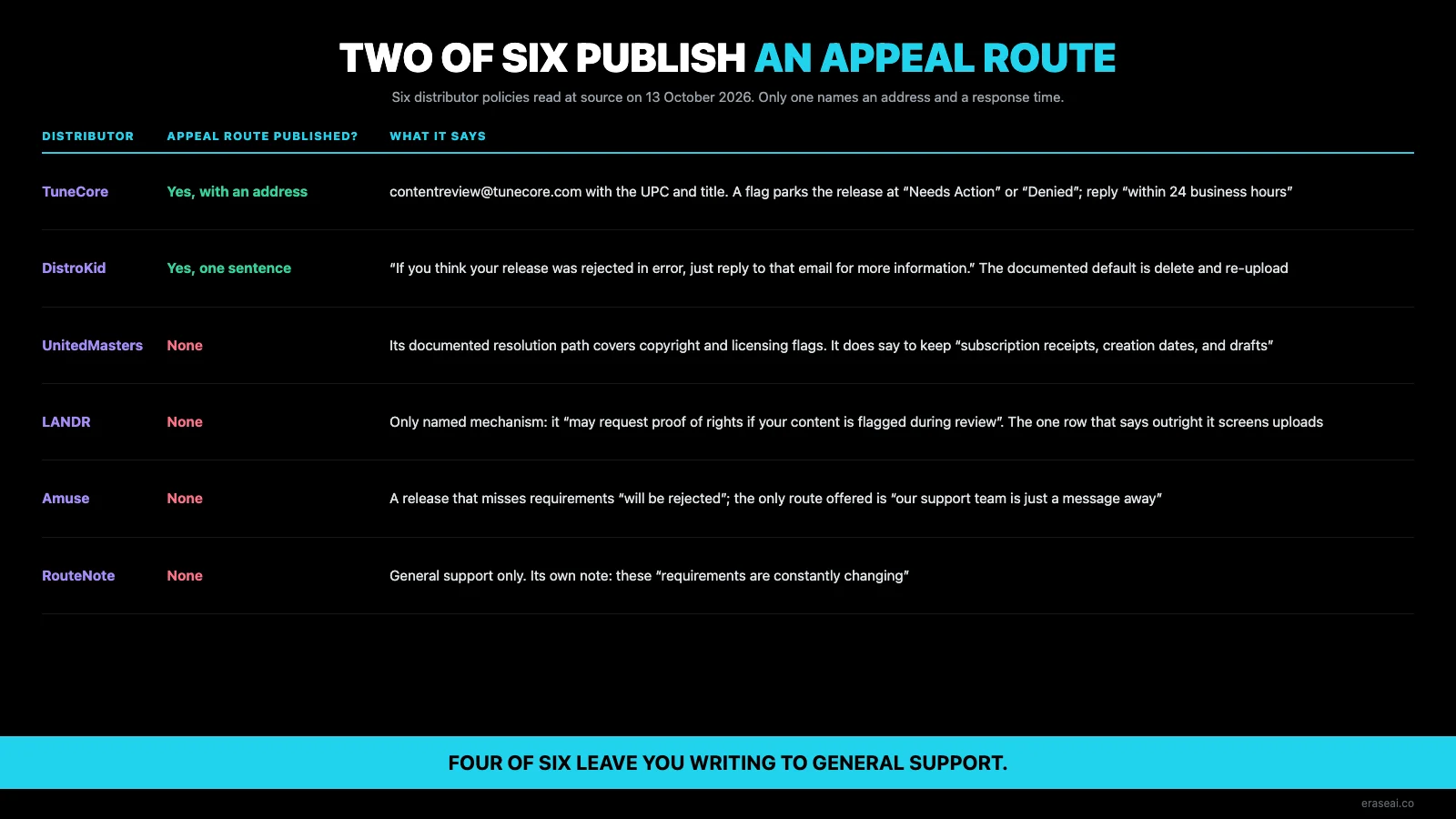
Only two of six distributors publish a route. TuneCore names an address and a window (contentreview@tunecore.com, “within 24 business hours”); DistroKid says to reply to the rejection email. UnitedMasters, LANDR, Amuse and RouteNote publish none.
Over-polished production is the risk factor, which is the opposite of what people assume. Mullings: detection algorithms “can mistake the lack of ‘human imperfection’ for robotic generation”. The cheap insurance is keeping the unpolished artefacts.
The appeal can fail. Papa Michigan appealed in writing, called the track “a 100-per-cent human studio recording” and asked for a human moderator — then pulled the song and released the album without it on 14 August 2026.
There is no published frequency figure. “Increasingly common” is the entire available claim, and a vendor’s accuracy percentage is not a rejection rate. Any page giving you a number invented it.
What an AI false positive actually is
One sentence, then the only quasi-authoritative statement on frequency that exists.
An AI music false positive is a recording made by people that a distributor's automated screening classifies as AI-generated and rejects on that basis. Nothing is infringing, no generator was involved, and the rejection email arrives phrased as a finding.
The authority on how often this happens is thinner than the problem deserves. Speaking to the Jamaica Gleaner on 5 October 2026, Evon Mullings, General Manager of JAMMS, said the scenario of human-made music being rejected as a false positive by digital distributors is “increasingly common”, and that the platforms “have been implementing aggressive, automated AI-detection software to screen uploads”.
That is the whole claim. There is no figure in the article, and “increasingly common” is not a rate. Vendors do publish accuracy numbers — we work through what those numbers measure — but a false-positive rate on a vendor's own test set says nothing about how many releases get rejected in a month. If a page offers you a percentage, it made the percentage up.
A fingerprint match on a sample or melody is a different system with a different remedy. If the email names a rightsholder, you are reading a copyright notice.
Being tagged as AI on a streaming service happens after delivery, and is a disclosure question. This happens at your distributor, before anything ships.
Nothing done to the file changes a decision about how the file was made. The remedy is evidence, sent to a human.
Why clean human recordings get flagged
The risk factor is polish, the reverse of what almost everyone assumes about an AI detection false positive.
Mullings gives the mechanism in one line, and it reframes the topic: detection algorithms “can mistake the lack of ‘human imperfection’ for robotic generation”. He adds that human music “can sometimes accidentally trigger AI filters because of how it was mixed”. Together the conclusion is uncomfortable: the better your production hygiene, the closer your master sits to what the screen is looking for.
It matches what the detector research shows about which human tracks land in the error bucket: not random ones, but heavily edited, densely produced audio, whose spectrum least resembles a plain acoustic capture. The producer most exposed is the one whose work is layered, corrected and finished to a professional standard.
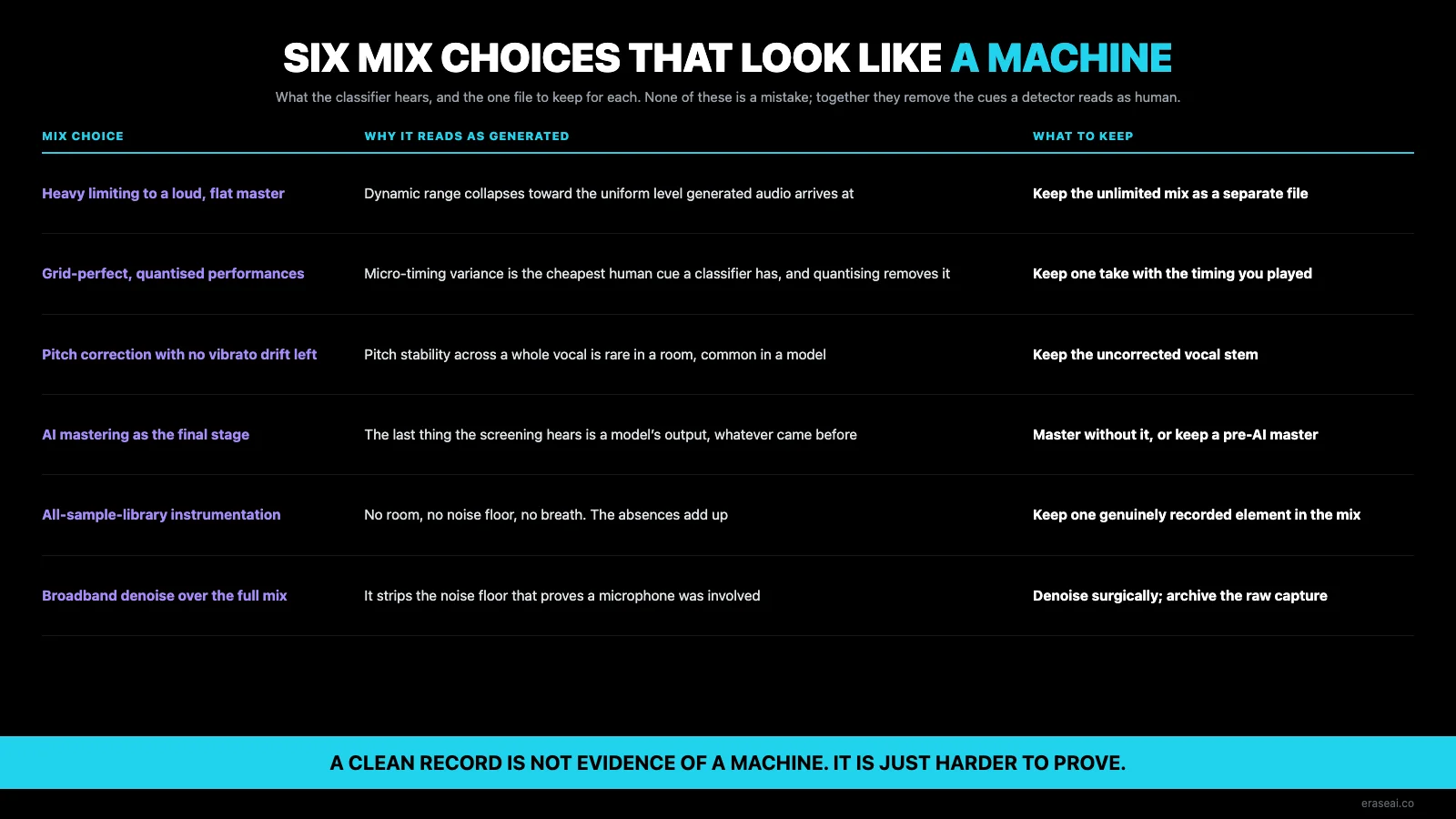
| Production choice | Why a classifier can read it as machine-made | What to keep instead |
|---|---|---|
| Heavy limiting to a loud, flat master | Dynamic range collapses toward the uniform level generated audio arrives at | Keep the unlimited mix as a separate file |
| Grid-perfect, quantised performances | Micro-timing variance is the cheapest human cue a classifier has, and quantising removes it | Keep one take with the timing you played |
| Pitch correction with no vibrato drift left | Pitch stability across a whole vocal is rare in a room, common in a model | Keep the uncorrected vocal stem |
| AI mastering as the final stage | The last thing the screening hears is a model’s output, whatever came before | Master without it, or keep a pre-AI master |
| All-sample-library instrumentation | No room, no noise floor, no breath — the absences add up | Keep one genuinely recorded element in the mix |
| Broadband denoise over the full mix | It strips the noise floor that proves a microphone was involved | Denoise surgically; archive the raw capture |
Two honest limits. The mechanism is sourced — Mullings on mixing and on “human imperfection”, plus the concentration of detector errors in dense audio — but the row-by-row mapping is our reasoning from it, not a rubric anyone publishes. And it is no reason to make worse records. It is a reason to keep the artefacts: the unlimited mix, the un-quantised take, the uncorrected vocal, the raw capture with its noise floor. Those files are your appeal.
A related trap catches careful people. DistroKid's AI Credits documentation says you need no AI credits if you only used AI as a tool — “pitch correction, auto-tune”, “AI-assisted mixing or mastering”. Correct as a disclosure rule, useless as a detection rule: declaring nothing is right, but assuming the screen agrees is not, because the last thing it heard was a model's output.
What happened to Papa Michigan
A named artist, a named distributor, dates — and the ending every other page leaves out.
Reggae veteran Papa Michigan submitted So Many Roads through TuneCore. Track 7, “Who Can Be Against Me”, was deemed ineligible. The Gleaner quotes TuneCore's wording: “our content review team identified indicators suggesting the use of generative AI tools”, which “rely on datasets that are not properly licensed”, so “this release is not eligible for distribution at this time”. He said he was shocked by the emails, took it to social media, showed the studio and the musicians who played live on the track, and stated he had used no AI at any stage.
So Many Roads goes to TuneCore for distribution under Rashanco Music.
Content review finds “indicators suggesting the use of generative AI tools” on track 7 and rules the release ineligible.
He replies in writing that “this track is a 100-per-cent human studio recording”, and requests a review by a human moderator.
He posts the studio and the live musicians, and says AI was used at no stage of the record.
The appeal does not resolve in time. He removes the song and ships the album, which is on the major streaming platforms today. Track 7 is not on it.
Write that ending down, because the implied ending everywhere else is “appeal and you will be fine”. The best-documented AI false positive in the trade press was not reversed in time, and the artist absorbed the loss to protect the release date. Appeal hard, and decide in parallel what you ship if it is still open on your date.
How to appeal, distributor by distributor
Six AI policies read at source on 13 October 2026, with the appeal route each publishes. Four of the six cells are empty, and the empty cell is the finding.
| Distributor | What its AI policy says | Published route after a rejection | Note |
|---|---|---|---|
| TuneCore | Only distributes GenAI music from models “trained on fully licensed datasets”, and applies that “if GenAI is used at any point” | Published. A flag parks the release at “Needs Action” or “Denied”: “You must reply to our email for your release to be re-reviewed and sent to stores.” contentreview@tunecore.com, with the UPC and title; reply “within 24 business hours” | The only named address and stated response time here |
| DistroKid | “Accepts music created with AI tools, but there are some rules”: own 100% of the rights, no impersonation, no mass-generated spam, no infringement | Published, in one sentence: “If you think your release was rejected in error, just reply to that email for more information.” | A route, but the documented default is delete and re-upload |
| UnitedMasters | “Allows the distribution of music created or assisted by artificial intelligence (AI)”, subject to its terms and release guidelines | None published. Its documented resolution path covers copyright and licensing flags, where you submit licences | Does say to keep “subscription receipts, creation dates, and drafts” |
| LANDR | Accepts AI-assisted music, caps AI tracks at 20 or 60 a month by tier, refuses AI covers: “We use detection technology to identify AI-generated songs” | None published. Only named mechanism: it “may request proof of rights if your content is flagged during review” | The one row that says outright it screens uploads |
| Amuse | “AI-generated music is allowed, but there are a few things to keep in mind”; AI covers rejected, imitation “won’t be approved” | None published. A release that misses requirements “will be rejected”; the only route offered is “our support team is just a message away” | Also: “Every release is reviewed before it’s delivered to stores” |
| RouteNote | “We do accept some AI music releases”, with one rule unique here: “you must not credit or reference the AI company” | None published in its AI article; general support only | Its own note: these “requirements are constantly changing” |
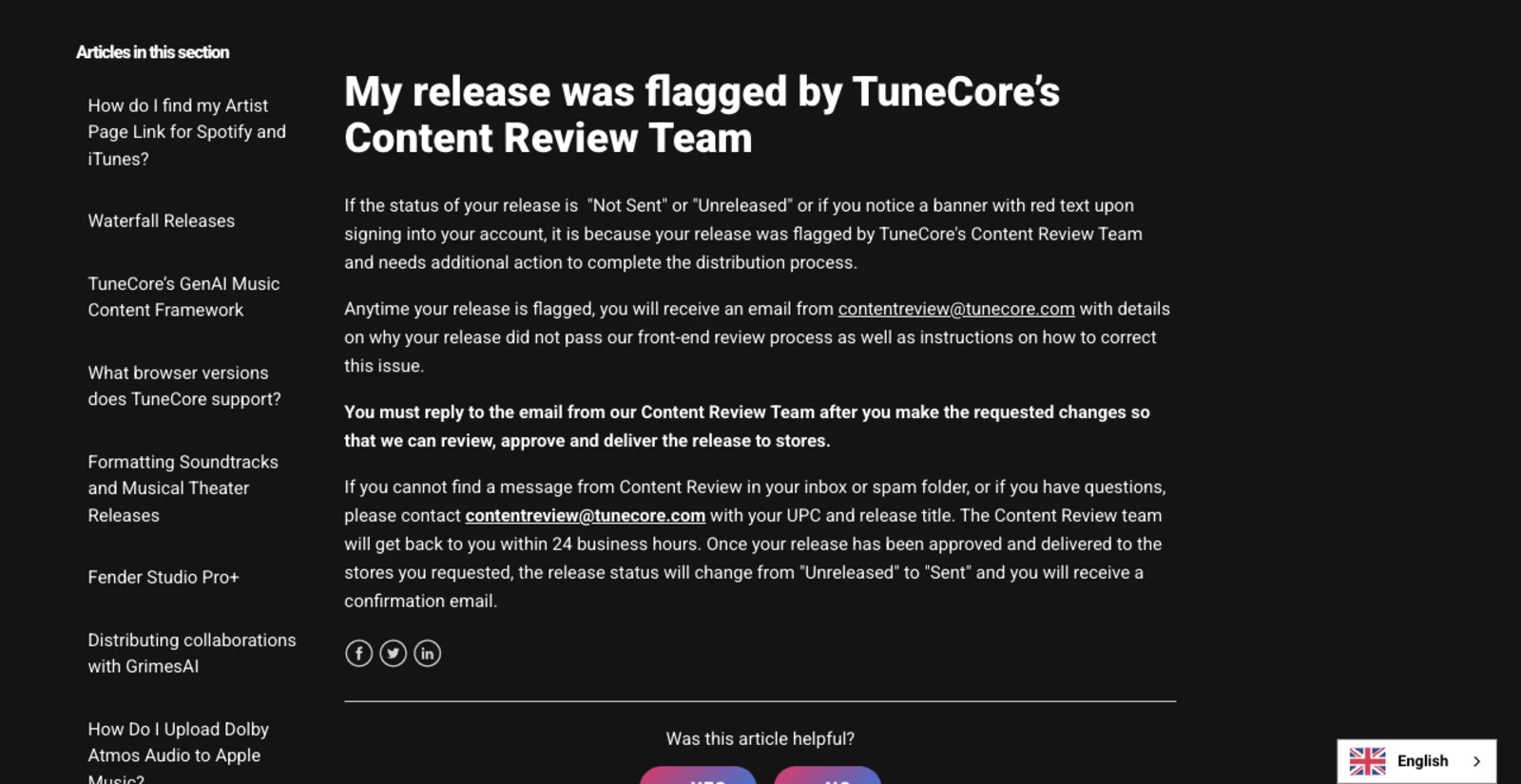
TuneCore is the one with a real procedure, which matters because it is also the distributor in the Gleaner case. Its release-status documentation says “You must reply to our email for your release to be re-reviewed and sent to stores”, and the content-review article gives the address, contentreview@tunecore.com, with the UPC and title and a reply “within 24 business hours”.
It also explains why a human record gets caught. TuneCore's GenAI Music Content Framework does not screen for AI as such; it screens for training data. “TuneCore only distributes music created using GenAI models trained on fully licensed datasets”, applying “if GenAI is used at any point in the creation of a track”. So the rejection template asserts unlicensed datasets, as it did to Papa Michigan — meaning what you rebut is not “this sounds synthetic” but “a model was used”.
DistroKid's route is one sentence in its rejected-release article, and everything else there is about correcting and re-uploading — so reply before you delete anything. Its AI policy is permissive, which is why a flag on a human track there is an error rather than a position. On the other four, plan for support rather than process: you are not filing an appeal, you are sending a ticket that has to carry its evidence unprompted, in the first message.
What counts as proof you made it
Ranked by what a reviewer can verify — not by what is easiest to send.
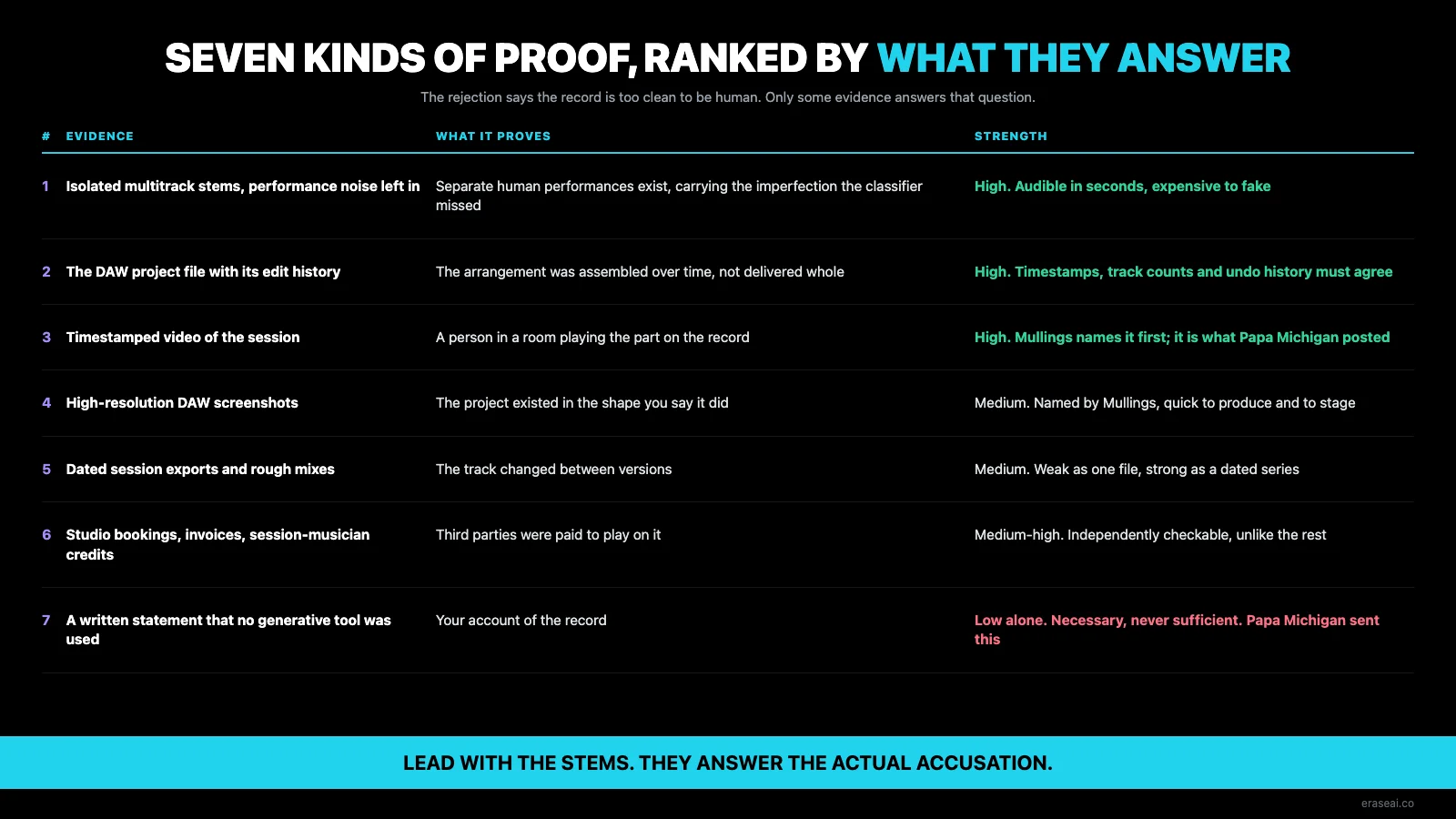
Mullings' remedy is specific: appeal to the distributor's support team and submit “proof of creation” — “video evidence, high resolution DAW screenshots, or offer to send individual raw audio stems”. Three items, not equally strong, so lead with the one that answers the accusation.
The classification said your record lacks human imperfection, so the direct rebuttal is the file that contains it: isolated multitracks with the performance noise left in — chair creak, breath, a fluffed entry, the room. A finished master buries all of that under the mix. A stem does not.
| # | Evidence | What it proves | How verifiable by a reviewer |
|---|---|---|---|
| 1 | Isolated multitrack stems, performance noise left in | Separate human performances exist, carrying the imperfection the classifier missed | High. Audible in seconds, expensive to fake |
| 2 | The DAW project file with its edit history | The arrangement was assembled over time, not delivered whole | High. Timestamps, track counts and undo history must agree |
| 3 | Timestamped video of the session | A person in a room playing the part on the record | High. Mullings names it first; it is what Papa Michigan posted |
| 4 | High-resolution DAW screenshots | The project existed in the shape you say it did | Medium. Named by Mullings, quick to produce and to stage |
| 5 | Dated session exports and rough mixes | The track changed between versions | Medium. Weak as one file, strong as a dated series |
| 6 | Studio bookings, invoices, session-musician credits | Third parties were paid to play on it | Medium-high. Independently checkable, unlike the rest |
| 7 | A written statement that no generative tool was used | Your account of the record | Low alone. Necessary, never sufficient — Papa Michigan sent this |
Send a short package, not an archive: one reply, the stems offered, two or three dated project artefacts attached, the names of anyone who played on it, and a paragraph naming your chain explicitly — the DAW, the plugins, the mastering, and the fact that no generative model produced any of the audio. TuneCore's framework is about models and their training data, so answer it on those terms.
Keeping this material is the cheap insurance, and it is not a cleaner master but the unpolished originals, archived with their dates. UnitedMasters says the same in its own AI guidance — keep “subscription receipts, creation dates, and drafts in case questions about a release come up later”.
What it costs you while you wait
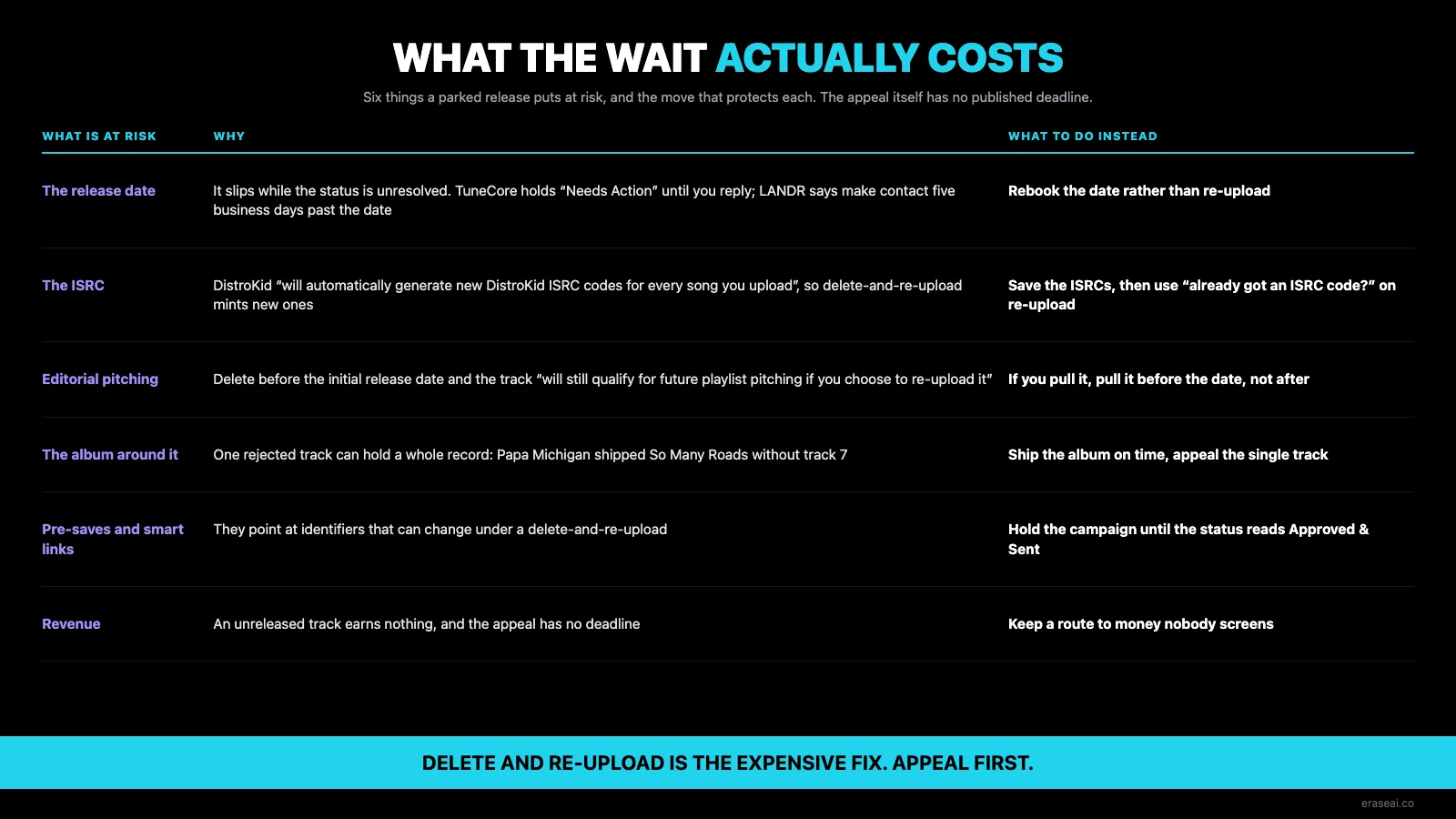
The release date is the obvious cost. The identifiers and the pitching eligibility are the ones people destroy by accident.
A rejection puts you under time pressure, and time pressure makes people delete the release and start again. On DistroKid that is the documented fix — and done carelessly it is how you lose two things you cannot get back cheaply.
| What's at stake | What actually happens | What you can protect |
|---|---|---|
| The release date | It slips while the status is unresolved. TuneCore holds “Needs Action” until you reply; LANDR says make contact five business days past the date | Rebook the date rather than re-upload |
| The ISRC | DistroKid “will automatically generate new DistroKid ISRC codes for every song you upload”, so delete-and-re-upload mints new ones | Save the ISRCs, then use “already got an ISRC code?” on re-upload |
| Editorial pitching | Delete before the initial release date and the track “will still qualify for future playlist pitching if you choose to re-upload it” | If you pull it, pull it before the date, not after |
| The album around it | One rejected track can hold a whole record: Papa Michigan shipped So Many Roads without track 7 | Ship the album on time, appeal the single track |
| Pre-saves and smart links | They point at identifiers that can change under a delete-and-re-upload | Hold the campaign until the status reads Approved & Sent |
| Revenue | An unreleased track earns nothing, and the appeal has no deadline | Keep a route to money nobody screens — see below |
The ISRC detail is worth thirty seconds. DistroKid's own documentation confirms new ISRCs are minted for every upload, that a later re-upload lets you click “already got an ISRC code?” to enter the saved ones, and that deleting before the initial release date keeps the track eligible for playlist pitching. Copy the ISRCs off the album page first.
Then the part outside the distributor's control. A release in review earns nothing and the appeal has no deadline, so keep one route to money with no screening queue. Pitching for paid sync placements in TV, film, games and ads is the one with real money in it — a brief matched by a human, one placement worth more than a release cycle of streams — with selling direct alongside it. Neither depends on a classifier's verdict or on algorithmic discovery, which is the other wall. If the track is pulled altogether, the five reasons a release disappears is the wider map, and a DMCA notice, which is a different process entirely, is worth ruling out before you assume detection did it.
If the track really is AI-assisted
Then there is no false positive to appeal, and the honest questions are different ones.
Be strict about which article you are reading. If a generative model made any of the audio, the appeal above does not apply to you — sending proof-of-creation evidence for a track a model produced is a false statement to your distributor, and distributors keep records. What applies instead is policy. On TuneCore the gate is the model's training data, and the only approved partner it names is its own Flow Music integration; on DistroKid and LANDR it is rights, impersonation and volume, with LANDR capping AI tracks at 20 or 60 a month by tier and refusing AI covers outright. Every published distributor policy, dated is the page for that, and disclosing an AI-assisted release is how you do the declaration without burning your audience.
The second question is whether the file is release-ready, and this is the one place on this page where a cleanup pass is relevant: an artifact-heavy generator export meets the same screening with a weaker hand, and audible artifacts read as a draft to listeners whatever a distributor decides. A service like Undetectr works on exactly that: the artifacts and how the audio holds up at intake. The boundary matters: no tool reverses a false positive, no tool stops a streaming service labelling a release as AI, and nothing done to an audio file answers a classification about who made it. If your recording is human, go back to the appeal.
Questions people ask after a rejection
Seven answers from the sources above.
What is an AI music false positive?
A human recording that an automated AI-detection screen classifies as AI-generated, and that gets rejected for distribution on that basis. Nothing is infringing and nothing was generated. JAMMS General Manager Evon Mullings describes the mechanism as detection algorithms mistaking “the lack of ‘human imperfection’ for robotic generation”.
How often does this happen?
Nobody publishes a number. The strongest available statement is Mullings telling the Jamaica Gleaner that human music rejected as a false positive is “increasingly common” — and that is the whole claim. A vendor’s accuracy percentage, measured on its own test data, is not a real-world rejection rate.
Can I appeal a rejection for AI?
It depends who you distribute through. Of six distributors read at source on 13 October 2026, two publish a route: TuneCore names an address and a 24-business-hour window, DistroKid says to reply to the rejection email. UnitedMasters, LANDR, Amuse and RouteNote publish none.
What proof of creation should I send?
Mullings names three: video evidence, high-resolution DAW screenshots, and an offer to send individual raw audio stems. Lead with the stems — isolated multitracks with the performance noise still in them answer a “too clean to be human” classification directly.
Will the appeal work?
It may not, and it may not work in time. Papa Michigan appealed in writing that his track was “a 100-per-cent human studio recording” and asked for a human moderator. He then pulled the song and released So Many Roads without it on 14 August 2026.
Does AI mastering make my human track look AI-generated?
It can raise your exposure, and the disclosure rules will not warn you, because they answer a different question. DistroKid says you need no AI credits for “AI-assisted mixing or mastering”. True as a disclosure rule, useless as a detection rule: the screen hears audio, and the last thing it hears is a model’s output.
Should I just disclose AI to be safe?
No. It is a false statement about your own record, and on TuneCore it backfires: music from models with unlicensed training data is ineligible for distribution, so declaring a tool you never used can close the route you were trying to keep open.
Sources, and what we could not verify
Everything quoted above, dated, and what this page refuses to state.
- Jamaica Gleaner — “AI false positive becoming more common in music”, Yasmine Peru, 5 October 2026: the Papa Michigan case, the rejection wording, the 14 August release of So Many Roads without the track, and every Evon Mullings quotation here.
- TuneCore — GenAI Music Content Framework, My release was flagged by TuneCore's Content Review Team and Release Statuses: the licensed-datasets rule, the appeal address and response window, the release statuses.
- DistroKid — Can I Upload Music Made With AI Tools to DistroKid?, Handling a Rejected DistroKid Release, What Are AI Credits? and Getting ISRCs From DistroKid: the AI policy, the reply-to-the-email route, the mixing-and-mastering carve-out, the ISRC and pitching costs.
- UnitedMasters — Does UnitedMasters distribute music that was generated by AI tools?, LANDR — Does LANDR accept AI-generated tracks?, Amuse — What content does Amuse not approve? and RouteNote — How should I format a release containing AI-Generated music?: Table 2's four “none published” rows, LANDR's detection statement and caps, Amuse's every-release-reviewed line, RouteNote's no-crediting rule.
Distributor policies read at source on 13 October 2026. TuneCore, DistroKid, UnitedMasters and LANDR run help centres that return 403 to automated readers, so their articles were read through those help centres' own public APIs; the wording is theirs and the links above are their canonical URLs. No source publishes a frequency for AI false positives, so this page gives none. Table 1's rows are our reasoning from the published mechanism, not a rubric anyone publishes. Nothing here is legal advice, policies change without notice, and the only authority on your rejection is the email you received. Last updated 13 October 2026.
Related guides
Do AI music detectors work?
What the published accuracy numbers measure, and which human tracks land in the error bucket.
DistroKid's AI policy
What it accepts, what gets a release rejected, and what the rules actually say.
Platforms that accept AI music
Every published distributor policy, read at source and dated.
AI music removed from streaming
The five reasons a release disappears — before you assume detection did it.
DMCA takedown on an AI song
A different process. Which notice you hold, and when not to fight it.
Disclosure that works
Declaring AI on a release, and what it costs you.
Or browse every guide on the site.
A false positive is appealed, not processed away.
If your recording is human, nothing done to the audio file changes the classification — send the stems and the dated project files to the address in your rejection email. The separate job, and the only one a cleanup pass reaches, is a genuinely AI-assisted export meeting screening with audible artifacts still in it. Different problem, different fix.
▸ Independent · We recommend Undetectr