Your Track Did Not Fail. Something Removed It.
Two people posted the same problem to r/aiMusic within twenty-four hours this month: a track they loved was simply gone, and in one case the channel had gone with it. Nobody had emailed them. That is the normal experience of AI music removed from streaming — no warning, no notice, just a dead link. We went through what Spotify, Deezer, Apple, YouTube, DistroKid and Suno have each published about removal, because the five real causes are not the ones the forums argue about, and four of them are survivable if you kept the right files.
The short version
Five findings from the published policies, before the detail.
Deezer began removing generative-AI tracks in July 2026 — both those tied to fraudulent streams and any that have not been streamed for six months or more. Detected AI music is already excluded from Flow, recommendations and editorial playlists, which is what makes six months of silence achievable.
Spotify removed over 75 million spammy tracks in the twelve months to September 2025 and rolled out a spam filter that tags and stops recommending the uploaders behind them. The target is mass upload and impersonation, not AI music as a category.
The most common removal has nothing to do with AI: DistroKid's help centre says an unrenewed subscription means your music is removed from services, reinstated automatically once the payment succeeds. Leave a Legacy is the paid exception at 29 US dollars per single, 49 per album, per release.
Suno's terms effective 3 September 2026 reserve the right to terminate accounts — and all of their corresponding Submissions and Output — that are inactive for an extended period. Your generator library is not a backup.
Three copyright strikes inside 90 days terminates a YouTube channel and removes every video on it. That is the one failure mode on this list that is not per-track.
Five ways a track disappears
Only two of them are about the music being generated.
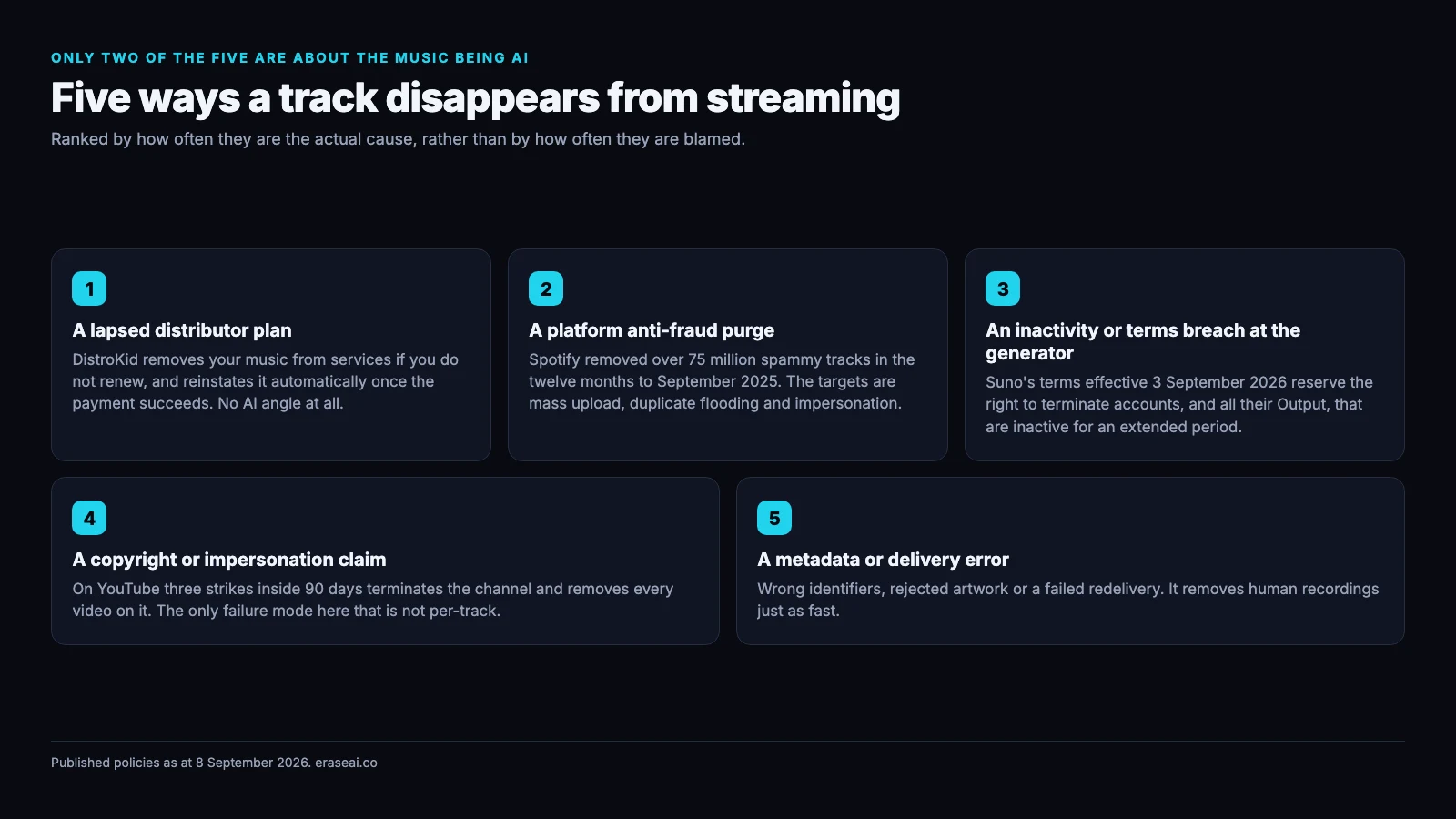
The first thing worth separating is who did it. A track can vanish because a streaming service removed it, because a rights holder claimed it, because your distributor pulled the delivery, because the generator closed your account, or because the release was never properly formed in the first place. Five different parties, five different fixes, and the diagnosis is usually visible in where the track is still playable.
If it is gone from one store but live on the others, the cause is at that store. If it is gone from every store at once, look at your distributor before anything else. That single check saves most people a week of arguing with the wrong support desk.
| Cause | Tell-tale sign | Notice given | Reversible? |
|---|---|---|---|
| Platform purge | Gone from one service, live elsewhere | Rarely | Appeal, sometimes |
| Copyright or impersonation claim | Gone from one service, claim in your dashboard | Usually | Dispute or replace |
| Distributor subscription lapsed | Gone from every service at once | Billing emails | Yes, on renewal |
| Generator account closed | Library and downloads inaccessible | Rarely | Only if you have files |
| Metadata or delivery error | Never appeared, or split across two artist pages | No | Yes, redeliver |
Read the last column and the article writes itself. Almost everything here is recoverable — provided the recording still exists somewhere you control. The rest of this page is those five causes in detail, then the archive that makes the last column true.
What Spotify and Deezer actually delete
Both published numbers. Neither number is about AI music as a genre.
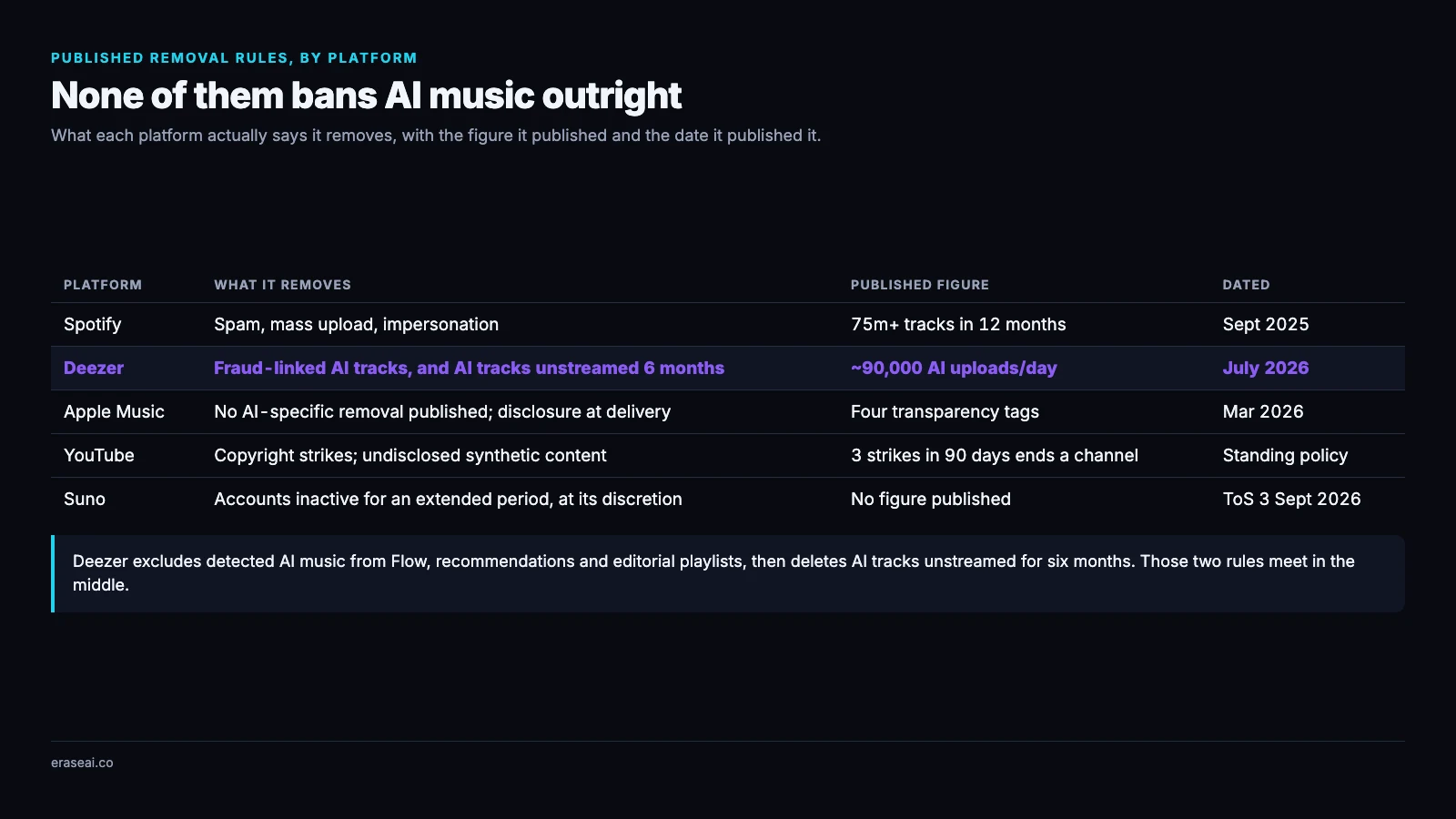
Spotify said in September 2025 that it had removed over 75 million spammy tracks in the previous twelve months, and announced a music spam filter that identifies uploaders and tracks using spam tactics, tags them, and stops recommending them. Read the wording rather than the headline: the targets are mass upload, duplicate flooding and impersonation. A single distinct release is not what that machinery is built to catch.
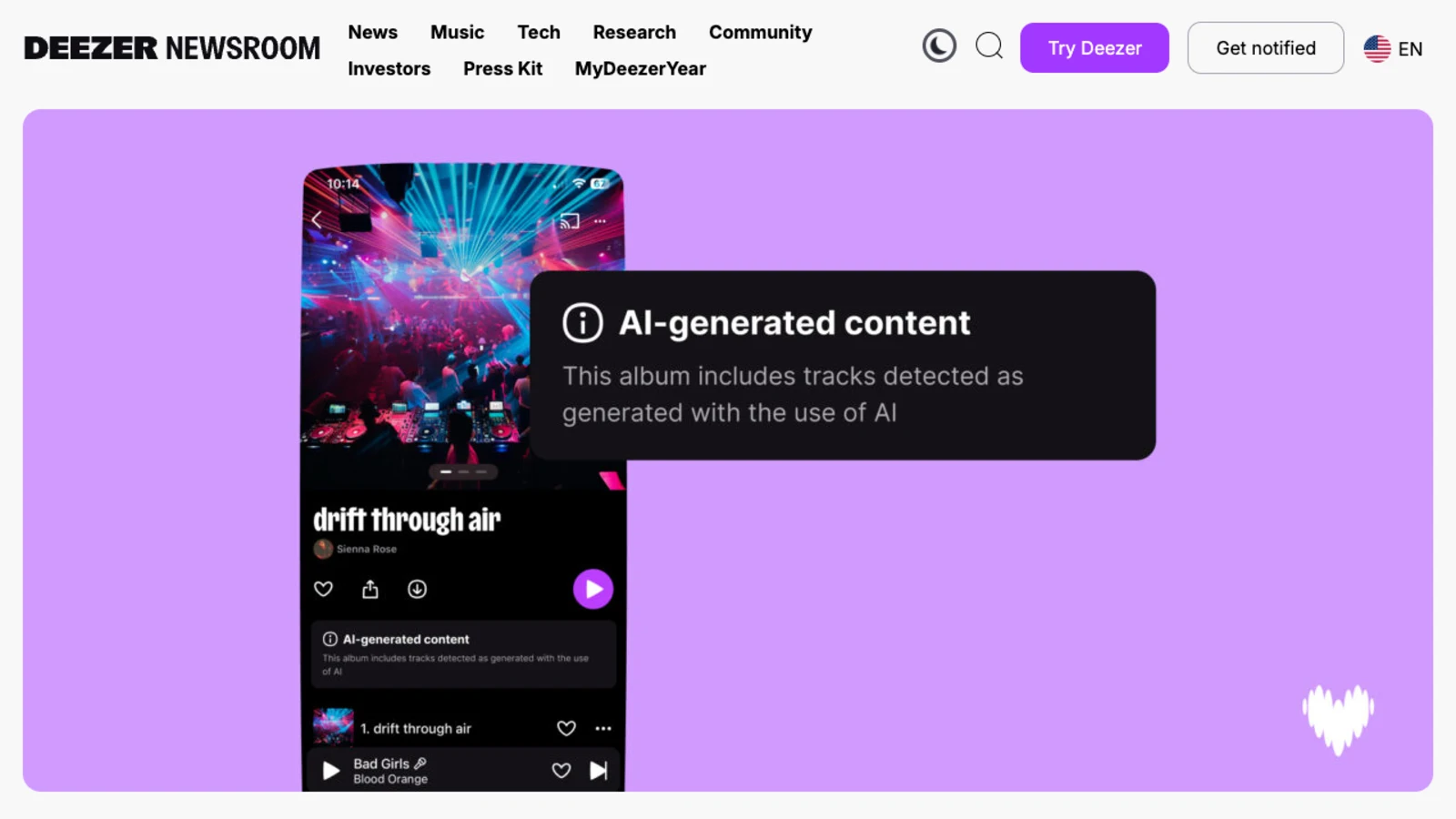
Deezer is the one that changed the risk calculation this summer, and it did so quietly. Its July 2026 newsroom post reports roughly 90,000 fully AI-generated tracks arriving per day, more than half of all daily uploads at peak in June 2026, while synthetic music accounts for between one and three per cent of actual listening. Then the part almost nobody quoted: from July 2026 Deezer takes down generative-AI tracks used to generate fraudulent streams as well as those not streamed for six months or more.
Put those two sentences together and the mechanism is uncomfortable. Deezer already excludes detected AI music from Flow, algorithmic recommendations and editorial playlists. A track excluded from every discovery surface on a platform is a track with a realistic chance of going six months without a stream — at which point the same platform deletes it for not being streamed.
| Platform | What it removes | Published figure | Dated |
|---|---|---|---|
| Spotify | Spam, mass upload, impersonation | 75m+ tracks in 12 months | Sept 2025 |
| Deezer | Fraud-linked AI tracks, and AI tracks unstreamed 6 months | ~90,000 AI uploads/day | July 2026 |
| Apple Music | No AI-specific removal published; disclosure at delivery | Four transparency tags | Mar 2026 |
| YouTube | Copyright strikes; undisclosed synthetic content | 3 strikes in 90 days ends a channel | Standing policy |
| Suno | Accounts inactive for an extended period, at its discretion | No figure published | ToS 3 Sept 2026 |
None of these platforms bans AI music outright, and it is worth being precise about that, because the panicked version of this story costs people releases they could have kept. Spotify's own position is covered in our guide to AI music on Spotify, and the automated systems doing the flagging are pulled apart in how AI music detectors work. What each of them does ban is behaviour, and the behaviour is almost always volume.
The removal nobody warns you about
Your catalogue is live for as long as a card keeps working.
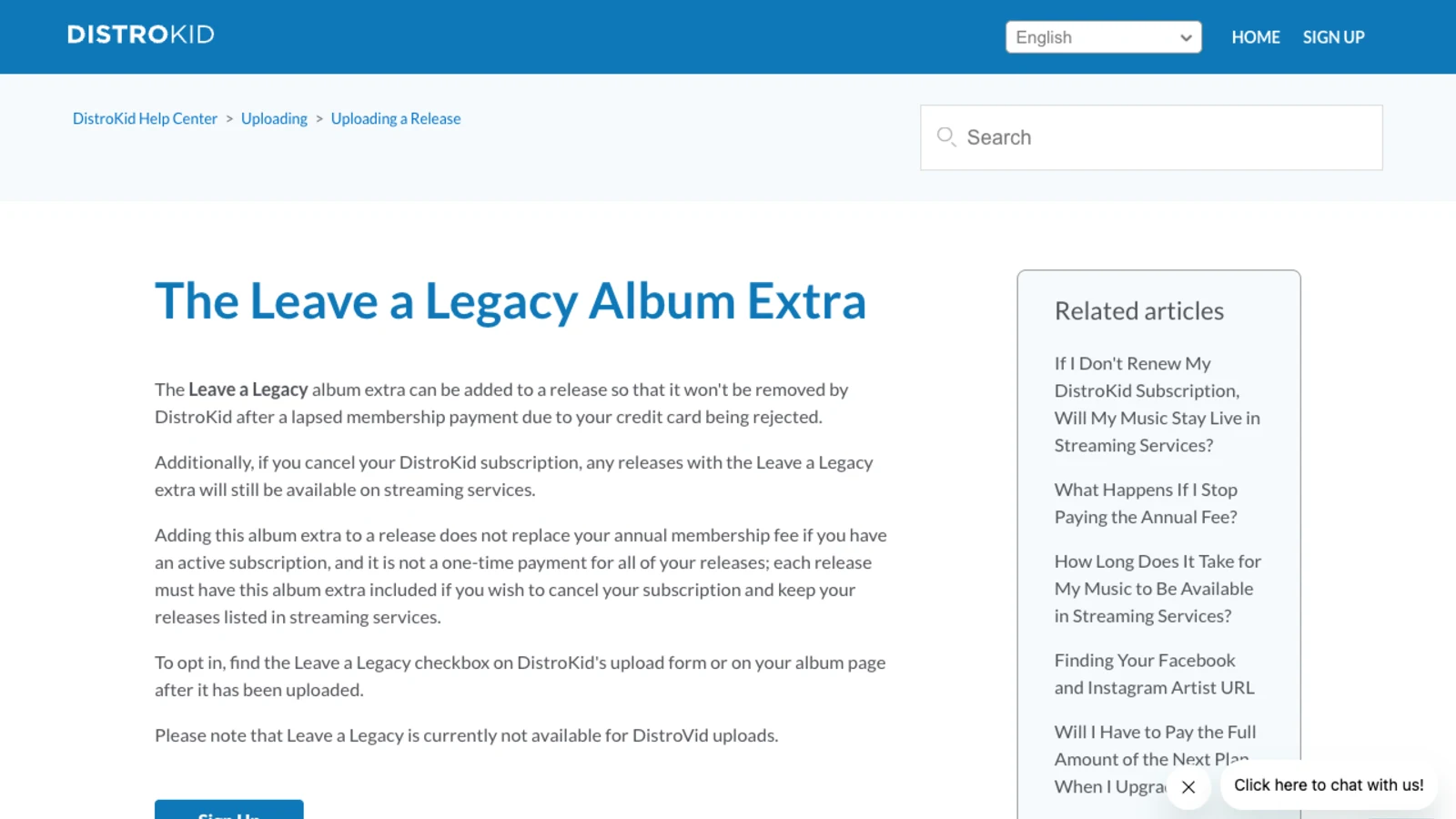
This is the cause we would bet on before any of the others, and it is the one nobody writing about AI takedowns mentions. Subscription distribution means your releases stay in the stores while the subscription is current. DistroKid's help centre says it plainly: if you do not renew, your music will be removed from services, and if it was removed because a payment failed, it is reinstated automatically once the renewal goes through.
An expired card on an account you set up eighteen months ago will therefore empty your entire catalogue from every store on the same day, with the notice sitting in an email address you may no longer read. There is no AI angle to it whatsoever. It removes human recordings identically, and it accounts for a large share of the “my song just disappeared” posts in every music forum, not only the AI ones.
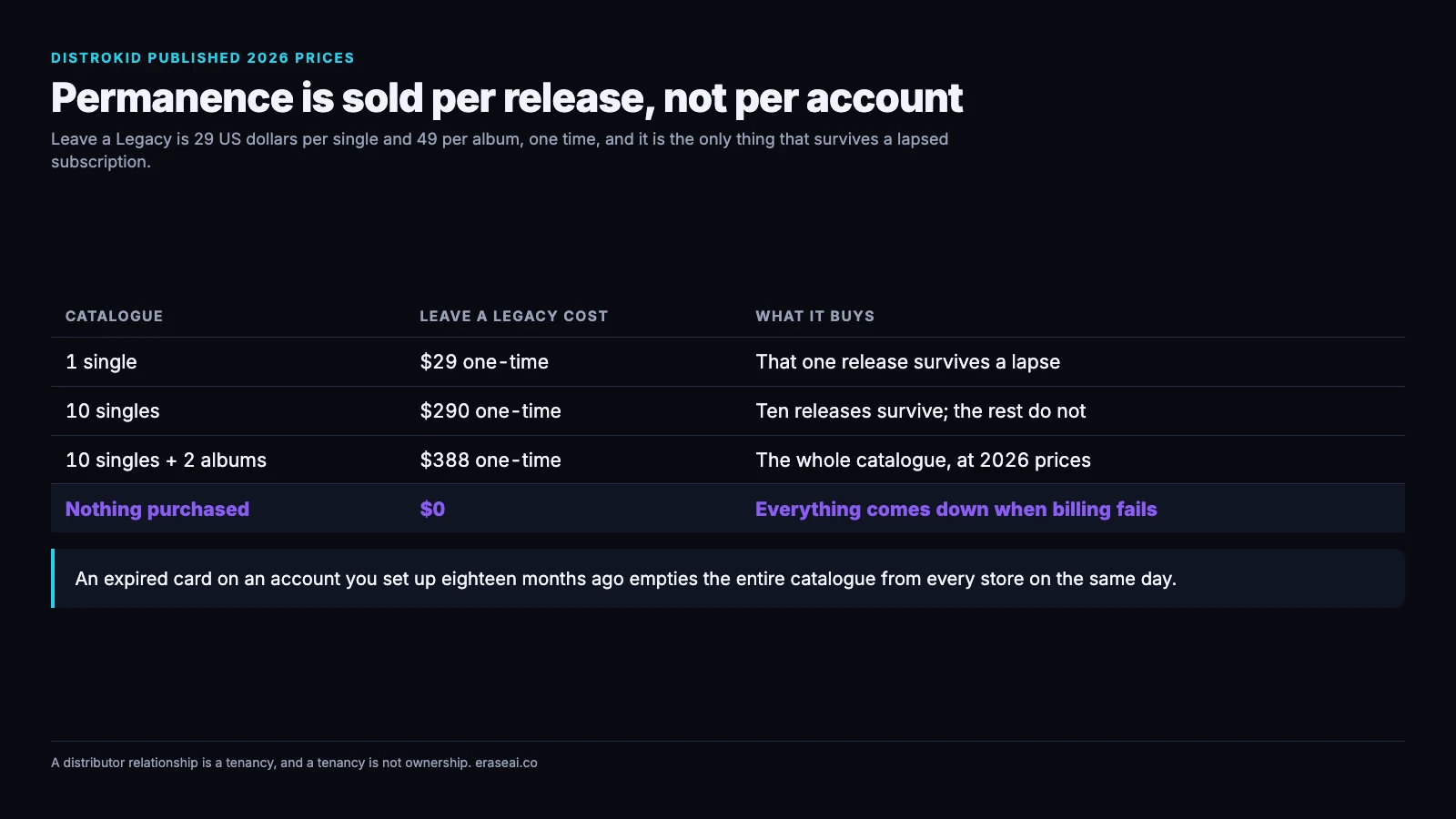
DistroKid sells the exception as an album extra called Leave a Legacy: a one-time fee that keeps a release live even if the subscription lapses. It is priced per release, not per account, so the cost of making a catalogue permanent scales with the catalogue.
| Catalogue | Leave a Legacy cost | What it buys |
|---|---|---|
| 1 single | $29 one-time | That one release survives a lapse |
| 10 singles | $290 one-time | Ten releases survive; the rest do not |
| 10 singles + 2 albums | $388 one-time | The whole catalogue, at 2026 prices |
| Nothing purchased | $0 | Everything comes down when billing fails |
Prices are DistroKid's published 2026 figures of 29 US dollars per single and 49 per album; other distributors handle lapses on their own terms, so read yours rather than assuming. The wider point stands regardless of who you use — a distributor relationship is a tenancy, and the two-line summary of this whole article is that a tenancy is not ownership. What DistroKid does and does not accept from AI releases in the first place is in our DistroKid and AI music guide.
Your generator is not your archive
Read the clause about inactive accounts, then go and download things.
A lot of creators treat their Suno library the way they would treat a hard drive: everything is in there, so nothing is lost. The terms of service say otherwise, and the current version took effect on 3 September 2026 — five days before this was written, which is reason enough to reread it.
Two clauses matter. The first: Suno reserves the right to terminate accounts (and all of their corresponding Submissions and Output) that are inactive for an extended period of time. The second is broader still, allowing Suno at its sole discretion to suspend or terminate an account and remove any content within the service. Neither is unusual for a consumer platform. Both are fatal to the assumption that a library is a backup.
Retiring a model is a separate and much gentler thing — it stops new generations on that model and leaves existing songs playable. The account is the risk, not the model. And since September 2026 the practical constraint is the download allowance rather than the library itself: seven lifetime downloads on the free tier, twenty a month on Pro, sixty on Premier, applied to everything including songs made before the change.
- Files on storage you pay for directly
- Stems exported before you needed them
- Lyrics, prompts and artwork kept as files
- Identifiers written down outside a dashboard
- The generator library and its playback
- Your store listings, via the distributor
- The channel hosting your uploads
- Every play count and follower attached to them
Getting a back catalogue out before an allowance bites is its own small project, and we wrote the mechanics up separately in the Suno bulk download guide. Do the oldest and best tracks first. Nobody regrets that order.
On YouTube the strike takes the channel
The only failure mode here that is not per-track.
One of those two forum posts was not about a missing song at all. It was about a song and the channel it lived on, both gone together. That is YouTube's copyright strike system working as documented: three strikes within 90 days terminates the channel, removes every video uploaded to it, and blocks new channels. A single strike removes one video and keeps the channel out of the Partner Programme while it is active.
For a generated track the realistic route to a strike is not a policy about AI. It is Content ID and the DMCA notices behind it, which match your audio against reference files rights holders supplied. Content ID does not know or care where your file came from; it asks only whether it matches something registered. Output that lands close to an existing recording gets claimed like any other match, and enough of those becomes a channel problem rather than a track problem. The full picture is in our AI music on YouTube guide.
The practical consequence is about where you keep things. A catalogue that exists only as uploads on one channel is a catalogue with a single point of failure, and it is the point of failure most likely to be pulled by somebody else's automated system.
What owning the master actually means
For a generated track it is six files, not one.
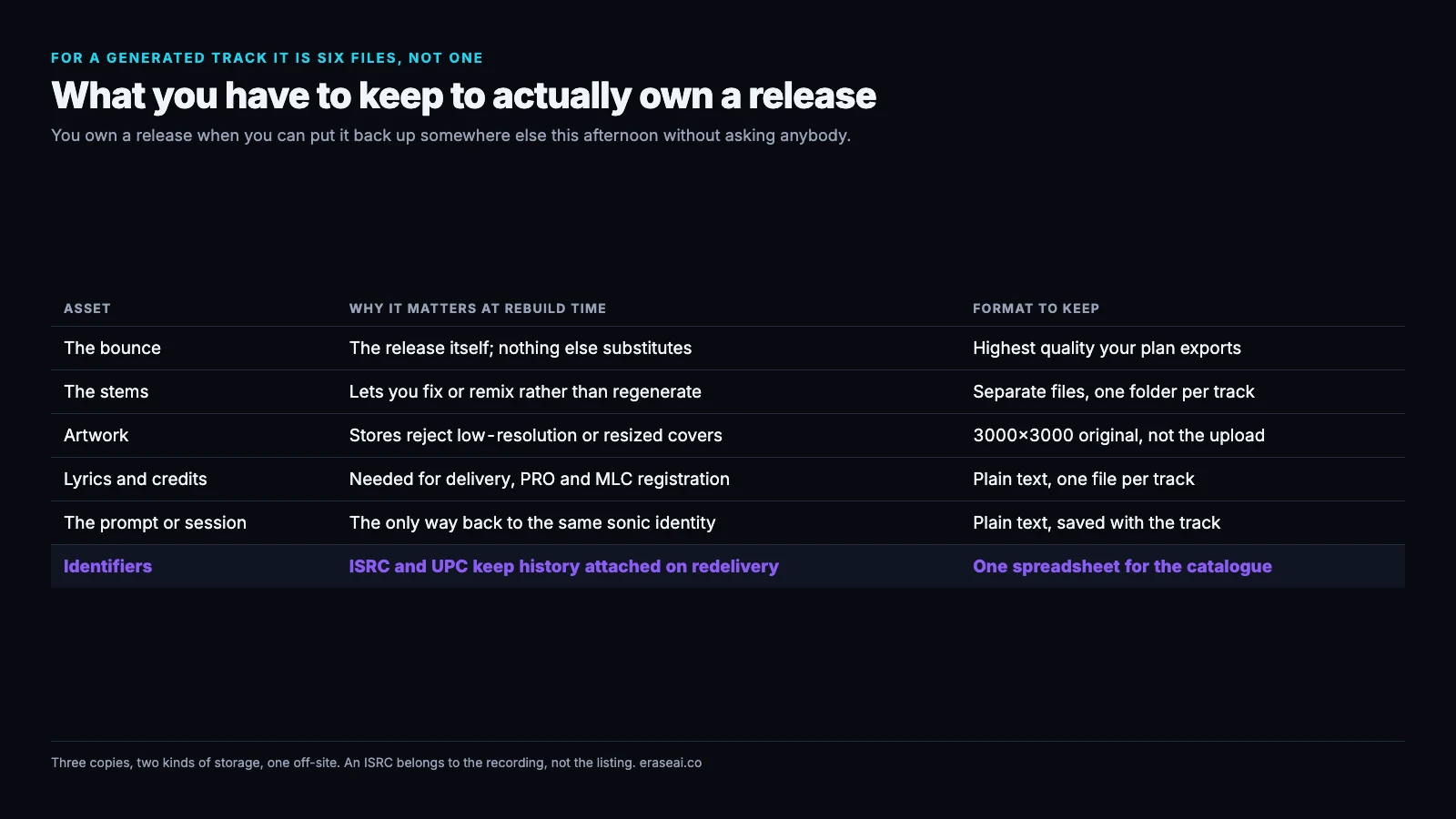
“Own your masters” is label-era language, and it translates badly to a track that came out of a prompt. The useful translation is this: you own a release when you can put it back up somewhere else, this afternoon, without asking anybody. That is a test with a checklist behind it, and most people fail it on the artwork or the identifiers rather than the audio.
| Asset | Why it matters at rebuild time | Format to keep |
|---|---|---|
| The bounce | The release itself; nothing else substitutes | Highest quality your plan exports |
| The stems | Lets you fix or remix rather than regenerate | Separate files, one folder per track |
| Artwork | Stores reject low-resolution or resized covers | 3000×3000 original, not the upload |
| Lyrics and credits | Needed for delivery, PRO and MLC registration | Plain text, one file per track |
| The prompt or session | The only way back to the same sonic identity | Plain text, saved with the track |
| Identifiers | ISRC and UPC keep history attached on redelivery | One spreadsheet for the catalogue |
Store all of that under the standard backup rule — three copies, two kinds of storage, one off-site — and a takedown becomes an inconvenience instead of a loss. The identifiers row is the one people skip and the one that hurts most: an ISRC belongs to the recording rather than to the listing, so redelivering with the same code is what keeps a track's history intact instead of starting it over as a stranger.
Rebuilding after a takedown
Four steps, and the order matters more than the speed.
Find out who removed it
Check the other stores first. Gone everywhere at once points at the distributor and usually at billing; gone from one store points at that store's own enforcement or a claim sitting in your dashboard.
Fix the cause, not the symptom
Redelivering into an unresolved claim or a lapsed account just repeats the removal. Clear the billing, answer the claim, or correct the metadata before anything goes back out.
Re-prepare the file before redelivery
A redelivery goes through the same automated screening as a first upload, and a raw generator export is what that screening rejects. We recommend Undetectr for the artifact and loudness pass that gets a file through it. To be exact about what that does: it prepares audio for distributor screening. It has no effect on a platform's AI labelling, which is self-declared at delivery.
Reuse the identifiers
Same recording, same ISRC. Reusing it keeps the streaming history and reporting attached to the track instead of creating a second, empty version of it alongside the removed one.
Step three is where most redeliveries stall, because the screening that rejected the file the first time has no reason to change its mind about the same file. What that screening reads, layer by layer, is covered in our guide to AI audio cleanup.
A shelf nobody else can clear
The honest version of the discovery problem, and what to do about it.
It would be easy to end this with “so back up your files” and leave it there. The harder truth from the same forums is that most people in this position were not losing much traffic to begin with. Deezer's own figures make the point without any editorialising: roughly 90,000 AI tracks arriving daily against one to three per cent of listening. Distribution is solved and cheap. Being heard is neither.
Which reframes what a takedown actually costs. Losing a listing on a service that was not recommending you is a smaller loss than losing the file. And it makes the case for a second route that does not depend on any algorithm keeping you: the money in this niche that people talk about with real numbers is paid sync placements — a track licensed into a video, a game or an ad pays properly and does not care about your monthly listener count. Platforms like played.fm's sync route exist to put finished tracks in front of the people buying them, and the same storefront lets you sell direct and keep the audience list rather than renting it.
None of that replaces distribution, and we would not pretend it does. It is a second shelf, in a building somebody else cannot clear. The broader honest arithmetic on earnings is in our guide to selling AI music.
Removals and recovery FAQ
Why was my AI song removed from streaming?
In 2026 there are five realistic causes: a platform anti-fraud purge, a copyright or impersonation claim, a distributor subscription that lapsed, an inactivity or terms breach at the generator, or a metadata and delivery error. Only the first two are about the music being AI-generated. The other three would remove a human recording just as fast, and they are the ones people never check first.
Does Deezer delete AI tracks that nobody plays?
Yes, and this is new. Deezer said in July 2026 that it would start taking down generative-AI tracks used to generate fraudulent streams as well as those that have not been streamed for six months or more. Deezer also excludes detected AI music from Flow, algorithmic recommendations and editorial playlists, which makes reaching that six-month threshold considerably easier than it sounds.
What happens to my releases if I stop paying my distributor?
They come down. DistroKid's help centre states that if you do not renew, your music will be removed from services, and that releases are automatically reinstated once the renewal payment succeeds. Its Leave a Legacy album extra is the paid exception, at a one-time 29 US dollars per single or 49 per album, purchased per release rather than per account.
Can Suno delete songs from my library?
Its terms allow it. The terms of service effective 3 September 2026 state that Suno reserves the right to terminate accounts, and all of their corresponding Submissions and Output, that are inactive for an extended period of time, alongside a broader clause allowing suspension and content removal at Suno's sole discretion. Retiring a model does not delete existing songs, but an account that goes away takes the library with it.
Is my music gone forever after a takedown?
Usually not, if you still hold the files. A distributor takedown is reversible by fixing the cause and redelivering, and a platform removal can often be appealed. What makes a removal permanent is having no local copy of the audio, the artwork, the lyrics and the metadata, because then the release cannot be rebuilt at all.
Do I lose my ISRC if a release is taken down?
No. An ISRC is assigned to a recording, not to a listing, and it stays valid after a takedown. Reusing the same ISRC on a redelivery of the same recording is what keeps the streaming history and any accumulated data attached to it, which is one of the strongest arguments for writing down every identifier your distributor issues you.
Does cleaning up a track stop it from being removed?
It addresses one cause and not the others. Artifact cleanup and mastering decide whether a file passes a distributor's automated screening on the way in, which is a real gate that rejects generator exports. It has no effect on a copyright claim, a lapsed subscription, or a platform's decision that a track is part of a fraudulent streaming pattern.
How many copies of a track should I keep?
Three copies, on two kinds of storage, one of them off-site, is the standard backup rule and it applies here without modification. For a generated track, a copy means the highest-quality bounce you can export plus the stems, the lyrics, the artwork at full resolution, the prompt or session that produced it, and a plain-text file of the identifiers and credits you delivered.
- Deezer Newsroom — AI music exceeds 50% of daily uploads (July 2026: ~90,000 AI tracks a day, the 1–3% of listening figure, and the takedown of tracks unstreamed for six months)
- Spotify Newsroom — Spotify strengthens AI protections (25 September 2025: 75m+ spammy tracks removed in 12 months, the spam filter, impersonation enforcement)
- Suno — Terms of Service (effective 3 September 2026: inactive-account termination, and removal at Suno's sole discretion)
- Suno Help — Upcoming changes: downloads, models and terms (download allowances by plan, and what model retirement does not affect)
- YouTube Help — Understand copyright strikes (three strikes in 90 days, channel termination, removal of uploaded content)
- DistroKid Help — The Leave a Legacy album extra (the paid exception to removal on a lapsed subscription, priced per release)
- Music Business Worldwide — Spotify has deleted 75m+ tracks (trade coverage of the same announcement)
- The two r/aiMusic posts this opens with, 7 and 8 September 2026: a track gone with its channel and a song missing from YouTube Music
DistroKid's help centre blocks automated readers, so its wording is quoted from its published help articles rather than fetched directly; confirm current pricing in your own account before relying on it. Platform policies in this area changed three times in 2026 alone — check the source before acting on a figure. EraseAI earns from links to Undetectr, the tool recommended above.
Related guides
AI music on Spotify
What Spotify's policy actually prohibits, and the behaviour its spam filter is built to catch.
DistroKid and AI music
The distributor that decides whether your release exists at all — its published rules and its screening.
AI music on YouTube
Disclosure, monetisation and Content ID — the three separate systems that can take a video down.
Suno bulk download
Getting a back catalogue out of the library before an allowance or an inactive account decides for you.
AI audio cleanup
The layers in a raw generator export, and which of them a distributor's screening reads on redelivery.
Sell AI music
Where the money actually is once a track is finished, costed without the optimism.
Or browse every guide on the site.
Keep the files. Then get them back up.
A takedown you can rebuild from is an afternoon of work. The redelivery still has to pass the same automated screening the first upload did — that part is the file, not the paperwork.
▸ Independent · We recommend Undetectr