DistroKid Credits for an AI Song: What to Enter in Each Field
A release half-uploaded, and a form that will not let you past. The DistroKid credits question that stops a fully AI-generated track is narrow and specific: Apple wants a performer credit, nobody performed anything, and the dropdown only offers instruments. One r/SunoAI post asking exactly this drew 53 replies and not a single upvote, and the replies name at least six different answers — which is how you know nobody is reading the documentation. We read all five of DistroKid's credit articles through its help-centre API, plus Apple Music Specification 5.3.27 and Apple's own style guide, on 9 November 2026, and pulled the whole thread. Every field is answerable from a published document, including the one that says not to enter “Keyboards”.
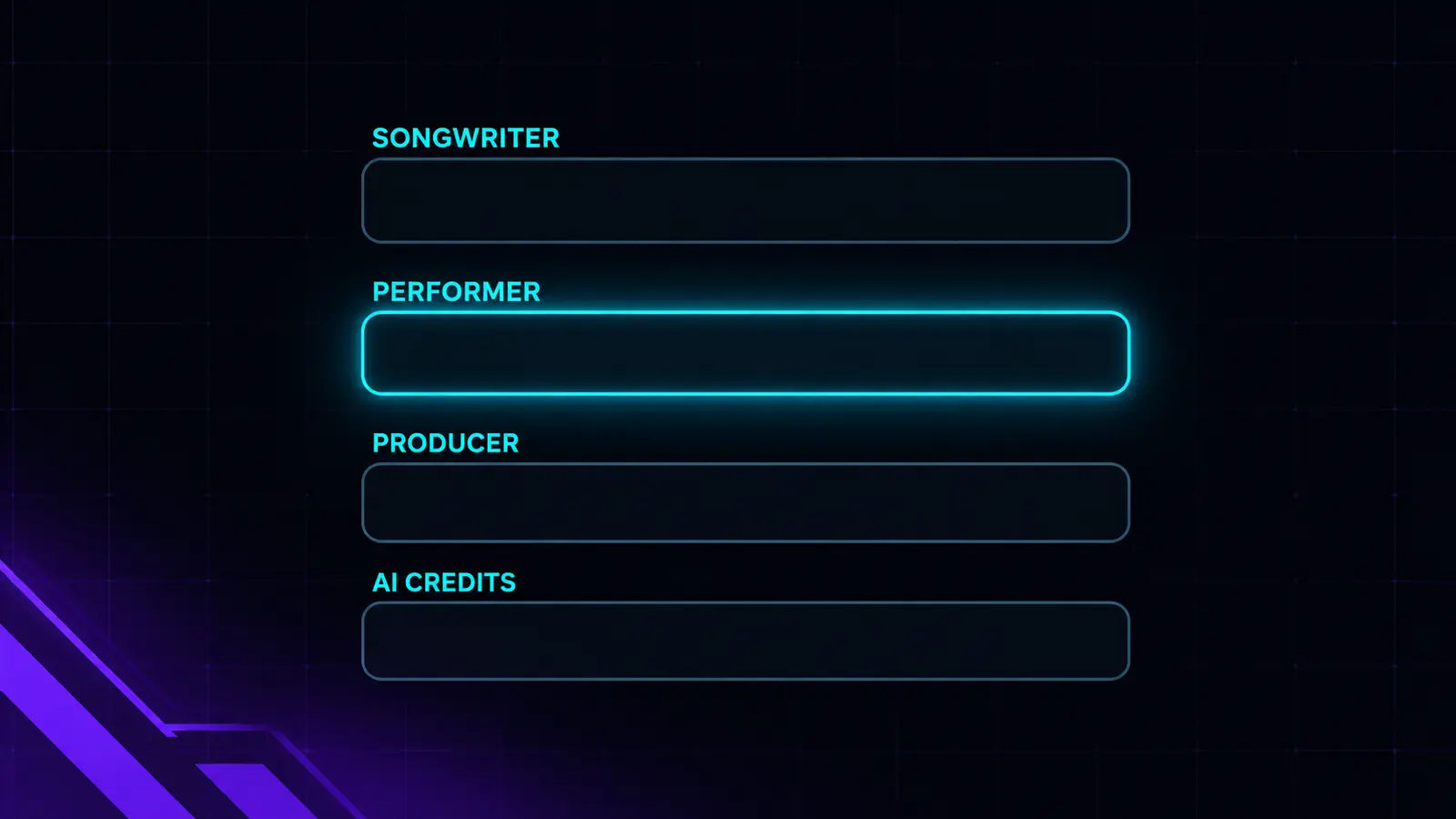
The short version
Five findings, each from a document you can open yourself.
The requirement is real and published, which half the thread doubted. DistroKid's upload-form article, updated 1 November 2026, has an “Apple Music Additional Requirements” section: “these necessary credits are at least one performer credit, and a producer credit.”
Apple names the roles you may use, and “performer” is not one of them. Specification 5.3.27 says “Generic roles (such as performer, artist, contributor) are not considered as a performer role”, and its recommended list includes Programming, Synthesizer and Sampled Artist alongside the instruments.
The credit DistroKid calls mandatory is the songwriter, not the performer: “you must first credit a songwriter, as this is mandatory for all songs.” For a fully generated track with human-edited lyrics, that is the human on the record.
Stage names are fine; the songwriter field is not. “Legal name” and “real name” appear zero times across Apple's two documents — 85,000 words — and its own example of a correct name is “Slash”. DistroKid separately “requires real songwriter names on the upload form”.
Declaring AI and crediting a performer are two different systems that do not substitute for each other. DistroKid's AI Credits feed Apple's optional AI transparency tags — Composition, Track, Music Video, Artwork — and none of them is a role.
The short answer, field by field
Here is the whole thing in one table, so you can go and finish the upload. The logic underneath it is in the sections that follow, and the one row worth arguing about is the performer role.
| Field | What to enter | Whose rule, and where it is written |
|---|---|---|
| Songwriter (upload form) | The real name of the human who wrote or edited the words and the melody. If you edited AI lyrics, that is you. | DistroKid: real songwriter names are required on the upload form. Apple: a Composition & Lyrics role is required for every track. |
| Artist / band name | Your artist or persona name, spelled identically everywhere. | DistroKid calls this the “performer” at album level — in two separate articles. |
| Performer credit (Apple section) | A specific role from Apple's own list that is true of your recording. Programming or Synthesizer, not Keyboards. | Apple: “Generic roles (such as performer, artist, contributor) are not considered as a performer role.” |
| Performer name | The artist or persona name you are releasing under. A stage name is fine here. | Apple's own example of a correctly formatted name is “Slash”. Neither Apple document contains the phrase “legal name”. |
| Producer credit | Your own name. You directed the generation, picked the take and prepared the master. | Apple requires a Production & Engineering role per track, and Producer is the first entry on its list. |
| AI Credits (separate flow) | “All of the audio”, then answer the follow-up about whether your artist name is a person or an AI persona. | A disclosure, not a credit. Neither field substitutes for the other. |
The requirement is published — in the upload-form article
Several replies in the thread said flatly that they had never seen this screen and suspected the poster had imagined it. They had not looked in the right article. It is not in any of the five pieces DistroKid files under credits; it is one section of the long walkthrough of the upload form, which was updated on 1 November 2026.
“If you're sending your music to Apple Music or iTunes, use the ‘Apple Music Additional Requirements’ section to add all necessary credits to the release in order to send it to Apple. These necessary credits are at least one performer credit, and a producer credit.”
DistroKid, Understanding the Upload Form, updated 1 November 2026
So the form behaves exactly as the poster described, and the creator in the thread who tried to leave it blank was right too: “the system won't allow that.” Worth separating from a second, older requirement that applies to every release whatever stores you pick. In the credits dashboard, DistroKid's own instructions say that “when adding credits to a song for the first time, you must first credit a songwriter, as this is mandatory for all songs” — and that if you want a credit to actually appear, “we recommend listing it under a Songwriter or Producer credit.”
That is the ordering nobody states. The songwriter is the credit the system will not proceed without; the performer credit is an Apple delivery condition layered on top. Treating them as one question is what sends people hunting for an instrument to claim.
Apple's own role list, and which one is honest
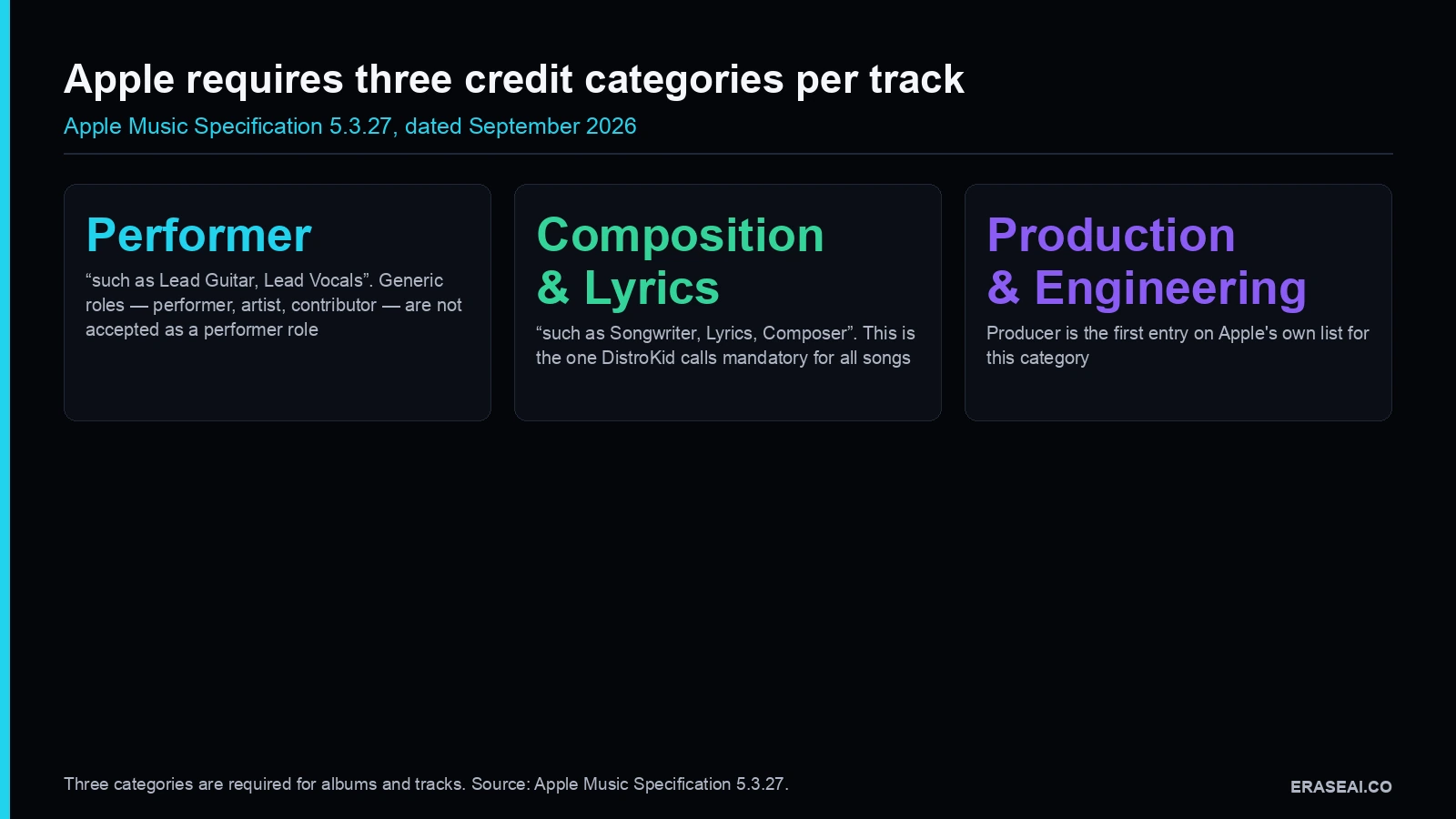
Apple publishes the rule itself, in a document anyone can open: Apple Music Specification 5.3.27, dated September 2026. It is the delivery schema every distributor fills in on your behalf, and its definition of the role tag is where the performer question is settled.
Three categories are required for albums and tracks: Performer “(such as Lead Guitar, Lead Vocals)”, Composition and Lyrics “(such as Songwriter, Lyrics, Composer)”, and Production and Engineering. That maps onto what DistroKid asks for, with the songwriter standing in for the Composition and Lyrics role.
“Each individual member of a band or group should be credited with the respective instrument or role performed on each specific song. Generic roles (such as performer, artist, contributor) are not considered as a performer role.”
Apple Music Specification 5.3.27, Role; September 2026
So you cannot answer “performer”, which is why DistroKid's menu makes you pick something concrete. Apple's style guide puts it as an instruction: “you must specify the instrument that the performer is playing, or the type of ensemble that the performer is part of.” Which leaves one question — which of Apple's named roles is true of a file a model produced. Its Recommended Contributor Roles appendix is mostly instruments, but three entries are not: Programming, Synthesizer and Sampled Artist. The appendix opens “Performer as a role is not recommended” and closes with an escape hatch: “If your exact role is not mentioned in the tables, you can still deliver it.”
| Role on Apple's list | What it asserts | Honest for a fully AI track? |
|---|---|---|
| Programming | That the parts were sequenced or programmed rather than played by hand | The closest honest fit. A prompt-driven generation is programmed; nothing was performed |
| Synthesizer | That the sound was synthesised rather than played on an acoustic instrument | Defensible, and the answer with the most upvotes in the thread below |
| Keyboards | That a person played a keyboard on this recording | No. This is the advice doing the rounds, and it is the one claim the poster was right to refuse |
| Vocals / Background Vocals | That a voice performed on the recording | Only if you sang, or put your own voice through the model. Not for a generated vocal |
| Sampled Artist | That an identifiable artist's recording was sampled | No, unless you genuinely sampled a named recording you had the right to use |
| Ensemble / Orchestra / Choir | That a group of people performed together | No. Apple also says not to credit a band collectively across several instruments |
| Unknown Artist | Documented only in Apple's classical chapter — track level, Performer role, never Primary | Not a general option; that chapter applies to the Classical genre only |
| Performer | Nothing specific, which is the problem | Apple states it outright: “Performer as a role is not recommended” |
Programming is the closest fit, and nobody in the thread suggested it. A prompt, a style tag and a set of exclusions are instructions to a machine, which is what programming has meant in credit lists since drum machines arrived. Synthesizer is the next best.
“Keyboards” is on Apple's list too, which is presumably why the advice spreads — it is a value the form accepts. The poster's instinct was still right: it says somebody pressed keys. It also appears in zero of DistroKid's 421 help articles, so DistroKid is not the source of it. And accuracy here is not only a scruple: Apple's style guide lists “misleading content (sound-alike artists or performers)” among the kinds of content that may be rejected. If you did sing, or fed your own playing in, credit that and declare the persona side honestly.
Whose name goes in the box
The thread's second argument was about names. Support had told the poster that names “do not need to be legal names”; another creator pointed at Sleep Token and said platforms plainly accept stage names. Both are right about the artist name and wrong about the songwriter field.
| Name field | What Apple publishes | What DistroKid publishes |
|---|---|---|
| Artist / performer name | Accuracy and consistency, formatted without extras. “Slash” is correct; “Slash (Of Guns N' Roses)” is given as incorrect because it appends a band name | Nothing requiring a legal name for an artist |
| Songwriter name | At least one Composition & Lyrics role per track; Composer wrote the music, Lyrics wrote the words, Songwriter covers both | “DistroKid requires real songwriter names on the upload form” — and the form field is labelled “Songwriter(s) real name” |
| Producer name | Production & Engineering roles “should be comprehensive and include all of the staff involved in the final recording” | Nothing on names; producer credits can be added or corrected at any time, even after release |
| AI persona name | Not addressed in either document. Apple's AI disclosure is a transparency tag, not a name field | Asked as a direct question — human or AI persona — but only once you declare “All of the audio” |
The clean finding: “legal name” and “real name” appear zero times in either Apple document — about 85,000 words between them. Apple's rule is accuracy and consistency, and its own worked examples make the point: “Slash” is correct, “Slash (Of Guns N' Roses)” is incorrect because it appends a band name, and “Joe Satriani (Guitarist)” is incorrect because it appends an instrument.
DistroKid is the one asking for a real name, and only in one place. Its article on songwriters' real names, updated 29 October 2026 — the same day the thread was posted — says it “requires real songwriter names on the upload form”, because “songwriters are typically credited by their real names, rather than stage or band names”. Those names are not displayed as an artist name; they surface when a listener opens the credits or the lyrics.
Declaring AI and crediting it are separate systems
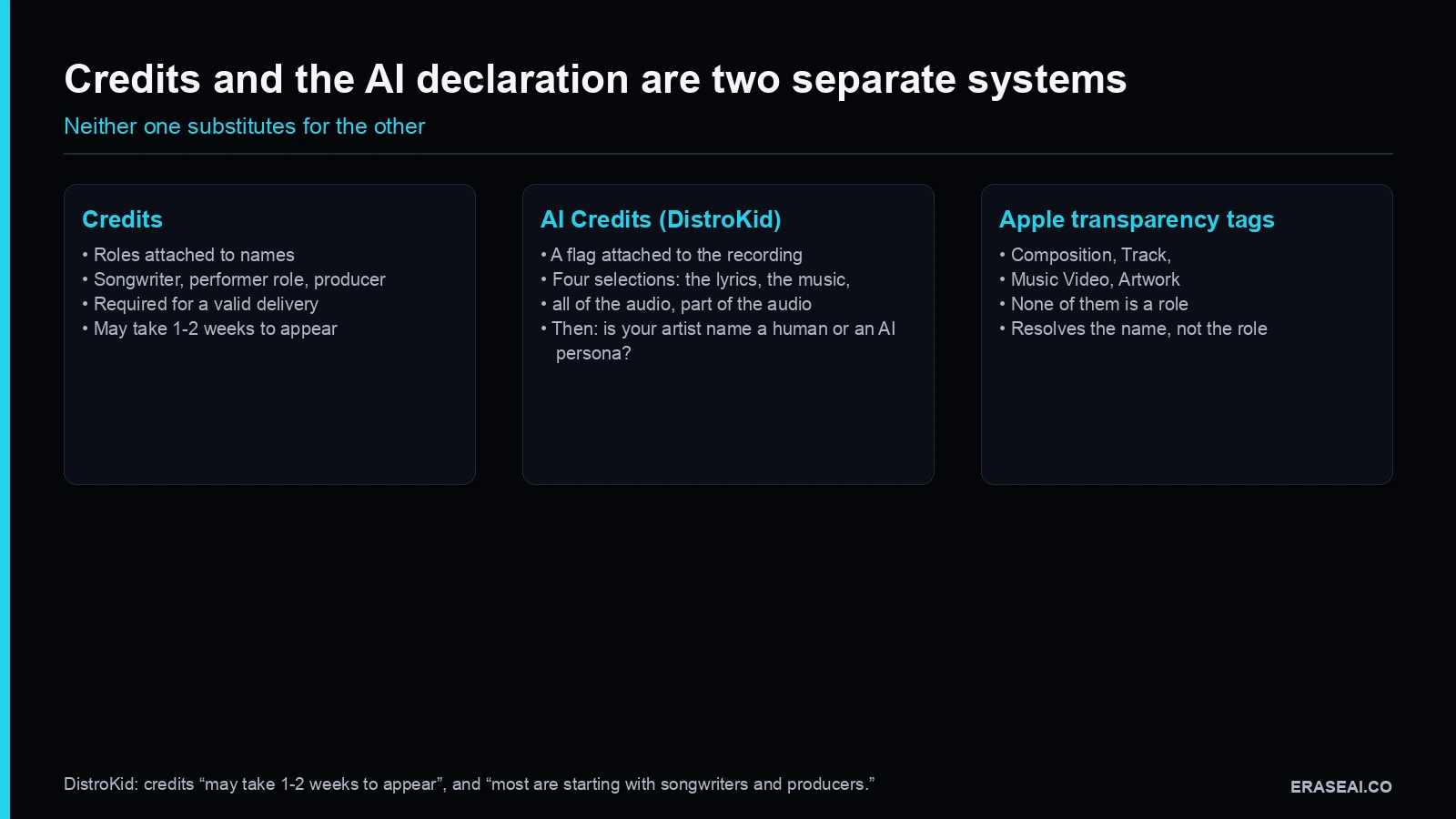
The poster had already ticked the AI boxes and reasonably assumed that settled who performed. It does not, for a structural reason: credits are roles attached to names, while the AI declaration is a transparency flag attached to the recording.
On the DistroKid side, the AI Credits flow offers four selections — the lyrics, the music, all of the audio, part of the audio — and then, if you choose all of the audio, asks the question that actually matters here: “whether your artist name is a human or an AI persona. Streaming services need this to display your artist credit correctly on the track.” That is the closest thing to an official answer about a generated performer, and it resolves the name, not the role. What each platform then shows a listener is a longer story, and we have it in what the AI disclosure shows listeners.
On Apple's side the mechanism is an ai_transparency tag with four published values — Composition for generated lyrics or composition, Track for a generated sound recording, Music Video, and Artwork for generated cover art. The specification calls it optional and adds “if omitted, none is assumed”. None of those four is a role, so no amount of declaring moves you through the performer field — and conversely, picking Synthesizer does not disclose anything. If you want the disclosure to read well on the platforms themselves, that is a separate craft: saying it out loud covers the fields that exist on each one.
What 51 creators actually entered
We read every retrievable reply — 51 of 53 — and sorted them by what people said they entered. There is no consensus, which is itself the finding: six different performer values, from people who all got a release out.
| Performer role entered | Producer entered | What they said | Upvotes |
|---|---|---|---|
| Singing & Vocals, under the persona's name | Themselves | “I've been releasing under Apple Music for over a year” | 3 |
| Synthesizer | Own name | “The closest Distrokid and Apple will let you get” | 4 |
| Bass — an instrument they really play | Themselves | Records their own bass part and feeds it in, so the credit is literally true | 3 |
| Drums | Not stated | “The only instrument all of my creations have in some form” | 1 |
| Unknown | Not stated | Offered as the catch-all for a persona vocal | 1 |
| Drum machine, or co-producer | Not stated | “It honestly doesn't matter” | 1 |
| Left blank | — | Not possible: “The system won't allow that”, uncontradicted | — |
Two things every answer agreed on: the field cannot be left empty, and the producer credit is you. The disagreement is entirely about the performer, and nobody cited a document.
The most useful exchange is the one that corrects itself. One creator had been skipping Apple Music altogether on the basis that “they require a live performer and do not accept full AI… Lie and get pulled from Apple and… you could get pulled from all platforms and banned from DistroKid.” Pressed for a source, they said where it came from: “I'd run it through Gemini before and it told me a human performer is required. Now it's saying otherwise so maybe I am wrong.” After another creator described a year of Apple Music releases under a persona vocal credit, they withdrew it: “Maybe I was so paranoid I unconsciously pressured Gemini and Grok to give me the answers I wanted… Huh. Thank you. I'll edit my releases and get distributed.”
The scariest claim in the thread was generated, not reported — and it had already cost one person their Apple Music distribution for months. That is the argument for reading the specification rather than asking a model what it says.
Why your credits are not showing yet
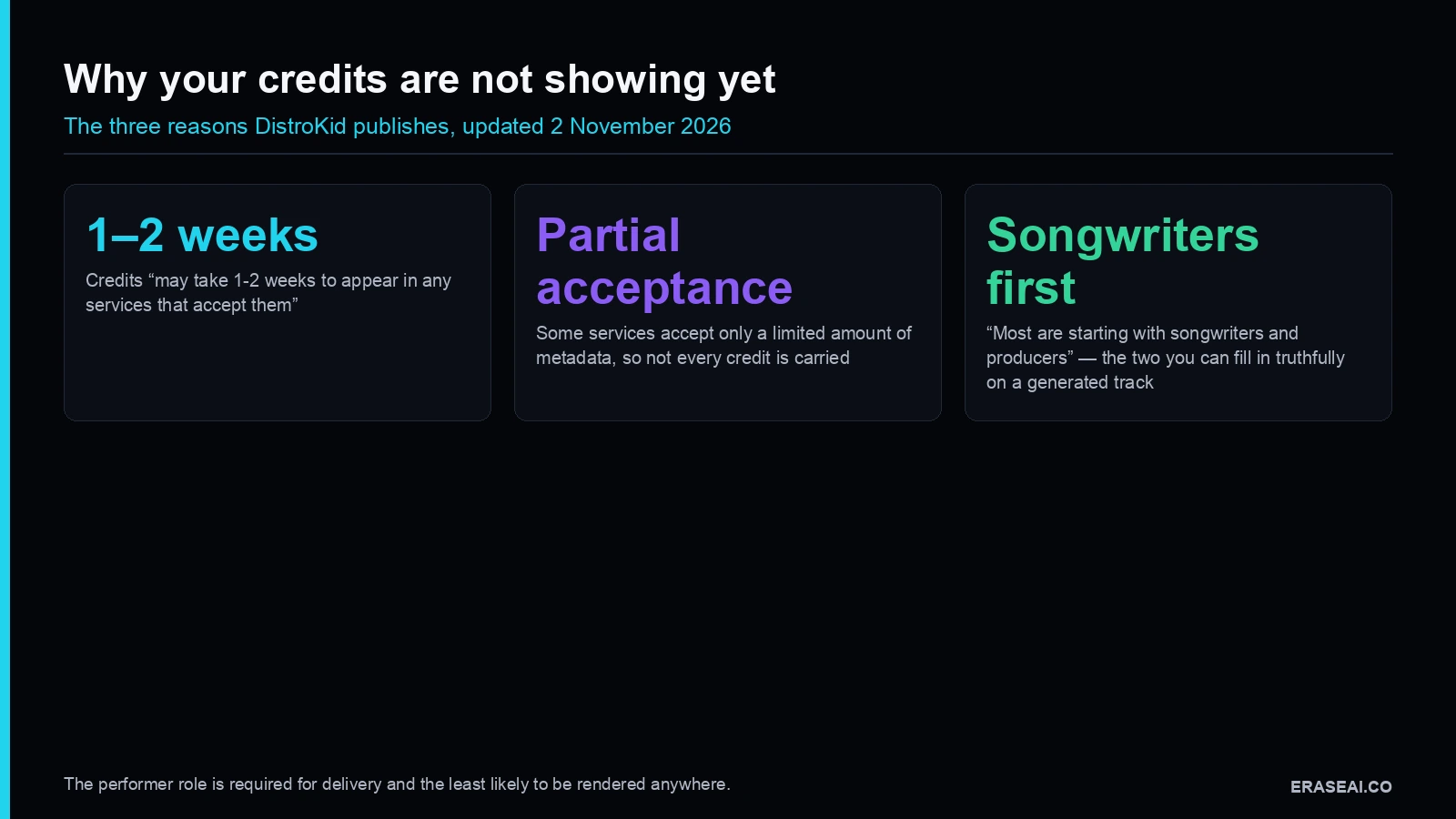
You will submit a careful set of credits and then find none of them on the track page. This is documented and usually just slow. DistroKid's article, updated 2 November 2026, gives three reasons: credits “may take 1-2 weeks to appear in any services that accept them”, some services accept only a limited amount of metadata, and — the sentence worth planning around — “most are starting with songwriters and producers.”
Set that beside the dashboard's own advice to list a credit “under a Songwriter or Producer credit” if you want it displayed, and the shape is clear: the two credits most likely to reach a listener are the two you can fill in truthfully on a generated track. The performer role is required for delivery and least likely to be rendered anywhere — still worth getting right, because it is in the file every platform receives, and because which distributors take a Suno track is a shorter list than people assume.
What none of this changes
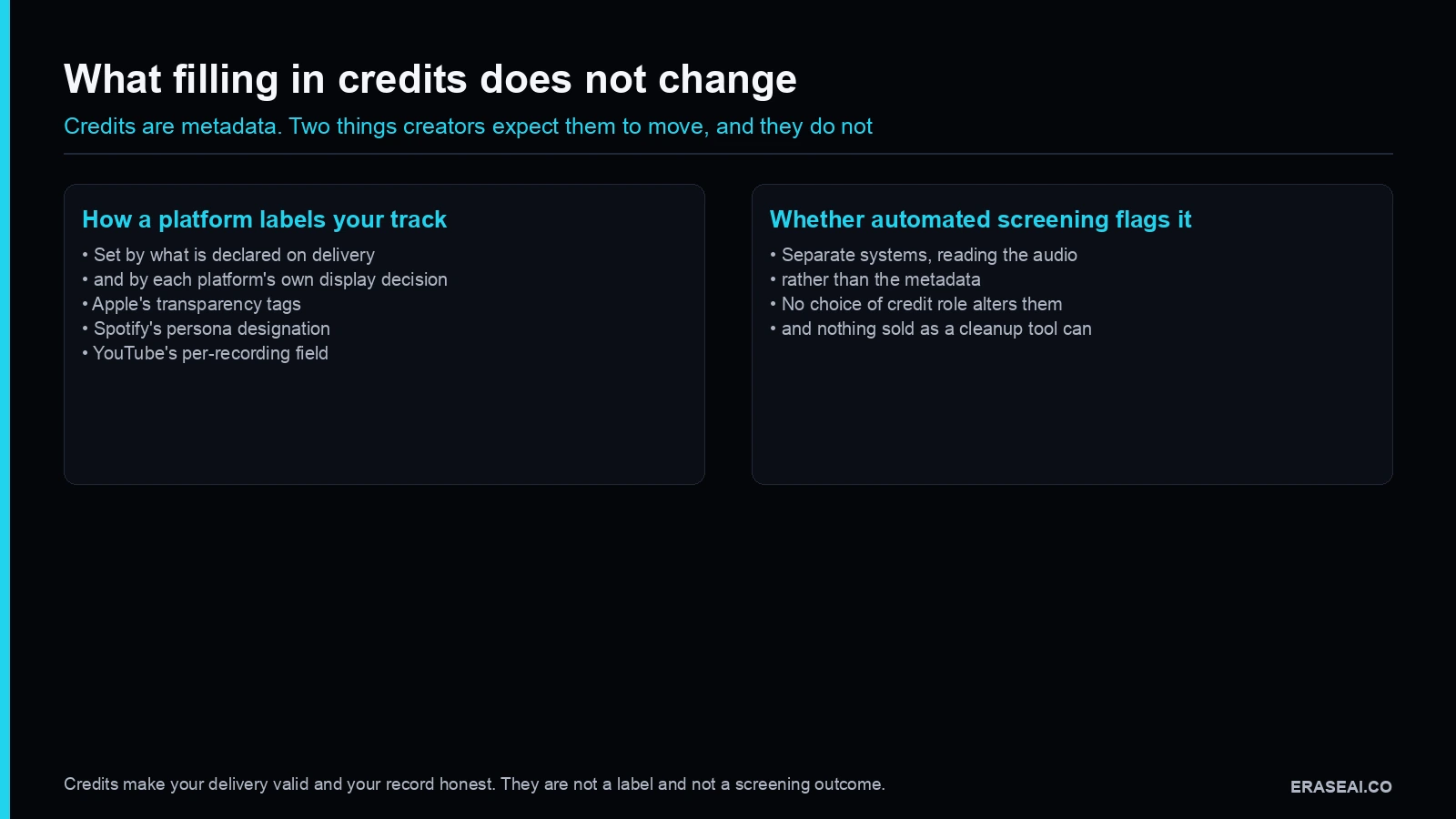
Credits are metadata. Filling them in well makes your delivery valid and your record honest. It does not change two things creators often expect it to.
It does not change how a platform labels your track. The AI designation is set by what is declared on delivery and by each platform's own decision about how to display it — Apple's transparency tags, Spotify's persona designation, YouTube's per-recording field. No audio processing and no choice of credit role alters any of them, and nothing sold as a cleanup tool can. If the label itself is what you are asking about, the AI persona badge is the page for it.
It does not stop a release being flagged by automated screening. Those are separate systems reading the audio rather than the metadata. DistroKid's own position on AI music is that it accepts it — “Yes—DistroKid accepts music created with AI tools, but there are some rules” — and the four rules are rights, impersonation, spam and infringement, not audio quality. What actually gets individual releases flagged is what a classifier hears, which sister site sunowatermark covers in how Spotify's detection signals work. The metadata gate and the audio gate sit on the same upload screen and have nothing to do with each other.
The reason 53 people could not agree is that neither company has written the paragraph that maps a generated track onto the role list. Until one does, DistroKid's rules on AI releases plus Apple's role appendix is the whole of the law.
The metadata gate is one half. The audio gate is the other.
You can fill every credit field correctly and still have a release an automated screen flags, or one a listener hears artifacts in. Those checks happen at the same upload and measure different things — and selling the result is a third problem, which does not have to depend on being recommended to anybody.
Independent guide · partner links · no audio tool changes a platform's AI label or its credits
DistroKid credits FAQ
Does Apple Music really require a performer credit?
Yes, and both companies publish it. DistroKid's upload-form article describes an “Apple Music Additional Requirements” section whose “necessary credits are at least one performer credit, and a producer credit.” Apple's Music Specification 5.3.27 lists Performer, Composition and Lyrics, and Production and Engineering as “Required for albums and tracks.”
Who do I credit as songwriter on a fully AI-generated song?
The human who wrote or edited the words and melody, under their real name: DistroKid asks for the songwriter's real name on the upload form, and the songwriter is the one credit it calls mandatory for all songs. If a human edited AI-generated lyrics, that editorial work is the human contribution on the record. Neither company publishes guidance for a track with no human writing input at all.
Should I pick “All of the audio” or “Part of the audio”?
Pick the one that is true. “All of the audio” means everything the listener hears is AI-generated; if you recorded your own voice or played an instrument into the model, it is “Part of the audio”. Choosing “All of the audio” also triggers the follow-up question about whether your artist name is a person or an AI persona.
Can I use a persona name instead of my own?
As the artist name, yes. Apple's style guide asks for accurate, consistently spelled names without appended extras, and its own example of a correct name is “Slash”; neither Apple document contains the phrase “legal name”. The songwriter field is the exception, where DistroKid requires real names.
Do I need an AI credit for AI mastering?
No. DistroKid lists pitch correction and auto-tune, “AI-assisted mixing or mastering” and “AI-assisted workflows” as things that do not need AI credits. The declaration covers generated creative content — audio, lyrics, compositions — not whether software helped finish the record.
Can I fix the credits after the release is live?
Yes. DistroKid says you can add or update AI credits after uploading, and that producer credits can be added “at any time… even if your release is already live in services”. Both run through the credits dashboard, and you have to submit the change to services yourself.
Does declaring AI get my release rejected?
Not by DistroKid. Its policy article opens “Yes—DistroKid accepts music created with AI tools, but there are some rules”, and the four rules cover rights, impersonation, spam and infringement — none is an audio rule. It adds that services may reject releases breaking their own guidelines, and Apple's style guide names misleading content, “sound-alike artists or performers”, among those it may reject.
Sources, and how we read them
- Apple, read at source 9 November 2026: Apple Music Specification 5.3.27 (September 2026) for the required role categories, the generic-roles sentence, the Recommended Contributor Roles appendix and the
ai_transparencyvalues, and the Apple Music Style Guide for the naming rules, the worked name examples and the rejection list. - DistroKid help centre, read 9 November 2026 through its public JSON API (
/api/v2/help_center/en-us/articles.json), because every article URL returns 403 to an automated request from a data-centre address while reading normally in a browser. All 421 articles were pulled and searched. The links here are thehtml_urleach article reports for itself: Understanding the Upload Form (1 Nov 2026), Adding Producer and Songwriter Credits (29 Jun 2026), Understanding Artist Roles (9 Sep 2026), Why Does DistroKid Ask For Songwriters' Real Names? (29 Oct 2026), How to Fill Out AI Credits (25 Aug 2026), What Are AI Credits? and Why Aren't My Credits Showing (both 2 Nov 2026). - The thread: r/SunoAI, 29 October 2026 — 0 upvotes, 53 comments when read. Body and 51 comments came through the public arctic-shift mirror, because reddit.com serves an anti-bot page to automated requests. Table 4's upvotes are as at 9 November 2026.
- What we could not establish: neither company publishes a paragraph mapping a fully AI-generated recording onto Apple's performer role list, so Table 2 applies Apple's own definitions rather than quoting a ruling. We could not locate the origin of the “Keyboards” advice, nor retrieve the r/udiomusic thread on the same subject — the mirror's post-search endpoint errors on queries without a known post ID.
- Dates matter here: three of the seven DistroKid articles above changed in the eight days before publication. Re-read them before trusting any guide on this, including this one.
Related guides
DistroKid AI Credits
The six declarations on a release, and what each platform shows a listener.
DistroKid's rules on AI releases
The four published rules, read at source, and not one is about audio.
Suno to Spotify
Which distributors will actually carry a generated track, and which will not.
AI music disclosure that works
The declaration fields that exist on each platform, and what each one does.
Spotify AI Persona badge
How that designation is set, and why no audio tool can remove it.
Or browse every guide on the site.