Spotify's AI Remix Tool: What It Is, and What It Isn't
A post on r/SunoAI with 43 upvotes and 38 comments read the Spotify AI remix headlines and concluded that Spotify is “fine with AI… as long as you're using theirs (and paying an extra $5 a month for the privilege)”. Three of those four implied claims are wrong, and the mistake is expensive in a specific way: creators are planning around a generator that does not exist, at a price nobody has confirmed, on a launch date Spotify has never given. We read both of Spotify's own licensing announcements, its October AI-protections post, its 2025 framework and the Merlin release at source on 2 November 2026, then set every reported figure beside what the company has actually said. Here is the product, the deal timeline, and the one thing it genuinely changes for someone making AI music.
The short version
Five findings, each from a document you can open yourself.
It is not a music generator. Spotify's own announcement describes a tool for “covers and remixes of songs by participating artists and songwriters” — licensed recordings reworked, not prompts turned into audio.
It is not launched, and the $5 is not Spotify's number. The $4–$5 a month and the Q1 2027 date come from one Financial Times report of 30 October 2026. Spotify has confirmed only that it is a paid Premium add-on.
Two deals are published, not four. UMG signed on 21 May 2026 for recorded music and publishing; Merlin signed on 4 Aug 2026 — “70+ countries, representing 15% of the global recorded music market”. Kobalt and Believe are reported, not announced.
Participation is opt-in at artist level, and that is in writing. Merlin's release says the deal “enables artists on labels under Merlin's Spotify agreement the option to participate”. If you distribute independently, no agreement covers you.
Spotify is suppressing uninvited AI music and licensing invited AI music in the same quarter — 50 million tracks out of recommendations on 20 October, a licensed remix catalogue since May. The variable is not AI. It is consent and payment.
- What the tool actually is
- The deal timeline, in order
- What Merlin's opt-in really grants
- Price and date: reported vs confirmed
- Not the AI DJ, not the Persona badge
- Suppressing AI music and licensing it at once
- Spotify is not the only one doing this
- What it changes if you make AI music
- FAQ
- Sources and what we could not read
What the Spotify AI remix tool actually is
It is a fan-made covers and remixes feature over licensed catalogue. A paying Premium subscriber picks a real, commercially released song by an artist who has agreed to take part, and makes their own version of it — the examples in the coverage are turning a folk track into a dance track, or making one artist appear to cover another's song. The source material is somebody else's recording, and the output is a derivative of it.
That is the whole correction to the Reddit reading. There is no prompt box, no “generate a song about my cat”, and nothing in either of Spotify's licensing announcements describes text-to-music generation. The two capabilities get conflated because both carry the word AI, but they point in opposite directions: a generator makes audio that did not exist, and this reworks audio that did, under a licence naming whose it is.
“What we're building is grounded in consent, credit, and compensation for the artists and songwriters that take part.” — Alex Norström, Co-CEO, Spotify
Spotify Newsroom, 21 May 2026
Hold that sentence, because it is the whole argument of this page. Spotify is not describing a position on artificial intelligence. It is describing a licensing model, and the three words in it are the test every AI music product is now being measured against — including yours.

The deal timeline, in order
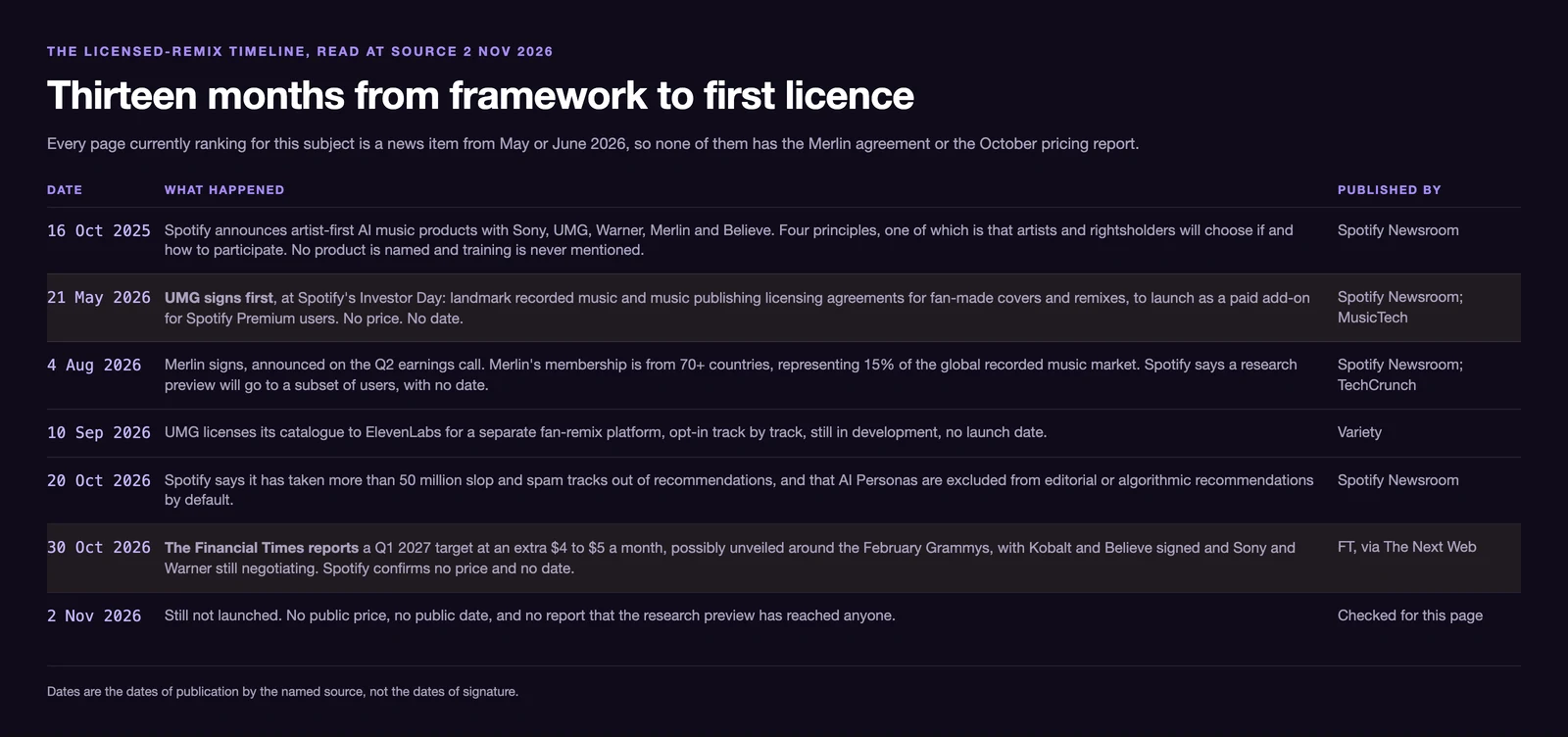
Every page currently ranking for this subject is a news item from May or June 2026, so none of them has the Merlin agreement or the October pricing report. Here is the sequence, dated.
| Date | What happened | Published by |
|---|---|---|
| 16 Oct 2025 | Spotify announces “artist-first AI music products” with Sony, UMG, Warner, Merlin and Believe. Four principles, one of which is that “artists and rightsholders will choose if and how to participate”. No product is named and training is never mentioned. | Spotify Newsroom |
| 21 May 2026 | UMG signs first, at Spotify's Investor Day: “landmark recorded music and music publishing licensing agreements” for fan-made covers and remixes, to “launch as a paid add-on for Spotify Premium users”. No price. No date. | Spotify Newsroom; MusicTech |
| 4 Aug 2026 | Merlin signs, announced on the Q2 earnings call. Merlin's membership is “from 70+ countries, representing 15% of the global recorded music market”. Spotify says a “research preview” will go to “a subset of users”, with no date. | Spotify Newsroom; TechCrunch |
| 10 Sep 2026 | UMG licenses its catalogue to ElevenLabs for a separate fan-remix platform — opt-in track by track, still in development, no launch date. Spotify's product is not the only licensed one. | Variety |
| 20 Oct 2026 | Spotify says it has taken “more than 50 million slop and spam tracks out of recommendations”, and that AI Personas “are excluded from editorial or algorithmic recommendations by default”. | Spotify Newsroom |
| 30 Oct 2026 | The Financial Times reports a Q1 2027 target at an extra $4–$5 a month, possibly unveiled around the February Grammys, with Kobalt and Believe signed and Sony and Warner still negotiating. Spotify confirms no price and no date. | FT, via The Next Web |
| 2 Nov 2026 | Still not launched. No public price, no public date, and no report that the research preview has reached anyone. | Checked for this page |
Two details in that table are worth more than the rest. The first is that the framework came thirteen months before the first licence: the October 2025 announcement named five partners and committed to building “through upfront agreements, not by asking for forgiveness later”, and it took until May 2026 for one of them to actually sign. That is slow for a product described as imminent, and it is the reason a Q1 2027 date should be read as a target rather than a plan.
The second is that the Merlin deal was announced on an earnings call, not in a standalone campaign. That matters for how its numbers should be quoted, which is the next section.
What Merlin's opt-in really grants
Merlin is the digital rights agency that licenses on behalf of the independent sector, and its agreement is the one that decides whether this product is a major-label toy or an industry-wide catalogue. Its own release puts its membership at “70+ countries, representing 15% of the global recorded music market”, funded by a 1.5% admin fee, and names Sub Pop, Ninja Tune, Warp Records and Nettwerk among the labels inside it.
The sentence that matters, though, is the narrow one: “The agreement enables artists on labels under Merlin's Spotify agreement the option to participate.” Read it twice. It is not a blanket licence over the independent sector. It is a permission that reaches an artist only if their label is inside Merlin's Spotify agreement, and then gives that artist a choice. Nothing is automatic, and nobody's catalogue is swept in.
Which leads to the figure everyone is repeating and nobody is sourcing. The “more than 30,000 labels” in every write-up is from the earnings call and the trade press that covered it. It is not in Spotify's Merlin post, it is not in the UMG post, and Merlin publishes no label count on its own site at all — its about page gives offices, a mission and a 1.5% fee, and no membership number. Nor does Merlin's own news index carry a release on this deal. So when you see “30,000 labels joined”, that is a reported number with a real source behind it, and it is not the same kind of fact as the 15%.
Price and date: reported vs confirmed
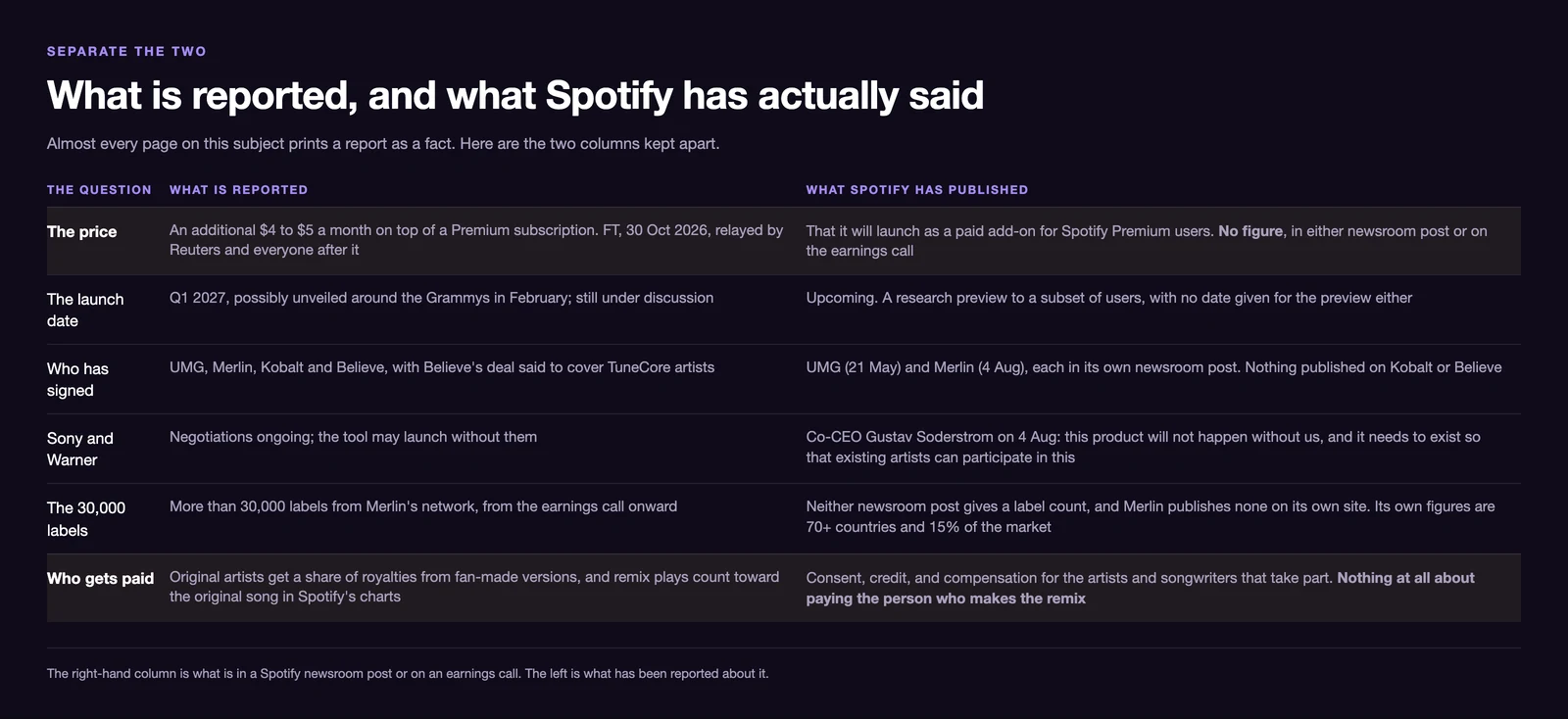
The reason the Reddit post was wrong about the money is that almost every page on this subject prints a report as a fact. Here are the two columns kept apart.
| The question | What is reported | What Spotify has published |
|---|---|---|
| The price | “An additional $4 to $5 a month on top of a Premium subscription” — FT, 30 Oct 2026, relayed by Reuters and everyone after it | That it “will launch as a paid add-on for Spotify Premium users”. No figure, in either newsroom post or on the earnings call |
| The launch date | Q1 2027, possibly unveiled around the Grammys in February; “still under discussion” | “Upcoming”. A “research preview” to “a subset of users”, with no date given for the preview either |
| Who has signed | UMG, Merlin, Kobalt and Believe, with Believe's deal said to cover TuneCore artists | UMG (21 May) and Merlin (4 Aug), each in its own newsroom post. Nothing published on Kobalt or Believe |
| Sony and Warner | Negotiations ongoing; the tool may launch without them | Co-CEO Gustav Söderström on 4 Aug: “This product will not happen without us, and it needs to exist so that existing artists can participate in this” |
| The 30,000 labels | “More than 30,000 labels” from Merlin's network, from the earnings call onward | Neither newsroom post gives a label count, and Merlin publishes none on its own site. Its own figures are 70+ countries and 15% of the market |
| Who gets paid | Original artists get a share of royalties from fan-made versions, and remix plays count toward the original song in Spotify's charts | “Consent, credit, and compensation for the artists and songwriters that take part”. Nothing at all about paying the person who makes the remix |
Worth noting where the Reddit poster got the $5: the thread's own link is to the Financial Times' social post about its 30 October story. So the figure in the complaint is the FT's reported figure, repeated one step removed — not a price Spotify announced and the poster read. That is the whole mechanism by which an unconfirmed number becomes a grievance in two days, and it is why the last row of Table 2 is the one to keep: nothing published says the person making the remix earns anything from it. The money flows to the rightsholder of the original.
Not the AI DJ, not the Persona badge
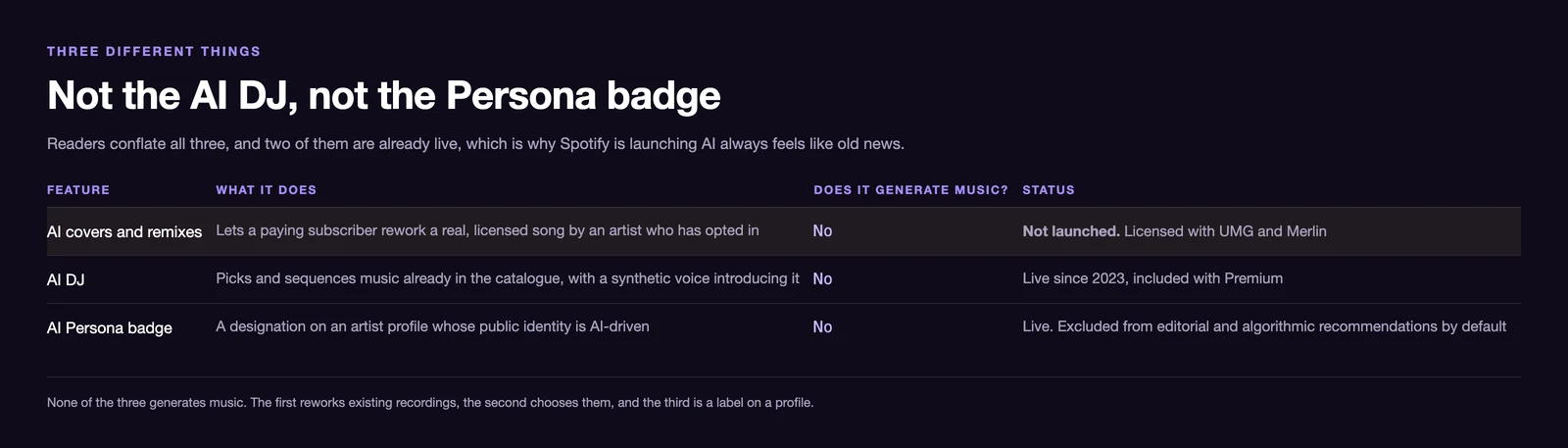
Readers conflate all three, and two of them are already live, which is why “Spotify is launching AI” always feels like old news.
| Feature | What it does | Does it generate music? | Status |
|---|---|---|---|
| AI covers and remixes | Lets a paying subscriber rework a real, licensed song by an artist who has opted in | No — it reworks existing recordings | Not launched. Licensed with UMG and Merlin |
| AI DJ | Picks and sequences music already in the catalogue, with a synthetic voice introducing it | No — it chooses, it does not create | Live since 2023, included with Premium |
| AI Persona badge | A designation on an artist profile whose public identity is AI-driven | No — it is a label on a profile, not a tool | Live. Excluded from editorial and algorithmic recommendations by default |
The badge is the one that affects you directly, and it works nothing like the remix tool. It is a designation on a profile rather than a judgement about a file, and no processing of your audio reaches it — we go through that in detail on the AI Persona badge. For how the platform actually decides what to flag, sunowatermark's piece on how Spotify detects AI music covers the signals side.
Suppressing AI music and licensing it at once
The thread's top comment is two words — “Bit hypocritical isn't it”, 32 upvotes — and the facts underneath it are real. On 20 October 2026 Spotify said it had taken “more than 50 million slop and spam tracks out of recommendations”, on top of more than 75 million removed from the platform entirely, and that AI Personas “are excluded from editorial or algorithmic recommendations by default”. In the same eighteen months it licensed a catalogue so that subscribers could pay to make AI versions of commercial songs. Both of those are true at once.
But “hypocrisy” is the wrong reading, and the right one is more useful to you. Nothing in the 20 October post objects to AI as a technology: the words it uses are slop, spam and impersonation, and the policy it describes is about uninvited volume and unconsented likeness. Meanwhile the remix product is built on three things an uninvited upload cannot offer — a signed licence, a named rightsholder who said yes, and a payment back to them. The variable is not whether a machine was involved. It is whether somebody consented and somebody got paid.
That is also why a licensed remix will not carry a discoverability penalty while an AI Persona does, a point one commenter in the thread reached before the coverage did. The two are not being judged by the same rule, because they are not the same transaction. Spotify also launched AI Credits in April 2026, which let an artist disclose “exactly which roles and instruments were made with AI” — declaration, not detection, and the practical version of that is on disclosure that works.
Spotify is not the only one doing this
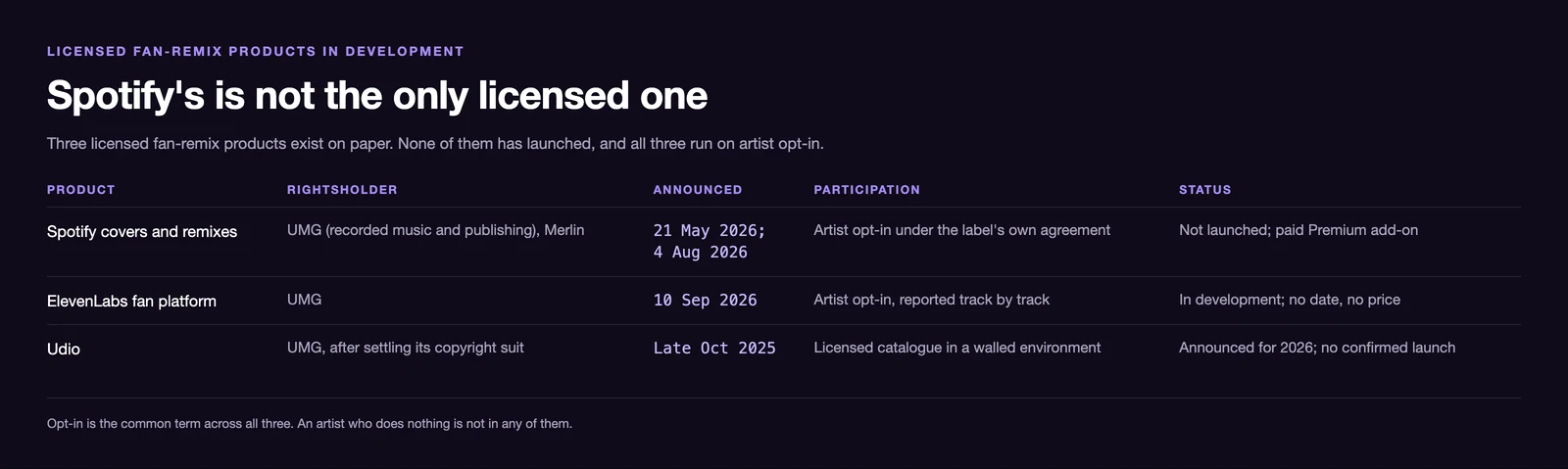
Three licensed fan-remix products are now in flight, all opt-in, none launched. Treating the Spotify one as a singular betrayal misses the shape of it.
| Product | Rightsholder | Announced | Participation | Status |
|---|---|---|---|---|
| Spotify covers and remixes | UMG (recorded music and publishing), Merlin | 21 May 2026; 4 Aug 2026 | Artist opt-in under the label's own agreement | Not launched; paid Premium add-on |
| ElevenLabs fan platform | UMG | 10 Sep 2026 | Artist opt-in, reported track by track | In development; no date, no price |
| Udio | UMG, after settling its copyright suit | Late Oct 2025 | Licensed catalogue in a walled environment | Announced for 2026; no confirmed launch |
The pattern is identical in all three: a rightsholder licenses a catalogue, an artist opts in, the fan pays, and the original gets credited and paid. Udio arrived there by settling a copyright suit rather than by signing first, which tells you what the alternative route costs — we cover what those settlements mean for tracks already released on the Suno lawsuits and your songs.
None of the three has shipped. If you are planning a release schedule around any of them, plan around nothing: there is not a single confirmed launch date across all three products, nearly a year after the first licence was signed.
What it changes for you
Directly, almost nothing, and it is worth being plain about that rather than manufacturing a stake. A licensing deal between Spotify and two rightsholders does not change how your release is screened on delivery, what you have to declare, which distributors accept AI music, or whether your profile picks up a designation. Those are separate systems with separate inputs, and Spotify's AI music policy is where the ones that touch you are set out. No audio tool changes how a platform labels a release, and nothing on this page should be read as saying otherwise.
Indirectly, it changes one thing and it is the big one. The industry has now stated, in money, where it draws the line — and the line is not AI. It is consent and payment. That has two consequences you can act on. The first is that the barrier in front of your own release is still mechanical: a distributor's automated screening, the artifacts a long generation leaves in the last minute, the declaration fields you fill in. That is work, and which platforms accept AI music lists where each one stands.
The second is harder and nobody on this SERP says it: the thread is right that a platform-native generator would hurt Suno, but it would not help you, because you would still be one more upload in a recommendation queue that just lost 50 million entries. The wall in front of AI music is not distribution — that has been solved for years. It is that nobody is listening. A licensed remix product is a reminder that the routes which pay are the ones with a named buyer on the other end: a sync placement, a direct sale, a commission. Those do not depend on being recommended, which is the one advantage they have.
The licence is theirs. The screening is yours.
Nothing in a Spotify licensing deal touches what a distributor's automated screening hears in your track, or what a listener hears in the last thirty seconds of a four-minute generation. That is the step worth spending effort on before you deliver — and the step after it is having a buyer who found you on purpose.
Independent guide · partner links · no audio tool changes a platform's AI label
Spotify AI remix FAQ
Does Spotify's AI remix tool generate new songs?
No. It is a covers and remixes feature over licensed catalogue: a paying subscriber reworks a real song by an artist who has opted in. Spotify's own announcement describes “covers and remixes of songs by participating artists and songwriters”, and nothing in either newsroom post describes text-to-music generation.
How much does the Spotify AI remix tool cost?
Spotify has not said. The $4–$5 a month figure everywhere online comes from one Financial Times report of 30 October 2026, which also called the pricing unsettled. Spotify has only ever confirmed that it will be a paid add-on for Premium.
When does it launch?
There is no announced date. The FT reported a Q1 2027 target with a possible reveal around the February Grammys. Spotify says only “upcoming”, and that a research preview will reach a subset of users first.
Will my music be used without my permission?
Not under the published agreements. Spotify's 2025 framework says “artists and rightsholders will choose if and how to participate”, and Merlin's release says the deal “enables artists on labels under Merlin's Spotify agreement the option to participate”. If you distribute independently, you are not under either agreement at all.
Do I get paid for a remix I make on Spotify?
Nothing published says you do. The reported model pays the original artist a share of royalties from fan-made versions, and Spotify's language is about consent, credit and compensation for “the artists and songwriters that take part”. The person paying the add-on fee is a customer, not a rightsholder.
Is this the same as Spotify's AI DJ?
No. AI DJ chooses and sequences music you already have access to and has been live since 2023. The remix tool changes recordings and is not launched. The AI Persona badge is a third, separate thing — a designation on a profile.
Does the remix tool change how Spotify treats my own AI tracks?
No. The signals Spotify lists for AI music are listener engagement, upload patterns, metadata and third-party AI detection, none of which reads a licensing deal. Your release is still screened on delivery and still carries whatever you declared.
Sources and what we could not read
- Spotify Newsroom, read 2 November 2026: the artist-first AI framework (16 Oct 2025), the UMG agreements (21 May 2026), the Merlin agreement (4 Aug 2026) and Prioritizing Human Artistry (20 Oct 2026) for the 50 million figure, the AI Persona exclusion and AI Credits.
- TechCrunch, 4 August 2026 for the earnings-call quotes and the “research preview… subset of users” detail, and MusicTech (26 May 2026) for the UMG announcement as the trade press carried it.
- The Next Web, 30 October 2026 relaying the Financial Times report: the $4–$5 figure, the Q1 2027 target, the Grammys timing, Kobalt and Believe, and the chart treatment. Every one of those is the FT's reporting, not Spotify's statement.
- Variety, 10 September 2026 for UMG and ElevenLabs, and Music Business Worldwide for the UMG–Udio settlement and licensed platform.
- The quoted thread is r/SunoAI, 30 October 2026 — 43 upvotes and 38 comments, read through a public Reddit mirror on 2 November 2026 because reddit.com serves this container a bot wall. The corroborating clip is one TikTok of 31 October, included only because it shows the story travelling, not as evidence of anything.
- What we could not read. The Financial Times article itself is paywalled to this container, so the FT figures here are taken from outlets that carried the report and are labelled as reported throughout. Merlin's own news index carries no release on this agreement, and no label count appears on Merlin's site, so the “30,000 labels” figure is cited to the earnings call and the trade press rather than to Merlin.
This story is moving and the product is unlaunched; prices, dates and the list of signed rightsholders will change. Table 2 is our arrangement of two columns that other pages merge into one. Last updated 2 November 2026.
Related guides
Spotify AI Persona badge
How that designation is set, and why no audio tool can remove it.
AI music on Spotify
What the platform's policy actually says about an independent AI release.
Platforms that accept AI music
Every published distributor position, read at source and dated.
AI music disclosure that works
The declaration fields that exist, and what each one actually does.
AI cover songs
Where a cover sits legally when the voice was never in the room.
How to make money with AI music
Five income routes ranked by dollars per hour, with the arithmetic shown.
Or browse every guide on the site.